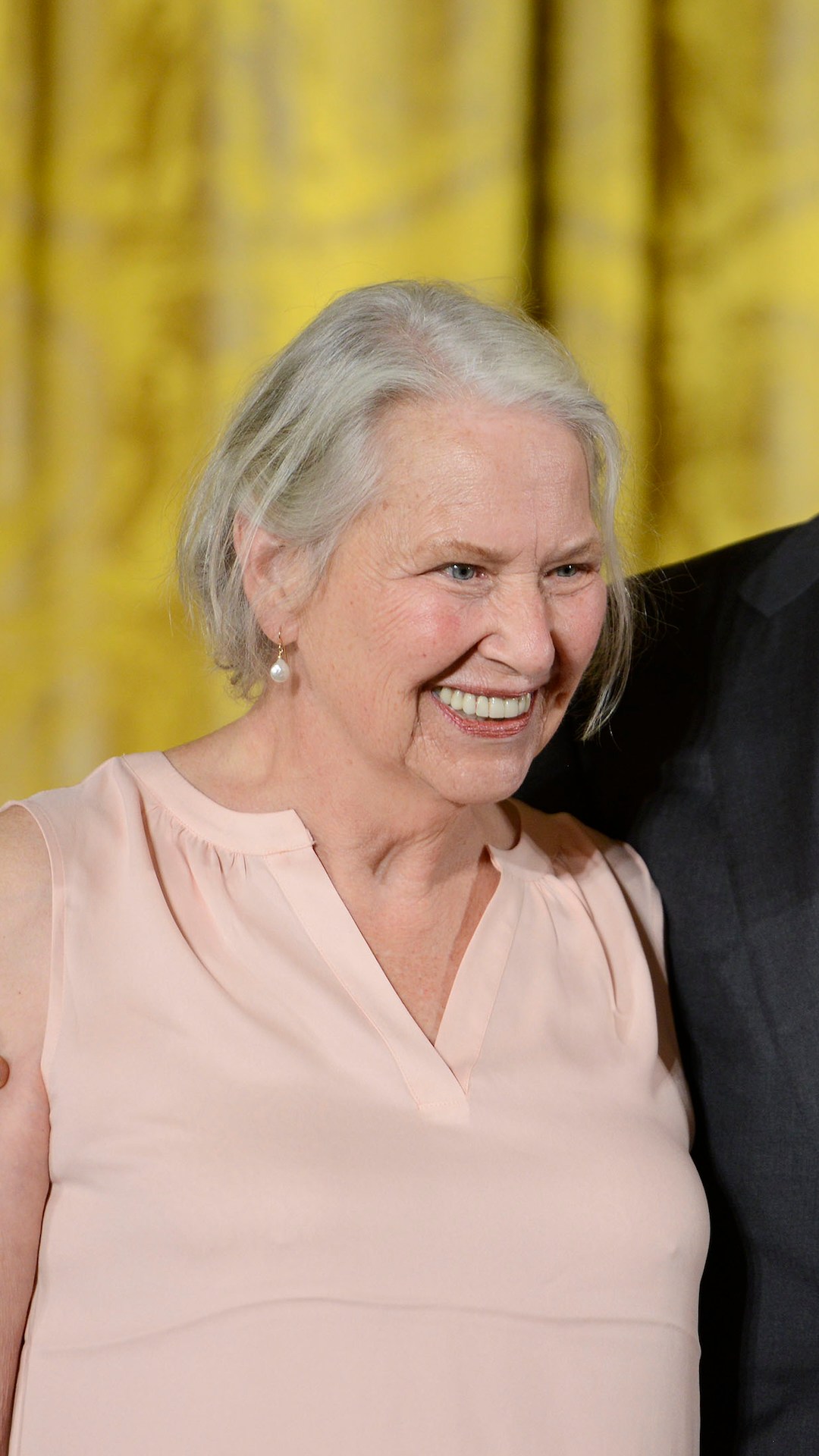
Following this week's news that the brilliant writer Annie Dillard has died at age 81, some Defector staffers wrote about what her work and example have meant to them.
Much is made of Dillard’s genius, her wizardry with language, her talent. But the Dillardism that has stuck with me strongest over the years comes from Alexander Chee's essay "The Writing Life," in which he describes taking an undergraduate course with her at Wesleyan in 1989: "Talent isn't enough, [Dillard] had told us. Writing is work. Anyone can do this, anyone can learn this. It's not rocket science; it's habits of mind and habits of work."
Chee's essay collection, How to Write An Autobiographical Novel, was a magnificent rendering for me of how truly a stranger could speak to my own core in nonfiction writing. When you're a young dummy with a writing dream, coming across someone who is able to fuck you up so thoroughly with their language feels like coming into contact with a god, or at least someone who has been blessed by some divine force. I felt that way reading Chee, and Chee felt that way in Dillard's class. But anyone who actually manages to achieve that facility knows that it is hard-earned through years of humbling, deliberate effort.
The part of Chee's recollection that stuck most with me is this: "I started with people much more talented than me, [Dillard] said, and they're dead or in jail and not writing. The difference between me and them is that I'm writing." I was early in my own writing career when I first read these words, and I adopted them so wholly that they've become a cornerstone of my values. I remind myself of this line whenever my confidence in myself falters, because how could it be possible that there were writers more talented than Annie Dillard? It's a reminder to me that the work, only the work, is what matters. — Alex Sujong Laughlin
The writing that I admire most invariably has some menace in it. Not in terms of subject matter, but more the sort of feeling you get while swimming in the ocean when a curl of cold water around your feet reminds you of how far away the bottom is, and how far out it all goes. It's not the menace of something that is lying in wait for you, or even that has any designs on your comfort or safety or sanity. It's the menace of something much bigger than that, big enough that it doesn't really care about or even notice you at all.
The natural world as Annie Dillard described it in a series of strange and virtuosic and mostly incident- and story-free books and essays is very often brutal, but not quite intentional enough to qualify as cruel. It's all the more terrifying for this. Things just happen, wild and violent but by no means unusual or inexplicable things, and Dillard sets herself to the challenge of describing them.
Everyone who wants you to read Annie Dillard, which is going to be more or less everyone you meet who has read Annie Dillard, will tell you to read “Total Eclipse,” which is about witnessing a total eclipse in 1979, and which was published in her 1982 anthology Teaching A Stone To Talk. They're all right to do it, but what I will add to that blanket recommendation is that the essay is at times more or less horror. If part of Dillard's talent in writing about nature and assessing her place in it was her capacity for awe, the better part of it—certainly the part that made her so important to me, as someone who virtually never writes about it and spends tragically little time in and around it—is making that feeling real for the reader.
And that feeling, in this essay as in other books in which Dillard hangs out in nature and writes about what she sees and thinks, is the feeling of being overwhelmed and outgunned by the sheer uncaring scope of the world. There is a religious aspect to it that comes and goes across her writing, but the thread that runs through it is to me something more like the feeling that people invented religion to describe—an abject sort of awe at the beauty of it, and a wholly justified terror at how small we are in it. Here is what the sun looks like, at one point in the eclipse:
It had nothing to do with anything. The sun was too small, and too cold, and too far away, to keep the world alive. The white ring was not enough. It was feeble and worthless. It was as useless as a memory; it was as off-kilter and hollow and wretched as a memory.
When you try your hardest to recall someone's face, or the look of a place, you see in your mind's eye some vague and terrible sight such as this. It is dark; it is insubstantial; it is all wrong.
The white ring and the saturated darkness made the earth and the sky look as they must look in the memories of the careless dead. What I saw, what I seemed to be standing in, was all the wrecked light that the memories of the dead could shed upon the living world. We had all died in our boots on the hilltops of Yakima, and were alone in eternity.
As a writer, what is most useful and transporting to me here is the force of the language, which to my mind is unparalleled among any of her peers. She didn't really do plot or characterization, there is very little to find in terms of politics or the broader cultural moment in which she wrote beyond a sort of vague and mournful dread at it, but every sentence crackles like lightning. No one else I've read really writes like this, and while she changes speed and register as needed from one moment and one work to the next, Dillard mostly seemed secure to write like this for as long as she could about the things that interested and frightened her the most. If I could do that, I would, too.
Because of her subject matter and especially because of her talent, Dillard was something of a mystical figure to me. By the time she was first recommended to me, Dillard was done writing; the person who recommended her, who knew her a little bit, said that Dillard was in cognitive decline. But I was delighted, in reading up on Dillard after her passing on Wednesday, to discover the wonderful Alexander Chee essay about having Dillard as a teacher at Wesleyan in the late 1980s.
She was a star by then, and teaching a star professor's courseload—one class, of 13 students selected from 130 applicants. Chee was in awe of her, cool and brilliant and successful as she was, but what radiates from the essay more than anything is gratitude. She did not want to teach students to write like her, she said, but to write like themselves; she didn't want to teach them to see the world as she saw it, and to find a way to channel the horror and grace in it that she discovered and described, but to learn how to see it clearly enough to find their own way into all that, and then to find a way to describe how it feels to them. It's not a question of perspective or style, but of belief—a willingness to look straight at the world, and to name it in a way that only the person standing at that particular point could.
"Yes, everything's been written," Chee remembers as one of the fundamental lessons he learned from her. "But also, the thing you want to write, before you wrote it, was impossible to write. Otherwise it would already exist. You writing it makes it possible." — David Roth
I read her before and after witnessing a total eclipse. I read her when running aground on my book chapter. I read her when I taught writing for the first time, as I tried to show the students how masterfully she'd arranged this absurd pileup of metaphor. I read her when I was up in the middle of the night in the NICU with my days-old daughter, because I had the book in the bag I brought to the hospital, and it seemed like the right companion as we sat at the threshold of existence and non-existence, bathed in awe. There's really no bad occasion to read Annie Dillard. But there is one especially good occasion, which I will detail for you, in case you find yourself in it.
If you are ever feeling like your own words have dried up and there is nothing left to say, my prescription is to read Annie Dillard sentences. As many as you can, until the situation has been addressed, and then a few more, just to be safe. It will fix you. Because—and this is a trait a handful of our best writers have, but her most of all—her work is infectious at the very level of perception.
Don't read her merely for her breadth of knowledge, her nimbleness with language, or metaphysical insight; obviously she has all those things, but her true power is somehow more fundamental than all that. It's how wide her eyes stay open. She is the antidote for jadedness. If there's something in your life you want to see anew, to shed all the cocooned layers of cliché and consensus, then just listen as she describes a bug or plant. Set aside anything you thought you knew about that thing and allow yourself to perceive it as she does. Instantly, you'll remember what it feels like to see and think for yourself. It's hard to imagine any writer offering us a gift greater than that one. — Giri Nathan
So much of how a person writes is determined by how they look at the world. You and I, in the same location with the same vision, will see different things. The work of writing is, first and foremost, a work of translation. I try to get you to see things the way I see them.
That's why, in the hands of a masterful writer, the world feels brand new. I remember the first time I read Pilgrim at Tinker Creek. It was as if I had never ventured out of doors before. I saw the grass and the air and the sun. I felt the breeze across my skin. I was born again: scales fallen from my eyes, the nature around me not mine, but Annie's.
Much later, I read her quotes about writing, her teachings to other people. She focused on precision, on verb choice, on making the work go somewhere new to you. There is a quote of hers from The Writing Life that I wrote out in my own hand and taped to the wall by my desk along with a few other reminders. It goes like this:
One of the things I know about writing is this: Spend it all, shoot it, play it, lose it, all, right away, every time. Do not hoard what seems good for a later place in the book or for another book; give it, give it all, give it now. The impulse to save something good for a better place later is the signal to spend it now. Something more will arise for later, something better. These things fill from behind, from beneath, like well water. Similarly, the impulse to keep to yourself what you have learned is not only shameful, it is destructive. Anything you do not give freely and abundantly becomes lost to you. You open your safe and find ashes.
Spend it all, I say to myself, not only in my writing practice but in other areas of my life as well. You cannot create from a starting point of fear and scarcity. Abundance is available to all who make things, if you can convince yourself not to be convinced of your own inadequacy and paucity of thought. Something more will arise later. The process is what matters. I wish so badly that I could have spoken with her even once. But luckily, her work speaks to me forever. I can only dream of writing something that talks back to hers. — Kelsey McKinney