There is a cottage industry in publishing dedicated to understanding Donald Trump and his followers. Since his election in 2016, a spate of books have attempted to contextualize, deconstruct, and analyze the President’s ascendency. The second Trump term has been no less prolific. This year alone has seen juggernaut bestsellers like Regime Change by Maggie Haberman and Jonathan Swan, and the upcoming Profiles in Cowardice by Jacob Weisberg. “Trump 2.0 is all about this break with the stylistic norms, rules, and traditions that governed the Presidency in the past,” Susan B. Glasser wrote in a 2025 New Yorker column.
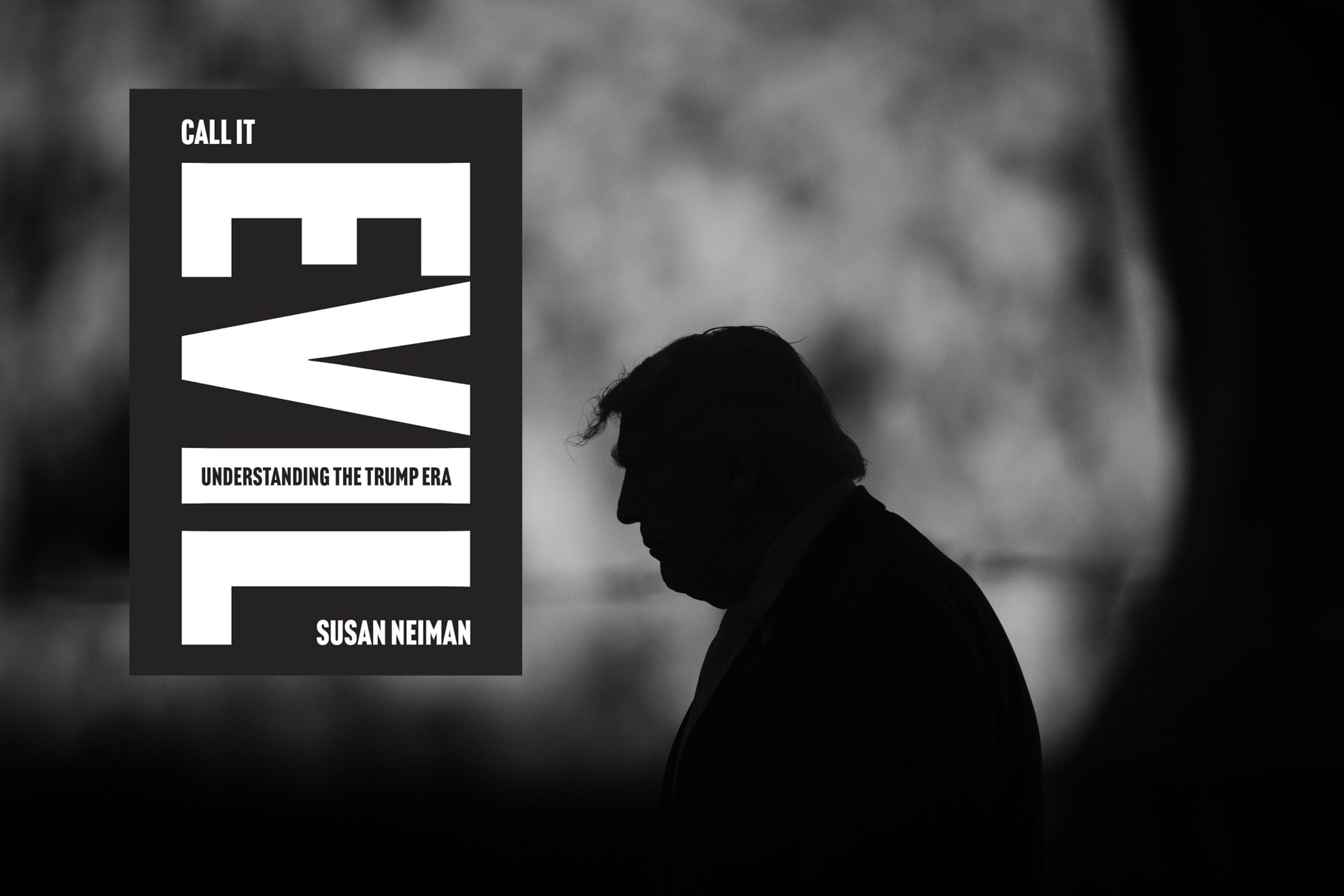
Over the years, Trump’s been called a number of epithets: cruel, heartless, old, stupid. There remains a collective nervousness around calling Trump a fascist, and few writers avail themselves of words like “evil.” Susan Neiman has been interested in the problem of evil for most of her career as a moral philosopher. Her 2002 book, Evil in Modern Thought, traced the history of philosophy as a matter of different responses to the existence of evil. So it’s surprising that her latest book, Call It Evil: Understanding the Trump Era, is curiously cagey about the current President’s alignment.
Neiman has written multiple books about theodicy, the problem with woke culture, and why progressives would benefit from more moral clarity. Her new book allows her to play the hits under a provocative title, but with little novelty. She never quite gets around to taking on Trump directly despite the little book’s title. Across seven chapters, Neiman considers the importance of discussing morality, the empty ideology the Trump admin has used to justify its actions, and how we must shift away from identity politics and liberalism and towards socialism. She argues that the left has ceded moral ground by claiming materialism instead of ideology—though her thinking about both seem muddy. Her ideas about ideology contain a lot of materialism and her ideas about materialism are undergirded by ideology. She dives into the discourse with a lot of cynicism around Marx, communism, Judith Butler, and big woke. “Many progressives were sick at heart about it, though they confessed it only to close friends, preferably after a glass of wine,” she quips about the latter. Identity politics is tribalism, rather than materialism. Like many philosophers, she seems to let the distortions of identity politics on both the right and the left distort the idea of standing up for minorities as not just a social issue, but a civic one. Whose materialism matters?
Class seems to scare Neiman, too. She doesn’t like Das Kapital much, but she does seem to believe in Mamdani and Socialism. Self-interest is the great cause of evil, she argues. She spends far more time on economics than on the current president himself. She relies on theorists like Hannah Arendt to understand the difference between the civic and social sphere. We must, she insists again and again, enact not just material arguments, but ideological ones too. “Politics that appeals to theory instead of reality will always go wrong,” she writes about leftism, while also claiming that “the left should reclaim the language of moral idealism.” Her arguments are circular and never quite cohere—the kind of philosophy that builds a never-ending staircase to an empty room.
“My concern is with the moral ideas that Donald Trump embodies and reinforces, ideas that are destructive enough to warrant the word evil,” Neiman writes in her introduction. “It’s a dangerous word.” She then uses ChatGPT to ask if Trump is, indeed, evil. It’s a hard introduction to stomach for those of us who believe that AI does, in fact, have moral consequences in our world. But Neiman soon arrives at a moving definition of evil: “an idea that arises whenever the gap between the way the world is and the way the world ought to be becomes too big to bear alone.” Evil is neither satanic greatness nor banal, as Arendt’s famous Eichmann in Jerusalem has it, but a "vacancy."
In her first chapter, Neiman argues that cannibals interest her less than a more political definition of evil. I admit, I think all forms of evil are fascinating, but I understand why a moral philosopher finds such standard deviations—like the Lindsay Clancy case or the Idaho college murders—to be more about sociopathy than the kind of all-encompassing moral erosion that she’s interested in. Instead, she believes that too many people embrace self-interest as humanity’s sole motivator and thus that we are not capable of acting morally. Neiman argues this belief was spread through capitalism and destroyed our capacity to act in accordance with our moral intuition. Perhaps power was no longer political, but economic, she points out, paraphrasing Foucault.
In her broad-strokes history of the modern era, politicians used the Red Scare to promote individualism and demonize communal solidarity. An atomized society was easier to control. You can see that we’re a ways out from Trump and already halfway through Call It Evil. Neiman eventually gets to wokeism, which she frames as about tribalism and thus inherently anti-universalist, but I find this argument unconvincing. Woke 1.0 certainly had its flaws, but its core arguments that minorities deserve rights seems to me an important value worth preserving, and one that often gets lost when talking about the amorphous discourse. What real change did the so-called all-consuming “Woke” really effect anyway? DEI has been discarded, Black lives are still routinely devalued, Epstein’s allies walk free, MeToo did not stop the rape epidemic or curtail men like Louis C.K. from having successful careers. Trans people have far fewer rights, which is something in particular Neiman seems to gloss over in favor of cheap pronoun jokes, about which she says “a clearer statement of woke bankruptcy has yet to be made.” Oh. Okay.
A few pages earlier, she makes a similar statement on bathroom debates. “Valorizing victimhood,” which is how she understands the worldview of people on the woke side of the argument, seems a purposeful misreading of the desire to no longer find oneself subject to the whims of state legislators as regards where one can pee. More than that, I’m not convinced identity politics is always tribal. It can, at its best, be universalist. Neiman also floats the idea that wokeism ultimately failed because it tossed aside class, which helps answer the question “Is there a single tired, years-old debate she won’t cover in this book?” Perhaps the one most compelling chapter of the book is “Why Gaza Matters,” in which Neiman frames the genocide in Palestine as the moral test of our time.
Far too little of Neiman’s book really focuses on Trump himself. If you are looking for a lengthy consideration of Trump’s avarice, greed, or other moral failures, you are more likely to find it in the journalistic account of 2025 by Haberman and Swan. Or, failing that, you could simply be someone who has a passing familiarity with the President and the things he does. It is all too easy to imagine Trump crawling around the White House, personally affixing gold applique while Ukraine struggled to hold its own. Consider Trump’s eventual disregard for punishing Epstein’s associates: “Are people still talking about this guy, this creep? That is unbelievable. Do you want to waste the time?” This from the man who E. Jean Carroll successfully sued for sexual harassment, and who challenged that ruling all the way to the Supreme Court, which recently denied that appeal.
He has declared his birthday a holiday, erected statues of himself, and attempted to remake not just the White House but much of the nation’s capital into a tacky celebration of his image. “I don't think there's anything that's going to get me into heaven. I think I'm not maybe heaven-bound,” he said late last year. If it’s true that lately he’s worried about getting through the pearly gates—and even asking for donations to that effect—he has plenty to be afraid of. Supporting the genocide in Gaza, killing countless civilians at home via ICE and abroad with missiles, erecting and supporting Alligator Alcatraz: There are so many examples of his personal wickedness that most will end up forgotten. So, too, will many of these books about Trump. We’re still waiting for a great, book-length chronicle of the man who puts his face on a gold coin.