


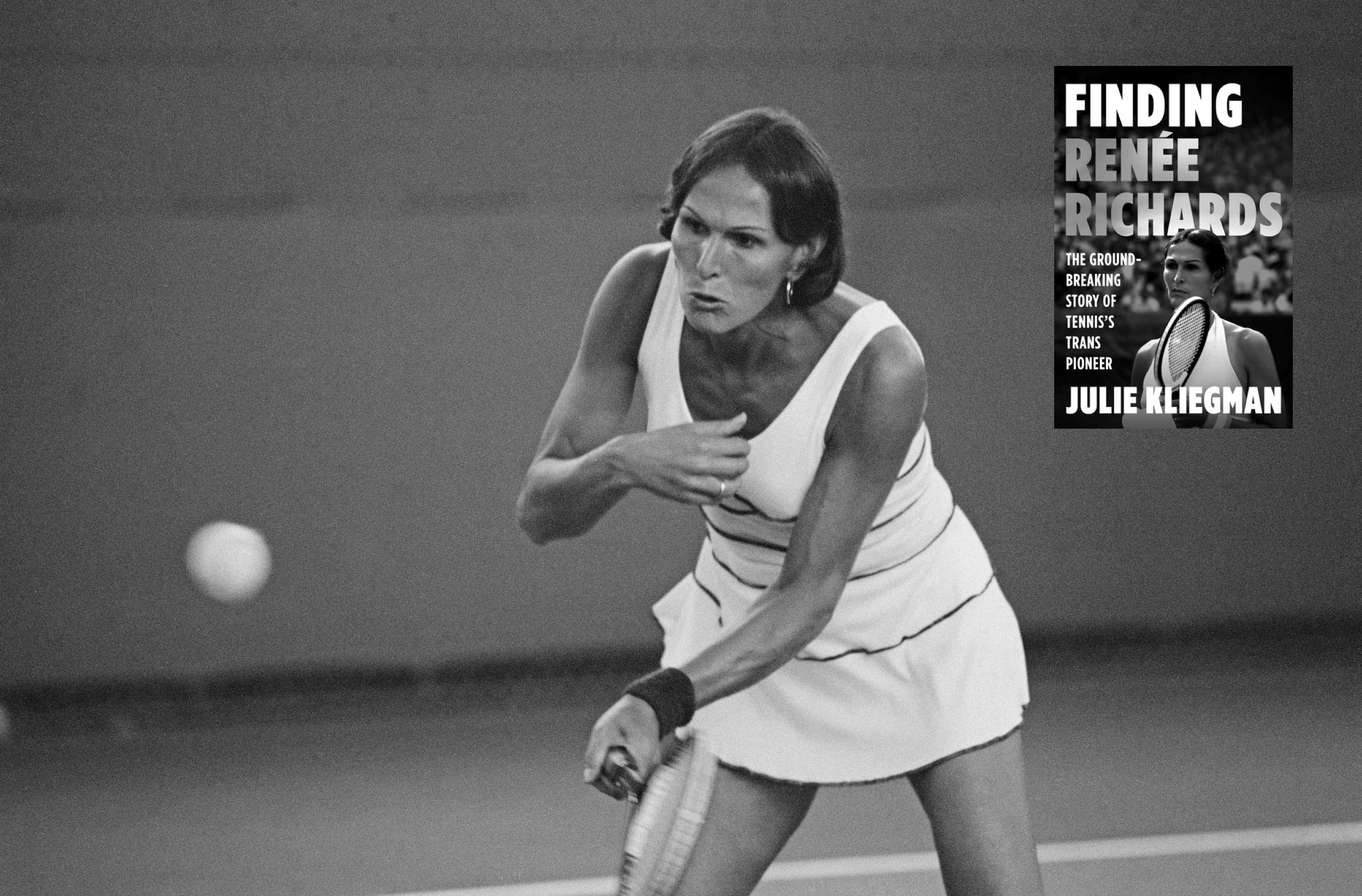
As Lauren Theisen pointed out last month, the ongoing, abstracted debate about trans inclusion in sports uses almost no proper nouns and lots of hypotheticals. Back in the late 1970s, there was a very real, very human example of a trans athlete playing at the highest level of a mainstream sport. Renée Richards competed in professional tennis, and her fascinating life is explored meticulously in Julie Kliegman's new biography, Finding Renée Richards. The book is an invaluable intervention in the tortured public discourse, which in recent weeks has been polluting the WNBA. Read this book and forget that Enes Kanter Freedom or Royce White exist.
I led a Q&A with Julie for the book's launch last week, and have condensed and edited parts of our conversation below.
In the time between finishing a book and it coming out, a lot of things change in the real world. I had this experience in a positive way, where I was watching the subjects of my book play these important matches against each other, and I was like, "This is awesome. Keep doing this." Suffice to say, it was much more complicated here, where your book feels extremely timely, but it's due to this disingenuous and infuriating fight over trans inclusion in sports. So I wanted to talk to you about your feelings, from the moment you finished the book leading up to the publication.
Yeah, it's honestly such a weird feeling. I didn't know exactly how the conversation around trans athletes would progress, but I knew that things would happen, and that they probably wouldn't be great. So I was somewhat bracing myself for it, and there's even language in the book, like, Certain cases are winding their way through the courts and may even be decided by the time this book comes out. It's not a great feeling to be like, Oh, this is so timely. I can sell books. But also I don't think that people are gonna seek out this book who really feel confident about their anti-trans views—I want to learn about this pioneering athlete. So yeah, bit of a mixed bag, bit of a weird feeling.
My favorite thing about this book is that it is a biography, but also an intergenerational conversation. You write in the book that you know you haven't spent a lot of time talking to people so far removed from you in age. What was it like developing this relationship? Did it feel like a friendship by the time you were through with the research and writing?
Yeah, it was really interesting. Before writing this book, I didn't have any close relationships with people of Renée's age. She just turned 92 the other day, so that was a really special connection for me. I would hesitate to say that we're friends, but she is friendly and very charming, and also lent me her vest one day when she thought I wouldn't have a warm enough jacket at her house. Then I left wearing her vest and had to mail it back, and it was a whole thing. We do have a special bond, I think, but also a very complicated one, because at the heart of this book is the fact that I don't really agree with her views on trans athlete eligibility.
That is one of the things that makes it such a captivating read: You do feel this back and forth, this push and pull between writer and subject. I was wondering whether that was always your concept for the book structure, or just kind of emerged over the course of your writing.
I was pretty much always thinking that I would be in the book a little bit, because I don't think it would have been a super responsible thing to do at this moment in time, to write a book about this particular person and not contextualize her views in the current moment of what's happening. I very much wanted it to be a biography, but I didn't think that meant that I couldn't use my voice at all, to talk to the reader, look at the camera just a little bit and be like, "Hey, so what she's saying is this, and what's going on now is that." It's not a choice everyone would have made. I know there are biographers who would never use a single "I" unless it's in the acknowledgments or something. But I hope it adds a layer to the book.
It absolutely does, because it lets you feel the shift in views on a subject over the course of generations, a 60- to 70-year time frame in this case. I think there's a lot of a lot of value to that. One of many character traits of Renée's that you sketch out in the book that I find quite charming is she has this desire to both be kind of central to discourse but also aloof from it. It's kind of writerly in a way.
Yeah, she gets salty a lot of times that people are not calling her about trans athlete eligibility and asking what she thinks, but she's also like, But I don't want to talk to them. This plays out all the time. Sometimes she does end up talking to people. I told her there was a CNN request that came in for both of us a couple weeks ago, and she was like, "The CNN person called, I'm so not interested in talking, but I told her she could call me on Thursday," and I was like, "Wait, what?" and then she didn't end up talking to her on Thursday, but the piece came out and it has interviews with both of us, which I think is really great even if it probably gave me and also HarperCollins a heart attack. I think it's a very relatable, very writerly thing, as you said. It's a very relatable contradiction.
One of the things I like about the book is you pushing her to look at things with a different frame, with a different political lens. I was wondering if there were any examples in the reporting where you really challenge Renée's thinking, or changed her mind on a given topic.
I don't think I necessarily am the reason she changed her mind on this. But I get into it a little bit near the end of the book, where I feel like over the course of reporting the book, and especially with Trump retaking office, she does seem to put together what I had been telling her beforehand, which is that there's a project of trying to attack and erase trans people in this country, and that's what Trump and other officials are spearheading, and that the conversation around sports is not separate from that. I think she's supportive of trans rights in almost literally every single arena except for sports, and she had previously been able to convince herself that they were separate projects. But I think seeing Trump's rhetoric scared her a little bit. As you know, it's very scary, and I think now she understands that. Well, she might have opinions about who should be allowed to compete, but she doesn't want those people to be converted to cisgender people, or living in fear. That was interesting to watch change over the course of the book.
That does feel like a really important realization for her to have come to. How about the other direction? Were there moments where Renée's thinking kind of challenged the way you've been thinking about something, or changed your mind?
I don't think necessarily that anything she was saying changed my mind, but it did challenge me in that I don't—you asked earlier if I considered Renée and myself friends, and I don't quite. But I'm not used to having friends whose political views differ so much from mine, and that was really interesting, to spend so much time with someone who—I knew she wasn't going to change my mind on anything really, but just sitting with that discomfort was a really interesting challenge for me.
[It's commonly said that] Renée's thinking around trans athletes is, and you talk about it in the book, "Well, this was fine for me, but I wouldn't want it in general." What were those conversations like, where you tried to walk through her individual experience but also come up against her refusal to universalize that?
In a way, it was easier to understand where she was coming from, because if she could go back, she wouldn't do this lawsuit to play in the U.S. Open again, and that's way further than I thought this went before I started talking to her. She always quotes this one headline: "Doc"—meaning her—"says, 'Do as I say, not as I do,'" and I think that's actually not quite right here, because she doesn't think that she should be the one exception. She thought at the time that she should be allowed to do this, and she did keep playing after she had this realization that maybe she shouldn't be allowed to do this. But that was so many decades ago. Now she called herself selfish to have done this, and so that's a little bit easier for me to wrap my head around than if she had just been like, "Well yeah, I could go back and I would play another five years on tour." She doesn't actually think she should.
What was Renée like as a tennis player? There's a lot of very vivid descriptions of her on court, but were you going back and watching archival video of any of the matches? I know you talked to a lot of her former opponents and looked at their commentary.
Powerful lefty serve is always kind of the headline for Renée. Distinguishable, recognizable, powerful lefty serve.
Which ends up being very tricky for her when she's trying to live as Renée Richards.
Yeah. Do you think that's true, by the way, that serves are like your fingerprint?
It's so true that there's a whole subgenre of Instagram tennis comedian just doing the first few bounces or movements in a player's serve, and I immediately know who they are every time. They're very distinctive if your brain is broken by tennis, and I'm sure Renée's is, and all the people she was playing against would have clocked that instantly.
Yeah, the serve was always the thing about her that everyone mentions first. She was, by all accounts, not the quickest ever on her feet. What's interesting is, I was talking to someone who would play against her not long after her transition. This was before she even was outed or played in the Open or anything, and his assessment of her playing was like, "Well, I think she's holding back. She's trying to be too like ladylike. I can tell there's more there." I think she had to reteach herself some of that aggression on the court, which is really interesting because that speaks to apprehension about how she was being perceived.
I want to talk a little bit about the decision to use the name Richard Raskind in the book, which you talk about up front at the start of the book, but which I know was a difficult one to make.
So my thinking was: I wrote the whole first draft of the book using Renée Richards as her name throughout and she/her pronouns throughout, because that is what most of society has agreed is the most polite, acceptable way to refer to a trans person, whether you're talking about their present or their past. After the first draft was done, I was going to Renée's house with a list of fact-checking questions, and I guess part of me knew that this might upset her, this strategy of using her current name and pronouns, because otherwise I wouldn't have said anything. But I ran through this list of fact-checking questions, some of which I thought could really upset her, and we kind of breezed through those in a few minutes, and nothing really fazed her about that process. Then it was like, "Hey, as an FYI, this is how I'm writing your name and how I'm referring to you," and we talked for at least an hour about that in person, and then I got some not-so-kind followup emails and texts from her about it. She was really adamant that I can't tell her story properly without using the name Richard Raskind, which was her birth name, and without referring to Richard as he and him until the point where she considers her transition complete.
To her, it was like, how are you gonna say that "Renée played high school baseball," or something like that? I'm like, Well, I think people get it. Readers are smarter than we all give them credit for at times. But it wasn't really about that. It was about the way that the push-pull between Richard and Renée happened in her brain, and the way she characterized Renée as this kind of force that she was trying to suppress. It became really, really important to her that I write about her that way. I was really torn because I don't want people reading this book to be like, "What was that choice? Is this a book I can trust? Is this someone who's actually knowledgeable about talking to trans people and writing about trans people?" But I talked to someone at the Trans Journalists Association, and I talked to any friends who would listen about it, and I was like, You know what? This isn't an authorized biography.
She didn't have any say over the final product, which is what I wanted, and she never asked me otherwise in that regard. But when it comes to her name and her identity, that's the one thing that she should have say over: how she wants to be referred to. I think it speaks to the intergenerational dynamic between us, and I wanted to write that into the book, partly to be like, "Hey, I'm not a jerk." She wanted it, but also because I think it does add something interesting to it and sets the stage for like, "OK, these two people are trying to work shit out together, but they're not on the same page about everything."
Not every subject of biography has already reflected on their own life at length. [Richards has written three memoirs.] What was it like diving into those books and finding areas where you wanted to maybe complicate the way the story was told, or add another nuance to it?
I think a lot of biographers are kind of bored by [writing] the earlier chapters; they feel like they just have to go through the motions. But I don't know, I found that stuff really captivating. It's one of the things I found super interesting about her own writing. I didn't want to speed-run [her books]. A lot of formative stuff happened in her childhood, and it may or may not be related to her being trans, but it is related to why she is the way she is today, and so I found reading her books and going back through them a lot of fun. They're so her. She collaborated with other writers on them, but you can still tell. They did a good job; you could still hear her voice in them.
If you look at them as just one lens, one part of the picture of who she is, then it can be fun to be like, "Hey, you wrote this in 1983. What do you think now?" My biggest question is, why are there so few pages devoted to her lawsuit in any of her writing? And I guess I get why now: It's because she considers the decision selfish, as I said, and wouldn't do it again. But I thought that was really telling.
The thing I like about the way you use those books is that you get to take a first, second, third pass at the same event in Renée's life and see how she's looking at it differently at each time. And when you've lived till 92, you have a lot of time to reflect on the events of your life, so it makes it for rich reading. One thing I want to touch on with Renée's own writing is that she's an incredible emailer. Her emails are some of the most fun little nuggets in the book. What is that about?
Well, everything is 10 percent more fun when it comes from an AOL email, so that would add a bit of flavor to it automatically. But her use of punctuation is really pioneering. I think it's so charming. It's so distinct. And the emails always come between the same hours of the day, so it's like, All right, I'm gonna sit down and answer my emails, which I think is really quaint.
She's so honest in them. At one point, I double-checked with her. I was like, You know, I can print these emails in the book, right? I know she knows that, because she's not new to being interviewed, new to media. She was like, Yeah, OK, whatever. But yeah, she's so candid in them that I was like, Wait, does she know what she's doing? Even though I know she knows what she's doing.
Yeah, they are charming, not just in the way that it's charming to communicate over a relatively new technology with an older person, but there's a lot of wit and idiosyncratic punctuation, a lot of wordplay, and they're really voicey, as you were saying about Renée's memoirs. I definitely liked the choice to put them in as they appeared in your inbox.
Well, the copy editor on the book changed the punctuation first, and I was like, "I don't think we can do that." That really changes the whole thing.
I'm glad you could use your own copy authority. [Kliegman is a copy editor.] A lot of interesting proper nouns come up in the book, and it got me thinking that the constellation of people who support Renée don't cleanly map onto the political divisions of today. Roy Cohn, for one example. Ilie Nastase, who's a contemporary of Renée, a top player on the men's side, who if you look at his more recent history, has made some nasty misogynistic remarks, hardly the picture of open-mindedness. Did writing this book change your sense of what a person's politics can be? You're really seeing these people express themselves over these 60-year timeframes, and as I read it, I'm thinking, Damn, we contain multitudes, and the fault lines of these political divisions change constantly.
Yeah, it definitely complicated my understanding of what people's political views are or what they could be. Mostly what it hammered home for me is you can have a lot of really hardline views on things, and you can make a lot of exceptions for someone you like personally, who is personally charming and has been in your life for a long time. A lot of the people I talk to who are close to Renée across the political spectrum say some pretty anti-trans kinds of things, but uniformly they're like, "You know, I don't mean that about Renée." Or whether they say that explicitly or not, not even the most transphobic person I interviewed for this book thinks Renée should use the men's bathroom, right? But do they think other people should? Yes, some of them do. It's really interesting what personal connections really mean to people.
I think you were referring to Martina Navratilova. I know that probably wasn't an easy reporting day, but what was your feeling leading up to the conversation? How did it play out, and how did you digest it after?
I was really anxious going into it. Well, it was justified in a sense, because the stuff she was saying to me was really out there. It wasn't just garden-variety transphobia. It surprised me. I'm sure you've had reporting calls where you barely say anything and they just kind of go and go and go. It was one of those. The funny thing is—well, it's not actually funny—but I pay humans to transcribe my interviews because I don't want to transcribe them myself, and I also don't like what AI comes back with, and the main transcriber for the book, they're trans, and I emailed them, "Hey, do you want to do this Martina one?" And they were like, "Nope, I thought about this, and I thought to myself, if Julie interviews Martina, that is where I draw the line. I don't want to subject myself to that."
It was such a bizarre couple of calls. She really—part of her believes she's not transphobic. I think she literally said, "We can't make Renée stop using the women's room or whatever, nor would I ever want her to." But she's also talking about "nipple goop" that comes out of trans people when they try to breastfeed and all this really hateful stuff that I didn't even know how to like ... she was talking about the "trans lobby" and stuff, and I wasn't even good at keeping up in the moment and being like, "What do you mean by that, Martina? Can you say more?" I was just so flabbergasted. Is that the right word? But yeah, I'm glad I talked to her. I mean, this is someone who Renée coached for. They played on tour together, and then Renée coached her through many of her Slams and stuff like that. And they're still friends to this day. How does that friendship exist? It puzzles me a lot, but yeah.
There's a line from Harper's that you quote: "Unprecedented achievement for a 42-year-old who had never before played top-flight tennis." It took me a while, but I thought about it and realized that is absolutely true. The question of Renée's age is such a big theme in this book. How did your thinking about that evolve as you did the research?
It's really interesting because Renée hadn't played top-flight tennis [before her transition]. A lot of the best players were not professional at that time, so she played a lot of top players as an amateur before her transition. But yeah, Renée transitioned in her early 40s, and that is ancient in professional athlete world, obviously. I think a lot of things came together because of that. I even talked to the daughter of the judge who ruled in her case, and she remembers her father mentioning that age played a role in his decision, and that it might have gone a different way if Renée had been, I don't know, even 10, 15, years younger. She didn't scan as a super high-level threat to Billie Jean King, Chrissy Evert, those kinds of players, that caliber of player. At the same time, I was talking to [tennis journalist] Ben Rothenberg, and he was like, "Yeah, the only thing I really disagree with you on here is when you suggest that Renée was not one of the top players." She did peak—and I fact-checked this a million times—that her singles ranking peaked at 20. I was like, Are we sure that doesn't include doubles? I checked 80 times. It's hard to believe.
That's huge. She was a threat, even though she wasn't necessarily winning the U.S. Open. Her first Open, she was bounced in the first round in singles, though she had drawn the Wimbledon champion. It was this weird thing where people both saw her as a threat but saw it neutralized by her age. Oh, there's only so much she can do. There's only so much prize money she can take from cis people.
I think it was that plus the factor of, Renée was the only person doing this. It wasn't like there were others. Not that today there are tons of trans athletes trying to compete, but at the time she was the one. A lot of people didn't even know if they knew a trans person at that time. I think her age, plus the fact that this was such a unique situation, seemingly was like, Well, this decision applies very narrowly to Renée, and I am comfortable with the scope of that, whether [they're] a fan, a competitor of hers, even journalists. Her age made a lot of things more palatable.


![USA's Ben Shelton celebrates his win against Spain's Carlos Alcaraz during the men's singles quarter-final tennis match on day ten of the US Open tennis tournament at the USTA Billie Jean King National Tennis Center in New York City on September 9, 2026. (Photo by Leonardo MUNOZ / AFP) / “The erroneous mention[s] appearing in the metadata of this photo by Leonardo MUNOZ has been modified in AFP systems in the following manner: [USA's Ben Shelton] instead of [Spain's Carlos Alcaraz]. Please immediately remove the erroneous mention[s] from all your online services and delete it (them) from your servers. If you have been authorized by AFP to distribute it (them) to third parties, please ensure that the same actions are carried out by them. Failure to promptly comply with these instructions will entail liability on your part for any continued or post notification usage. Therefore we thank you very much for all your attention and prompt action. We are sorry for the inconvenience this notification may cause and remain at your disposal for any further information you may require.”](https://lede-admin.defector.com/wp-content/uploads/sites/28/2026/09/GettyImages-2293730421.jpg?resize=2880%2C1920)