
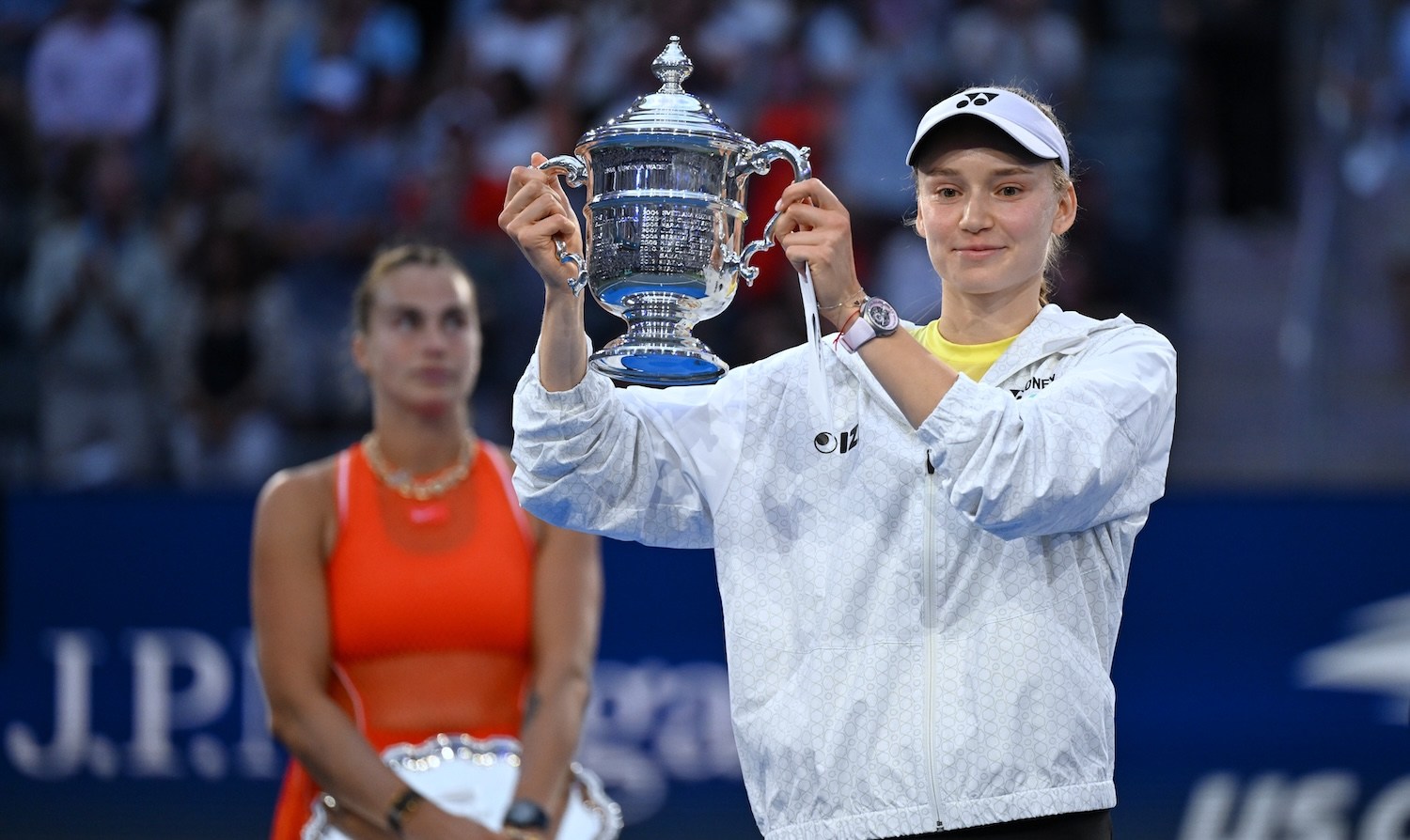
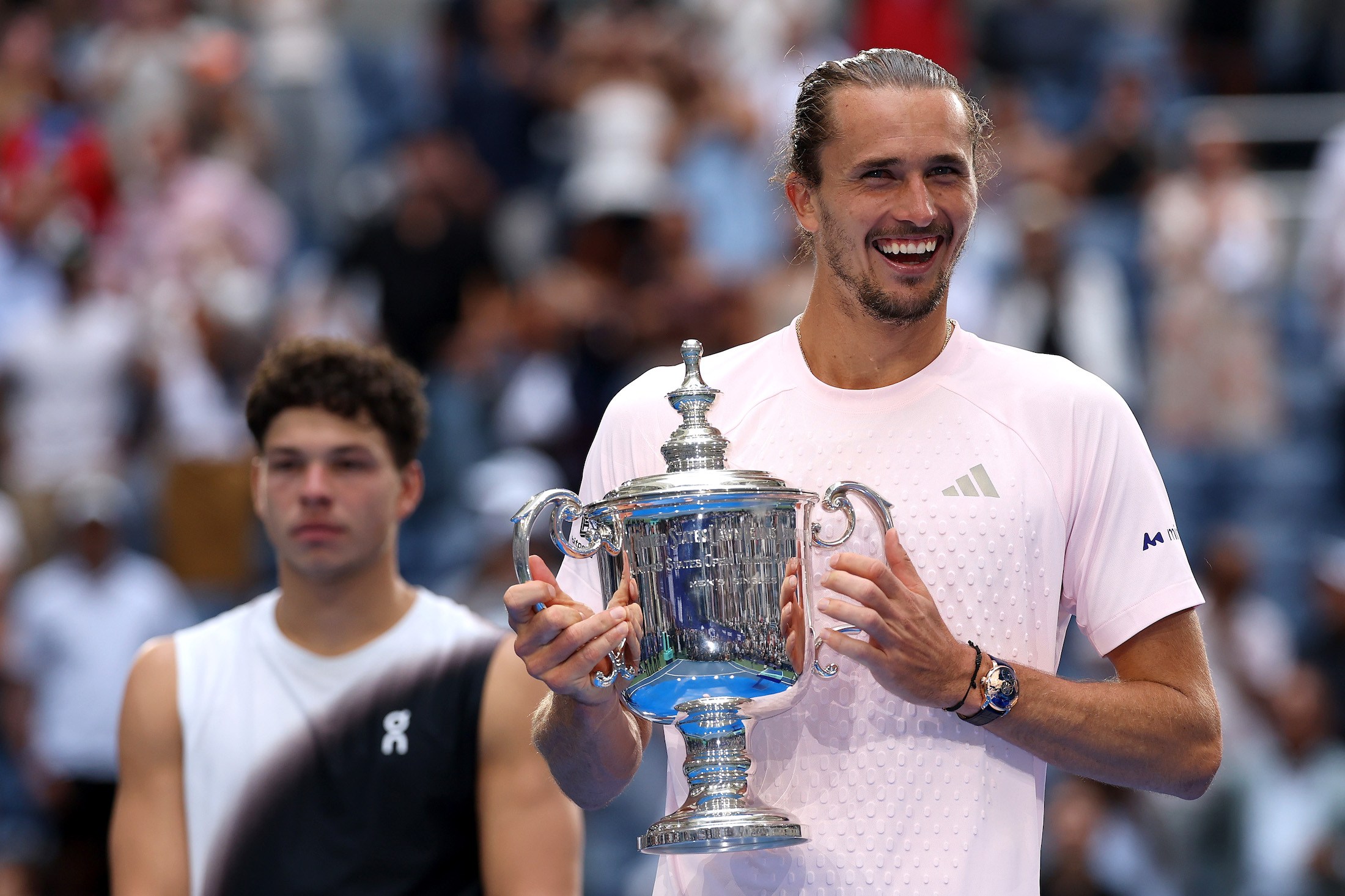
The 2026 U.S. Open is done, with Elena Rybakina and Alexander Zverev hoisting the trophies. The Defector tennis corps got together to talk about their impressions of the tournament, their feelings on players who didn't win either Final, and the hair situations of the ATP Nos. 3 and 7. Enjoy!
Patrick: Lorenzo Sonego, I'm pouring vinegar on you, goat. Two points and all this could have been different. Instead, Alexander Zverev has won as many Slams as Sincaraz combined this year, and we had to talk about 20,000 ball bounces instead of Carlos Alcaraz's hair.
Kathryn: Which is tragic, because it looked the best it's ever been, especially considering the, uh, previous situation, and that he was bald at this exact time last year. Between the Zverev Slam count and the Alcaraz hair situation, change simply happens too quickly.
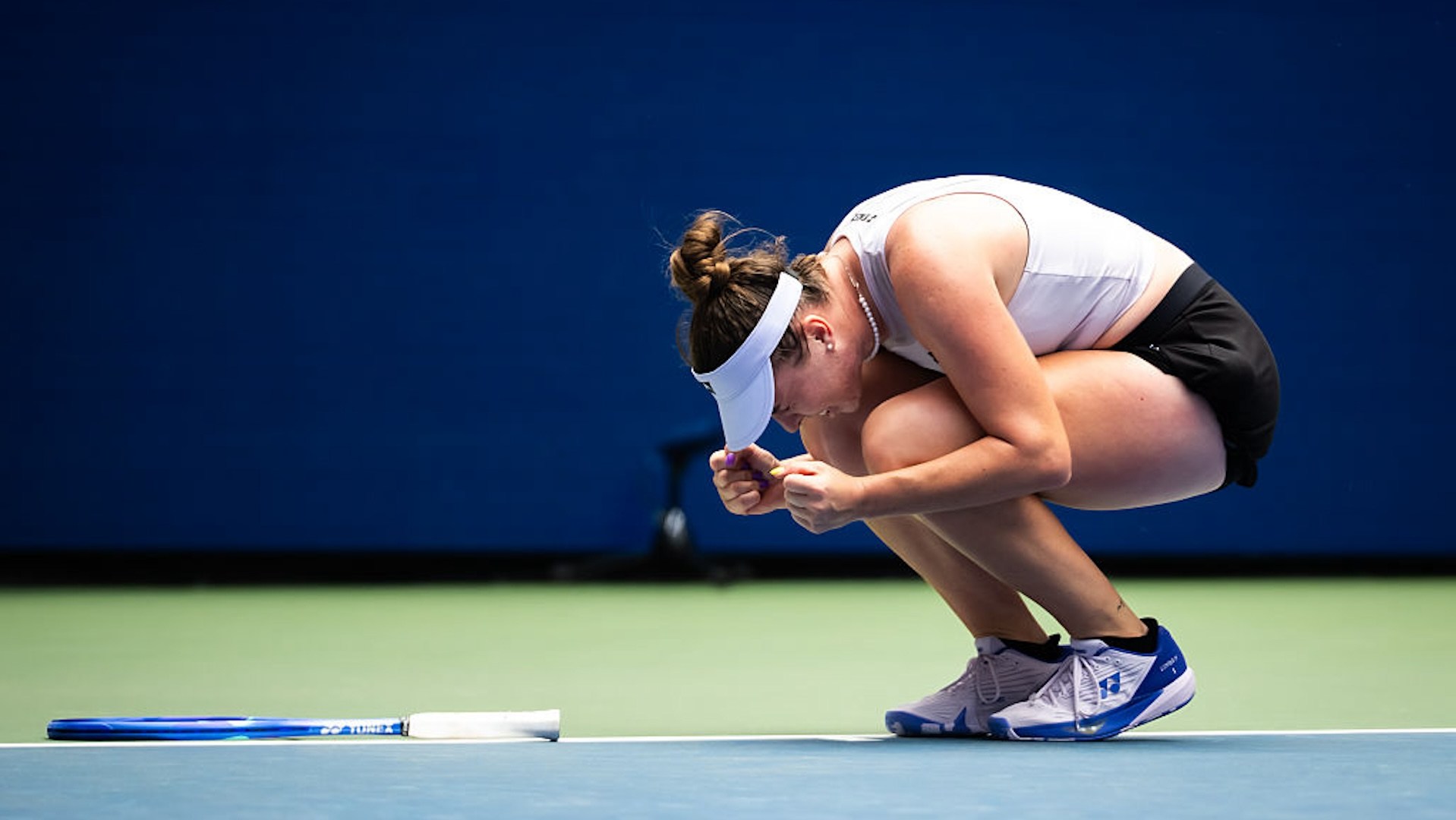
Owen: [Extricating self from large pile of empty Honey Deuce cups] Yeah, I'm still reeling from the whiplash between the joy of Alcaraz coming back after a dire four months, the jagged emotional peak of his quarterfinal loss to Ben Shelton, and all the air going out of the men's tournament soon afterward. But let's put that off as long as possible and start with the women's side, which brought us a new world No. 1 in the icy ball-striking queen Elena Rybakina, and new depths of despair for the already tortured Aryna Sabalenka, now without a major title this season for the first time since 2022. As another writer said to me on our way out of the final, one must imagine Sisyphus Belarusian.
Kathryn: It feels very narratively complete for Rybakina to become world No. 1 after winning the U.S. Open and beating Sabalenka for it, which ends the Iga Swiatek–Aryna Sabalenka reign over that particular honor. Owen, I remember talking to you about how the Swiatek–Sabalenka rivalry has lacked big finals, while Rybakina–Sabalenka has had some insane bangers. I don't know how the rest of you felt about this particular one. Unfortunately, I was largely barred from enjoying it live by jet lag and evil European time zones.
Patrick: Like many Sabalenka losses, I found this one narratively compelling and aesthetically frustrating. Because nearly every match she plays in is on her racket, the losses almost always tend to be about her missing more than the other player taking it to her. This isn't always necessarily true, and it's not to suggest Rybakina isn't a deserving winner or someone capable of troubling a fully activated Sabalenka, merely that I found Sabalenka–Noskova and Rybakina–Gauff to be far more entertaining watches.
Kathryn: The stat that really stood out to me after the fact was Rybakina winning the first set serving 27 percent, and winning the whole match serving 47 percent.
Owen: Yeah, the first set in particular was surreal: Rybakina made a grand total of eight first serves, yet her ground game was so immaculate that it hardly mattered. Sabalenka couldn't even produce a break point. That has to be the best set anybody has played while recording serving numbers that putrid; I can't even think of one that comes particularly close.
I think that's my overall read on the match, too. I'm a believer in Sabalenka to a fault, but aside from a 10-minute patch at the end of the second set, it always felt like Rybakina was the better player. This final may not have touched the heights of their Australian Open finals in 2023 or this past January, but it firmly established Rybakina as the best player on tour, breaking Sabalenka's fairly insane 99-week run. Aryna seemed more upset about not winning this tournament, though. This completes a two-year stretch in which she's been ranked No. 1 going into all the majors, been favored at five or six of them, made four finals, and won all of one. Ouch.
Giri: It is truly crazy how long Sabalenka has been dominating the tour and how little Slam hardware she has to show for it. I'm also remembering how Rybakina looked physically in Cincinnati, and the fact that she won seven matches in a row on that leg makes this feat all the more remarkable.
Patrick: I wonder why Sabalenka's Slam record is so dire, at least compared to her talent level. Perhaps it's the mental strain of her low-margin style; who knows. It's sort of impressive given the dire form she came in on to have made the final, but she'll still have regrets. Who else surprised or disappointed you from the women's side?
Kathryn: Yeah, I honestly had considered both Sabalenka (mental boomage) and Rybakina (Achilles situation?) to be lesser favorites, and then they both proved me wrong through the tournament. I was really looking toward either Swiatek or Gauff, in the end. Gauff lost to Rybakina, but my girl Swiatek's loss to also my girl Zheng Qinwen in the Kathryn Xu Bowl, as Giri called it, was pretty disappointing for me. I'm not pressing the panic button on Swiatek yet because she had a great lead-up, and I'm liking how her game's looking way stronger than this time last year. But this is also the first Slamless year for her since 2021, and I am not enjoying the mental boomage aspect of some of her recent losses.
I do want to note here that Zheng, who came up as a qualifier, was an extremely makeable backhand pass away from serving for the match against Rybakina, and things could've looked very different had she made it! Yeah, yeah, play the Nadal clip, but even without the victory, she was one of a few great secondary runs or minor storylines throughout the tournament.
Owen: I think Iga comes to mind first for disappointing runs for me too, Kathryn. Zheng pulling out her third round from 5-0 down in the third set against Madison Keys and then repeating the trick in the first set with Iga was one of the most impressive feats I've ever seen in the sport, but a round-of-16 exit does seem like something of a waste of Swiatek's previously superb American hard-court form.
She's underachieved at majors in a different way than Sabalenka: While you can pencil Aryna into the late rounds but also expect her to collapse spectacularly, Swiatek has played better on hard courts outside majors than at them for four years running. She hasn't made a hard-court major final since the 2022 U.S. Open. During her partnership with coach Wim Fissette, Swiatek played great at the start (those first five rounds at the 2025 AO) but then gradually got more muddled. We're still early in Francisco Roig's tenure as her new coach, so I'm curious whether this recent burst of form was something lasting or another honeymoon period.
Giri: Strange to call a quarterfinal run from a 19-year-old a disappointment, but Mirra Andreeva, who looked extremely good throughout the Open, botched the closeout against Coco. Two match points, and you could see the collapse coming after she lost those. The 79-mph first serve on match point was grim.
Patrick: I found the Andreeva collapse interesting as a lesson in tactical rigidity. She was bashing the Gauff forehand at every opportunity, as most opponents try to do, though eventually, she seemed to play that shot into form instead of breaking it down. From there, she seemed so flummoxed that she more or less stopped actively participating in the match, which I read as a teenager learning a hard lesson more than an indication of a fatal flaw. Speaking of which, sort of: Do you guys also think Jovic–Eala was the match of the tournament?
Kathryn: There's so much magic to watching teenagers who haven't fully ironed out their games playing each other, especially when the serves are not serving. I'm not saying that Jovic and Eala are gonna be WTA Sincaraz or whatever, but I love the sort of tennis that can only be produced in that very specific window of time. And of course Eala brings the atmosphere wherever she goes, even on zombified-ass Ashe.
Owen: Absolutely, with a slight but decisive edge over Shelton–Alcaraz. Jovic and Eala hardly lapsed for three hours, despite their so-so serves necessitating a grueling baseline exchange every time they needed to win a point. Giri, I thought yet again about your theory that the best matches are born out of a blend between underdeveloped serves, polished groundstrokes, and youth. I'd have taken a sequel of this match over any other in the tournament. The men's side, on the other hand, is so serve-dominated I spent much of the past two weeks wondering if ATP matches should have the returner start every game at love-15 up.
Kathryn: When a player I like has a good first serve? That's just them refining their tools as any great player should. When a player I am even neutral about or don't care for has a good first serve? Least ethical thing I have ever seen! Jail! Permanent ban! Get this freak off my screen!
All respect to Ben Shelton, who played about as well as he could have for chunks of this tournament, but I greatly prefer returnbots in the ATP. That said, maybe it's finally time to return to the ATP and that absurd Shelton-Alcaraz match. Speaking of expectation, I did not think Carlitos would look so good returning after such a long break, and I did not think that Shelton was going to win after it went to five. But there we were, at 3:33 a.m. or whenever it was.
Patrick: Sorry, correction: 12:33 a.m., as the sun was just beginning to dip into the Pacific Ocean.
Kathryn: I am disgusted by the excesses allotted by the West Coast timezone. -30-
Patrick: I was convinced from his first match until the moment he lost that fifth-set tiebreak that Carlos was going to win the tournament. To both of your points, the biggest difference I saw from him at this tournament was that his serve was nonfunctional. However, we have a scholar of the form here, so I'm curious for his thoughts on the version of Alcaraz we saw in Queens.
Owen: I'm hopelessly biased, so at first I was really disappointed that he lost to Shelton, then I started thinking the real miracle of the match was that Carlos pushed it to a fifth-set breaker despite being sufficiently undercooked to lose nine games in a row earlier in the match. I'd also love to know our resident Alcaraz scholar's thoughts, and how much of my take is cope. But I just missed his presence on the tour so much. Where else are you going to see shit like this.
Giri: I know Alcaraz was super happy after the match, as if he'd been playing the whole tournament with house money, which was great to see, but I'm very curious how much of his diminished first serve speed is him taking it easy in his first tournament back and how much of it will endure into future matches. That really was the weapon that carried him through the Open last year, and one that takes his overall game to a level that even Sinner will struggle to match.
As Carlos has said before, it's the one shot that does not come naturally to him, but I'll go on the record as saying this dude simply does not lose skills, he only gains them, with alarming ease. It just depends on if his body can sustain it, and that's a real question after this wrist tendon injury. I wonder if the solution will come down to load management, or, potentially more complicated, a modification of his technique.
Kathryn: The stretch of majors from Roland-Garros to the U.S. Open has been interesting in re: Sincaraz domination because I felt before this year that envisioning the circumstances that could create a non-Sincaraz Slam winner was pretty hard. And now we have two case studies in how poorly timed injury and absences can, in fact, make it possible for Zverev to be a two-time major champion. (Speaking of hopeless bias, I was very sad Sinner couldn't play this tournament—abolish knees!—which is partially why I was so checked out of the men's side this year.) Maybe Djokovic should still keep clinging on for number 25.
Owen: You say that, Kathryn, but this was the first major in which Djokovic endured a true humiliation in ages. I have to question how long even a guy like Novak, with the pain tolerance of a masochist and one-time endurance of a marathoner, wants to keep puking his guts out in early-round matches during the summer. His five-set loss to Mariano Navone looked truly torturous, and ended with the feeling that Djokovic was done. Naturally, I kind of do expect to see him in the Australian Open quarterfinals in January.
Patrick: Two weeks ago, I felt both the women's and men's fields were pretty open, but for opposite reasons: Everyone is good and nobody is good, respectively. In this way, Zverev is a perfect winner on the men's side: He's beaten two top-10 players all year, and drifted into the final on a pillow-soft draw. While a win is a win—and there are obviously some huge off-court reasons here too—there's nothing Zverev can do to move me.
A hard lesson I've had to learn is that hitting a big serve and being consistent matter way more than doing cool stuff, and while the hopefully soon-to-be-resumed Sincaraz era showed those two aren't mutually exclusive by any means, Zverev's on-court boringness is probably actually beneficial. He makes sense as the first non-Sincaraz winner, for personifying, again in a purely on-court sense, the often banal, often brutal realities of tennis.
Kathryn: Yeah, for all of the "Ball don't lie" thought processes surrounding sports, I find Zverev's recent victories a good case study of how sports matches are fundamentally amoral enterprises, and why I have been less capable of extracting non-sporting vindication from them. For all that it's nice to imagine sports as some larger equalizer, a win or loss doesn't prove anything outside of that fact: An athlete won, or they lost. There's no higher moral power tipping the scales to punish an athlete for off-court sins, or even rewarding an athlete for having an aesthetically, righteously beautiful game. It's just a sport, even tennis.
Giri: Learner Tien could have stopped all this. Or at least he had a better chance of doing so than Karen Khachanov. Let's all remember the plummeting ticket prices for the Khachanov–Zverev semi. Karen Khachanov—does he have shooters? Can you think of a player with a weirder ratio of Grand Slam performance to people caring about them?
Patrick: I would say one interesting thing is that Karen Abgarovich Khachanov[a] (born 21 May 1996) is a Russian professional tennis player. Another is that He has been ranked by the Association of Tennis Professionals (ATP) as high as world No. 8 in singles, which he achieved on 15 July 2019, and No. 53 in doubles, attained on 29 January 2024.
Owen: I walked into the media center a little bit after the Zverev–Khachanov semi and chatted to some people there, shaping up to talk about the match, only to realize … no, I had not a single thought about it. Reports needed no further details than that it started, some time passed, and then it was over.
I think the points about sports being divorced from arenas of judgment are good. I'm reminded of boxing fans hate-watching Floyd Mayweather, hoping he'd suffer the same kind of beating he odiously doled out to numerous former partners. But Mayweather was allowed to take part in those fights, which had nothing to do with the fact that he was boring to watch, which had nothing to do with the fact that he never lost.
It really is a hard lesson to learn, because sports position themselves as metaphors for society, and when they make satisfying alignment with the perceived just outcome, it's irresistible. In reality, the metaphor only works some of the time. All the power to those who champion any and every Zverev opponent, but until somebody invents hyperthin cables that can channel that energy directly into a player's serving arm, it can't be more than a coping mechanism.
Patrick: But if Learner Tien would have beaten Khachanov, received Alexander Blockx's retirement with grace, then dispatched Zverev, maybe I would have felt differently. It was sad to see the most stylish player in the men's field blow such a good shot to make his first Grand Slam semi, though his win over Jakub Mensik—he chopped that guy's legs off—was great. We should end on a positive note: Was there any stuff you liked on that side of the tournament?
Kathryn: I got a bit attached to Rafa Jodar earlier this year, before he revealed some of his more evil elements (in an alarming personal development, I have started to use the word "son" a la Kelsey McKinney for certain athletes, and Jodar would certainly be a terrible one), but I love the mononymous Buyunchaokete, stylized as Bu Yunchaokete, who in beating Jodar delivered one of the earliest upsets of the whole tournament. Jodar helped by playing like he was possessed or something, but still, considering his form going in, what a guy to beat to get your first-ever main draw win at a major.
Other than that: Learner Tien 2027 U.S. Open champion, who says no?
Owen: I found myself watching a weirdly high number of Flavio Cobolli matches on Louis Armstrong. Since making the Roland-Garros final, he's started to grate on me—this player in the Alcaraz Lite mold is carrying himself like a seven-time major champion, too. As the fifth seed, he fell to his knees in triumph after winning his first-round match from two sets down, and pointed to his ear after winning the third set on a net cord winner. It seemed tacky to me, less for the breach of etiquette than the celebrations being disproportionate to his accomplishments. But for some reason, something changed for me during his third-round loss to Blockx. Cobolli had just been bageled in the third set, but spent the fourth (which he went on to lose) thumping his chest and roaring. Why not, I thought, swept up in the adoring crowd. Pump that fist, Flavio.
Giri: I'll also add, having seen yesterday's amazingly boring final, that Cobolli should also be thanked for making a Zverev Slam final fairly interesting to watch. Zverev standing deep behind the baseline and hitting slow rally balls until Shelton glitches is some of the worst non-servebot tennis that the sport has to offer. At least Flavio was out there doing stuff. Sometimes that includes cornrows, but, you know.


![USA's Ben Shelton celebrates his win against Spain's Carlos Alcaraz during the men's singles quarter-final tennis match on day ten of the US Open tennis tournament at the USTA Billie Jean King National Tennis Center in New York City on September 9, 2026. (Photo by Leonardo MUNOZ / AFP) / “The erroneous mention[s] appearing in the metadata of this photo by Leonardo MUNOZ has been modified in AFP systems in the following manner: [USA's Ben Shelton] instead of [Spain's Carlos Alcaraz]. Please immediately remove the erroneous mention[s] from all your online services and delete it (them) from your servers. If you have been authorized by AFP to distribute it (them) to third parties, please ensure that the same actions are carried out by them. Failure to promptly comply with these instructions will entail liability on your part for any continued or post notification usage. Therefore we thank you very much for all your attention and prompt action. We are sorry for the inconvenience this notification may cause and remain at your disposal for any further information you may require.”](https://lede-admin.defector.com/wp-content/uploads/sites/28/2026/09/GettyImages-2293730421.jpg?resize=2880%2C1920)