

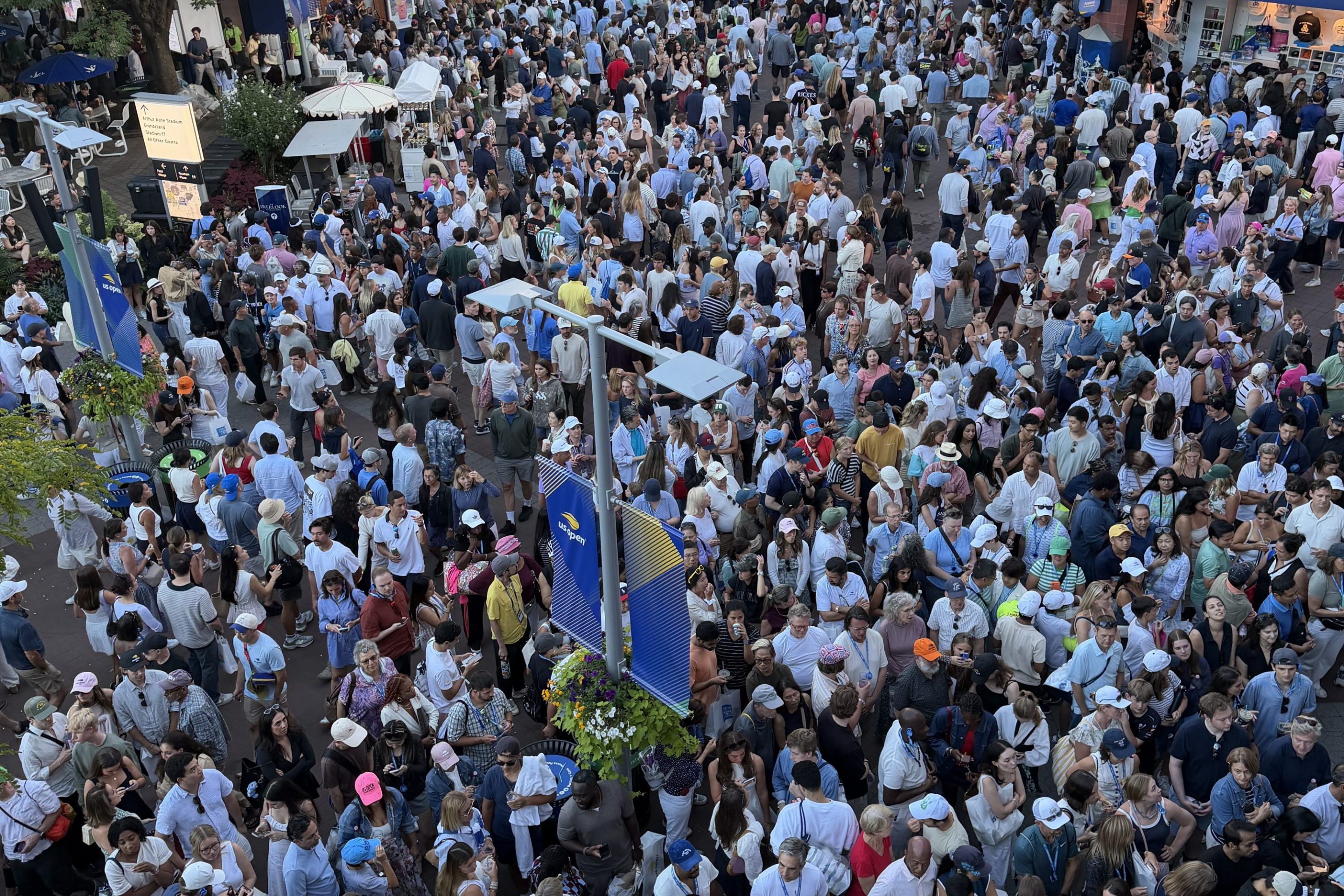
FLUSHING, N.Y. — The U.S. Open is a city in miniature. The food is expensive; wealthy people flock to the tallest vantage points while richer experiences on the outskirts are ignored; influencers bother the masses. Read enough about the tournament, or just walk around the grounds for a few days, and you could forget that tennis is played here. At its worst, the Open feels like a 15-day cocktail party where a couple hundred of the world's best tennis players happen to be present. Those players aren't going anywhere, though, no matter how high the ticket prices get or how muted the ambiance becomes. And they tend to play some great tennis while they're here.
Carlos Alcaraz is back from a four-month layoff for a wrist injury, and so is his forehand. He hit a winner at 107 mph to get his first break of the tournament. The serve's still missing, but that's fine; he's playing at an all-world level even without it, and the forehand was always more synonymous with his abilities as an entertainer. Alcaraz spent his first two matches reviving the gonzo, inventive style that went extinct during his absence. Rather than crush short backhands down the line, he wafted them crosscourt, trying to hit the advertising boards along the sides of the court before his opponent could reach the ball. He tickled the forecourt with drop shots and let the area around the baseline feel the vertical plonk of a lob as well as the horizontal swipes of his forehand.
To some, though, Alcaraz's off-court movements are of more interest. During his first-round match, I inadvertently glanced at my media section neighbor's phone and caught an incoming text, printed here with neighbor's permission: "Is Carlos a pussy hound?"
"I think so," my neighbor responded.
By the end of his first-round match, Alcaraz looked like a plausible champion; by the end of his second, he looked like a likely one. As he dismantled Jaime Faria on Day 4, I texted with Giri Nathan and Patrick Redford about how Carlos's brother Alvaro's hair seems to grow in tandem with his own, which is longer for this tournament. (I welcome the loss of the cornrows he debuted in August.) I then ran into Alvaro in the maze of tunnels beneath Arthur Ashe Stadium after the match. "He looked good, congratulations," I said.
"Thank you very much," Alvaro replied with a grin that could have held up a bridge.
Up 2-0 in the second set in his third round against Wu Yibing, Alcaraz's serve vanished. He coughed up two double faults. The sun, already pumping 85-degree heat into beleaguered media members' faces, seemed to double in wattage. At 4-3, Alcaraz shanked a forehand, walked over to the towel box, and gave it a firm kick. It wobbled on its hinges, the reverberations growing and rippling through the stadium, the grounds, the state, and, not to exaggerate, the entire world. At 30-all in the same game, Carlos opened the court with a savage crosscourt backhand, then thumped his forehand into the net. "NO!" he roared, throatily, as if USTA CEO Craig Tiley had told him, effective immediately, that smiling is banned on court. Alcaraz wore a white undershirt beneath his sleeveless top in this match, following some internet buzz over his nipples exploding through his armholes during his first two matches. Anyway, Alcaraz won the second set 6-4, the sun dimmed, I left to watch him clean up the third from the disintegrating but air-conditioned media center, and the people smiled once more.
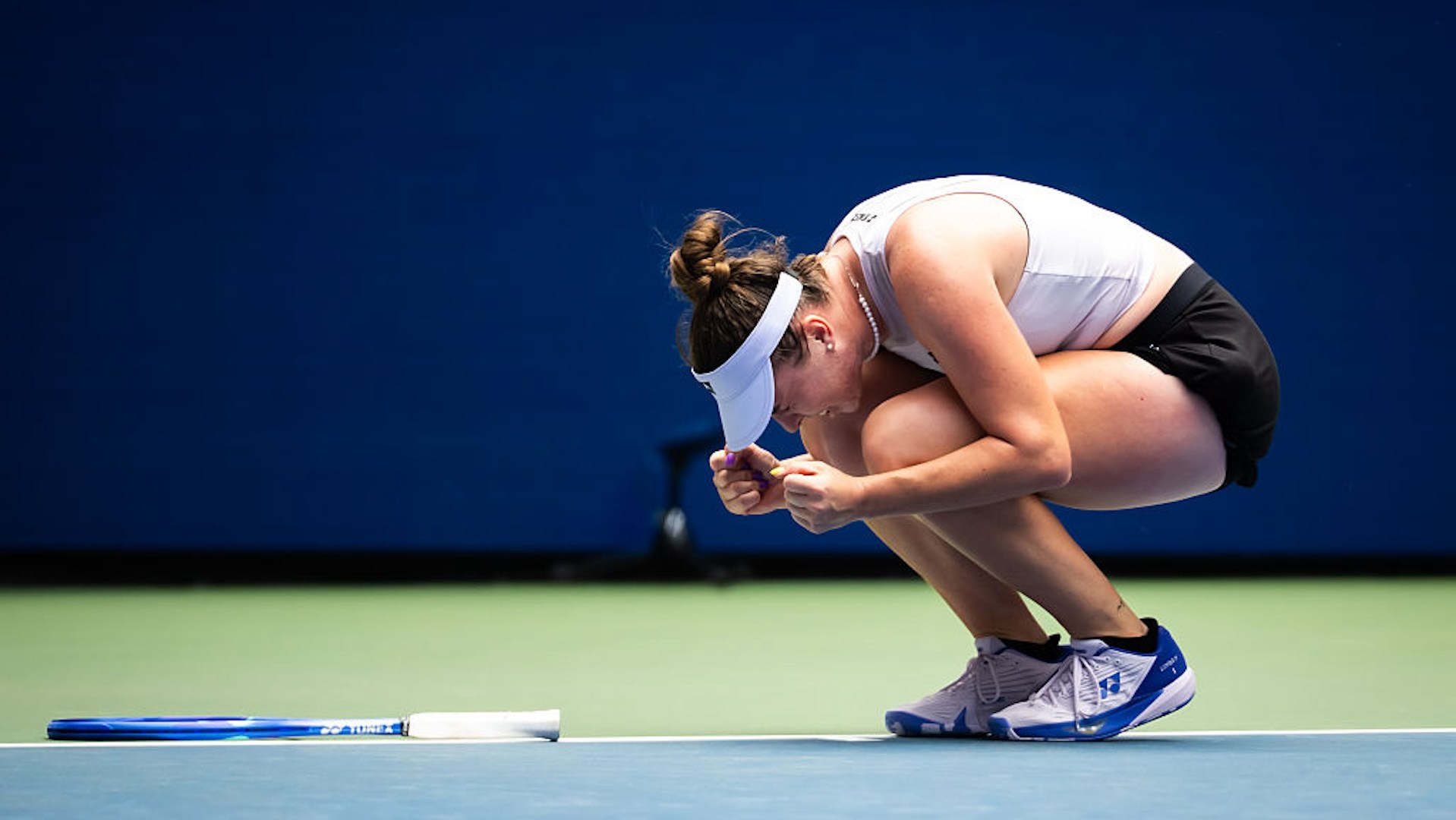
On Day 7, I watched the third set of Madison Keys–Zheng Qinwen, sticking around after Keys went up 5-0 out of some possibly errant sense that the match wasn't over. With Zheng serving at 4-5, love-15, a baby beyond the rim of the stadium started absolutely wailing, forcing her to pause her service motion twice. When she finally struck the ball, she came up with a perfect serve down the T. When Keys scythed a final forehand wide, Zheng collapsed onto the court like she'd won the tournament. Which she sort of had. Keys flung her racket into the net. An overjoyed Zheng blew kisses to the crowd and drew hearts in the air.
This, I suddenly realized, is what tennis is all about. Zheng's happiness looked so pure—all surprised pleasure, rich gravy on top of an already successful comeback tournament—that I could hardly stand it, and I welled up a bit. If only every match could produce this kind of joy, with no thought of the next match in two days. Keys was off the court before the cheers for Zheng faded.
I didn't notice that sweat had soaked the back of my shirt until I got up to leave. On my way back to the media center, I heard someone shout, "I need a clear path!" It was a train of four security guards enveloping Iga Swiatek, who was next up against Marie Bouzkova. Iga passed within two feet of me, wearing headphones and a dark purple cap, looking down almost blankly, so focused that she seemed in a meditative trance. I decided that she was perhaps less socially inclined at the moment than Alvaro Alcaraz a few nights ago, and kept walking to the media center to talk to anybody who would listen about the best comeback of the year. In the fourth round, Zheng replicated her 0-5 comeback in the first set against Swiatek and beat her as well.
I took a day off from going into the tennis—I'd been trying and failing to stave off total exhaustion since staying until 2:30 a.m. on Day 3—and stood in a small crowd waiting for a train to Times Square. Two minutes before it arrived, a guy ambled slowly past us, a small, bright scalpel in hand, openly contemplating sticking it into somebody. There were no cops down here, he mused, and his girlfriend was a nurse. (Was she on hand to stitch somebody up?) He refrained from following through on that dark fantasy and was gone quickly. The dread in my stomach took a few minutes to fade, and when it gave way to relief I imagined it was how Keys or Swiatek would have felt if Zheng's comeback had stalled at 5-4.
I've developed a complicated relationship with the main courts. On the one hand, high-stakes tennis between the best players in the world. On the other, the background din of mindless chatter. I walked out to the side courts to watch some women's doubles. From a few feet away, scenes construct themselves in seconds. I can see how Player A makes crystal-clear contact with the return of serve, but it clips the net cord and sits up, surprising the returner, who pops up a meatball for Player B to whack, but they slam it into the net and look to Player A to apologize, only Player A is scratching at a mark on the court with her racket, because she felt that the serve she returned so emphatically was out, and Player B gets her to forget about it and move on. Tennis on Arthur Ashe isn't volunteering any of those details in between 20,000-strong eruptions, and Louis Armstrong might only offer a couple. There's an inverse relationship between how much ball fans know and the size of the court where they're watching.
But did you see Iva Jovic play Alex Eala on Ashe? These two are close friends, and at the perfect moment in their careers—the serves of juniors, the returns of war goddesses—to produce spectacular tennis. Seventeen breaks in 33 games! Both modest in the power department, Jovic nonetheless unloaded countless forehand winners down the line, while Eala strained so hard for a couple extra miles per hour that her grunt sprouted a second syllable.
After losing the first set, Eala looked like she had the match sewn up at 4-2 and up a break point up in the third set, only for Jovic to explode into an ace and a pair of forehand missiles, and all of a sudden she'd stolen Eala's fuel. As Eala served down match-point a few minutes later, I squeezed and mangled the loop on my backpack from the nerves. Eala whacked a short-range forehand into the net, and I felt like crying sad tears. Eala stood there for a second, in shock or disbelief, before managing to give her close friend a real hug. Plenty of friendships have splintered as a rivalry intensifies; for now, what a gift to feel affection for the person who best lays bare your tennis for what it is. May they play 500 times.
On Armstrong, I saw Wimbledon champion Linda Noskova crack a seemingly fatal forehand on match point against Marta Kostyuk, and I saw Kostyuk float across the baseline to dismiss it with a mighty forehand swipe. Later in the game, another match point dealt with, she smiled atop the baseline at her own audacity. When Kostyuk broke serve to stay in the match, a wincing Noskova stuck her fingers in her ears. She double-faulted and sent a forehand egregiously wide to lose the set, as clear an example I've seen this tournament of tennis's mind-mangling qualities: The winner of the last major, who'd been through an identical experience in that final, felt so much strain that she just wanted the set to be over. Noskova returned to play an immaculate third set, right up until she had another match point. Kostyuk saved it, then another, then another, then smiled. It was happening again. Down break point, Noskova lasered a forehand down the line and found her best serves to put an end to her misery.
She collapsed onto her knees, screaming at the ground for a single cathartic second. There are so many degrees of removal between a top professional player and me—wealth, lifestyle, ability, strength, capacity for stress—that it should really be impossible to relate to them in matters beyond the personal. But anybody who has played tennis at any level knows how it feels to have a match within their grasp, let it go, and suddenly grab hold of it again when the emotional stakes are at their very highest. Noskova sinking to the ground proved that dedicating a life to this game does not make one immune to its pitfalls, all the sadistic ways it worms into the brain and tempts errors, collapses, full-blown breakdowns. It closed the space between participant and observer. Tennis as an infrastructure is about as unequal as it gets, evident here in everything from the ticket prices to the $14.75 milkshake at Van Leeuwen, to who's in the suites on Ashe eating sushi brought to them by waiters, to the upcoming quarterfinal between Jessica Pegula and Emma Navarro, dubbed "Big Rich" and "Little Rich" by Chinese fans for their inherited generational wealth.
But wealth won't stop one of those two from losing Tuesday night. When they do, for a little while, nothing will matter except for the pain on one side of the net, matched by the joy on the other. Then the fans will leave for their overpriced dinners and long commutes, the players will depart for ice baths and suites, and the distance will open up again.


![USA's Ben Shelton celebrates his win against Spain's Carlos Alcaraz during the men's singles quarter-final tennis match on day ten of the US Open tennis tournament at the USTA Billie Jean King National Tennis Center in New York City on September 9, 2026. (Photo by Leonardo MUNOZ / AFP) / “The erroneous mention[s] appearing in the metadata of this photo by Leonardo MUNOZ has been modified in AFP systems in the following manner: [USA's Ben Shelton] instead of [Spain's Carlos Alcaraz]. Please immediately remove the erroneous mention[s] from all your online services and delete it (them) from your servers. If you have been authorized by AFP to distribute it (them) to third parties, please ensure that the same actions are carried out by them. Failure to promptly comply with these instructions will entail liability on your part for any continued or post notification usage. Therefore we thank you very much for all your attention and prompt action. We are sorry for the inconvenience this notification may cause and remain at your disposal for any further information you may require.”](https://lede-admin.defector.com/wp-content/uploads/sites/28/2026/09/GettyImages-2293730421.jpg?resize=2880%2C1920)