

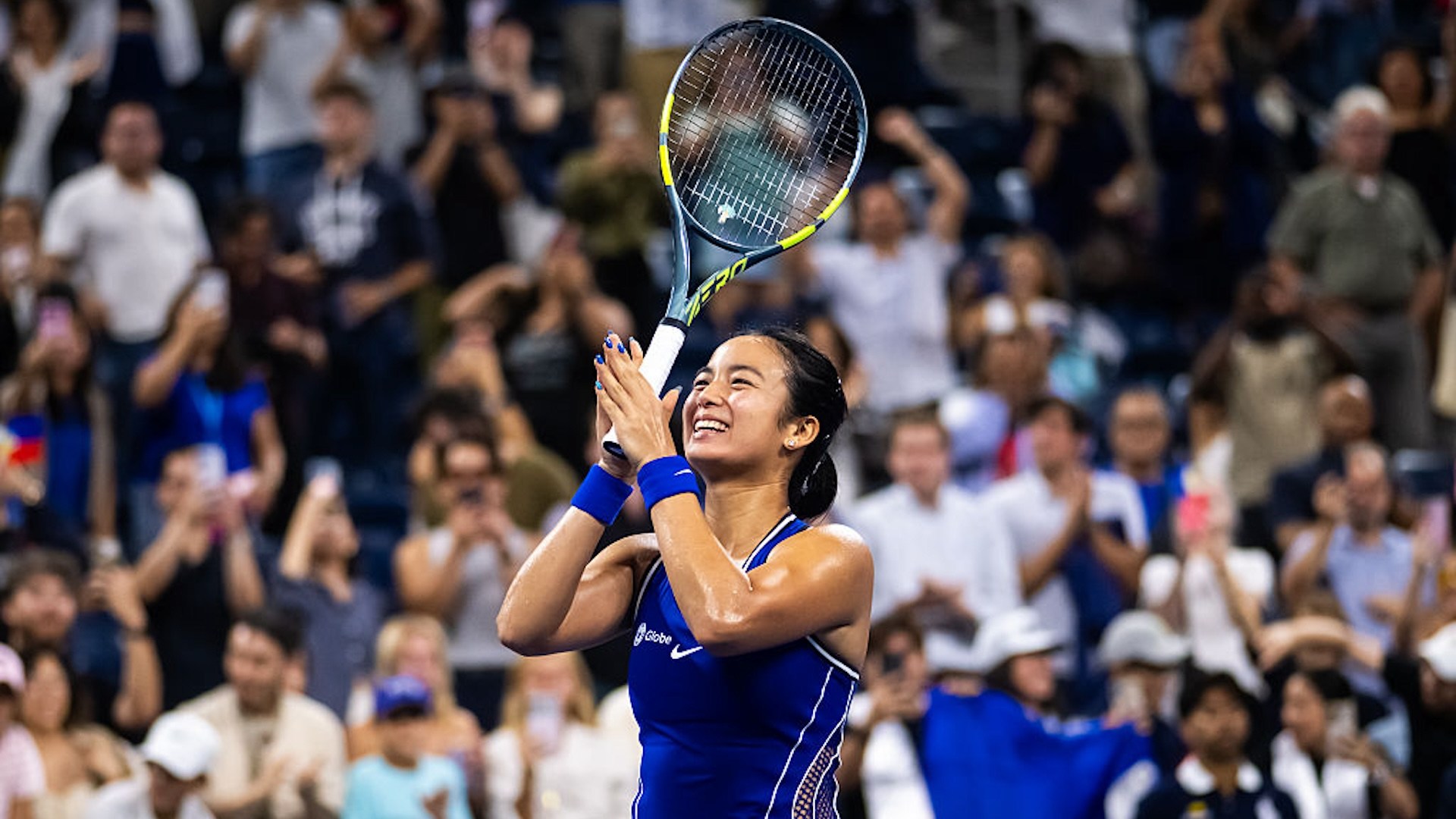
FLUSHING, N.Y. — As we waited for Alexandra Eala to walk into Louis Armstrong Stadium for the most anticipated first-round match of the tournament, the crowd whooping as a victorious 40-year-old Gael Monfils shed his shirt, I had a quick chat with Dyan Castillejo, the first Filipino ever to play on the WTA Tour. Castillejo is now a journalist; I'd read a number of stories in American publications by American authors that analyzed Eala's spectacular fame, but here was a chance to talk to somebody who could tell me firsthand about Ealamania in the 117-million-strong Philippines. Per ESPN, Castillejo has covered Eala since she was six years old. So just how big a deal is she?
"She's a super big deal. She's our biggest star now, whether athlete or non-athlete," Castillejo said immediately. "I would say she's probably the most celebrated Filipino right now. Because of her, tennis is introduced in the Philippines. Before, it was a segment of a tennis community. Now the masses are learning about tennis, what the sport is all about. Tennis clubs are full, trainers are busy, rackets are selling, parents want their kids to take up tennis."
By tennis metrics alone, the 21-year-old, 18th-ranked Eala's popularity startles. Roger Federer, who visited the U.S. Open on Monday night to rapturous cheers—people filmed him from so high up on Arthur Ashe Stadium that he couldn't have looked like anything bigger than a very fashionable ant on their screens—is often held up as the ultimate example of popularity in tennis. When he played the great British (Scottish) hope Andy Murray in a Wimbledon final in 2012, you'd hear the crowd's rooting interests described as 50-50. When Eala beat American Jessica Pegula in the final of the D.C. Open last month, the crowd was around 95-5 for Eala.
After losing to Eala in Canada, Caty McNally thanked her for sharing the brilliant atmosphere. Eala's most impressive career achievements so far are a 500-level title and a fourth-round run at Wimbledon, but in terms of star power, she might already be able to match any tennis player in history.
It was a brilliant atmosphere Tuesday night, too. The low hum of the often disinterested fans is a constant presence at the U.S. Open, dissolving cheers as soon as they arrive and creating the feeling that I'm watching the match through a pane of very foggy glass. On Tuesday, the adoring peals of the fans drowned out the announcer long before he could say the name "Alexandra Eala." A food vendor lingered just beyond the outer rim of seats, eyes locked onto the court, filming Eala's walk-on. I saw small Filipino flags, big Filipino flags, Filipino flags sewn into jackets, fans waving art and magazine covers, purple-font shirts reading "U-B-E-lievable Alex." Somebody held up a large cardboard baby's head, the identity of whom was unfamiliar to me. Why not!
Eala was playing Mary Stoiana, a 23-year-old American qualifier, and immediately began torturing her with low, piercing groundstrokes. Eala is a lefty sniper, compensating for a relative lack of power with crisp ball-striking and a keen sense of when to go down the line (often). Occasionally she summons the ghost of Rafael Nadal by hoicking a forehand winner from behind her body while on the run, as seen in her third-round Wimbledon victory over defending champion Iga Swiatek. (The full replay of that match has 1 million views on YouTube; the excellent final between Karolina Muchova and Linda Noskova, uploaded the same month, has 52,000.) Her groundstrokes, struck early and hard to read, baffle opponents.
In Cincinnati, Eala lost to Amanda Anisimova, 4-6, 6-4, 6-2; it was evident she'd run out of gas by the end. But before then, Eala repeatedly drove Anisimova, a far more powerful player, to despair. She'd crack a return winner at a vital moment. She'd slide shriekingly along the back of the court to return Anisimova's bullets, often until Anisimova missed. Anisimova won the match, but looked like she'd had to compress a month's work of emotional tennis labor into two and a half hours.
On Tuesday, Eala ripped off the first five games against Stoiana. Between points, she faced the back wall and mimed groundstroke swings, slow and languid like a meditation, usually backhand then forehand, though not always. She's incredibly quiet, seemingly channeling the crowd's mania into focus. Ben Shelton has released glass-shattering "YEAH" roars in front of fans half this invested.
With Eala leading 3-0, the umpire made her first attempt to settle the joyous crowd. "Good luck," said the media member to my left. On a changeover, somebody twerked on the Jumbotron. I can't be sure, but I think Eala glanced up and smiled for a second. Stoiana had some fans there, and was fortunate that Eala backers cheered her hot shots, too. Mostly she did everything you could ask of her: head down, celebrating every tiny victory. She sweated through her lavender outfit in minutes.
Eala started the second set slowly, and had to battle through love-30s or break points in all her service games. Her serve lacks bite, but even that can work in her favor. Multiple top players have said the vacant pace in her serve proved difficult for them to handle—they're used to quicker serves that bounce closer to them. She's similar to Nadal in that way, too: His serve was less a weapon than a point-starter that proved difficult to attack, and everything worked out all right for him. (Eala trains at Nadal's academy and got a scholarship there at 13.)
Eala erased each deficit to hold four straight times, often with help from serves faster than she usually hits, reaching 108 mph on this night. In the middle of the second set, as Stoiana tore back to the middle of the court after hitting a backhand, Eala totally duped her with an off-pace slice forehand that landed a foot deeper than Stoiana expected. It wasn't enough to win the point outright, and Eala had to rally until Stoiana missed a drop shot, but the shot was a layer of subtlety and craft you rarely see from bigger-hitting top players. A few minutes later, Eala had a break point to all but put the match away. She flew toward a better drop shot and flipped the ball tightly over the net, at a sharp angle … and just wide. But the crowd shrieked more loudly than they had all night, partly because half of them initially thought she made the shot, and partly because it was so fun just to watch her try.
Eala won 6-1, 6-2, and smiled slightly on her way up to shake hands. Then she grinned big, skipping and hopping and blowing kisses to the crowd. She walked over to sign fans' memorabilia and took the cardboard baby, beamed, held it up to the matchcam, and later complimented her fans' creativity in press. (She also confirmed that the cardboard baby is her.) As she whacked a few tennis balls into the crowd for the postmatch ritual, a fan nearly tumbled from the upper bowl in their desperation to catch one.
The common refrain whenever Eala plays is that she's the most popular sportsperson from the Philippines since the boxer Manny Pacquiao. It's a bigger declaration than it might sound, particularly if you don't know of Pacquiao. "Pacman" rose from poverty and obscurity to author an unprecedented career in which he rose through the weight classes with impunity, knocking out foes far bigger than he. At his peak, Pacquiao was a universal phenomenon. He is a consensus top-15 boxer of all time, with a life made for a biopic.
"For me," Castillejo said, seconds before I'd planned to ask her about the comparison, "[Eala is] just as big as Manny Pacquiao."
I asked Castillejo about the pressure Eala must be feeling. "Pressure?" she responded. "Oh, you know what, she's kind of like Pacquiao in a sense, where she really gets a double boost of energy from the Filipino crowd. I don't see her pressured, I see her game elevated. She played in our WTA 125 at the start of the year, and people thought, Oh, she might get pressured. No, she absolutely loved it. She loves having the crowd behind her. If you're asking whether her popularity among the Philippines puts added pressure, I would think the opposite. I think it adds to her adrenaline."
Eala's fame and popularity have sent her ticket prices skyrocketing, more so than any other player. What makes this additionally fascinating is that she's not a realistic candidate to win the title, at least for now: She's never made it past the fourth round at a major, and never made it past the second round at a hard-court major. There are stories wondering why she was scheduled to play on Louis Armstrong, the second-largest stadium on the grounds; Coco Gauff, the second highest-ranked American player on the WTA and the champion of this event in 2023, got the plum slot. It doesn’t seem to matter to her fans, they’re just happy to watch her play.
At her press conference, I asked Eala how different the night had felt from her first round at the U.S. Open a year ago: also a win, but on a smaller court, with lower expectations, as the unseeded player in the matchup. "It was very loud," she said, laughing, of Louis Armstrong Stadium, which she'd dreamt of playing on as a child. She said coming in as a seeded player came with the benefit of confidence, but also more expectation.
"But I think I handled it," she said, before catching herself. There's more work to do, more fans to gratify. "I've been handling it well."



![USA's Ben Shelton celebrates his win against Spain's Carlos Alcaraz during the men's singles quarter-final tennis match on day ten of the US Open tennis tournament at the USTA Billie Jean King National Tennis Center in New York City on September 9, 2026. (Photo by Leonardo MUNOZ / AFP) / “The erroneous mention[s] appearing in the metadata of this photo by Leonardo MUNOZ has been modified in AFP systems in the following manner: [USA's Ben Shelton] instead of [Spain's Carlos Alcaraz]. Please immediately remove the erroneous mention[s] from all your online services and delete it (them) from your servers. If you have been authorized by AFP to distribute it (them) to third parties, please ensure that the same actions are carried out by them. Failure to promptly comply with these instructions will entail liability on your part for any continued or post notification usage. Therefore we thank you very much for all your attention and prompt action. We are sorry for the inconvenience this notification may cause and remain at your disposal for any further information you may require.”](https://lede-admin.defector.com/wp-content/uploads/sites/28/2026/09/GettyImages-2293730421.jpg?resize=2880%2C1920)