

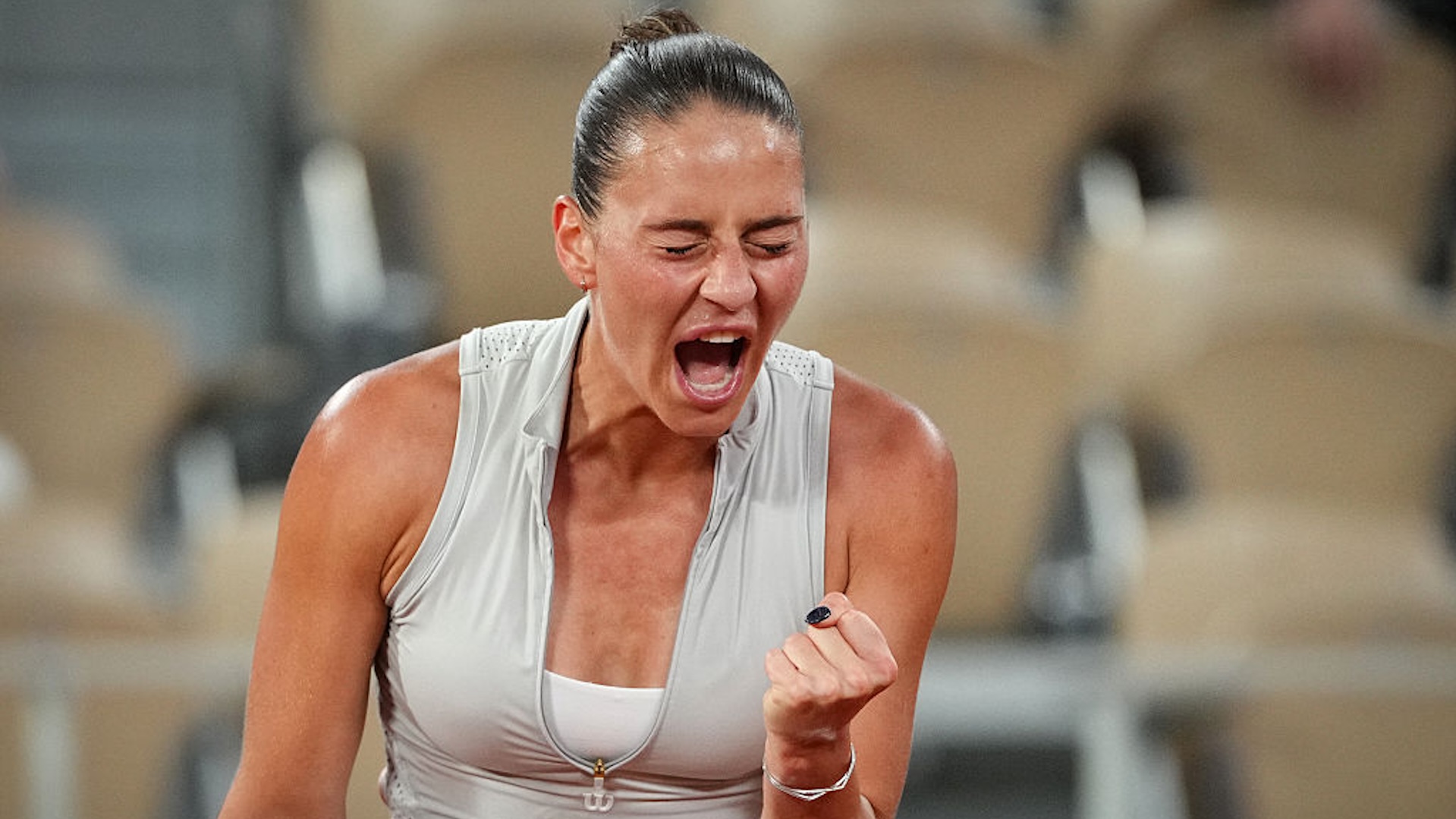
The morning of her first-round match at Roland-Garros, Marta Kostyuk learned that a Russian missile attack had killed four people in her native Kyiv, Ukraine, dangerously near her parents' house. "Most of the morning I felt sick … if it was 100 meters closer, I probably wouldn’t have a mom and a sister today," Kostyuk said after her comfortable win against Russian-born Oksana Selekhmeteva. Compartmentalization sometimes impresses as much as any athletic exploit.
In the middle of her fourth-round match against four-time champion Iga Swiatek, Kostyuk was dancing. She'd never taken a set off Swiatek before, but survived the opener, 7-5, despite being down a break on two occasions. After a brief chat with coach and blogger Sandra Zaniewska, who spent the match taking notes atop a copy of Sally Rooney's Intermezzo, Kostyuk had a few extra moments before Swiatek returned from her standard bathroom break and got her boogie on to the courtside music to cheers from the crowd. Everybody should have known the eventual result right then. You simply do not dance on court unless your game is singing. An out-of-sorts Swiatek returned from the toilet and broke serve in the first game of the second set, then watched Kostyuk swipe the next six in a row to inflict the most resounding defeat Iga has absorbed at this tournament in seven years.
The day of Kostyuk's quarterfinal on Tuesday, Russian missiles and drones killed at least 22 more Ukrainians, three children among them. Against her countrywoman Elina Svitolina, who had mentored Kostyuk and is in arguably career-best form, Kostyuk won in three sets. The quirks and sharp edges of tennis regularly drive players to various displays of infancy, as if each missed backhand or dubious line call represents a vital part of their life shattering before their eyes. Despite shouldering truly life-altering stress, Kostyuk was even-keeled throughout, greeting misses with smiles or shrugs in which the frustration level looked closer to everyday levels than "Daniil Medvedev."
On break point to go up 3-2 in the deciding set, Kostyuk hit the shot of the match: Svitolina snapped a backhand pass down the line that caught the net tape, ruining the shot's trajectory and predictability. Plenty of similar shots fly past the player at net, stock-still and pissed off at their misfortune. But Kostyuk somehow reflexed a perfect forehand volley into the open court, then spread her arms like a stage magician. Buoyed by that bit of witchcraft, she ascended to a new level entirely and grabbed 12 of the final 13 points, almost all of them with winners. After the match, her coach and husband cuddled with Kostyuk's two small, floofy dogs, which accompanied the team to Paris. On the court, Kostyuk wept. "I want to give this match to Ukrainian people and their resilience," she said. The crowd, dotted with blue and yellow flags, cheered for a good 40 seconds.
The first traces of Kostyuk as an elite player came in the 2025 clay season, during which she played two exhausting epics with Aryna Sabalenka. Sets ran 90 minutes and ended in ecstatic tiebreaks: One player would save set point with a winner, then the other would answer with two of their own. Sabalenka, playing the best dirtball of her career, didn’t allow Kostyuk to win a set in either match. Kostyuk played flush to her skills’ ceiling, but Sabalenka, the best player in the world then and now, had access to higher elevation. Since the war began, Ukrainian players have declined the customary post-match handshake when they play Russian or Belarusian opponents. After these glorious matches, Kostyuk and the Belarusian Sabalenka parted without a word.
Kostyuk's game is best characterized by a sense of toil. She trained in acrobatics for seven years as a child, and you can see the background when she sprawls for a shot at end range—surely those tendons will come screaming off the bone, you think, as she contorts to retrieve a forehand, but no, the ball arcs back high over the net and the player recovers to the centerline. There's no sense of ease or energy conservation or sometimes even control with her flailing gets. But her defense is among the best on tour, capable of getting depth on shots struck way behind the baseline. She's quick enough that foes are rarely sure where to place their putaway. If they miss their spot, Kostyuk resets the point so quickly, their advantage might as well never have existed. Exhibit A:
Recently, though, Kostyuk has been emphasizing aggression. She hits the shit out of the ball without the benefit of easy power; her whole body does the work, not just the wrist-timing blend that is the privilege of the biggest hitters. While her defense evokes a desperate kind of whiplash, her offense evokes fury. She's winning around 70 percent of first serve points in most of her matches this tournament, a healthy number in general and a spectacular one on clay. She whacks second-serve returns so hard, she sometimes loses her aim, and the shot misses or lands in the middle of the court. The silhouette of a great offensive player flickers when she fires what could have been a putaway down a wide central channel, or a forehand down the line six feet wide. But her shots are so potent when accurate that this tournament, the inconsistency hardly matters. Swiatek and Svitolina found no solace in her high unforced error counts during those matches. Kostyuk kept pace with them when her shots sailed, and left them in the dust when her shots landed. Though she’s never made a major semifinal before, it's worth wondering if anybody can keep up: She's on a 16-match winning streak, with a 17-0 record on clay this year.
Next up is Mirra Andreeva, the Russian 19-year-old Kostyuk beat in the final of the Madrid Open in May. After that, it'll most likely be a final with Diana Shnaider, also Russian (against whom Sabalenka pioneered her most spectacular flameout yet in the quarters). Reminders of the war are everywhere you look in this draw. When asked about it, most Russian and Belarusian players express a bland wish for peace and stress their singleminded dedication on winning tennis matches. For some of the Ukrainian players, that's not good enough. "They are all grown-ups. They know what they’re talking about. They know what's going on. They have phones. They have Instagram. They have news," Kostyuk said of Russian players after winning her quarterfinal. "I wish there was some more clear stance on what's going on, especially when your country is killing other people." She advocated for players afraid to speak out against Russia to leave.
It all makes a major semifinal feel fairly inconsequential. Those at that stage of a tournament, particularly for the first time, try to blot out every stray thought in their head that might possibly interfere with their performance. Playing the best tennis of her life or not, Kostyuk will not have that luxury.


![USA's Ben Shelton celebrates his win against Spain's Carlos Alcaraz during the men's singles quarter-final tennis match on day ten of the US Open tennis tournament at the USTA Billie Jean King National Tennis Center in New York City on September 9, 2026. (Photo by Leonardo MUNOZ / AFP) / “The erroneous mention[s] appearing in the metadata of this photo by Leonardo MUNOZ has been modified in AFP systems in the following manner: [USA's Ben Shelton] instead of [Spain's Carlos Alcaraz]. Please immediately remove the erroneous mention[s] from all your online services and delete it (them) from your servers. If you have been authorized by AFP to distribute it (them) to third parties, please ensure that the same actions are carried out by them. Failure to promptly comply with these instructions will entail liability on your part for any continued or post notification usage. Therefore we thank you very much for all your attention and prompt action. We are sorry for the inconvenience this notification may cause and remain at your disposal for any further information you may require.”](https://lede-admin.defector.com/wp-content/uploads/sites/28/2026/09/GettyImages-2293730421.jpg?resize=2880%2C1920)