


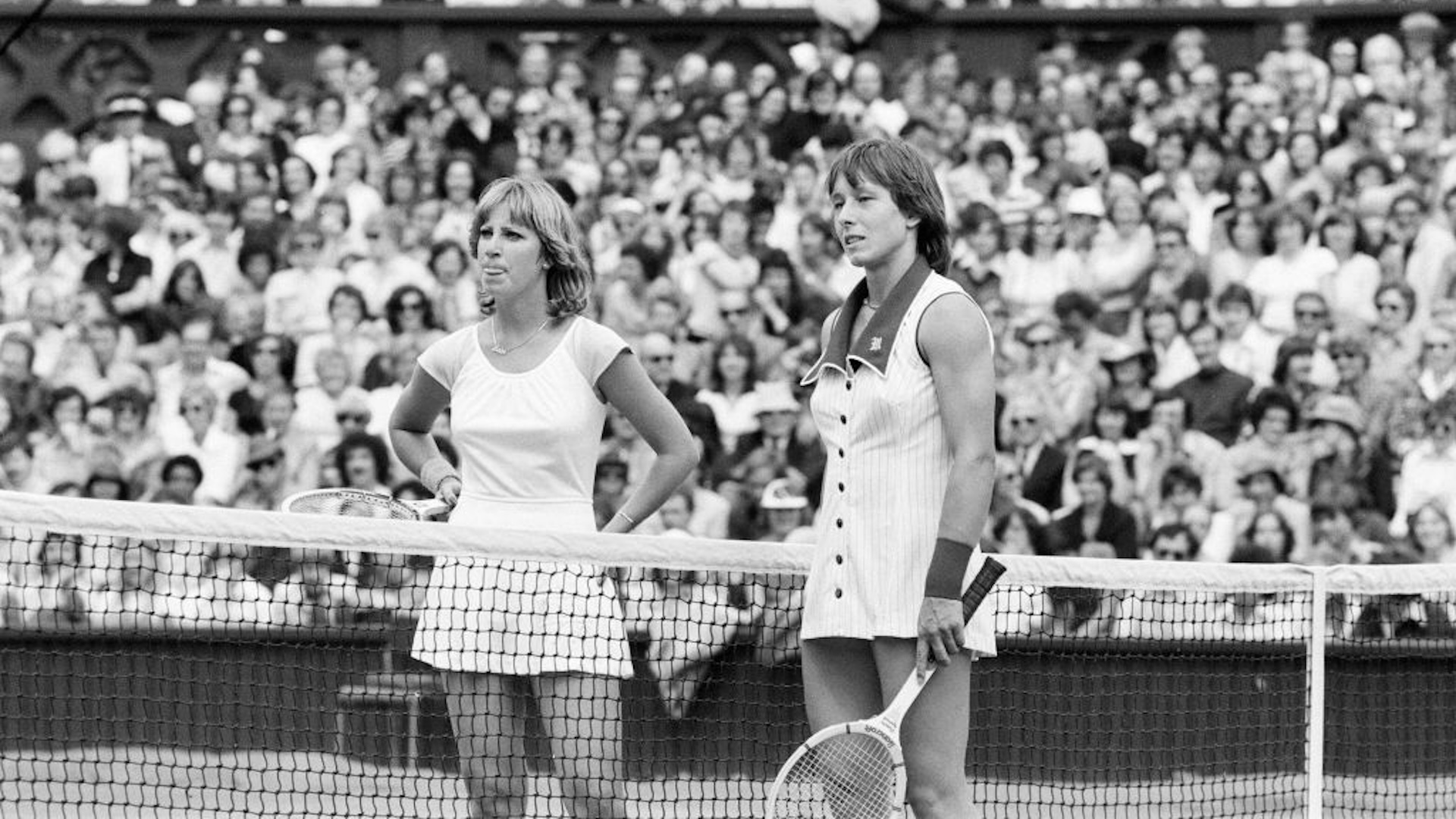
There's a bit of symmetry in the new Netflix documentary The Final Set, a chronicle of the epic, tumultuous rivalry and friendship between Martina Navratilova and Chris Evert. Long removed from their legendary careers, both women were diagnosed with cancer in recent years: ovarian for Evert, breast and throat for Navratilova. After beating back the disease, they each go in for a scan. Just before sliding into the tubular machine, Evert hesitates, then removes her cap for comfort, revealing her chemo-bald head. Navratilova follows the exact same instinct at her appointment, taking off her shoes at the last second. In both cases, the discarded article of clothing lay nearest their greatest on-court asset, as portrayed in the doc. Evert is praised for her unwaveringly calm mindset; Navratilova, for her indefatigable legs. The Hall of Famers ended their careers in a deadlock at 18 major titles. Their friendship has survived major finals, sabotage, and now bouts with cancer. When both scans come up clean, this staunch atheist's mind admitted the words "bound souls."
The Final Set, directed by Rebecca Gitlitz, is the latest in a growing line of Netflix tennis documentaries. You had the discontinued Break Point, a messy Carlos Alcaraz in My Way, and last month, Rafa, a revealing look at Rafael Nadal's physical and mental trauma. There's reason to think this new entry into the online streaming canon is the best yet. Navratilova and Evert's narrative is better and more complex—they played 80 damn times, 60 of those in finals—with higher stakes than Alcaraz trying to navigate burnout or even Nadal breaking his body to prolong his career.
Eighty matches! Evert favored a baseline-heavy style, with creative passing shots to defuse her rival's net-rushing and skillful, dipping volleys, though both dipped into the other's bag plenty in search of successful adjustments. Navratilova edged the head-to-head 43-37, a narrow margin that disguises a number of fascinating twists. Evert was first to hit her prime and ran out to 20-5 and 30-18 leads in the rivalry. The friendship flourished during these Evertian summers, generating shared practice sessions and even a doubles partnership. In a moment of frankness, Chris admits it was easy to maintain a relationship during these years because she was better; Martina's observation that Evert "was only really close friends with players who could never beat her" has some bite. Once Navratilova began turning the tide, Evert broke off their occasional doubles partnerships.
Navratilova eventually caught the eye of famed basketball player Nancy Lieberman, who insisted that Navratilova wasn't in sufficient shape to excel. Over the following years, Martina stuck to a grueling training regimen through which she became the first tennis player to sweat her way to every possible physical advantage. Perhaps equally as importantly, she and Lieberman struck up a relationship (the latter was in the closet at the time, so they didn't disclose it publicly to the press corps, some of whom were extremely weird about homosexuality). Evert was the one to create distance between herself and Navratilova, but with Lieberman's encouragement, Martina was the one to widen the gap into an Arctic crevasse. The rivalry grew acrimonious to the point of silence when they shared locker rooms.
For Navratilova, hatred-as-motivation worked perhaps a little too well. She became virtually unbeatable. Beginning in 1982, she won 13 matches in a row against Evert, including four major finals, not stopping until she led the head-to-head 31-30. She lost one singles match in 1983. According to the statistics website Tennis Abstract, from 1982 to 1986, Navratilova won 436 matches and lost 15, lifting 71 singles titles. She simultaneously constructed a legendary doubles career, and was a popular candidate for the best player ever before the advents of Steffi Graf and Serena Williams. But the way Navratilova talks about this period is not without regret, because it came at the cost of her friendship with Evert.
The doc effectively mixes in archival footage to situate us in the moment. We see how each player was covered—Evert, the conventionally attractive, charming American, was the darling of the press; Navratilova, the gay, sardonic defector from communist Czechoslovakia, was feasted upon. A writer for the New York Daily News outed Navratilova against her will. There's a level of openness threaded through old interview segments that's bracing, refreshing, and completely foreign to the modern tour. Evert gets specific about how much money she makes, from both tennis and endorsements. Asked if she is a better player than Evert, Navratilova casually volleys back an "I think so," and later suggests Evert is jealous. Viewing from 2026—in which press conferences embrace etiquette above all else and post-final speeches are dedicated exclusively to thanking as many people as possible, regardless of what kind of match preceded them—each piece of bitter frankness from Navratilova and Evert feels like a sacred text. The how and why of their eventual reconciliation is only fuzzily explained in this documentary, but that it happened at all is remarkable. You still get the sense that Nadal and Roger Federer would rather go fishing or skiing than do much of anything with Novak Djokovic. And that they'd rather brain themselves with rackets than risk complicating their images by honestly telling an audience of millions why.
The Evert-Navratilova story is so irresistible that it's hard to appraise this documentary for its artistry. Still, one particular omission is impossible to ignore. Navratilova spent much of her career advocating for gay and liberal causes, and the documentary touches on her outspokenness. But in recent years, she's taken up the cause of transphobia. The Final Set completely ignores this. The irony that many of Navratilova’s comments, like when pushing for the Australian Open's Margaret Court Arena to be renamed, could now apply to her goes unexplored, as do the feelings of trans people who have had to watch a liberal icon turn on them. (Evert echoes Martina's talking points, for what it's worth.) I wondered here if a longer, episodic format, might have provided the filmmakers more opportunity to explore Martina staining her legacy as an activist than the existing movie-like 99-minute runtime. Then again, maybe time and space weren't the problem. Sally Jenkins, an executive producer and a talking head on the doc, wrote a widely read and well-received Washington Post story about Navratilova and Evert in 2023—in many ways a more detailed, textured version of the documentary; here’s where you can get the correct account of their reconciliation—that didn't mention Navratilova's transphobia either.
The Final Set is content to leave us with vulnerable, wise portraits of its protagonists. Their approaches to cancer are inextricable from the ways they tried to solve each other on the court; rather than unravel, the specter of fear and death clarifies their thoughts and lives. In interwoven scenes, one doctor presses hard on Evert's stomach and another inserts a frighteningly long camera up one of Navratilova's nostrils, a horror-movie version of a doctor's office COVID test. They express pain, process it with seeming immediateness, then let the doctors get on with their work.
The documentary fades out as the friends and rivals walk out of frame, cancer seemingly behind them. But reality rarely ends as neatly as a film. Last week, Evert posted that her ovarian cancer was back for a third time, requiring surgery and more chemotherapy. That means more uncertainty, more suffering, more letting go. Her greatest on-court rival figures to be her fiercest supporter, once again.


![USA's Ben Shelton celebrates his win against Spain's Carlos Alcaraz during the men's singles quarter-final tennis match on day ten of the US Open tennis tournament at the USTA Billie Jean King National Tennis Center in New York City on September 9, 2026. (Photo by Leonardo MUNOZ / AFP) / “The erroneous mention[s] appearing in the metadata of this photo by Leonardo MUNOZ has been modified in AFP systems in the following manner: [USA's Ben Shelton] instead of [Spain's Carlos Alcaraz]. Please immediately remove the erroneous mention[s] from all your online services and delete it (them) from your servers. If you have been authorized by AFP to distribute it (them) to third parties, please ensure that the same actions are carried out by them. Failure to promptly comply with these instructions will entail liability on your part for any continued or post notification usage. Therefore we thank you very much for all your attention and prompt action. We are sorry for the inconvenience this notification may cause and remain at your disposal for any further information you may require.”](https://lede-admin.defector.com/wp-content/uploads/sites/28/2026/09/GettyImages-2293730421.jpg?resize=2880%2C1920)