


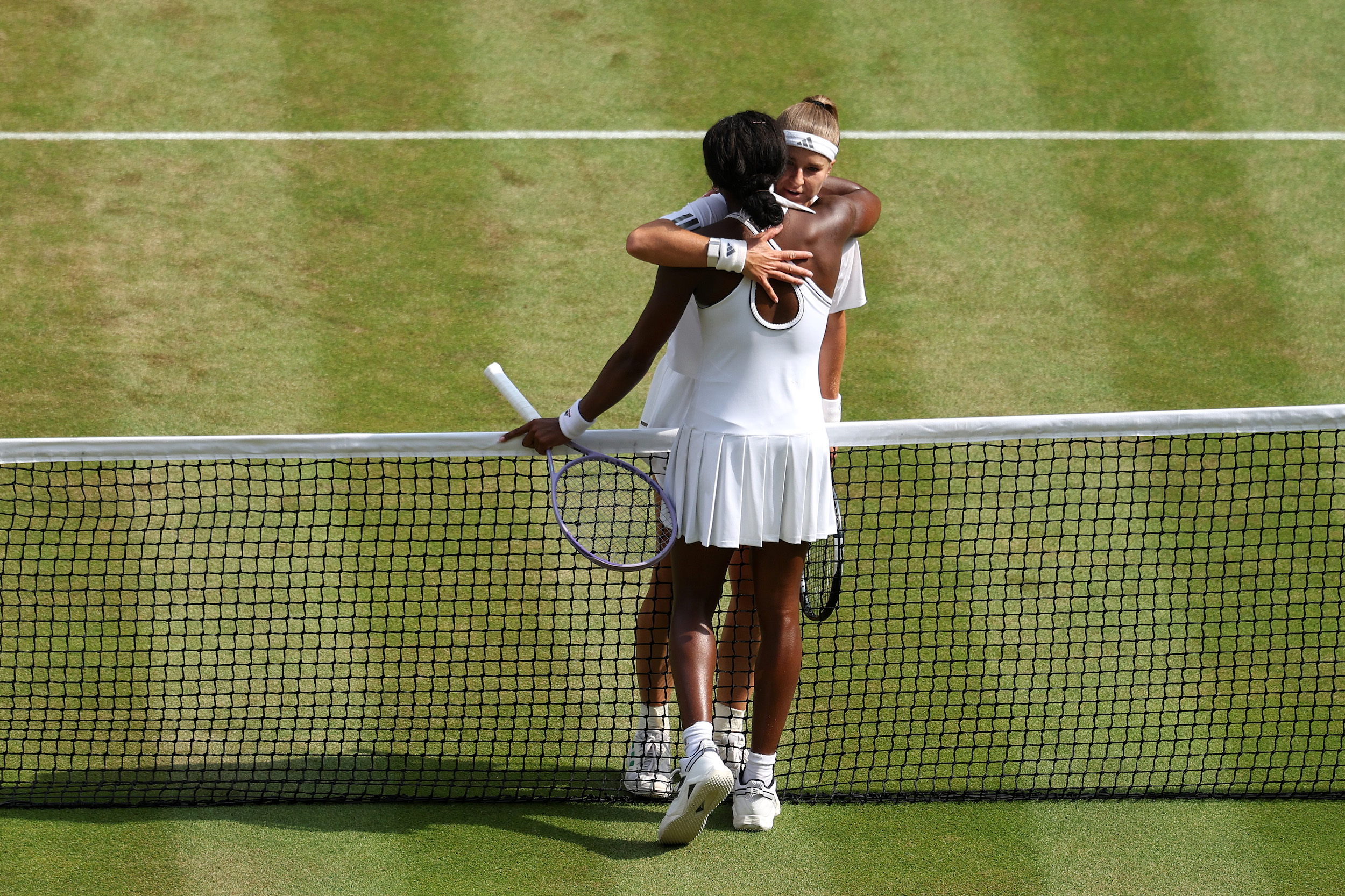
Nervy tennis is so rich. It can contain both the worst of the sport (in a technical sense) and the best of it (in a narrative sense). You can witness breakdowns in routine strokes, diseased shot selection, and facial expressions that indicate a horrible geyser of bile into the esophagus. But you'll also see the bravery of a player who is flagging, hurting, and still playing gorgeous tennis from a land beyond conscious thought. Rarely will there be tennis nervier than the third-set tiebreak that decided Thursday's Wimbledon semifinal between Coco Gauff and Karolina Muchova, and would have advanced either player into her first final at the tournament.
The two women had traded the first two sets, each won with roughly equivalent ease, and danced cagily all the way to 6-6 in the third. Between points, Muchova clutched at her right side with a wince; in press afterward she diagnosed it as a stitch, said she "couldn't catch a breath," and was trying to massage it away. Despite coming out flat, Gauff elbowed her way back into the match with her usual stamina, opportunism, and guile; she looked fresher going into the deciding frame. They proceeded to play 22 points so entertaining, with career-defining chances earned and squandered by both players, that I had to run back the tiebreak as soon as it ended in Muchova's favor. Why not do it together?
0-0: Muchova squeezes in a second serve, and Gauff shanks a forehand return into the sky. Whether or not the 22-year-old can stay in this (or any close) match depends in large part on whether she can tame her cranky forehand under pressure. It's probably the least reliable groundstroke belonging to an elite player on tour.
1-0: Muchova, who always flows forward in the court when she can, sends an approach shot into Gauff's forehand, a stress test aimed at her foe's weakest point, then moves to cover the middle of the net. That leaves open a down-the-line passing shot, with Gauff executes with surprising aplomb, dipping it inside the service line, so it would've been hard to pick up even if Muchova had covered the sideline instead. This is the stage of the match where both parties know each other's flaws, and know that they know them, so it all comes down to execution.
1-1: Gauff comes to net. Muchova—who mystifyingly lost the ability to hit a passing shot for the past hour of the match, allowing Coco to feast at net in that span—finally dips a crosscourt backhand that Gauff gets a racket on but can't handle.
2-1: On paper, what happens next is a Muchova serve-and-volley; in practice, it's a vision of the divine. Trapped at the service line, the 29-year-old sticks an astonishing ankle-height forehand volley that nicks the sideline. Best hands on the planet? Nobody but her or Carlos Alcaraz would attempt and make that shot at this juncture of a match. I could watch it a thousand times. When people talk about the beautiful tennis she plays, they are referring to these revelatory moments.
3-1: Unreturned Muchova serve down the T. From the player's box, her coach Sven Groeneveld does a loosey-goosey dance, swaying his arms side to side, encouraging his charge to keep her arms relaxed even as she struggles with pain and sucks in breaths between points.
4-1: High-quality 15-ball rally, brought to an end when Muchova carves out a backhand dropper. Gauff, who beats anyone on tour in a foot race, tracks it down and send it back at an angle so good that Muchova can't manage to deflect it into a court left entirely open.
4-2: Muchova badly misses a backhand return. It's her weaker groundstroke, and Gauff is smart to target it on serve, but this miss screams tension in the arms, despite her coach's recent dancing efforts.
4-3: Muchova moving forward again, and dancing once again. A lunge into a diving forehand volley, full extension of the arm with clean contact, for a winner. She even has the clarity of mind, in the fraction of a second after she's hit the shot and before she's landed on court, to fling away her racket so she can catch herself with both hands and avoid injury. Too smooth.
5-3: Muchova ace. Everything about her facial expression and body language looks belabored, but the scoreboard tells a different story.
6-3: Muchova comes in again, sending an approach shot to the Gauff forehand. It's a decently deep ball, but in truth this is another stress test, this time under higher scoreboard pressure. Once again, Coco pulls off the crosscourt pass, the best one she's hit all match. It's as though she stowed away an underground cache of good forehands, and now she's cracking it open and enjoying them in the key moments of this match.
6-4: Muchova hammers away at Gauff's forehand again and again, with good depth, but trademark indefatigable defense allows Gauff to escape near-certain doom. This is why Coco Gauff is my favorite tennis player whose tennis I don't actually enjoy watching. It's the marvel of her poise under duress, and the way she's built the whole infrastructure of her game around glaring technical deficiencies but still locked up a Hall of Fame career by age 22 by doing literally everything else at a near-perfect level.
6-5: A trade of neutral balls, until Muchova sees an opportunity. Gauff has ceded enough space for Muchova to go for the kill with an inside-out forehand, and she does—but clips the tape and the ball dribbles off it to land just wide of the sideline. Three points in a row for Gauff to get back on serve.
6-6: A decisive serve-plus-forehand from Muchova. Routine points in this tiebreak are rare. It's almost a relief after the nonstop stress.
7-6: Gauff lolls in a spinny second serve, and Muchova tries to load up on her forehand but shanks it. This is a ball she'd have struck for a winner if she had seen it 90 minutes ago. Nerves overcome her once again.
7-7: Gauff largely conquered the double-fault demons, which plagued her for years, but it also felt inevitable that they'd recur in a moment this pressurized. And they did.
8-7: Muchova, in total control of the rally, sends a forehand down the center of the court a foot long.
8-8: Muchova accepts a time violation so that she has more time to catch her breath before this extremely consequential first serve. She misses it anyway. On the second serve, she catches her toss. Anxiety is palpable. Then, once the point starts, she misfires a backhand way past the baseline and puts her hands on her hips. First match point for Gauff.
8-9: Gauff sends a big first serve down the T that sends Muchova scrambling. As Gauff moves up to the service line, getting ready to dispose of an elementary short ball, I am already visualizing her walk onto the court for Saturday's final. And yet: She goes for a too-cute forehand dropper that farts off the net cord. These are the moments that haunt lesser minds for a lifetime. If Gauff didn't hadn't already constructed a career on being Built Different, I would be concerned for her welfare. But the match isn't over yet anyway.
9-9: Gauff comes to net with conviction but Muchova comes up with a two-shot pass, first low at Gauff's feet, then a soaring topspin lob. Improvised solutions are her thing. Match point to Muchova now.
10-9: Within a few seconds, Muchova experiences the full double-edged nature of tennis on a lawn. She plays platonic grass-court tennis, attacking into big spaces and fluently transitioning to net, where she sticks a volley, which Gauff can only scoop up over the center of the net. As the ball hangs in the air, this time I'm visualizing Muchova walking onto court for Saturday's final. And yet: Muchova moves to volley but loses her footing—the perils of grass-court tennis—and falls onto the court as the unthreatening ball sails past her and into the court. She smiles darkly.
10-10: Back on serve now. Muchova in control, spreading the ball from corner to corner, lines up another match point to compensate for her last error.
11-10: Just like the last rally, Muchova is dancing around her inside-out forehand, putting the ball wherever she pleases until she sees a sideline so open that even Gauff's speed can't close it down. Here, Muchova redirects a cool backhand down the line to win 6-2, 1-6, 7-6(10), entering the Wimbledon final on a 10-match win streak on grass.
Both players could have left this semifinal with pride and enormous regret; Muchova managed to banish the latter. In her post-match press conference, Gauff said that she was caught off guard by the height of the short ball on match point, which landed in a "tricky place." If she had to do it again, she might've chosen a forehand slice down the line rather than the drop shot that failed to cross the net. "At the end of the day, that's the choice I made. Was it the right one in that moment? Maybe not. But then also, if I make it, everyone's going to say how clutch of a shot that was," she said, correctly. "I think that's just tennis. You lose some points off margin."
In Muchova's press conference, she acknowledged the roiling emotions of the tiebreak. "One point I felt good, I hit a nice winner, and then I did a terrible mistake," she said in her press conference, and explained how she coached herself through the final stretch knowing that Gauff's defense would extend every rally one ball longer than expected. "I was telling myself if I'm going to lose this, I want to lose on my own terms. My terms is going forward, playing aggressive, going to the net." That she did, and it was as fine an ending to a tennis match as you'll ever see.


![USA's Ben Shelton celebrates his win against Spain's Carlos Alcaraz during the men's singles quarter-final tennis match on day ten of the US Open tennis tournament at the USTA Billie Jean King National Tennis Center in New York City on September 9, 2026. (Photo by Leonardo MUNOZ / AFP) / “The erroneous mention[s] appearing in the metadata of this photo by Leonardo MUNOZ has been modified in AFP systems in the following manner: [USA's Ben Shelton] instead of [Spain's Carlos Alcaraz]. Please immediately remove the erroneous mention[s] from all your online services and delete it (them) from your servers. If you have been authorized by AFP to distribute it (them) to third parties, please ensure that the same actions are carried out by them. Failure to promptly comply with these instructions will entail liability on your part for any continued or post notification usage. Therefore we thank you very much for all your attention and prompt action. We are sorry for the inconvenience this notification may cause and remain at your disposal for any further information you may require.”](https://lede-admin.defector.com/wp-content/uploads/sites/28/2026/09/GettyImages-2293730421.jpg?resize=2880%2C1920)