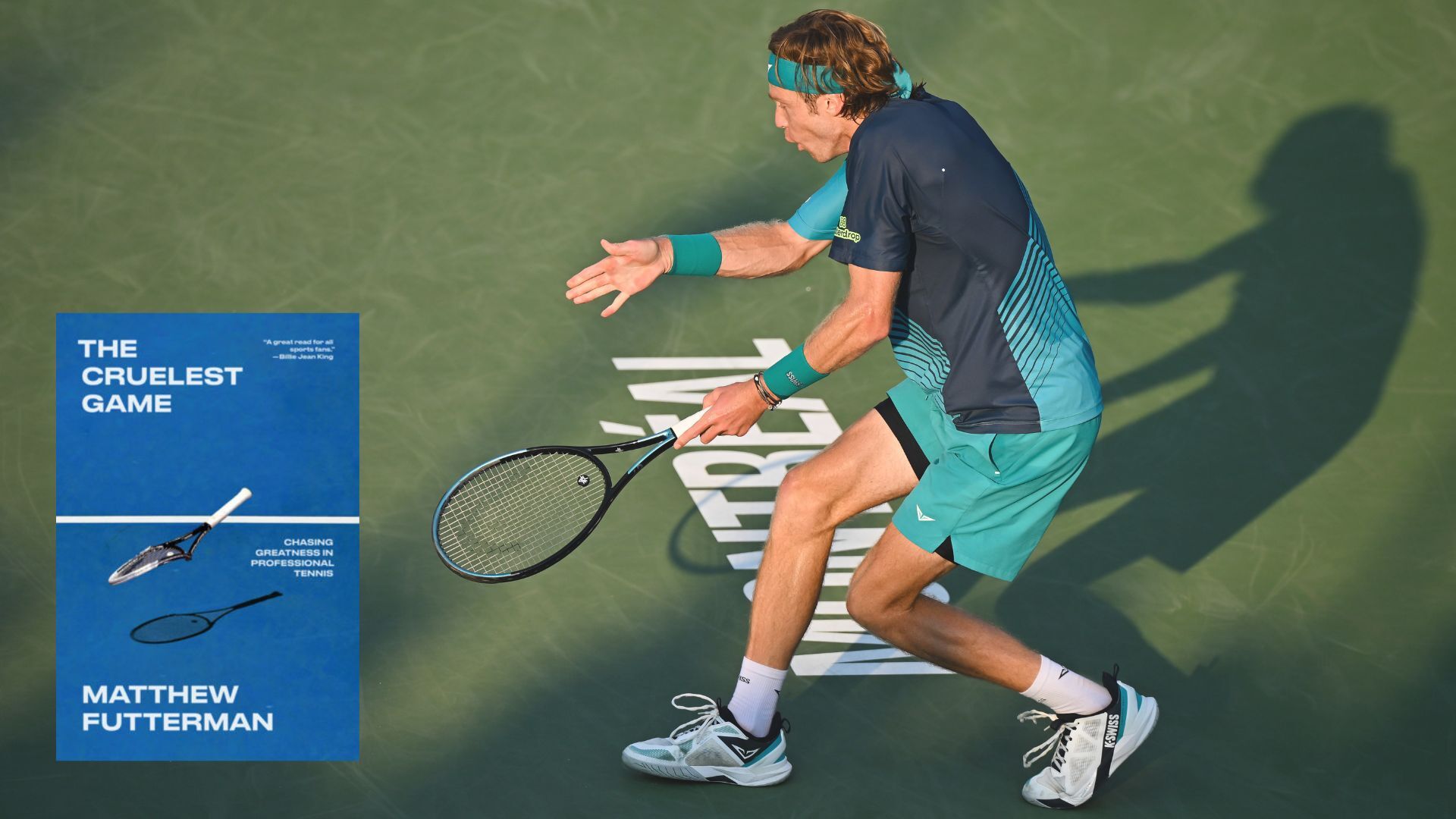
Professional tennis has a way of breeding misery. It begins with the dream of reaching the No. 1 ranking, but almost everybody falls short. Those who find the promised land feel puzzlingly empty once there. Familial and coaching roles blur. Prodigious children bear the responsibility of feeding and enriching their families. The mechanism through which matches are decided is a torturous maze disguised as a scoring system. Tune in and you may see grown adults reaming out their support staff, family, the chair umpire, and themselves; tearful breakdowns mid-match; balls whacked out of the stadium, into the stands, or occasionally into a tournament employee's vital organ; rackets thrashed and mangled on the court.
It's that last image which resides on the cover of Matthew Futterman's new book The Cruelest Game: Chasing Greatness in Professional Tennis. With decades of covering professional sports behind him, Futterman wondered why tennis seemed uniquely taxing. It's a question with which he leads off the book: "Why does this game seemingly drive everyone mad?" By the end of its 329 pages, it seems generous to even call high-level tennis a game. Most games are fun. The current generation of top players and their families approach it more like life and death.
As the tennis press dwindles and players withdraw behind agents and personal YouTube channels, Futterman has pulled off a coup of access. He's able to ask the top players about their hunts—and the price of their lifelong chase. It can be a bleak scene. Zheng Qinwen tells Futterman about her father taking her on a long car ride, under the guise of her doing a tryout with a new coach, and leaving her behind. The coach had already agreed to take her on; Zheng was seven years old. Tommy Paul recalls seeing parents beat up their children after losses in juniors. Those without generational talent are miserable, forever pursuing the standard of the blessed. The chosen ones often find that standard but also spend a lot of their time being miserable. Oh, and having dedicated their lives to this sport, nobody knows who they are in its absence.
Last week, I spoke to Futterman about The Cruelest Game, the cost of playing tennis at a high level, and how players can make their way through it. Our conversation has been lightly edited for clarity.
How has the reception to the book been so far, and has anything about it surprised you?
I think the reception has been pretty great. It's been incredibly gratifying to hear people who really know a lot about tennis reach out to me and say how much they've enjoyed it, how much I got right. That's really something. It's a really engaged and informed conversation. It feels like it was the right book for me to write, and a book that comes at the right time, because a lot of the issues that I write about in the book seem very current with what's going on in professional tennis. That's been great.
In terms of what's surprised me—you write a 300-page book and you never know what little moments stick out to people, so it was very funny to see someone the other day took a photo of the page where I talk about Jannik Sinner not having a poker face and cheating at card games. That was doing the rounds in certain circles on the internet. It's always funny when that animal takes over.
You start the book by asking, "Why does this game seemingly drive everyone mad?" I'm curious how you arrived at that question.
The thing I was seeing mostly in real time, in my first years as a full-time tennis writer—I've been covering this sport for about 20 years, on and off—was Naomi Osaka's struggles. I was wondering how long she was going to last. She seemed the most likely candidate to be the next burnout victim. She seemed to really be struggling with so many facets of her job. Doing many of them seamlessly, but the attention part of it was really difficult for her, and she has obviously spoken very eloquently about what she has struggled with many times. Then Ash Barty quit in 2022—all of a sudden, No. 1, 25 years old. The parallel between that and Björn Borg, who quit when he was No. 2 in the world and the same age, was incredibly striking. I started to look at it, and think about things, and look up people's ages. Having covered so many other sports, it seemed to me the thing that set tennis apart. In other sports you just don't have people walking away when they're at the top, in the prime of their careers. The question became, Well, why does this happen? Why is this happening over and over again in this sport? And why do we just accept it? Because it's not normal. We sort of talk about it and think about it like it's normal, but it's not.
So that became one of the early driving forces to get at that question. But the flip side of that is, What does it take to survive it, and what does it take to thrive at it? And the people who do, what do they know that everyone else is trying to find out? The main dynamic was the great players leaving the stage, and the younger players scrambling to both replace them and figure out what their secrets were.
I found myself thinking about the title after finishing the book. This certainly is a cruel sport, but it doesn't even feel like a game. Games are supposed to be fun, and these players are treating tennis like life and death.
That's sort of the juxtaposition of it. It is a game, it's a game that people play, but it's also a job, it's also a profession. And it's really hard. The book was getting to the core of what makes it so hard, and treating these players with the most dignity possible. These people are professionals at the top of their industry, and they're so young, so you get to thinking that they're girls and boys at play, but really they're women and men at work. They've been working at these jobs, often, since they were six or eight years old. That's pretty intense.
Something that really struck me while reading was how little control these people sometimes have in their stories, principally because they're starting so young. Reading that Mirra Andreeva's mother fell for tennis while watching Marat Safin, I was like, Jeez, Mirra's temper never had a chance. It seems like these players don't have a ton of agency in going down this path in the first place.
Yeah, many of them don't. Yes, they all have the agency of walking off the court, putting down the racket, and refusing to play, but it becomes so clear to them, at such a young age, that the best way to receive love and care and support and happiness from their parents is to play the game and play the game well. So of course they're gonna keep playing; that's the message they're receiving.
And that's not something I make up—it's something Andre Agassi tells me while we're sitting in an SUV, stuck in rush hour coming back from the U.S. Open one day. He's talking about what he has seen, and the messages that parents inadvertently deliver. Even the best ones who are supportive and take their kids out for ice cream after they lose, and pat them on the back. But then they celebrate really hard when the kid wins. The message becomes: That is equated with this. And if I don't produce this, I don't get that. You do have a choice, but your choice is based on the data and information in front of you. Part of that is what your parents are giving back to you in that feedback loop.
You're reminding me of a bit in [Agassi's memoir] Open, where Agassi as a kid gets a sportsmanship award in a junior tournament, and they present him with this beautiful trophy. And he's riding back with his dad, who is just silent. Agassi says, "I don't want this thing," and they end up throwing it out. You get the sense that he says that for the benefit of his dad, because his dad wants him to be the best.
There's a lot of painful parts of Open, but for me the most painful part is when he wins an early professional tournament and there's a $1,500 prize. He's still an amateur. He calls his father—he's 15 years old, or something—and says, "What do I do?" And his father says, "Well, you take the money! You actually can't do anything else. This is all that you do. This is who you are." Imagine being told at 15 years old: You're only capable of doing one thing. You're not capable of going to school and college and becoming a senator or a writer or an accountant, or anything! This is it! This is all you've been practicing for. Take the money! This is the rest of your life.
The goal for everybody is: Win a major or become No. 1. Very few people get to do that. You have all these prodigies, and from a very young age, they're told, You're gonna win a major, you're gonna be No. 1. Then they advance almost to the point of doing it, and some of them realize, Oh, I might not actually have enough talent to do this, even if I do figure out all the secret codes. It makes me think that something has gone very wrong with that being the goal for everybody. It's too hard. Not everybody gets to do it.
It's funny, everybody tells you that's their goal. Maybe a lot of them are secretly just fine with being 35th or 55th in the world. It's better than putting on a suit and tie and going to an office every day. But I don't think anyone embarks on a professional tennis career to be 35th in the world. If you're 35th in the world, you're pretty much losing in the third round of a Grand Slam. You're not advancing very late in tournaments, and you're not really looked at as a winner.
It's hard. You should be able to feel pretty good about yourself if you're better at your job than all but 34 people on the planet. But that's not the way the sport works. I think it can be hard for people who are 11th or 12th in the world to feel good about themselves. I know it is, because [in The Cruelest Game] we've heard Taylor Fritz say, If I don't win a Grand Slam, nothing I've done will really be worth shit in a lot of people's eyes. That's a pretty harsh thing. Unfortunately, that's the way the dynamics of the sports atmosphere—certainly in this country—are set up right now.
That's why I think Alex Eala is at such an advantage at the moment. Everything she does at this point is gravy, because the Philippines have never had a tennis star before. Even being 19, 18, in the rankings, she's wildly popular in a massive country and will collect millions and millions in off-court income because of that. She'd be in the same position had she hovered around 40 [in the rankings], because that's what happens when you come from a non-traditional tennis country. Ask Kei Nishikori, who made huge amounts of money throughout his career. Never won a Grand Slam, but he was the best thing Japan ever produced before Osaka. It's a different equation depending on which country you come from, but for a lot of people, it can be really hard if you don't get to No. 1 or win a Grand Slam. All these players are so great. They all, for the most part, looked really, really good when they were younger. But most of them were told they were destined for greatness from a very young age and throughout their childhood.
Fritz is a guy who sometimes I want to shake a little and say: I fully understand you've gotten close, so you feel like you have to do it, but it's not your fault! You were not born with the body that is able to cover the court the way you have to. And Alex de Minaur, you were not born with a Joao Fonseca forehand. Instead they feel like they're failures when, in a healthier atmosphere, they'd be seen as incredible maximizers of the tools they were given.
I think there's plenty of moments when they do feel really good about themselves. It's just that in their most public moments, which for the most part take place when they're alone, in the sun, on a really hot court, under the biggest spotlights, late in the rounds of important tournaments, they don't feel good about themselves. At least, not so far. And that's really hard.
In this book, you go a lot into the team members, who are getting fired all the time, who are not always tennis people. Some cross every boundary available, and others, like Shadi Soleymani, Amanda Anisimova's physio, stresses to you, "I'm not her friend." What about tennis makes it so ripe for all the boundary-crossing, whether it's a parent or a psychologist or a coach?
First of all, there's a history of it. Chris Evert's dad was her coach. Serena and Venus [Williams]'s dad was their coach for a long time. Coco [Gauff]'s dad raised her as a tennis player. If you have the right athletic specimen as a child, there is clearly a lot of success you can achieve by studying and watching videos. So much of success is down to the player. Coaching can have some impact, but ultimately it's the player figuring it out. But there is no certification process, really. You don't really have to pass any tests to be a tour coach. You've gotta get clearance with safeguarding and stuff like that, but there's no hierarchical structure the way there is in the NFL, where there are big teams owned by billionaires and front offices, who are managed by people who have been working in and studying the NFL for years.
In tennis, it's just whoever makes a player feel like they're gonna reach their potential in that moment. That definition can change. It's different for many players. By and large, I would say it's really unhealthy to have a partner as a coach. But it sure works for Madison Keys at the moment. She explains in the book exactly why it works: All these other coaches didn't make her feel like there were no consequences if she lost, that their approval and support and love was not on the line. And [her husband] Bjorn Fratangelo makes it feel that way, makes her feel safe to just go for it.
Reading that chapter especially made me wonder if it's easiest to be happy as a professional tennis player if you're operating from a bit of a remove, if you give yourself permission to fail. I think most would regard Gael Monfils as an underachiever relative to his talents, but you watch him out there, and he's having a great time. Andrey Rublev is falling to his knees against Jerry Shang after missing a match point. It does seem like you either need to give yourself permission to fail or, as you write, "care a lot but also not really care at all."
If there is a set of codes that are important, certainly at or near the top is: Separate your results from your identity. Very quickly after that has to be moving on to the next point, the next match, the next tournament … as quickly as you can. That seems to be something that the great ones do so incredibly well. They all have different techniques for getting over it and settling themselves back to this moment—not the one that just happened, not the one that's coming up, but this moment—even if it's just: What does it feel like to breathe right now while I'm sitting here on a changeover? What does it feel like to have a cold drink while I'm waiting to get back on the court? Really get back to, in a somatic sense, the feel of right now. Something tells me Andrey Rublev is not that great at that.
Do the players talk to each other about how miserable they are?
Sure! Listen to The Player's Box. They have plenty of complaints about it. It varies. I don't know how many heart-to-hearts Stefanos Tsitsipas is having with Sascha Zverev at the Monte-Carlo Country Club these days, but in some ways, they're all employees at a slightly dysfunctional company. They've got a fair amount of free time waiting for matches, hanging around practice courts, in the locker room. What do employees in any walk of life do when they've got free time? Complain about the boss, or complain about so-and-so who got a raise, or make fun of this guy who got a Lululemon deal, who's ranked 32nd, instead of me, and I'm fourth in the world. It comes out in different ways at different times, and sometimes there are those heart-to-hearts.
Especially on the women's side, I would say, there are some players who are very close with each other. At the same time, I do think the women's tour is a more lonely existence in terms of camaraderie than the men's tour. I mention this in the book. Female players have told me this—a female player passes another female player in the hallway, and often they don't say hello. Whereas men seem to be grabbing food with each other. They spend most of their time, especially at the top, with their teams. There's no question about that. But Tommy Paul had a lot of tennis-player friends at his wedding. Those are some of his closest friends.
Zheng Qinwen makes a point of not making friends on tour, but after reading about what her dad did to her when she was seven, you hope she talks to some people about that.
Yes, and I think she is. I know she is. She's had amazing success, had this injury, and hopefully she can climb back. It's amazing, given what she went through, that she is as bright a light as she is. I think that experience of being abandoned like that, at that age, I would have to think that's gonna crush a lot of people.
After finishing the book, I did get a little existential: Is pro tennis a net negative for almost everybody? I saw you say in another interview that you're not really sure what could change because you have to start young to be able to compete, but is there anything that can be done to change this?
I think there's very little top-down things that can be done. The only things that will work is if you start seeing people have success who didn't follow the tried-and-true path of online school, academies, pro at 15, and have experiences of playing, at least through middle school, lots of different sports. But until something like that happens, I don't know that there's going to be much change. The data that parents receive is that this is the life kids have to follow in order to get to the top of the top. It would be great if Michael Zheng starts winning Grand Slams after four years at Columbia. I think Michael would be the first one to tell you, I think that's gonna take some time, and we'll have to see.
Like you write, Alcaraz has hit, what, multiple million more forehands than Ben Shelton, just because of when they started.
I did some quick back-of-the-napkin calculations [laughs]. Alcaraz started incredibly young; grandfather owned a tennis club. Shelton had his own advantages—both had fathers who were professional tennis players, and Shelton's dad was a coach—but he liked to play football. In my life, I have never seen an athlete like Ben Shelton on a tennis court. Maybe he's the answer to the question of What if Steph Curry chose tennis instead of basketball? Every tennis fan in America has imagined that [while] watching other sports, because we're such a big country and the athletic talent in other sports is so ridiculous. That's why I find Shelton completely fascinating. You have everything—great genes, unbelievable athletic skills and talent, can basically play any sport. The only issue is that he didn't really get serious about tennis until he was 13 or 14.
I'm watching him against Jenson Brooksby the other day, and he's coming to net off a couple of those down-the-line forehands that curl right toward the middle of the court. Alcaraz is never, ever gonna do that.
Or maybe he'll do it once and then fix it, or figure out something else to do.
Or hit the half-volley off the amazing passing shot anyway.
Yeah. Ben hits some outrageously good shots, and makes a lot of people gasp plenty. But it's just a matter of how much magic does he have in his hands right now, and how much can be injected into him through practice and training and experience over the next few years.
What do you want to say about the book that I didn't give you the chance to talk about?
What my hopes for the book are, and what success looks like to me. I've thought about this a lot, because I write so much about players struggling with results and identity, and them judging their success on numbers. That bleeds into the life of a writer, especially these days, when it can come down to things like pageviews and minutes of engagement and book sales. I try really hard in all my writing to write not just about the sport but also about the human experience. In a lot of ways, what I'm trying to focus on is the idea that if one person, one young tennis player, reads this book, is helped by it and feels a little less lonely, all the work was worthwhile.