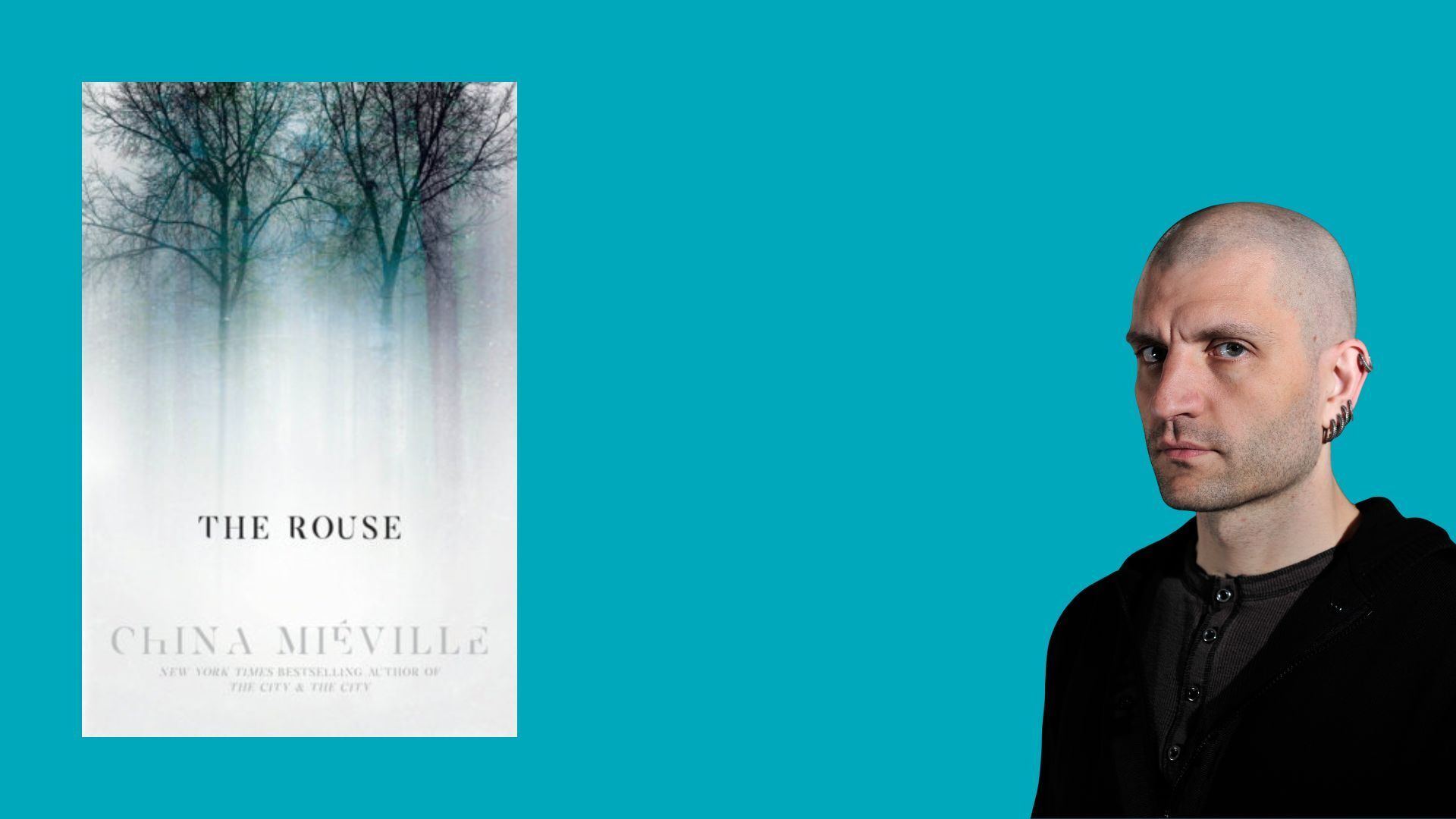
It takes an open mind to engage with China Miéville’s work. A writer for whom the already cliched phrase “genre-bending” is even more banal, Miéville has never opposed the designation of genre writer. As much influenced by Oliver Onions, Ursula K. LeGuin, and Karl Marx, Miéville’s writing incorporates all manner of historical and linguistic snags, at once erudite and irreverent, challenging but inviting. A Miéville novel or story collection is like a rabbit hole, prompting the reader down stray paths of unexpected inquiry and discovery. It’s never a bad idea to read one of his novels with a dictionary nearby, not because his work is abstruse or opaque, but because, in order to fully step into the worlds Miéville creates, one has to learn a slightly new language. This is, in fact, a microcosm of the premise of his 2011 alien novel Embassytown.
Many readers are happy to put in the work. He has won the Hugo and World Fantasy Awards and reached the New York Times bestseller list, most recently with the excellent novel The Book of Elsewhere, co-written with Keanu Reeves. Scan through the timeline of his career and one will find all manner of surprises, from a children’s book to a contribution to the Pathfinder RPG to non-fiction, with a book of Marxist theory, a history of the Russian Revolution, a book about the Communist Manifesto, as well as Salvage, a bi-annual literary political journal co-founded by Miéville alongside other leftist writers like editor Rosie Warren and Richard Seymour.
Miéville’s political and historical forays, alongside his talents as a master of the strange and inexplicable, inform his new novel The Rouse, a 1,200-page epic that incorporates every rabbit hole he’s ever traveled down and then some. The Rouse follows a British woman named Maur from the 1970s into the present day. Maur is many things: a mother, an artist, an activist, a haunted fighter. After her only son’s inexplicable death while serving in the British army, Maur unwittingly stumbles down a dark, ancient path in order to find answers. Who was her son? What was he involved in? Why are there so many other parents of deceased soldiers in the exact same predicament as her? The Rouse untangles multiple narrative and historical strands, traveling from the early 20th century through the Cold War into the GWOT and finally present day. Shadowy government forces utilize covert, even supernatural tactics to fight anti-imperialist splinter cells. This is a world of black ops and shamans, where the revolutionary legacy of Patrice Lumumba intertwines with unfathomable eldritch horrors.
I was grateful to speak to Miéville over Zoom about the many ruptures of Western history, the uncanny violence of war, the boundaries and blurred edges of genre, and what it took for The Rouse to see the light of day. Our conversation has been edited for clarity and length.
How has it felt to have this guy [lifts The Rouse into frame] finally out in the world? I imagine you have to chip away at something on this scale beside everything else on your plate at any given time.
Today is publication day in the U.K. and it was a couple of days ago in the States, so it feels very much like two boots hitting the floor. The honest truth is that this book, more than any other I've ever done, does feel completely defining to me. It's been so long coming, and all these other projects that I was doing were very important and I took my time with them. But this book has been with me for 20 years, so I'm still very much feeling a sense of I don't quite know who I am anymore to be not working on it. That's exciting. That can be a sort of existential, discombobulating thing, but for me I'm genuinely excited to find out who I am now with regards to the work.
The Book of Elsewhere, as an example, was such an odd project in so many ways and I had such a lovely time with it, but the analogy I've used many times is “playing with someone else's toys.” But I was working on The Rouse the whole time, and Keanu was really generous about it because I was deep towards the end of a draft when he first spoke to me. I sort of said to him, “I can't do anything for the next six months because I have to finish this.” So it's funny for me to know that The Rouse accompanied all these other things that were coming out previously, do you know what I mean?
You’re keying off what I already wanted to ask you, which is how something like this book lives with, against, beside the other parts of your working life. But now I’m curious to hear how you arrived at a point where you felt it was done. Or, as done as it was ever going to be.
Yeah, that's a really good question, because a few years ago it felt like, Well, I'm just always going to be doing this. And almost without despair, almost a certain kind of resignation: This is the rest of my life, whatever else I'm doing, I'm going to be working on this and it will never be finished. There were various upheavals in my life, in the world, and reaching the last page, or I should say the first version of the last page, took at least 15 or 16 years. When that last full stop was written, that was the first point I felt—and I knew there was a ton of work to be done on it—but that was the first point at which I felt like, Oh, this actually could have an end. At that point I think the book was at least half as long again, and I knew that it was too long and it was a mess, but it was also full of the stuff that I needed it to be full of.
I've always been lucky with editors, but I had the greatest editorial experiences in my life with this book both here and in the States. My two editors Lewis Russell and Tricia Narwani just did the most extraordinary work on it. It was that initial belief that it was possible to finish, and then from there having other eyes on it for the first time in well over a decade and their suggestions, most of which I agreed with. But even where I didn't, you have to think about it in this external way. I was able to go into it with a slightly more calm, instrumental relationship to it. And even then there was still a good three, four, five years of work left. I would say, for about the last quarter of the writing of it—because it wasn't a question of starting it 20 years ago and putting it in the drawer, I was always working on it in the background—for the last quarter of that period, I believed it would end one day.
And this will sound like a line, but I promise you it's true: In those five years I became like, Don't die, not now. Look both ways before you cross the road. You know what I mean? One of the things about being my age is that you know people who've died. A good friend of mine died relatively young, and he had been working on his white whale for a very long time, and he died with it unfinished and he made his peace with it, but I found that really distressing. So I was kind of like, Look, you're allowed to be hit by a bus the day after you've handed it in, but not until then.
It’s interesting because The Rouse does feel monumental and it does feel, for those of us familiar with your work, like a culmination. It’s also so different from anything you’ve written before. I keep describing the first 100 or so pages to people as, unexpectedly, very moving realist fiction. I think for certain people who are going to find this novel in the genre sections of a bookstore, they’re going to be like, OK, but when does the weird stuff happen? But it’s truly cumulative. Which is to say, as a whole, there are parts in the novel you “don’t need” but later you understand that you actually do. If that makes any sense.
OK, so lots of things to say. First of all, if I may ask, have you actually read it to the end? This is not a trick question.
No, of course. I have read it to the end.
I'm very grateful to you for working through it. I think it's important for me to be clear that I really understand that if you write a novel of this length, you are asking quite a lot of people. I don't take that for granted, and I feel very grateful for people who are willing to make that effort. Compounding that, I'm also under no illusions about the fact that it is, in a lot of respects and in a lot of places, quite dense and quite difficult. The wager is that you can make that worth it.
Now I withdraw my question. It's not a fair question to ask you, it was because I was going to say spoilery things.
Oh, it’s totally fine. We can avoid them for the sake of readers of this interview.
Sure, OK. So I really like your formulation in various nested scare quotes like, “This isn't necessary,” and I think the thing about that is, well, once you reach a certain point of size … I didn't set out to write a really long book originally. This is partly a function of this particular book becoming freighted with a bunch of meaning that I didn't know that it was going to initially. And there was a certain point, I would say probably about a third of the way through the writing, where I realized, Oh, this is going to be big but also in the sense of like, This is going to be maximalist. I started becoming very interested again in the works of people like Pynchon and Marguerite Young and William H. Gass and books that lean into using length. You can do something with length that you can't do with a shorter book in precisely the same way as you can do something with terseness in a novella that you can't do with a longer book.
Once you get to a certain level—let's call it 200,000 words—the question of what's necessary becomes a completely different beast. I remember reading an interview with Lucy Ellmann where she was talking about doing the final edits on Ducks, Newburyport, which is a very long book. It's probably, I don't know, 350,000 words, maybe 330. She was talking about getting edits from the editor. When you're dealing with a 90,000-word novel, you have to be really, really cautious and rigorous because if you take out 5,000 words here, that really changes the whole feel of the book. When you're dealing with this size, it's like, Well, do you need these 10,000 words?
To say nothing of the concerns of punctuation in a book like Ducks, Newburyport, where it’s pretty much just one sentence.
There's a little homage to that book in The Rouse because I thought it was really powerful. But the thing about that is … how do I say this? You still have to justify everything that's in there, but you're doing it according to a different kind of calculus. I don't want this to sound defensive.
Not at all.
It becomes about, Are you doing something with this that you can't do in a shorter book? and obviously that doesn't mean that you always get it right. I don't mean that this is licensed to simply go on forever. I'm quite sure people will say, “Well, you know you could have done it…” But the aspiration is to do something where you're creating—to use Nabokov's phrase about Ulysses where the reader gets lost in the dream of the book—the book’s own dream.
This is an analogy that came up in another interview I did, and it's a slightly risky one because it can be deployed against me, but I don't know if you're a Tarkovsky person, whether you are a fan of Stalker?
Huge, huge fan.
Even people who admire Stalker will sometimes say it really pushes you with its length. It's not just long, but it has these longueurs and it becomes an exercise in a certain kind of frustration. The thing about Stalker, without spoilers for those who haven't seen it, is for example, there's one scene where one very small strange thing happens, which in another film, you wouldn’t really notice. But in this particular film, it becomes this shattering moment partly because the film has ruthlessly forced you to accommodate yourself to its own pace up until then and has pushed it to the point of frustration. It’s trying to find the point where it's always teetering on the edge of too-muchness.
I think what I wanted to do was try, as far as I could, to create a maximalism where you're not just making an encyclopedic novel that has everything in it, but to also make the failures as exciting as possible. That forces you to live within the book at the book's own pace, even pushing the point of frustration so that when that pace changes, you get an effect that you couldn't get in a shorter book.
There might be several chapters where you almost forget that this book has an end and you're living it as if you're watching a long-running soap opera that's been going for decades and decades. In a way, my dream reader is someone who reads, I don't know, 20 pages a day for several months and just kind of inhabits it. Then those very slow changes of pace or those very abrupt changes do something completely different than they would in a book that more clearly has a sort of beginning, middle, and an end. That is, of course, a high-risk strategy because it's very easy to get it wrong, and I do not doubt there will be readers for whom this doesn't succeed and I accept that, but that's the aspiration.
I think you have to allow yourself, as a reader, the opportunity to trust the author of a book this size. As you say, there are different considerations at a more protracted length, but that also offers different narrative rewards. Especially when one is parsing how Maur’s thread as a young woman then a mother dovetails with the counterinsurgency thread with the character Allardyce.
I’ll say, for my part, reading The Rouse felt a lot like when I first read Moby-Dick in that I got halfway through and then, for reasons that had nothing to do with disliking the book or losing interest in it, I just kept bouncing off of it. So I put it down and came back to it months later, always picking it up again here and there and always thinking about the book, and then, for similarly mysterious reasons, finally just devoured the second half.
I find it very moving to hear how you're describing it, and I know that that's not why you're saying it, but I do thank you for that. And the kind of bouncing-off thing, that doesn't horrify me, not least because many of the books that I adore the most I found very difficult, especially at first. For example, I love Gravity's Rainbow. It took me six goes, and every time I would get about 100 pages in and I would go, I think this is brilliant, but I just can't. It's just not the right time. Or like, I think this is brilliant but I've lost it. And I would try again and then I’d find the rhythm. Again, I think you would be disingenuous to write a book of this length with this kind of rhythm and language and not be aware that that might happen for some readers.
I love that you were still thinking about it in some way. Moby-Dick is an extremely flattering analogy but it's also exactly what you mean, to use your line of “Is it necessary?” The interweaving of the threads was very intricately and carefully done. In the initial draft, Maur and Allardyce were basically completely separate. They were basically two books sutured together. I knew they were going to be interwoven, but I had to figure out where to do it and how to do it. What took a lot of the time was altering the rhythm in the right way so that you're drifting in a certain kind of temporality and then being brought up short into a different temporality. The risks between what's actually happening in the juxtaposed chapters was carefully worked out and there was a lot of rejigging.
It's funny to me: I never know what is going to be sort of clear and obvious and what isn't. We can avoid spoilers here, but there’s a reveal we spoke of off the record and I do remember very clearly thinking, Don't proceed on the basis that this is going to be a revelation such that that will feel like what you were trying to do. But then some readers have been completely blindsided by that reveal to the extent that they've been really annoyed with reviews that give it away. And I'm pleased with that. Obviously it doesn't hurt if you don't know it’s coming. But I never know what is or is not necessarily going to be clear.
It's one of the reasons I don't tend to be a huge fan, either as a reader or a writer, of puzzle-box books whereby the point of the book is to figure something out. Even if I'm reading a whodunnit, I couldn't give a toss about the clues. I never sit there and try and work out who did it. The end when the detective says, It’s because this, that, and the other, I always enjoy as a kind of piece of prestidigitation, but I'm not that fussed about the logic.
There are certainly moments in which The Rouse is revealing something to the reader, but I didn't want it to feel like this book lives or dies on its reveals. It's intended to live or die on its rhythms and its affect—sorry to use the word—but that sense of hauntedness, that sense of what it is in you that you can't quite put into words.
And if I can just go back to something you said before.
Please do.
It was very important to me to have that initial introduction in which nothing ostensibly supernatural or strange happens and that it could work as a sort of standalone realist short novel.
There were two purposes, and one of them you actually adverted to and I cheerfully hold my hands up, which is: I like teasing my readers. Obviously you hope new readers will come, but for people who are not new, they know the kind of thing I write and they know the kind of thing they like. I quite liked the idea of people being like, Well, there's no monsters. What's happening? Have I missed something?
I love the supernatural, the weird and those things will always be tremendously important to me, but it was absolutely vital to me in this book, above all other books that I've done, that the realistic aspects—the life and death of real people unadorned by anything weird or uncanny, beyond the world that is outside of our windows—were their own ethical stakes. They do not derive their meaning from being adjuncts from these other things. I needed you to care about these people. I needed you to care about what happened and I needed them to earn their own stance as important ethical puncturing points irrespective of any monsters or aliens or ghosts or anything like that.
And then after having established that, if I've done my job right, that terrain is what operates in relation to the strange and as a sort of substrate of the strange. Rather than being merely an excuse to do these fantastic elements, which I love. This is not to disavow those elements, but it's to say I needed to honor the realism in this particular aspect.
In the grand scheme, that first chunk of the book with Maur does a lot. I was unsettled purely on the level of not understanding how it fit. But this is the privilege of this kind of book. You realize how far, or not, you're in and you're like, OK, well, something else is going to happen later. Frankly, if the whole novel was like the first 100 pages, I would have been fine with it because I think that first part is so beautifully written.
But rupture is something I wanted to ask you about, because it’s so key to The Rouse. Rupture on the familial level but also historically, structurally. There’s a really provocative idea in the novel that there's a certain point in history after which nothing is the same.
It's interesting you talk about rupture, because rupture is a concept that has become increasingly important to me in my non-fiction as well as my fiction. Over the last six years, in particular. I became really fascinated with the philosophy of rupture both at an individual level and a society level.
For me, this book is very much about epochal shift, which is another way of saying rupture in a sense. The Rouse took so long that I was writing it over what to me code as more than one epochal shift in the world and I tried to mark some of that sense of rupture in the form as well as in the content, which then creates this rather dizzying feedback loop and mise en abyme when you're working on it.
I need to do the obligatory and sincere disavowal of autobiography here. There are clearly elements in which I drew from my own childhood and youth in the depiction of these characters, but anyone who knew me as a kid, anyone who knew my mother will know that Maur is not my mother, Maur’s son Ewan is not me. Now, that said, it is true that the northwest-London-growing-up-single-parent-child-in-the-early-’70s is all from me. I was born in ’72. Everyone thinks their own period was the most important one in world history, but what I will say is that some of us are correct. In the sense that a lot of people who are 20–30 years older than me who were around at the time talk about something abruptly shifting in the early ’70s. It was a moment of epochal rupture. Delia Derbyshire, the wonderful avant-garde musician who was in her late twenties at the time, said that the world “fell out of tune with itself” between ’72 and ’74. This is not just a cultural thing, you can also read about it in geography and in political economy and you can tie it to the decoupling of exchange rates and so on, but also to this sense of unmooring.
Allowing that there are always hazy edges and so on, part of what I’m trying to do is map these moments in which lifeworlds and structures of feelings map quite closely onto major geopolitical or economic and political shifts, and you can sort of say something changed in the world in 1973ish. Something then changed in the world in 1999. Something then changed again in 2008. Something changed in 2016. I always knew that the book was partly about those things, but also the rupture is going from being a child to being a mother and then this maps in an imperfect but important resonant way into what's happening in the world. There's an oscillation between the personal and the political which happens at all these moments of rupture.
One of the few things that I like about being middle-aged, and being middle-aged is fine, but it's weird. Aging is very odd. It's odd on all kinds of levels, but one of the things I find fascinating, as well as irritating, is that you actually do start to have enough of a historical perspective where you can personally relate to these epocals shifts rather than just abstractly. It's difficult for me to talk about this particularly with someone younger and not sound like an asshole.
You don’t sound like an asshole at all, I understand what you mean. Even on a much smaller level. I turned 30 in March, which is by no means old, but I feel such a dramatic distance from Gen Z and Gen Alpha and I do have moments where I think, You don’t know what you don’t know. To get back to The Rouse, something I really appreciate about the novel’s relation to time and to history is that that oscillation you mentioned is not hierarchical. Maur’s grief, her unanswered questions about Ewan, her almost gothic experience of having and losing a child, are as much a part of world history as the stuff you learn about in textbooks.
I have to tread very carefully here, not just for spoilers but because I do think I reached a point in your book where I hit a real failure of language in my ability to describe what was happening. Not because I didn’t understand it, but because so much was being woven together at once. But this failure of language is also built into the fabric of The Rouse. Characters are literally constantly searching for the right words for things that they’re experiencing and coming up short.
There's so much to be said. The limits of language is precisely one of the things that fascinates me most and that I increasingly come back to over time. There's that very cheap joke, but it's true, about Lovecraft and his constant description of things as “indescribable” combined with a four-page description of them. You can see that as a bug or you can see it as a feature, and for me it's a feature because, precisely as you say, there's something about where language fails. I'm not breaking new ground here, there are plenty of writers for whom this has always been fascinating, whether it's in poetry with someone like Rilke, whether it's in fiction, whether it's in philosophy.
I've become fascinated with apophantic theology, the theology of that which is not sayable. One of the advantages/disadvantages of a maximalist book is that it is about everything. It's about too much. And one of the things that it is “about” is the failure of language. The characters in it are constantly failing at language and how well you can fail with language is one of the most exciting things for me because you're going to get much further and do something much more interesting with an honorable failure than with a drab and dishonorable success. So all those things you're saying feel absolutely apposite to what I was trying to do.
There's a question of levels of derivation, if I can go back to the thing you were saying about the historical ruptures and the epochs. One of the questions that I get asked a lot is, “What influences you? What are the influences in this book?” Anyone who reads this book is going to see a lot of pretty overt references to various classic supernatural fiction and hopefully some less well-known but still very important supernatural fiction, a lot of war fiction, a lot of Cold War stuff, etc, etc, etc.
But for me, one of the books that looms largest in terms of the creation of The Rouse is one by Fred Block called The Origins of International Economic Disorder, which is a very important but somewhat unfairly neglected radical economy book about precisely the kind of shifts in accumulation and finance between the end of the Second World War and the 1970s. Especially those early sections in London and especially some of Maur’s conversations with her father are deeply inspired by that. And it's not a dry book, it's brilliant, but it's technical. There's something that sounds kind of provocateurian and counterintuitive about this very technical, very carefully researched scholarly book on exchange rates and economics that acts as the substrate for this book about theology and the supernatural. But it’s not at all. It is absolutely foundational to it. No less than M.R. James or John le Carré or Barbara Comyns.
To that point that you were saying about those early sections: You used a phrase about the “gothic” of having a child. My ears pricked up, because this dovetails nicely with what we were talking about about the way generations speak to each other and speak past each other. We all have our own specificities and we all think our own thing is more important than anyone else, so people who are older or younger than me can take that with the salt that they want, but to me there was something uniquely quotidian gothic about being a child in a working-class area of London in the early ’70s. It had a texture to the lifeworld of strangeness and of a kind of barely battened-down violence that I have never experienced before or since. I don't think that's only nostalgia, I think there was actually something to it. This isn't about saying that it's less violent now, but there's a difference. One of the experiences I have not infrequently is just trying to describe elements of my childhood—and my childhood was fine, let me be clear, this is not a poor-me story—trying to describe elements of lived existence as a child in that time to friends of mine who are Gen Z or whatever, I start to realize how insane it sounds. It sounds absolutely deranged.
I don't think I'm quite making the point, Oh, Gen X, we were tough, you kids are snowflakes. I know that's very boring, but there’s something about stuff that was taken for granted in the texture of the time that is almost impossible to communicate to someone who hasn't grown up with that. Partly The Rouse was an attempt at the beginning of Beowulf or something. I want to sing of this time because it was not like anything I've ever known since. As someone who is 54 as of a week ago, I feel very privileged to be the age I am. You can't even say this about Gen X because there's a big difference between old and young Gen X on this, but if you split it right down the middle of Gen X as I am, we are the last generation that grew into active, adult everyday life without the internet. You go six years younger than us, it's different. We were young adults when the internet really came along, people in their twenties who were living lives, who were paying rent and I do think that that created a major shift in the way that generations talk to each other and the way they experience rupture.
If I'm lucky that this is the midpoint of my life, roughly speaking, because the actuarial tables in my family are not good, then I like to think of this book as the midpoint hinge of before and after. And it is a book that, as you pointed out I think very perspicaciously, is precisely about the relationship to beforeness and afterness.
I wanted to ask you about the pockets of history that find their way into this book. I was surprised, in a genuinely excited way, when things shift to include a perspective on and narrative threads about Cold War anti-imperialist revolutionaries like Patrice Lumumba. There’s a version of this book that traverses the same temporal ground of the ’50s through the ’70s in a more superficial Russia-versus-America way without ever going to Southeast Asia or Africa, let alone naming people like Andrée Blouin. Obviously anyone who knows your work knows your politics aren’t secret, but I was so intrigued and exhilarated by how this sort of leftist, almost guerrilla history appeared.
I'm very glad that that resonated. I guess there's several aspects. One is, as you say, my politics are my politics and I'm interested in these aspects of the great waves of anti-colonial struggle. They’re very inspiring and important to me as political events. But everything in the book is exhaustively researched, even down to minute details of missions in Malaysia on particular days and so on. I wanted to be as rigorous as possible. That meant taking these things very seriously. And so partly it's just I'm interested in those things, but it also wouldn't occur to me to not have them.
I ended up doing a lot of work on counterinsurgency, British counterinsurgency in particular but also American counterinsurgency because, for me, the States is a huge absent presence in this book.
I noticed that.
This book is very obviously about Britain, but I think of it as about Britain (and the States) in floating brackets. Counterinsurgency almost definitionally tends to focus not on the big enemy, not on Russia or whatever it might be but on variably scrappy bands of guerrillas and so on. So partly out of respect for the history, it's important to get those details right. One of the paradoxes is that, if you read a lot of special forces memoirs, which I did, and research counterinsurgency and so on—to your point about general mass culture, including general conservative culture, not really talking about Andrée Blouin or Patrice Lumumba—these fuckers certainly are. The counterinsurgency people know them inside out. They can cite their theories chapter and verse. They take their enemies seriously. And so you end up with this mildly counterintuitive thing, which is that the people at the sharp end of this, from the most implacable anti-communist, reactionary, often torturing, murderous basis, are ones who have by far the more serious encyclopedic, and in some weird cases, respect and understanding of all these things. To them, it's very important to understand the difference between the USSR's position and China's position and Kenyatta's position.
For the most part, the novel is extremely close third-person. I think of it as shoulder cam: You're not actually inside people's head, but you've got two characters and you're basically perched on the camera right next to their head. There are a small number of places, I think fewer than on the fingers of one hand, certainly two hands, where that breaks. And almost always when it breaks, it breaks to gesture towards these issues in a way that I hope isn't heavy-handed.
These days there is a lot of talk about “centering,” it comes from a really important political instinct, but I heard Daniel Maté the other day talking about The Zone of Interest, and Daniel’s family were murdered in the Holocaust, and the reason for him that The Zone of Interest is such a fascinating film, and such a great film, is that it doesn't center his family. As he put it, “My great grandparents are the smoke billowing out of the chimney in the background.” The people who are centered are the Nazi commanders. That has its own value as well. If that's all culture ever did, that would be invidious. But particularly within a context in which people are taking agency of the subaltern more seriously, that kind of deliberate refusal to center that ideologically can have a role.
So this is a book in which the people for the most part, certainly for half the book, who are centered are the operatives of imperialism. That allows me, as long as I'm very restrained about it, a couple of points where I can force the book to push against that just for one second.
It makes me think of one of the writers who blurbed your book, Jordy Rosenberg, and his novel Night Night Fawn. That book centers an incredibly acerbic, prejudiced character, but to profound effect.
What makes Night Night Fawn such a fucking fantastic book is that it performs that action in the context of a lot of other books that do indeed center a queer youth, and so within that context it's a beautiful, brilliant, fantastic book that does a job that those other books aren't able for very good reasons to do. If every single book about a family with a right-wing parent and a queer kid was like Night Night Fawn, we would have a pretty impoverished culture, but given that that is not the case, Night Night Fawn is a work of fucking genius.
I like that resonance. The Rouse exists in a matrix with a lot of others. All books do. The question is how consciously you are aware of that and what you try to do with that. I can't claim whether or not it's successful, but it is certainly a conscious, deliberate strategy to be aware of that.
My final question is about the Rouse themselves. Really, just how the concept of them came to be. Not quite ghosts, not quite revenants, but very familiar and also something very unique to you. There are parts of the novel where you talk quite specifically about cultures around the world and their own folklore surrounding these entities.
We are inevitably into spoiler territory now. What I will say is that, in some respects, the elevator pitch for this book didn't change over 20 years. It remains very simply what it was but the way that was actualized changed dramatically. Initially the supernatural entities, the ghosts, to use the shorthand, were much more the kind that one might encounter in other literature. What started to happen as I was going through the process of writing was two things.
One is I wanted to try and establish a degree of defamiliarization. This also gets to your point about the limits to language. One of the things that I was trying to do was have this idea that there is at least a plausible way of reading these entities as serious agents within the world, but it's also very important that they are extremely not like us. I wanted to keep them as opaque as possible but with a sense of internal logic. There's a repeated image of sand spinning in the book, which is one of the old ways you deal with spirits: You pour out sand because they'll try to spin it like wool. This is in a lot of folk tales. You put out threads and they'll try to untangle them. As with a lot of folk logic, you stop and you're like, Why? What the fuck? And you don't have to answer that question, but simply asking it opens a door onto this giddily alien cognition in a way that I find really, really exciting.
The other thing, and this was in some ways very difficult, is I had to decide ultimately that there would be fewer bits of this kind of irruption of the supernatural than I suspect a lot of readers might expect and maybe even want. That is entirely deliberate and it is also deliberate that we don't get internality and we don't get shoulder cam of the entities themselves. Maybe there are writers who could, but I could not do that and maintain that sense of fidelity to the radical limits of the language, the radical limits of explanation that I wanted to articulate. The circle that one is attempting to square is saying you're dealing with something that we can call an intelligence, something that has its own logic, but constitutively it is going to be beyond you. That doesn't mean it's good and it doesn't mean it's bad but what it is is radically other. There is this very hard limit to a sense of empathetic communication across the divide.
There’s a kind of embedded moralism and sentimentality that’s in a lot of ghost stories, including ghost stories I love a lot, where essentially an injustice was done then you appease the ghost and so on and so forth. It's not about saying that there was no injustice, but it's about saying that that kind of quid pro quo just will not wash with an alien cognition. Therefore, you're in a radically more unstable foundation for dealing with these things.
There is a charisma to them, I think. Maybe that’s its own anthropomorphic projection on my part, but they assert individuality in all these very strange ways.
Maybe that's anthropomorphic, but at the same time, I think that's inevitable. I think we are talking here about a constitutive failure. You can't succeed at this. That's OK because, on the one hand, if you depict them as, broadly speaking, humans, if you do a Star Trek alien, then you're failing to treat them as alien. But if you treat them as alien, but you present them in a book that is designed for humans to read, then humans are going to project things onto them. So even that attempt at a kind of radical estrangement can only ever succeed up to a point. To me that's precisely the generative tension that is exciting, and towards the end of The Rouse I tried to lean into this exact point of subverting something, which is then auto self-subverting. I don't think that it's a failure, necessarily, if one is projecting onto these things so much as what I think Jameson called a constitutive ambivalence.
I think that’s the fun of a book like this. You become excited wondering where it all cashes out. Not in terms of climax, but really just where the narrative ends up. I’m excited to read it again.
For me again, the analogy here might be Gravity’s Rainbow, where you're dealing with a really big sprawling book that has a lot of moving parts and that deals with conspiracies.
Now I don't know about you. I don't know about a lot of readers but certainly for me, especially when it's a big book like that, I often essentially take that on trust. I got to the end of Gravity’s Rainbow, and I couldn't sit down and draw you a diagram of how it all works. But the book is presenting me with this powerful sense of completion.
I can firmly say that I worked very hard on this book, and it's not to say that everything is explained, but it is to say that it all fits. If you are someone who actually wants to read it, I mean, thank you, thank you. If you want to read it a second or a third time, you may well be able to see more of those things and I hope there's real satisfaction in that. I did work very hard to make those work, but I also tried hard to make it work so that at the end of it, if you put it down and you're like, I'm not even entirely sure of what happened, but it feels like it ended well and I'm glad, then that's also OK. Sometimes, with a really monumental book, that’s how I feel at the end of it.