The first line of Emily St. John Mandel’s new novel Exit Party sets the tone of the whole book. She writes, “In the first spring after the collapse of the United States, the blossoming of the jacaranda trees felt to Ari like grace.” We have been dropped into yet another one of Mandel’s post-apocalyptic worlds, but, as with Station Eleven and Sea of Tranquility, it retains a vivid glimmer of hope and life.
The book introduces Ari as our protagonist, but, as with other Mandel books, she is not our only main character. The first section of the novel is called the A side, and begins with a party in Los Angeles where something strange happens. We quickly come to find out that this isn’t our only world. A parallel universe, this record's B side, features many of the same people and places. Both worlds contain a sought-after painting, but where Ari’s America is grappling with the fallout of a second Civil War, this other version is a surveillance state. At first glance the B side appears more orderly than the A side, but we swiftly learn that neither world is a preferable future iteration of our own.
I spoke with Mandel ahead of Exit Party's release about time, multiple lives, and her unique revision method. Our conversation has been lightly edited.
You’ve written a couple books about a global pandemic. Station Eleven was written pre-pandemic, but Sea of Tranquility was written during. Exit Party has a different type of post-apocalypse in the U.S. after the breakdown of the central government. How and why did you come to this setting?
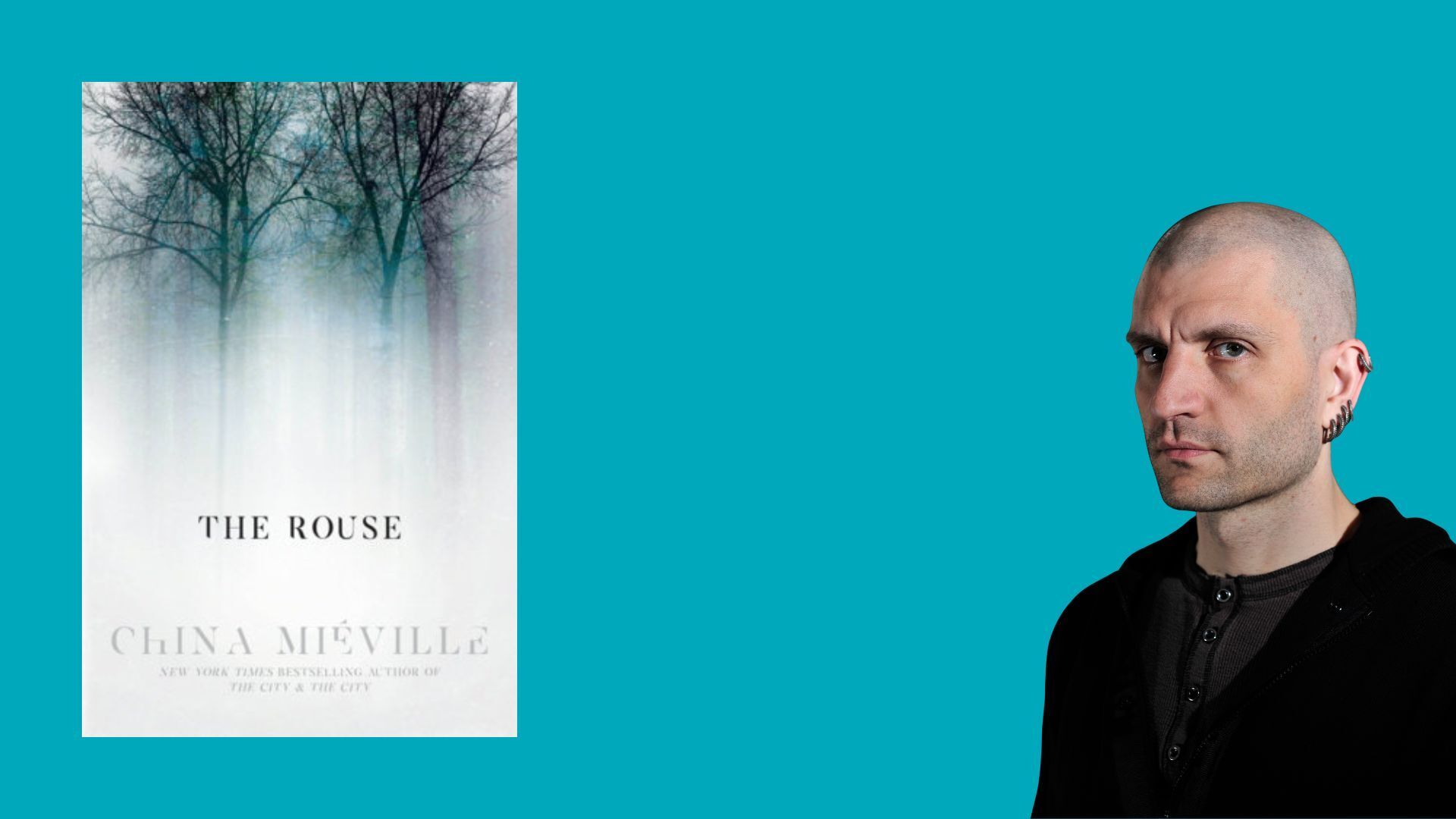
I've always read the news and I try to keep up with things. Our political landscape is so incredibly fractured, and it feels like an incredibly divided time. And a few years ago, I found myself thinking more and more about this sci-fi novel that I read years ago: China Mieville's book, The City & The City. The premise felt fantastical at the time when I read it. It's about two countries that occupy exactly the same geographical space. You're kind of trained from birth to not see the other city, and you grow up kind of in a place where you can only see what you see, and this entirely other city overlaps it. It was fascinating to me. It's just such an interesting premise, and as the years pass living in the United States, it feels less and less fantastical.
I was thinking about the situation politically, where it feels like it's no longer a matter of reasonable people disagreeing on policy. It's more that we don't agree on what reality is. I do have significant anxieties around how you come back from that. I was thinking, well, what if there were a worst-case scenario?
I've never been interested in writing about disaster per se, but I am interested in writing about the aftermath of disaster, the kind of new beginnings, the possibility and chaos and hope, and I thought, what if I were to start a novel in the aftermath of a second American Civil War? I see the book as being a conversation with the contemporary moment.
The kind of joke I made when I was telling people I was doing this interview is: Do you know something we don't know because you wrote that pandemic book?
I do not.
I don't need to plan a bunker at this time?
No, as far as I know. Okay, but I mean, I know, I’ve got that reputation because I wrote the pandemic book, and then the subsequent novel was about the fragility of the supply chain. But look, I just read the news. I have no inside knowledge.
You seem like someone who notices patterns. Would you say that's accurate?
Yeah, I think that's accurate. I think if you pay attention and you have a somewhat overdeveloped imagination, you might pick these things up. I will say, in the case of Station Eleven, the pandemic was so incidental in the novel, which I know sounds crazy now, but I kind of just wanted to write about this post-technological world and, at the risk of sounding like a psychopath, I had to end the world somehow. A pandemic just seemed like the most effective way to do it. I certainly did not set out to become “the pandemic novelist.”
You were born Canadian, but now you live in the U.S. and you write so much about the American experience. Do you identify with both?
I do. I was actually born with dual citizenship. I was born in Canada. My mother is Canadian, but my father was from Southern California. They came up to Canada after the Vietnam War.
As someone who can kind of live in both worlds, what's your relationship to being an American and our failures/attempts at opportunities?
You know, what I think about all the time is I had a really interesting conversation with Omar El Akkad, who wrote American War, which I think is a brilliant novel. It's a very different book from mine, but also about a speculative second American Civil War. We did an event together where I interviewed him at a bookstore in Brooklyn, and we were talking about the relationship we have with the United States. He's also Canadian, but lives in Portland. We were talking about how, on the one hand, we've had incredible opportunities in the U.S. that we would not have had elsewhere. It's been possible to build fantastic careers here that would not be possible in a smaller country or a country with a smaller population.
But, on the other hand, there is this feeling of infinite risk, which you don't have in Canada, where you have health insurance and there's a much stronger safety net. Your kid probably doesn't do active shooter drills in kindergarten. He said something that's always stayed with me. He said, “There's no ceiling and there's no floor,” and that's how I think about life in the United States—there's no ceiling, there's no floor. There's incredible potential and possibility and also really unacceptably high risk. I'd say I have a slightly uneasy relationship with the country. At the same time, I feel such gratitude. I've been able to build a really wonderful life here.
In this book, we have the two different parallel worlds. I spend a lot of time thinking about time travel and parallel worlds in my, you know, anxieties.
Same.
I once interviewed the Doctor Who showrunner, and he told me he doesn't believe in time travel. And I'm wondering, do you believe in time travel?
I think I'm like that character in The X-Files: I want to believe. Do I believe? Uh, no, I don't. I don't think you can travel forward in time. I don't think I believe that it's possible, but I also don't believe we're anywhere close to a full understanding of how the universe works. We're still realizing and saying things about quantum mechanics, and there are still so many weird unknowns around consciousness. I want to believe it's real. I don't think it's currently real.
His take was that we’d know by now.
I don't know, would we? Why do we always assume that we're somehow at the apex of the story? This could just be the opening chapter.
Same thing with the parallel universes—in Exit Party, we have sort of a scientific journey/accident that gets us into the parallel world. Do you think that is at our fingertips?
Oh, probably not. But I know that I needed a halfway plausible explanation for how doppelgangers showed up at a party, if I’m being totally honest here.
I think you've touched on this really interesting decision that a writer of speculative fiction has to make pretty early on in the project, which is about how deeply into the weeds one wants to go in one’s scientific fictional technology. For me, I've always been much more interested in people and how characters respond to extremity than I am in, say, the mechanics of this science-fictional technology.
When I was writing Sea of Tranquility, there's a full-on time machine; it's hard sci-fi in that way, and I did go down a rabbit hole for a while of thinking, What are our current ideas and technologies that could be extrapolated several steps forward into the future to make this work, like, how does the quantum blockchain work, for example? And then I had this realization that if I don't care how a car works in my 2020 storyline, why do I care about the mechanics of time travel? It's just transport, was kind of my feeling.
What I'm personally always going for is just plausible within the context of a work of literary fiction, but I will say there are writers who take the exact opposite approach, and I find it really interesting. If you think, for example, about Cixin Liu, The Three-Body Problem. He will go so deep into the weeds and it's fascinating. I’ll be reading about silicon farming, and it sounds real to me. It feels real.
Here we are in this world where even physicists aren’t fully in agreement about whether or not there are alternate realities, which makes it fascinating to think about because literally anything could be true. I find myself much more interested in the characters. How do these people respond to these strange or extreme scenarios? So I’m more interested in that than I am with if it is actually possible.
At my local indie bookstore, you live in the fiction section, not the sci-fi section. The Three-Body Problem lives in the sci-fi section. I find it really hard to figure out the difference between literary fiction and any other genre of fiction. I wonder if maybe the difference is if it's character-driven. It also probably has to do with the writing.
I think there's a legitimate question to be asked about whether these divisions are even useful to us. I think we have this kind of mania for classification as a species, not even just in literature. Is it a one or zero, black or white, A or B, whatever the division is. I kind of love the idea that a book can be more than one genre. I am often categorized under sci-fi. I'm also often categorized under literary fiction. I feel like it's both. The world feels more and more sci-fi, as science continues to develop. I don't know how much these divisions make sense anymore.
In the first universe we spend time in, we can wonder if that's ours. And then the one that's parallel is a lot more like old-school books like Brave New World or 1984. Why did you choose to contrast them in that way?
I found it really interesting to think of two different directions that a country could take. Something I've been interested in for a while is the idea of a counter life—the life you didn't live where you married a different person or moved to a different city, or whatever that inflection point was which over the passage of time would shift you toward becoming a somewhat different person, a different version of yourself. So, it's interesting to me to think about that in terms of people. But it's also really interesting to think about the counter life of a country. What inflection points might make a country become this version instead of that version of itself?
I had this really interesting experience writing this book. In the beginning, I started thinking about Los Angeles and the party and the chaos immediately following a second American Civil War, and I thought, Obviously, that's our world, extrapolated forward by a few speculative fiction steps. By the time I finished the book, I was really struggling to stay ahead of the news cycle on the B side—that scenario of unidentified secret police wearing masks, picking up civilians in SUVs, that was literally Minnesota. It's so dark, and it's actually happening here. That gave me kind of an unhappy feeling that we might get to experience both sides at the same time.
In the book, one of the characters calls 9/11 “a hinge moment.”
I just came across a review where somebody said the world diverged at 9/11, and that hadn't occurred to me, to be totally honest with you, but it's kind of a cool idea. I kind of wish I’d thought of that. That was the creation of the Department of Homeland Security, which one could argue pushed us into one direction and not another. It did bolster the security state and the surveillance state. In the book, I never quite specified, even for myself, where that hinge moment was that separated Universe A from Universe B.
As is your style, this book has multiple interconnected narrators and not necessarily one protagonist. Does someone talk to you first? How does it work for you to get into this kind of story? I've heard that you are a pantser. You don’t outline.
Total pantser. I usually start with one character who I find really interesting and then discover other characters along the way, and find them really interesting, and then sometimes they become equally important.
I started with Ari. She was the villain of my 2010 novel, The Singer's Gun, really unambiguously the villain. She is bad news in that book, but she's also interesting. I found myself thinking about that character and thinking, What kind of person would she be at the other end of a very long prison sentence? It was interesting to imagine her stepping out into a kind of strange new world, and this is related to one of my interests in the book, which is the way that science-fictional ideas can kind of map onto day-to-day life. I did a couple of events in prisons a few years ago, talking about Station Eleven and talking about lost technologies in front of a room full of men who'd never used a smartphone because they've been locked up for a very long time. What is a time traveler? If a character goes into prison as Ari does in 2007ish and then comes out in 2030, she's really emerged into a different world.
We're kind of all time travelers. There's the world in which we turned 18, and we started to move toward thinking of ourselves as adults—I started paying rent when I was 18. There's the world that you learn to be an adult in and then, a few decades later, that world's gone; it goes away by degrees. Something new takes its place. But you're still there. We kind of all become time travelers.
With Ari, I had this character I found really interesting, this sort of time traveler from a different time, the time when she went into prison, and I found that, for writing a book set slightly in the future from a kind of technical narrative perspective, it was actually really useful to have a character who'd just come out of prison, because she's kind of learning the rules of the world at the same time as I'm presenting them for the readers. So she's trying to figure out how to be a new person in a new world, and I found that to be such an interesting idea. And then, as I wrote the story, more characters kind of inevitably come up and some of them were really interesting. I was fascinated by Nico, Sebastian, and Kareem.
You have said that the book comes out in the revision process. How do you untangle all of the knots of a first draft into your next and then eventually final draft?
I'm so glad you asked. I have so many revision ideas. Most of the prose kind of comes out more or less complete, which is a weird thing to say when there's so much revision, but I'll go back through written notes and find sentences that haven't changed from the beginning to the end. I write a fairly messy first draft, and the prose isn't going to change enormously, except that the characters are underdeveloped, and there'll be huge plot problems, and it won't be that coherent as a novel.
Then what I usually do is revise it. I usually do it about three times from beginning to end, going through the book and at first fixing enormous problems.
As problems get smaller and smaller and smaller, I do this thing that sounds a bit eccentric, but it's really helpful, which is a random page order edit. I know, it sounds crazy, but what I realized is that once you've been working on this thing for months or potentially years, it's like your brain kind of knows what's coming, and just glides over problems. If you print out your manuscript and then revise page 36 and then page 230 and then page 1 and page 180 and just jump all over the place, I find I catch huge problems that I've missed.
I also read the entire book aloud, because I care about the rhythm and the beauty of the prose, but also I find that really forces you to confront awkward sentences. If you're reading aloud and you're stutter-stopping on a sentence, you’ve got to fix it.
I like to have at least three early readers to tell me what could be improved. They're not necessarily novelists. I've definitely sent it to booksellers, to friends who work in publishing who have deep experience, evaluating stories. TV writers—nobody's better at plot. I send it out to a range of people, get their comments.
And then, at that point, I'll finally send it to my agent, who's also an excellent editorial reader. She always has great notes. Once it's kind of polished enough that I've addressed her notes, then it goes to my editors, and I try to sell it. I have three editors, so you know the notes are substantial.
One character I'm sorry to identify a lot with is Marlowe. She has complex PTSD that's affecting her memory. So you've tied this in a few times: What is memory, and what is time? With that character, how did you decide to weave this kind of thesis about memory into this sci-fi story?
I was thinking about how sci-fi ideas map onto real life. That idea of “PTSD is timeline corruption,” which is the line in the book, feels real to me, that condition of being interrupted by the past when you're in the present. Also in the way that I was thinking about counter lives and doubles. What are different versions of a person? What are different versions of a country? What does the word "violence" mean? What are different kinds of violence? There's the very explicit kind that you get on the A side—there's gunfire, but there are other kinds of violence that are incredibly insidious and might absolutely derail a life and a psyche. And that's what I was thinking about with her.
The painting Swan Dive lives in both universes, and it feels kind of like it's a thread that ties universes together in some ways. How did you come to decide that the thing that lives in both worlds should be a physical piece of art?
I never really established what exactly overlaps and doesn't between the worlds. Obviously, a lot of people, presumably some objects, cities. But, not all cities, not all people, and not all objects.
With this one, there were a couple of things going on. One is that, as a topic, I'm interested in the way art moves through time, the way a given work of art can be incredibly meaningful to multiple people for their own individual personal reasons over decades and potentially centuries, and the way it moves through time that way.
There's something kind of moving to me, thinking of this human endeavor moving through time. It's this interesting kind of immortality about it. So, I was thinking about that. I liked the idea of there being a piece of art that multiple characters at different points in their lives in two different universes have relationships with.
This goes back to the revision question of the unglamorous technical side of constructing a novel. When I have a novel that's really structurally complicated, like multiple timelines, multiple points of view, weird elements like transcripts, I find it really helpful to have one or two objects that act as a through line and move through the pages of the book. In Station Eleven, that was the Doctor Eleven comic book. In this novel, it's this Swan Dive painting. I think it helps to give a kind of cohesion to the novel.
There's also this other function, which is that in this novel, the painting's kind of a red herring, where characters speculate whether that somehow is the door. It isn’t. It's just something that people love.
A cultural reference that I wanted to mention is PostSecret, which I was obsessed with. This particular postcard was a memory I didn't know I still had. It time-traveled me. What made you want to include this?
I was obsessed with the website, too. I don't know why I fell out of it. I should go back and visit it. That particular postcard, which appeared at some point in the 2010s, it’s a photo of the Twin Towers, and the text was “Everyone who knew me before 9/11 believes I'm dead.” You don't even have to be a novelist to get chills from that. I remember looking at that, thinking, Oh my God, that's incredible, actually. It lives rent-free in my head, and I found myself thinking of it again.
Do you have any other rabbit holes?
God, I love that question. Something that's kind of been a long-standing rabbit hole for me is thinking about the people surrounding the villain in the massive white-collar crimes. I got into this pretty deep in The Glass Hotel, where every character in that book is completely fictional, but of course, the starting point for the crime was the Madoff Ponzi scheme. I'm thinking about all the Madoff employees who went to prison because they were actively participating. Those figures are kind of an ongoing rabbit hole for me.
Because, in this book, you have Ari, who was the villain and you brought her in as the kind of hero, not necessarily like a traditional hero.
She's got this thing that I love, which I'm fascinated by—that thing where you get to a certain point in your life, you look back, and you realize you're not looking back at a life, singular. It's one life after another. And I feel like with a character like Ari, that's so vivid and intense. She's been this, and then that, and then this, and then that. I love that idea.
I mean, I could talk about your books all day, but I want to be respectful of your time. Is there anything else you want to talk about regarding life, the universe, the books …
The one thing I like to emphasize in this book is I think it sounds unavoidably super dark when I talk about it because of the opening premise. I actually do sincerely believe that it's a hopeful book with a lot of joy and humor in it. I always like to mention that because I don't want people to think, Oh my God, this thing is so depressing, I'm not picking it up.
It starts hopeful. And—spoiler alert—it ends with a little glimmer of hope. It really does go all the way through.
Yeah, and Marlowe gets away from that guy.