


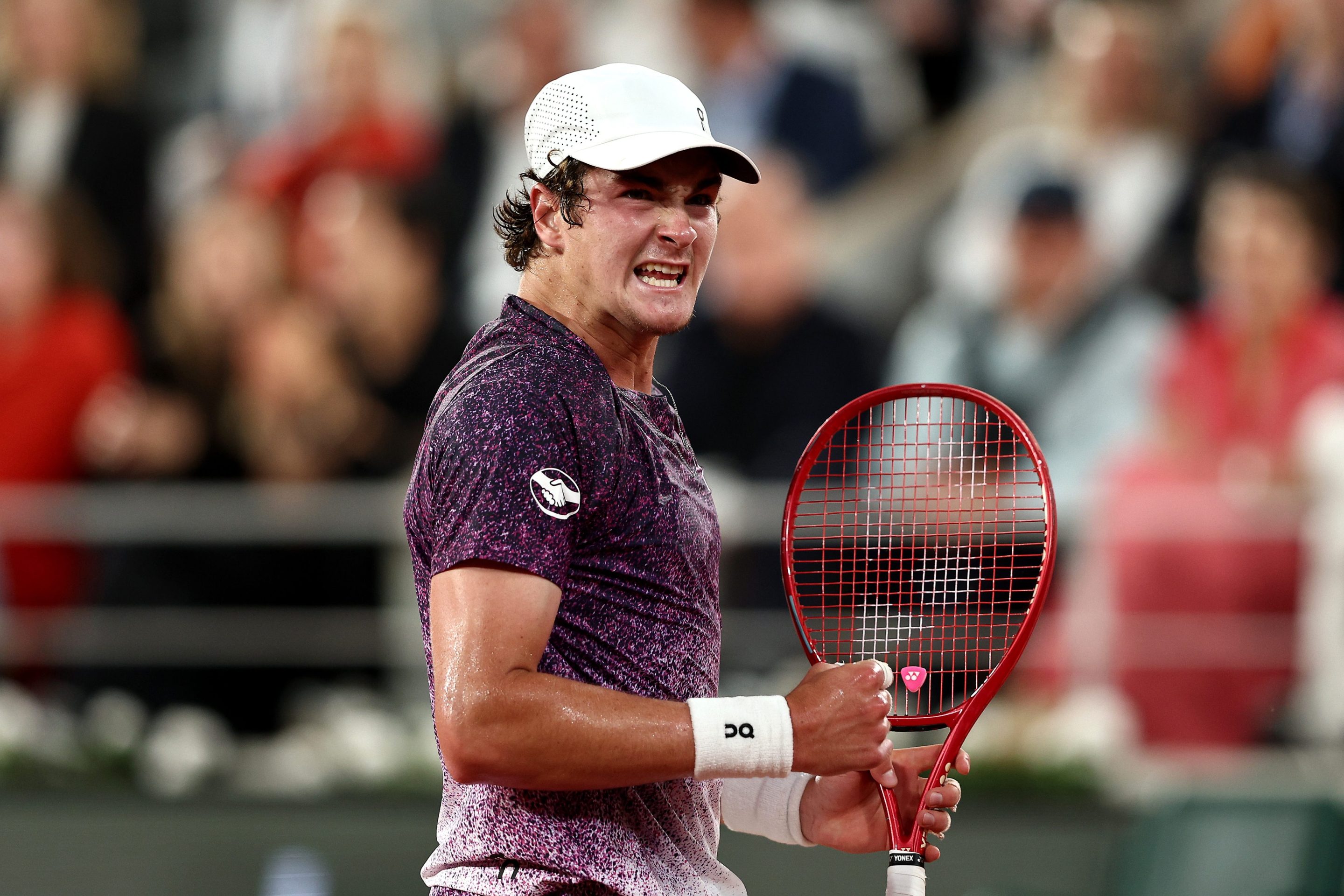
Three drop shots, three aces—that's a sequence that I'll never forget. Nineteen-year-old Joao Fonseca wrapped up his upset of Novak Djokovic in scandalous style. Friday's third-round match at Roland-Garros had the gravity of a classic final: the shot-making, the comeback from two sets down, the nearly five-hour span, and especially the intergenerational warfare, as the youth brought revolutionary firepower to bear on a historically great elder.
Djokovic will never see a clearer path to major title No. 25. He had been advancing through a wide-open draw devoid of the two junior nemeses who finally managed to wrench the sport out of his hands: Carlos Alcaraz, out with injury, and Jannik Sinner, downed by cramps in the second round. Instead Djokovic was taken down early by a colossal talent from an even younger cohort. His perfect 18-0 record when playing teenage opponents at the majors ended when Fonseca polished off a 4-6, 4-6, 6-3, 7-5, 7-5 victory. It was only the second time in Djokovic's career that he had lost a match from two sets up.
Tennis arguably reveals an individual's composure under pressure with even higher fidelity than do team sports, because of the magic of shot selection. Every time a player sees the ball coming at him, only he can choose a reply. The bravery (or cowardice) of that choice will come to define him, both in that particular match and general reputation. Simply flip to "Zverev, Alexander" for the cautionary tale here. Fonseca was already known for his tendency to go big, and we'll never need more conclusive proof than his performance in the tensest moments of this match, played against a 39-year-old whose own mind has been tempered like steel over the last two decades, and who clearly delights in unraveling less experienced opponents.
Fonseca could challenge Sinner or Alcaraz in a competition for biggest forehand in the world. Given that the current meta in men's tennis is sheer ball speed, he's well set up for the future, and he proved as much in a brilliant showing against Sinner two months ago at Indian Wells. Any given Fonseca forehand is capable of instantaneously ending the point, no matter where he's hitting it from; what's most impressive to me is that he can do it without getting perilously close to the lines, such is the speed of his ball. It's the kind of shot that warps the opponent's usual decision-making with respect to court positioning and rally patterns.
As Fonseca's match against Djokovic went on, he did not relent. In fact, by setting up this expectation of incredible power, he was able to subvert it in a critical moment, fooling Djokovic with three drop shots that helped him break serve in the penultimate game of the match. With an opportunity to serve out the match, Fonseca sprayed some errors and faced break point. Then he closed out the match with three consecutive searing aces. Djokovic was visibly tired by then, but he's also the greatest returner and best anticipator in the sport's history. He was up against a teenager who managed to go for the most with the most at stake.
Despite the climactic atmosphere, there was no trophy awaiting Fonseca at the end of that match—just another difficult opponent in a taxing format. Best-of-five matches are still relatively new terrain for him; last season, he advanced to the third rounds of Roland-Garros and Wimbledon, but no further. In fact, his comeback against Djokovic was also his second consecutive win from two sets down, since he had to do the same against fellow talented youth Dino Prizmic this past Wednesday in the previous round. No sane observer would have held it against Fonseca if he had been too depleted by two straight five-setters to put up a fight in the fourth round against Casper Ruud, a two-time Roland-Garros finalist and one of the few steady hands left in the tournament.
It has been a time of widespread sphincter-tightening on the men's draw. With the loss of Djokovic, the tournament was guaranteed to anoint a first-time major champion. This has led to some nervy, entertaining matches. When a player squares up against Alcaraz, he faces no expectations and swings freely; when Alcaraz is gone, there looms the prospect of actually winning Roland-Garros, and everyone loses their shit. One quarter of the draw, which previously belonged to Sinner, saw all four of its matches on Saturday go to five sets. WTA player Madison Keys, who had to wait to get on court, poked fun at the men: "I think we’ve seen in the men’s scores today that they're all really worried about who is going to be in the finals, and not on the match today." Second-tier stars like Alex de Minaur and Andrey Rublev, who have long toiled under the Sincaraz regime, have already squandered the rare opportunity here in Paris.
Ruud was a player I thought might actually advance through this open draw and lift the trophy. He'd lost in the finals to Rafael Nadal in 2022 and to Djokovic in 2023; this year, no all-time great would be an obstacle. Unless I've been misreading Fonseca's potential. The way he consolidated the Djokovic victory was arguably as impressive as the victory itself. For all the praise I've lavished on Fonseca's forehand, Ruud's high-topspin, Nadal-lite forehand is still one of the best weapons on clay. And Ruud also had the better track record in terms of movement and stamina, though he was coming off a five-setter in a heat wave that had him "walking around like a zombie," in his own words. But both players looked sprightly in the first three sets of Sunday's match, and it was a battle of raw firepower where Fonseca once again prevailed, before easing ahead in the fourth to win 7-5, 7-6(8), 5-7, 6-2. Fonseca's quarterfinal opponent is a fellow youth: Jakub Mensik, a big-serving 20-year-old who just dispatched de Minaur and Rublev, and still has the single biggest resume item of any player in their age bracket—the 2025 Miami title—even though others are seen as having higher ceilings.
Unlike the beleaguered players in their late twenties, Fonseca will be viewing this Roland-Garros as just one of many opportunities he'll enjoy in his career, rather than some once-in-a-lifetime vacancy. He is now on the sort of run that makes me reconsider my evaluation of him, in comparison to the defining players of this era. I still feel confident saying he'll never move in and out of the corners of the court as smoothly as Sinner or Alcaraz. But Stan Wawrinka didn't move like Djokovic or Rafael Nadal, and he beat those guys in finals to win three major titles. There may yet be room at the top of a tour for a slightly different profile: a bruiser who can move just well enough to land instant-kill forehands—and, crucially, who never gets scared.


![USA's Ben Shelton celebrates his win against Spain's Carlos Alcaraz during the men's singles quarter-final tennis match on day ten of the US Open tennis tournament at the USTA Billie Jean King National Tennis Center in New York City on September 9, 2026. (Photo by Leonardo MUNOZ / AFP) / “The erroneous mention[s] appearing in the metadata of this photo by Leonardo MUNOZ has been modified in AFP systems in the following manner: [USA's Ben Shelton] instead of [Spain's Carlos Alcaraz]. Please immediately remove the erroneous mention[s] from all your online services and delete it (them) from your servers. If you have been authorized by AFP to distribute it (them) to third parties, please ensure that the same actions are carried out by them. Failure to promptly comply with these instructions will entail liability on your part for any continued or post notification usage. Therefore we thank you very much for all your attention and prompt action. We are sorry for the inconvenience this notification may cause and remain at your disposal for any further information you may require.”](https://lede-admin.defector.com/wp-content/uploads/sites/28/2026/09/GettyImages-2293730421.jpg?resize=2880%2C1920)