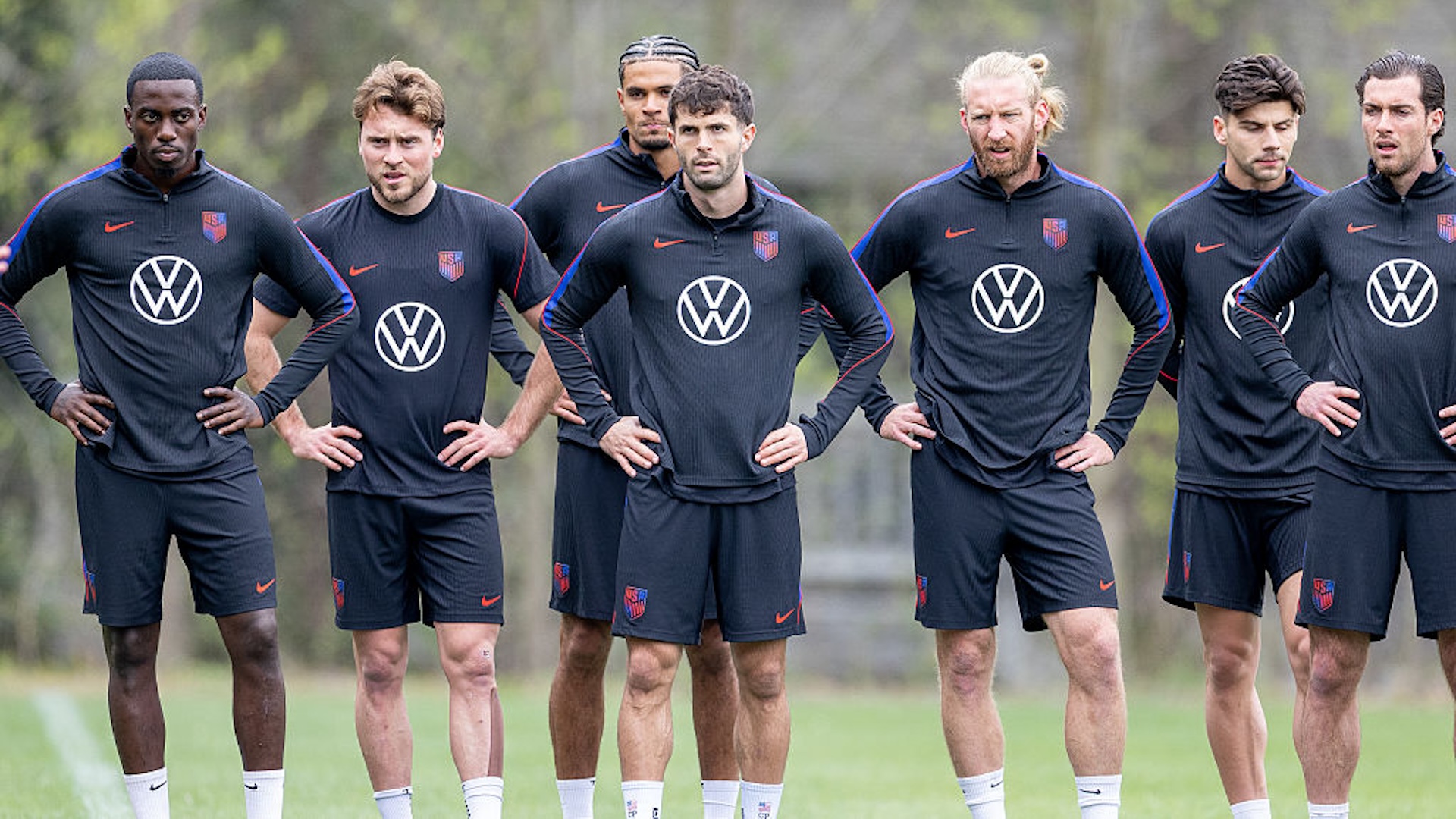
It's almost time for the World Cup. Before the tournament, we'll be previewing each of the top 15 teams by FIFA rankings that made the tournament. Why the top 15? Because that's how many we needed to do in order for the USMNT to make the cut. You can read all of our previews here.
The story of the past decade of American soccer has been the eastward migration of the nation's best young players out of MLS purgatory and into the best teams and developmental academies in the world. That story is supposed to have a happy ending for the national team, or at least some positive plot developments. So far it has not, though the Jürgen Klinsmann prophecy has yet to be really tested. That's what's at stake in this 2026 World Cup: a resolution. One moment, one goal, one game goes your way, and everything is different. This is the competition that matters.
As to that migration: After feeding on relative scraps for decades and having to accept that only Clint Dempsey was capable of playing at the game's highest level, American soccer fans can now enjoy watching dozens of their guys ply their trades across Europe. This is a bounty that U.S. soccer fans would have killed for three World Cup cycles ago, when Bobby Wood and Darlington Nagbe were leading a rudderless program; or four World Cup cycles ago, when the fate of the program seemed to hinge on whether or not a teenager on the outer cusp of playing for Bayern Munich would pick the USMNT; or five World Cup cycles ago, when Landon Donovan had finally called time on his ongoing European rumspringa and accepted life as the best MLS player ever. Now, the program has a guy who started for Atlético Madrid against Arsenal in a Champion's League semifinal, and he can barely see the field for the national team. They are coached by Mauricio Pochettino, a manager who has enjoyed a decade of success with the biggest clubs in the world. Surely, the program's newfound transatlanticism is coeval with newfound success?
No. They look like every other, more MLS-based U.S. team of the past 20 years. The USMNT enters their home World Cup with the same prognosis they've had for the last three World Cups: should make it out of the group, not much further. It's remarkable that for all the change within the program's player pool, boasting as they do the closest they've yet come to a world-class talent, good depth at most of the important positions, and roughly 15 top-level right backs, the team's place within the world pecking order is unchanged. Their FIFA ranking has oscillated between 10 and 30 for two decades, though that is a fake stat that in this case overstates variance. The USMNT is a regional powerhouse capable of good results on bigger stages, which are rare, given structural and personnel deficiencies. I use the present tense there, though this in-between state is not specific to the present.
Much of this comes down to playing in CONCACAF, which by its nature cannot offer the USMNT the biennial participation in meaningful tournaments of their South American and European counterparts. Which is not to say the USMNT's experience in the federation has not been without its hiccups. Rather, it's simply the case that they rarely have the experience of playing teams better than them in games that matter. This time around, they don't even get the valuable experience of playing teams worse than them in games that matter. The crucible of qualification forces the often maddeningly abstract notion of the USMNT—How does Noahkai Banks's Germany situation play out? Which guys do you play to balance talent and coherence in the midfield?—to materialize.
With a spot in the main draw confirmed eight years ago, this group of players has not gotten to benefit from that pressure. Instead, they have played a bunch of theoretically interesting friendlies and a handful of competitive tournaments. What's striking is how familiar it's all felt. The best stretch the team has played under Pochettino came last fall, when they played a stretch of five friendlies against 2026 World Cup teams and posted four wins and a spirited draw. That showed their potential, though they followed that stretch by losing a combined 7-2 to Portugal and Belgium. In other words, the gap between being a fun, lively team in the middle and being a real contender is a gulf. Still, host nations tend to perform well at these things (cheating-ass Russia even beat Spain in 2018), so there's probably more positive variance here, but don't get your hopes too high. Also, their group sucks (something you'll hear a lot at this World Cup)!
Who Is Their Main Guy?
This is the moment Christian Pulisic's career has been building towards since he broke out at Dortmund a decade ago, and the USMNT will go as far as he takes them. The roster is full of good players, though nobody else is as capable as Pulisic of the sorts of moments of brilliance that win you big games.
As Pulisic has settled into the center of his prime, it's been interesting to see the sort of player he's become. Too small to play up top, too uncreative to play in the middle, not quite good enough to a great team's best player, Pulisic has made a career out of elevating decent teams to, but not above, mediocrity. AC Milan of recent vintage makes sense for a player of his particular gifts. Surrounded by a bigger but more mercurial talent like Rafael Leão, Pulisic has often been the best performer in teams ultimately unable to aspire to anything big.
The U.S. gives him more creative responsibility than any of his club teams do, and he does a ton with it, typically playing better in a U.S. shirt than a club uniform. Until this past weekend, he hadn't scored for his country since Nov. 2024, which was the subject of a good deal of handwringing, though Pulisic delivered big-time for a lively USMNT in their first pre–World Cup friendly. He was deadly against Senegal, teeing up Sergiño Dest for a simple little goal in the sixth minute then scoring from a deceptively difficult position 14 minutes later.
Those two highlights show what makes Pulisic special. He is direct and deadly with the ball, capable of both creating and finishing at a very high level. The Senegal match, which the U.S. won 3-2, rekindled some of the mostly dead embers of my hope for this team. If Pulisic is operating, he can make magic against anyone.
Who Is Their Main Defending Guy?
That would be Chris Richards, who rocks. At the start of the year the last World Cup was held, Richards was 22, playing for Bayern Munich, and in one of the least enviable positions in soccer. He was not quite good enough to break into a notoriously competitive top squad, but also no longer young enough to keep hanging around hoping for a breakthrough. He'd played pretty well for Hoffenheim on loan, then got a permanent move to Crystal Palace. It seemed like exactly the right place for him to settle. He was not a Bayern player, but making things work on an always-fun Premier League team was something to be proud of, if he could swing it.
Initially, Richards struggled for consistent playing time, then to carve out a role. The presence of Trevoh Chalobah kept him on the periphery, and even forced him to deputize in defensive midfield for some reason. Over the second half of last season, though, Richards seized the starting center back role and has excelled since. He won the FA Cup last season, playing the whole match in a shutout 1-0 victory against Manchester City in the final. He tweaked his ankle a few weeks ago, but he should be good to go.
Richards is a fun, well-rounded central defender. He's a great athlete, impossible to push around, and he's always played well alongside Tim Ream, who is inexplicably still a rock for the USMNT. Richards is not quite a hypermodern, ball-playing center back, but he's no slouch moving forward.
Who Is Most Likely To Break Out?
There are not a lot of super-obvious candidates for this honor. Most of the players are youngish, though almost everyone who matters is known. Weston McKennie has played in more than 200 matches for Juventus, Brenden Aaronson is who he is, and Folarin Balogun has already broken out and then down.
The most likely answer here is right back Alex Freeman, which is a risky one given how little he's played at the club level in 2026. Freeman, whose father is former NFL All-Pro Antonio Freeman, moved to Villarreal in January after playing well at the Gold Cup last year. He's made three La Liga starts and has been, by all accounts, pretty good. Villarreal is easing him in after signing him to a six-year contract, and Pochettino clearly thinks he's awesome. I think he's right! Freeman is great, a real speed demon who can kill in attack and more than hold his own on defense. He could really do something in this tournament.
Who Is Most Likely To Eat Shit?
The USMNT has almost always been able to rely on great goalkeeping. Who could forget Tim Howard against Belgium? This time around, neither NYCFC's Matt Freese or the New England Revolution's Matt Turner inspire any confidence. I'm worried.
How Can They Win It All?
They cannot win it all, though given the expanded field, they have the opportunity to win a knockout round game for the first time in forever. That will earn them the opportunity to get flattened by Ecuador or something. Awesome.
The best answer I can give here is: Extralegal wrangling.