I was introduced to the work of Kane Parsons via my YouTube algorithm. His first Backrooms video, “The Backrooms (Found Footage)”, came up on my homepage the week he uploaded it in early 2022. I remember it well because the video—impressive on its own for being slick, professional, and, crucially, scary—quickly racked up views over the course of a few days. I wasn’t familiar with the Backrooms concept, born from a 4chan thread imagining an endless series of drab and empty yellow-tinted rooms that look like abandoned ’90s conference halls. Sometimes otherworldly beings dwell in these places, where furniture and walls meld together in awkward, nonsensical angles. Other times, you are simply trapped in an ever-expanding liminal space that has no end or exit. Parsons expanded on this idea by creating entirely computer-generated yet photoreal videos documenting the Backrooms. Soon his version, with an increasingly intricate and developing lore involving top-secret government programs, took off on its own. With the release of his first feature film, Backrooms, produced by A24, I tried to remember why I was served Parsons' video at all. Creepypasta content was never my forte, though I did follow a few filmmakers committed to showcasing their work on YouTube, notably Adam Butcher, who made one of my favorite short horror films, Internet Story. Throw in a few longform YouTube essays I watched in high school about "unexplained events," and perhaps this is how I wound up following Parsons over the years.
The reason this is of any interest now is because a small but growing cadre of YouTubers turned feature-horror directors have drawn media and box-office attention: Danny and Michael Philippou, who directed 2022's Talk To Me and 2025's Bring Her Back; Chris Stuckmann, with 2025's Shelby Oaks; Mark Fischbach, better known as Markiplier, with this year's Iron Lung; Curry Barker's recent film Obsession; and now Parsons, with Backrooms. That this group of young men began their careers online has been the source of both suspicion and hyperbolic praise, signaling either admirable scrappiness and ingenuity or barrel-scraping trend-chasing on the parts of their producing partners. What is true for each of these directors is the fact that they had little to no familiarity with traditional filmmaking techniques or studio involvement. For those like Fischbach, whose long, frenetic tenure online has seen him work on a diverse (though not necessarily formally or narratively rigorous) range of projects, an outsider's ethos results in a compelling, authentically strange, and unique passion project.
For pretty much everyone else, one finds derivative filmmaking aping certain cinematic aesthetics—notably the locked-camera, low-lit, slow-zoom, jarring and shrill horror of Ari Aster—without any real understanding as to how or why these elements work. These films appear sleek and professional with sharp digital photography, symmetrical framing, and devoted performers. But there is no real grasp of cinematic language, no instinct or learned skill for blocking or staging, and no narrative sophistication, to say nothing of the dialogue, which tends toward the overly expository and literal. The horror is derived from sudden loud sounds, abrupt cuts to a shocking image, the juxtaposition of upbeat music and disturbing imagery, and, without fail, someone's head being smashed to a bloody pulp. This is a cinema of non sequiturs and vacuous, sometimes nonexistent, interiority. As critic Esther Rosenfield wrote in an essay about Iron Lung, “None of the skills required to make viral video content carry over to the art of filmmaking.”
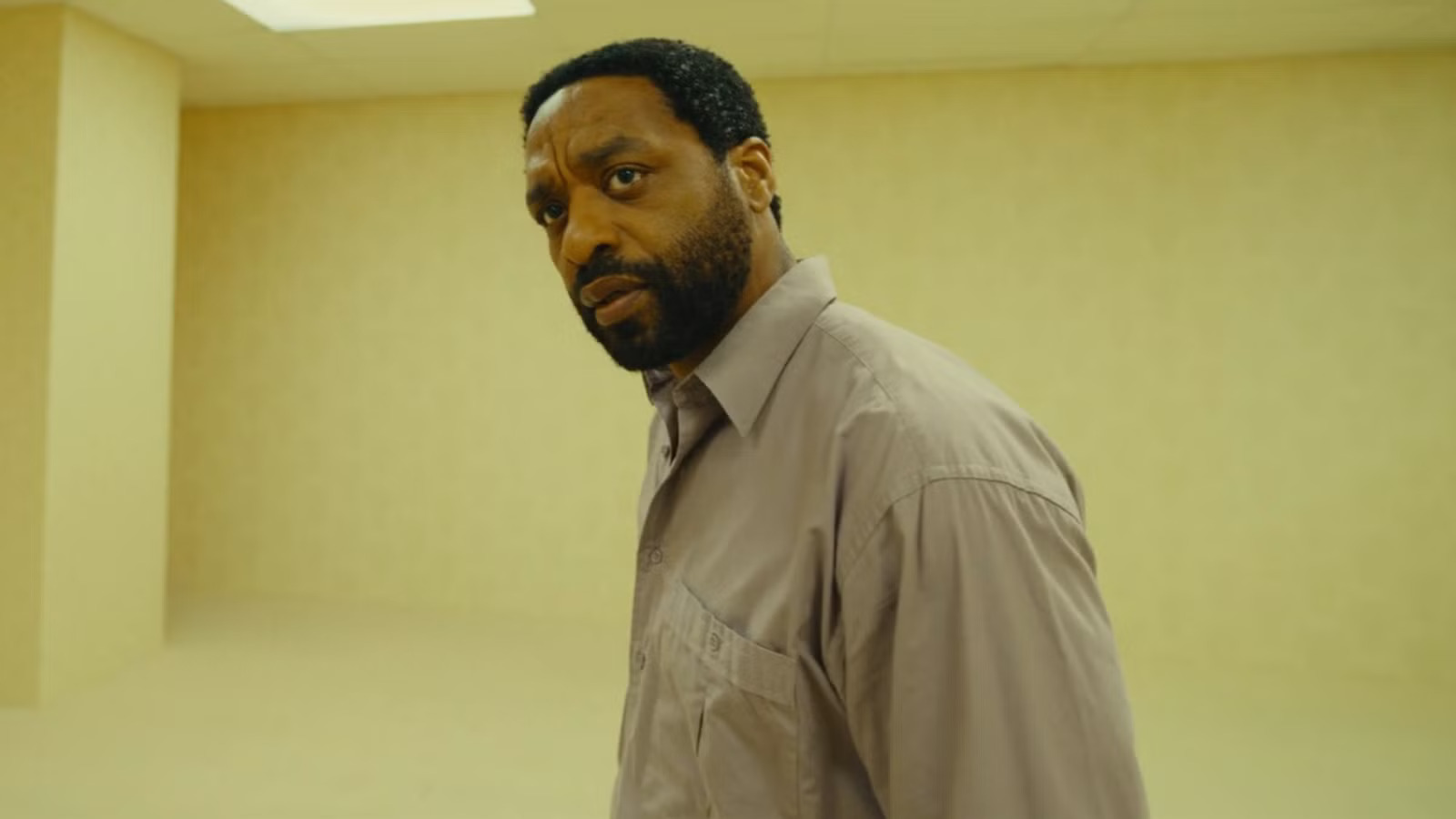
Refreshingly, Parsons’ visual concerns in Backrooms are mostly about space and the perception of depth, and the patient discovery of how the two can combine to create discomfort. Instead of dark environments where the viewer has to squint to see what’s hiding in the corner, there are brightly lit, garish corridors that dwarf their inhabitants, spaces that cut into each other creating frames with frames. That said, Backrooms is odd for several reasons, not least of which is its clear struggle to turn a series of interconnected videos, in which people are the least interesting aspect, into something resembling a self-contained movie that places two characters at its narrative center. Set in the 1990s, Backrooms revolves around Clark (Chiwetel Ejiofor), an emotionally volatile furniture store owner, whose therapist, Mary (Renate Reinsve), is unsure how best to help him through his feelings of resentment. In Clark, Ejiofor is given the chance to embody a broken, stubborn, and lonely man thwarted in his attempts at projecting authority and masculinity. Parsons demonstrates real confidence in the scenes between Clark and Mary, allowing both actors to enhance often stilted dialogue through expression and body language.
When Clark finds a portal to the Backrooms in the basement of his furniture store, Parsons allows a long, nearly silent sequence following Clark’s exploration of the space to play out languidly. Indeed, these scenes of discovery, where each successive room and hallway unfolds like an eerie art installation full of impossible angles and sunken chairs, are where Parsons excels, and where Backrooms gives the audience a glimpse of what is most unique about the director’s vision. But there’s a disconnect between Parsons’ vision and the demands of the film-shaped container he’s working within. Part of the issue lies with Will Soodik’s script, which privileges overdetermined emotional arcs and half-developed traumatic character backgrounds in order to embed a human element into the story. This is not what makes the Backrooms or Parsons appealing.
In his original video series, Parsons created an extensive back story involving a group called the Async Research Institute and its exploits into the nowhere dimensions of the Backrooms during the 1990s. Part found footage, part instructional video, the aesthetic mandate of Parsons’ Backrooms world is of a piece with that of Stranger Things, It Follows, and Longlegs. Which is to say, a nostalgic, semi-fetishistic pastiche of a different time where the feedback and distortion of analog technology—old TV screens, camcorders, cassette players, shoulder pads, bustling malls—is both familiar and alienating. The fawning recreation of the look and feel of the ’80s and ’90s in these projects is the product of an affinity for visual and cultural representations of the period rather than a true interest in what it was like to live through those decades. Parsons himself admits to this idea. In a 2022 Vice profile, the filmmaker said, “I mostly remember that time through little glimpses of memories here and there and then family photos.”
What Parsons tapped into with the Backrooms was that palpable, sometimes uncomfortable sense of déjà vu one gets when looking at an old photograph. It’s the reason every video in the series looks like it’s playing off a VHS; the staticky filter, in combination with the immediately recognizable architecture of a late 20th-century office space, triggers an almost automatic response. The Backrooms, as Parsons envisions them, are filled with the detritus of an era he never lived through (he was born 2005), everything just slightly wrong until the errors accumulate into a terrifying series of disturbing facsimiles. In that way, it’s also reminiscent of Jordan Peele’s Us, a similarly conceptually dense and overdetermined film that nonetheless managed to posit a genuinely unsettling mirror world. Just like Us, no matter how intricate the lore of the Backrooms became, its most essential element was just how extensive, varied, and strangely sentient its pocket dimension felt.
To that end, Backrooms the movie is in conflict with itself, often feeling like an adaptation of material that was cherry-picked for a few striking images rather than the whole of Parsons’ vision. After all, the video series worked so well partially because each installment felt as if it had been floating around the internet for years, making every addition a kind of decontextualized puzzle piece. In Backrooms, so much of Parsons’ pre-existing world is pushed to the margins in favor of an emotional and psychological journey for its protagonists that has almost nothing to do with the plot, such as there is. While there are a few sequences that try to capture the same handheld-camcorder immediacy of the original video series, they come off as self-referential winking to a pre-existing audience of fans. There is a very real sense by the end that neither Parsons nor Soodik knew how to end a story that worked best when there was no story at all.
The dilemma for any film studio that wishes to experiment with idiosyncratic IP adaptation is knowing when to trust the instincts of the director and when the gimmick has reached its creative limit. It’s admittedly harder to sell a version of Backrooms where Chiwetel Ejiofor and Renate Reinsve walk around for two hours. And yet that’s exactly when the film is most compelling, when claustrophobic, fluorescent hallways and dead ends give way to city-sized open spaces still bounded by a roof and walls on every side. There’s no doubt that Backrooms will encourage the wave of YouTube-to-Hollywood horror films being greenlit. It easily stands far above the majority, a credit to the strength of Parsons’ directorial instincts and his patience in letting events develop with visual and conceptual clarity. But what makes Backrooms most exciting is also its caveat: It’s more compelling to think of what its director will do next.