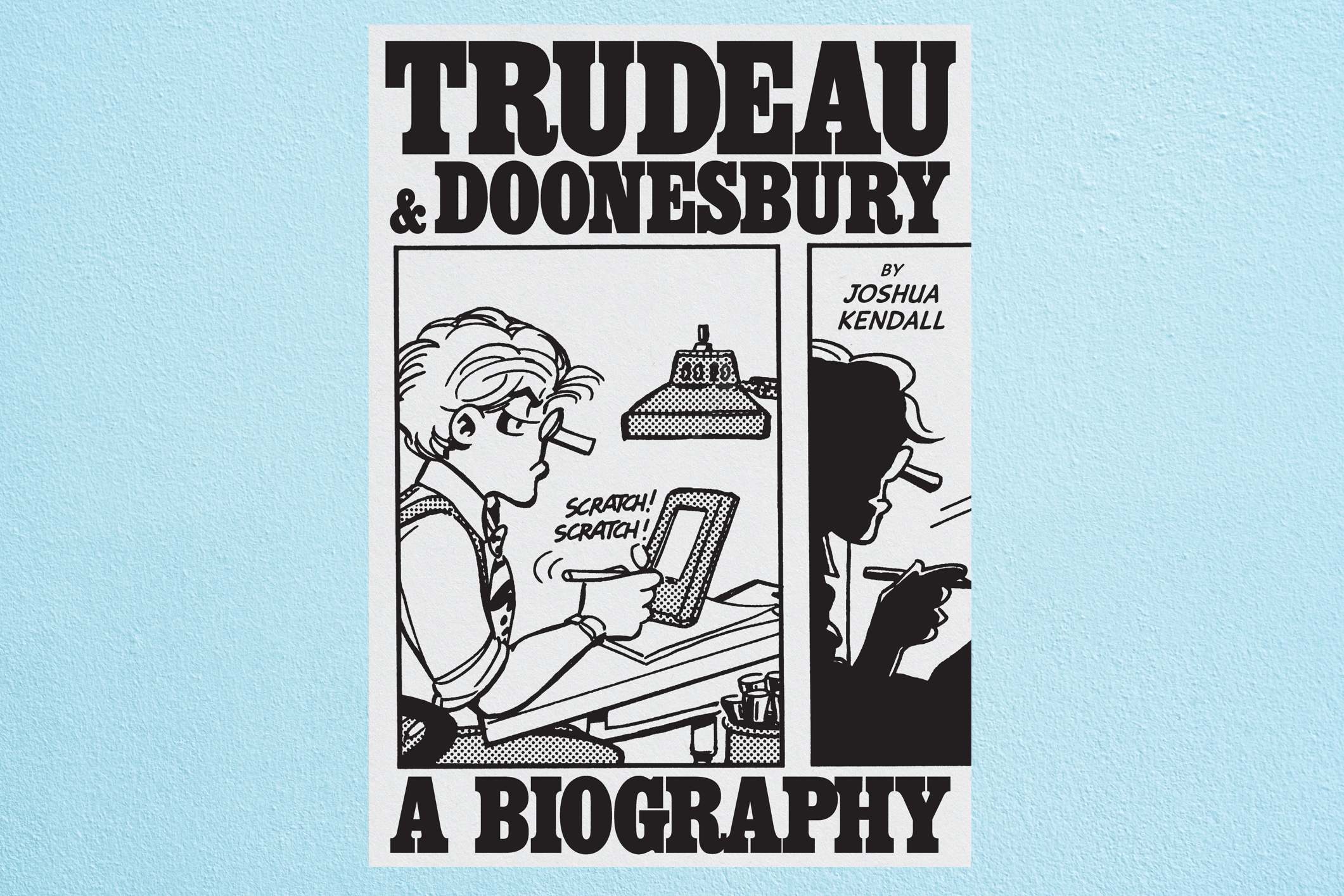
The following is excerpted from a chapter of Trudeau & Doonesbury: A Biography, by Joshua Kendall. The book is available for purchase now.
In the spring of 2015, like many Americans, Garry Trudeau figured that the upcoming 2016 election would essentially be a repeat of 1992, as it would also feature a Bush versus a Clinton—in this case, former Florida governor and younger brother of 43, Jeb Bush, versus former First Lady and Secretary of State, Hillary Clinton. When asked by Chuck Todd how he would likely depict the 2016 candidates, Trudeau stated, “I have a long history of unpacking the baggage of the Bush family.” He added that it would be hard to draw Hillary Clinton because “we’re just waiting for her to make mistakes.” But in the end, Trudeau would never draw a strip about either Jeb Bush or Hillary Clinton, because the 2016 election became a nonstop Donald Trump reality TV show.
Trudeau’s first Trump strip in 2015 appeared in April—a couple of months before the candidate descended the golden escalator and made his official announcement in Trump Tower. At that point, radio journalist Mark Slackmeyer, who couldn’t bear to utter Trump’s name, figured that Trump was just teasing, as he had done in 1987, 1999, and 2011. Trudeau himself, however, sensed that this time might be different, but as he told The Washington Post after Trump had sewn up the Republican nomination in 2016, he “also assumed he’d quickly drop out after he’d maximized the promotional value.”
As Trudeau has put it, Trump has been irresistible “because I didn’t have to do much in terms of exaggerating, the way you normally do in a parody.” That summer, Trudeau published Yuge! 30 Years of Doonesbury on Trump, which collected the key strips that dated back to the days when the self-promoting businessman “rocketed to the top as the Big Apple’s loudest and most visible asshole.” Yuge! was a New York Times bestseller, Trudeau’s biggest book in years. Obsessed with Trump, Trudeau turned him into his strip’s central character. As he also put it in 2016, “Some people feel that Trump is beyond satire, but we professionals know he is satire, pure and uncut, free for all to use and enjoy, and for that we are not ungrateful. For our country, though, we can only weep.”
Since 2016, Trudeau has published four more collections of Trump strips, including Day One Dictator: More Doonesbury in the Time of Trumpism, which was released just before the 2024 election. While Trudeau could never draw Obama or Biden, he has been unable to stop caricaturing Trump. In the view of his conservative critics, his constant spoofing of Trump over the past decade reflects his own pathological tic. As Peter Parisi of The Washington Times put it in 2024, “But if one had to designate a Patient Zero—the person identified as the first carrier of a communicable disease in an outbreak—for Trump Derangement Syndrome, that dubious distinction would have to go to Doonesbury cartoonist Garry Trudeau.”
Trudeau’s very first Doonesbury strips on Trump, which appeared in September 1987, have been called “prophetic,” as he was among the first writers to grasp how the tycoon’s buffoonery and braggadocio might actually propel him to the White House. At the time, Trump was a known entity only in New York, where he had made his mark on the Manhattan skyline as a real estate developer. But in the summer of 1987, the idea of Trump as a presidential contender was first broached. In mid-July, Mike Dunbar, a political activist in New Hampshire who considered the likely nominee—Vice President George H. W. Bush—“boring,” announced that he would begin circulating a nominating petition to put Trump on the ballot in the state’s Republican primary. In early September, Trump told The New York Times, “Anyone would be honored to hear this, but I don’t know any more details about it,” adding that while he wouldn’t rule out a run, he was highly unlikely to take the plunge. When Trump then took out full-page ads in New York City’s major newspapers that year to air his foreign-policy views, Trudeau couldn’t resist the urge to pick up his pen:
As Trudeau explained in 2016, “The ads were the first ‘uh-oh’ moment and my response was a kind of reflexive, prophylactic slap-down. The grandiosity was so over the top that it would have been comedy malpractice to ignore it.”
In October 1987, Trump did give a speech at a New Hampshire Rotary Club, but he did little else to advance his presidential prospects. The following month, he published The Art of the Deal, which turned him into a national celebrity. Armed with 20-20 hindsight, biographer Michael D’Antonio has argued that Trump’s first flirtation with a presidential run was nothing more than an attempt to market this book, noting that the billionaire developer “was one of the first people actually to use running for president as a business tactic.” In the wake of the book’s spectacular success, other satirists soon began to chime in. On the bestseller’s two-month anniversary, Spy magazine, the monthly cofounded by Kurt Andersen and Graydon Carter, issued a mock lament, “Nation to Trump: We Need You.” The piece reported that “one in 25 Americans wishes that Donald Trump were running for President,” stressing that these were “impressive figures Trump can build on.” In the same issue, the satiric magazine also famously dubbed the real estate tycoon “a short-fingered vulgarian.” “Like Garry, we sensed that Trump was a major character in American life, and we kept coming back to him in issue after issue for the next couple of years,” Andersen tells me.
Trudeau held off on lampooning Trump again until the summer of 1988, when he decided to link him directly with Doonesbury regulars. That summer, Duke was hired as the captain of Trump’s executive cruise ship, Trump Princess. In August, the yacht made a stopover at the Republican National Convention in New Orleans:
Alluding to the famous catchphrase popularized by his friends over at Spy, Trudeau here turned Trump’s small hand into an emblem, which proved resistant to the ministrations of those representing President Bush and Vice President Quayle. In September, Duke’s on-again, off-again romantic partner, Honey Huan, was hired as the social director of Trump Princess. And several months later, J.J. Caucus, Mike Doonesbury’s wife, then an artist, got an assignment to decorate the boat’s bathrooms. Thanks to Duke, Mark was soon invited to interview Trump during an outing on his yacht. Reflecting on these 1988 Trump strips nearly three decades later, Trudeau observed, “Once I’d introduced him into the strip, I then wanted to build stories around him,” adding that he kept devising ways to get his characters onboard the yacht. “I’d never done that with any other public figure, but he was so over-the-top, and he kind of reminded me of Daffy Duck in his self-regard and in his strange way of speaking.”
In the fall of 1989, B.D. and his girlfriend, Boopsie, also entered Trumpworld when she auditioned for a part in Trump’s game show:
Though Trump seemed to bond with the somewhat Neanderthalish B.D., he soon fired Boopsie.
Ever mindful of how he was being portrayed in the media, the real-life developer paid attention to Trudeau, and he did his best to punch back. As he stated in 1989, “Doonesbury is one of the most overrated strips out there. Mediocre at best.”
This TV extravaganza that Trudeau invented in 1989 was completely fictional, but these strips point to the cartoonist’s prescience, as a decade and a half later, Trump would in fact morph into the host of a reality TV show, The Apprentice, where he would regularly fire his contestants. Trudeau wasn’t sure what Trump’s next act would be, but the cartoonist was convinced that his brashness would soon take him places, as he stressed in his last Sunday strip of the '80s.
In contrast to most of Trudeau’s other core characters who were happy to say goodbye to this decade of greed, Trump—who, along with Duke, the captain of his yacht, embodied the nation’s darkest impulses—saw America’s downward spiral as something that he could feast on. For Trudeau, “the Donald”—as Trump was often called before he entered politics—simply represented the excesses of a celebrity culture gone amok.
In the fall of 1999, when Trump next flirted with a presidential run, Trudeau jumped on the chance to work him into the strip once again. That October, Trump announced that he was forming an exploratory committee, which would help him decide whether to seek the nomination of the Reform Party, a third party established by businessman Ross Perot, who had made presidential bids in both 1992 and 1996. While Perot was not running again, Trump’s principal challenger would be former Nixon aide Pat Buchanan. As Trudeau suggested, Trump sensed that his own narcissism might actually be his ticket to the Oval Office:
In February 2000, just as Trump’s campaign was fizzling—he would officially drop out on February 14—Trudeau himself threw another Reform Party candidate into the mix—Uncle Duke:
Duke’s promise to restore American greatness harkened back to Reagan’s 1980 slogan—“Let’s Make America Great Again”—which Trump would filch when he officially ran for the presidency for the first time in 2015. Duke dubbed himself “a compassionate fascist,” which was Trudeau’s way of poking fun at the Republican nominee, George W. Bush, who called himself “a compassionate conservative.” But Duke mostly modeled himself on Trump, so he tried to copy the same dubious strategies to appeal to voters. For example, since Trump was then dating the model Melania Knauss—who would become his wife in 2005—Duke hired Boopsie to serve as his arm candy.
Between February and November 2000, Trudeau would trace the evolution and eventual devolution of Duke’s presidential campaign in a steady stream of strips, which ran both in the daily and Sunday papers. But he would also promote Duke’s candidacy outside the comics section—in the real world. Besides setting up a campaign website, Trudeau arranged for Duke to do regular appearances both on the Internet and on popular TV shows—such as Larry King Live—which relied on the latest animation technology. As Wired noted in a long feature that August, “Garry Trudeau is on a digital roll, reveling in dotcomedy—and chasing vertical eyeballs with his 3-D, full-motion, cross-platform Duke2000 campaign.” That fall, Trudeau also arranged for Duke—voiced by Fred Newman, a well-known sound effects artist who had worked with Garrison Keillor on A Prairie Home Companion—to sit for a series of interviews with Time magazine correspondent Roger Rosenblatt, which were broadcast over Minnesota Public Radio. After losing the election in November 2000, Trudeau’s fictional character foreshadowed what Trump would actually do after being kicked out of the White House twenty years later. After denying his obvious defeat, Duke tried to collect the names of all his supporters so he could sell them stuff.
Newman and Rosenblatt are core members of the Meathead Movie Club—aka “The Meats”—a male-only group that Trudeau helped establish more than thirty years ago. As such, it is a cousin of sorts to the two other tight-knit bands of brothers that have sustained him since his Yale days—one featuring his roommates in Davenport College and the other his classmates in the artsy secret society Scroll and Key. “We watch together bad and often violent movies, which we know our wives couldn’t stand,” Rosenblatt, a former scribe for Time and PBS NewsHour, tells me. The other regulars include the photographer David Levinthal; David Stanford, who has edited Trudeau’s work since 1979; and Erik Kolbell, a New York City pastor and psychotherapist. In the group’s early years, they used to sit together in the front row of theaters and talk back to the screen. Many of the flicks have revolved around the feats of intrepid men—say, the Die Hard series. Trudeau often emits his spontaneous humor. As they were watching the muscular leads do their killing in Gladiator (2000), he quipped, “Well, when this happened about two thousand years ago, they were probably all just four and a half feet tall!” During the pandemic, “the Meats” switched to watching films over Zoom. “At our age, we don’t get out as much,” says Stanford.
From 2000 to 2015, Trudeau alluded only a few times to Trump in the strip. But even so, he couldn’t stop thinking about the real estate tycoon, who evolved into a bona fide TV star in early 2004 when he began hosting The Apprentice. That fall, as the tight presidential race between Bush and Kerry was in its final leg, Trudeau planned to focus almost exclusively on highlighting the horrors of the Iraq War. But at the last minute, as his notebook makes clear, he couldn’t resist doing a week of strips on Trump.
In these September strips, Zipper, the nephew of Zonker, is mesmerized by the banality of Trump’s The Apprentice:
The following year, Zonker enrolled in the fly-by-night Trump University, as he was taken in by its motto, “Greed est bonum.” In early 2006, after Trump joked on The View that he might date his daughter Ivanka, then in her mid-twenties, Trudeau was horrified and began jotting down his thoughts feverishly in his notebook. “Wow, that’s creepy!” he mused. “Even as a joke! Who makes incest jokes about his own daughter.” Trudeau then came up with a doodle of Trump in which he tried to get his hair just right; he also kept wondering if Trump felt any shame.
Even though Trump was constantly on his mind in 2006, Trudeau never turned any of these musings into a strip.
But a year later, as George W. Bush was finishing up his second term, Trudeau did manage to weave in a few jibes at Trump. Then still host of The Apprentice, the Donald was embroiled in a protracted feud with another TV star, Rosie O’Donnell, then a regular on the popular ABC show The View. Trump was furious because O’Donnell had recently taken to the air to challenge his financial acumen. In a week of strips in early 2007, Trudeau imagined that the lame-duck president would ultimately decide not to take sides in this widely covered dustup—a course of action that would likely enrage Trump:
O’Donnell was delighted, writing to Trudeau, “You fuckin’ rock.”
Trump also made a prominent appearance in Doonesbury during Obama’s first term.
In April 2011, Trudeau devoted a week of strips to Trump’s decision to launch an investigation into whether Obama was actually born in Hawaii:
As in many of his depictions of Trump, Trudeau focused less on the aging celebrity’s facial features than on his ubiquitous hair. “Whenever I sit down to make sense of it, it never fails to engage,” he said a few years later. “It’s an unknowable triumph of weaving, lacquering, and taxidermy, and I’ll never quite get it right.” These 2011 strips were based on a series of public comments that Trump had made a month earlier demanding that Obama show his birth certificate. “There’s something on that birth certificate he doesn’t like,” the Apprentice star told a startled Whoopi Goldberg on The View. In the fictional world of Doonesbury, Trump asked Sarah Palin, the former governor of Alaska who had run in 2008 to be John McCain’s vice president, to head his bogus investigation because of her “solid conspiracy credentials.” When Obama released his long-form birth certificate at the end of April, the controversy died down. But as Trudeau suggested in these 2011 strips, the real reason Trump tried to fuel “the birther conspiracy” was to test the waters for his own presidential bid in 2012—an idea that Trump would soon nix.
However, ever since Trump emerged as a political heavyweight in early 2016, he has been front and center in Doonesbury. Over the last several years, Trump- themed cartoons have constituted a significant portion—at times, nearly 30 percent—of the fifty-two Sunday strips that Trudeau has produced each year. In April 2016, after Trump became the presumptive Republican nominee, Trudeau figured that he would quickly pivot to marketing his branded insults to adolescents.
When asked about Trump shortly before the Republican nominee’s surprise victory over Hillary Clinton in the 2016 election, Trudeau stated, “He uses up so much of the oxygen ... it’s like having a big air horn installed in your head.” And even when Trump and his hair didn’t make it into a strip, Trump still loomed large. As Trudeau told Rolling Stone in 2018, Trump was the “subtext” in almost all the strips that he wrote during his first term: “Doonesbury is very character-driven, and it’s intuitive for me to think about how this calamitous presidency might affect day-to-day life for Mike and his cohort.”
On January 24, 2021, a few days after Biden was inaugurated, Trudeau published a strip that borrowed an old theme from the Nixon days to highlight that a corrupt, authoritarian leader had been felled. But since Trump, in contrast to Nixon, immediately began plotting his political comeback, Trudeau could not stop obsessing about him. During Joe Biden’s administration, he completely ignored the sitting president. Instead he focused on Trump’s shadow presidency, his various criminal trials, and his lingering impact on the culture at large, in which his original Doonesbury characters—such as Mike, Zonker, B.D., and Mark—edged toward their sunset years.
In October 2024, Trudeau was feeling confident that Vice President Kamala Harris would manage to defeat Trump in his bid for reelection. But as he told me then, given that Trump still occupied such a huge amount of space in his head, he figured that he would spend a few years doing “a thorough damage assessment of the Trump era. Since he did so much harm, that will take a while.”
A month later, after Trump soundly defeated Harris, Trudeau was stunned. “Like many people, I went dark after the election, even avoiding commiseration with friends over the devastating outcome.” But by the end of 2024, Trudeau “moved on to acceptance,” observing that “what was calamitous for the country was yet another windfall for my profession. I’m back to poking the bear!”
During Trump 2.0, Trudeau has continued to attack his favorite target as ferociously as ever. As one of Trump’s top advisers reminds the president in a strip published in the fall of 2025, “I think your secret sauce is shamelessness. You feel humiliation, of course, the pain of being mocked. But never shame, the sense of having done something wrong. That moral void! It’s your super-power!”
As Trudeau tells me, he has relied on “muscle memory. I’d been studying Trump’s awfulness for decades, and am now just addressing the latest outrages.” When asked about the difference between Trump’s first and second terms, the cartoonist points to the “lack of adults in the room. These days he’s much more comfortable in the company of sycophants who support his impulse to fling crap at everything and everyone, creating that target-rich environment that satirists dream of. At any given time, I’m massaging a half dozen riffs about Trump or Trumpism writ large, and how it impacts the lives of my characters.”
But while Trudeau’s basic take on Trump has remained a constant since the late 1980s, now that the MAGA movement exercises complete control over the Republican Party, the cartoonish president’s oversized character flaws are no longer a laughing matter for a significant slice of Americans. That’s why The Dallas Morning News suddenly decided in February 2025 to drop Doonesbury from its Sunday edition, though the paper has continued to publish reruns of the strip on the other days of the week. By way of explanation, Grant Moise, the paper’s publisher and president, declared, “I want The Dallas Morning News to be seen as a news source rooted in fairness and balance. When a comic strip (or any other source) we publish detracts from that goal, we must make decisions supporting our objectives and values.”
As a satirist, Trudeau has never seen it as his job to present both sides of any issue. His mission, as he understands it, is to remain true to his point of view, one that the nation’s first investigative cartoonist shares with many journalists: to comfort the afflicted and afflict the comfortable. But although Trudeau was disappointed by the loss of a long-standing client, he was understanding. As he observed, “I’ve never challenged editorial prerogative—it’s categorically wrong to call it censorship, as some readers reflexively do. In addition to approving content, editors have a right and responsibility to decide what not to put in their papers, which they routinely do as part of their job. They may do it for parochial or self-serving reasons, but I’m not the one who has to answer to their communities or their employers.”
With new cartoons appearing just once a week, Trudeau now focuses mostly on what he deems to be Trump’s latest missteps. “In the absence of daily story arcs,” he says, “it’s been tough moving the characters forward. The Sundays are mostly set pieces, cartoon essays.” One notable exception was a strip published in November 2025 that marked a major transition in the life of Mark Slackmeyer.
Mark’s discussion with Mike Doonesbury and his second wife, Kim, about the diminished state of the journalism business in general and of political satire in particular raises concerns dear to Trudeau’s own heart. As Trudeau tells me, he was alarmed by the decision of CBS in July 2025 to cancel Stephen Colbert’s late-night show, calling it “a craven, preemptive act of submission by the network.” The suspension of Jimmy Kimmel’s show by ABC two months later, he says, “was much more brazen, an ugly gangster move that, had it stuck, would have had major repercussions for free speech more broadly. That it failed so spectacularly has granted political satirists some breathing room.”
But given Trump’s repeated attempts to intimidate and silence all his political opponents, his administration clearly continues to pose unprecedented threats to the nation’s satirists, who are often left feeling as if their worst nightmares have already come true. As Art Spiegelman, the author of the Pulitzer Prize–winning graphic memoir Maus, which focuses on his father’s experience during the Holocaust, tells me, “We live in dark times when satire writes itself in every day’s headlines.”
Trudeau has produced a steady stream of fierce social criticism for nearly sixty years and has no intention of changing his tune anytime soon. He remains an eternal optimist who vows to continue to make the most of whatever breathing room he is given. As the cartoonist emphasizes, “It’s a lot easier to get through the day in the presence of hope.”
Excerpt from the new book TRUDEAU & DOONESBURY: A BIOGRAPHY (Abrams Press) by Joshua Kendall.
Text: © 2026 Joshua Kendall
Images except pages 310 & 311: DOONESBURY © G. B. Trudeau. Reprinted with permission of Andrews McMeel Syndication. All rights reserved.
Page 310 & 311: courtesy Garry Trudeau Papers. Yale Collection of American Literature, Beinecke Rare Book and Manuscript Library.