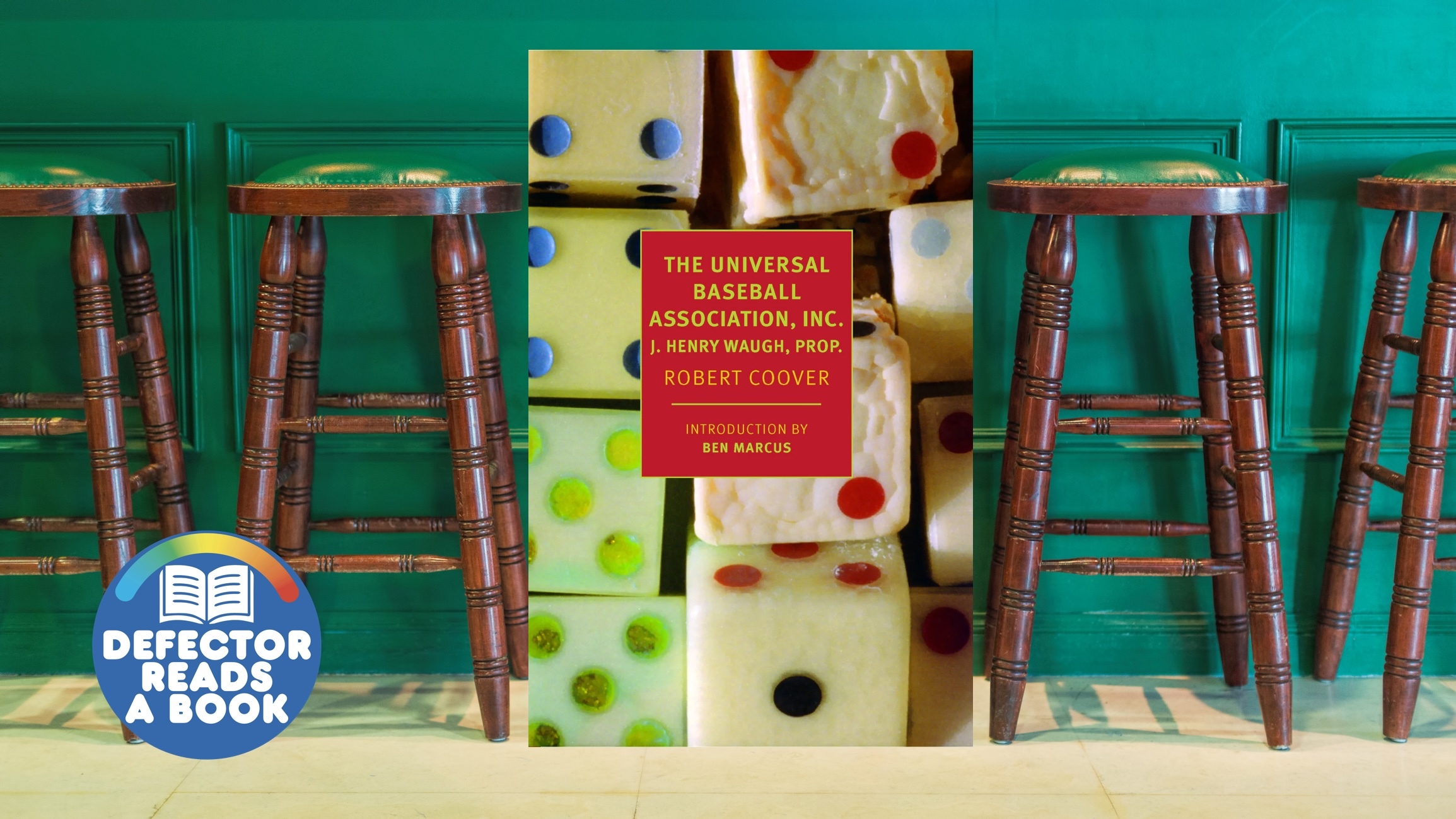
From the moment you begin Robert Coover’s 1968 novel The Universal Baseball Association, Inc. J. Henry Waugh, Prop., you are in a rarified space. What kind of title is that for a novel, so long and unwieldy? The recent reissue of the novel by New York Review Books gives little clue as to what could happen inside its cover. Behind the title, there are several misshapen die with colorful dots and crumbling edges. It is a strange book, with a strange protagonist, and a sentence structure so mesmerizing that I couldn’t put it down.
When I picked up this book, I had no understanding of it, except that it was “about baseball.” But the book isn’t about baseball, at least not in the traditional sense. It’s about a version of baseball that exists only in the mind of the book's protagonist, J. Henry Waugh, who lives alone in an apartment, neglects his job as an accountant, and has pastrami sandwiches delivered to him so that he can spend all of his time working as the commissioner of a baseball league he has made up in his vivid imagination. Each game is played with die rolls that determine how a batter performs at the plate and what happens to the ball. The keys have been built over decades of play by himself. The teams themselves have backstories, difficulties, and histories. There are events that exist inside the world of the league that are not real and yet impact the behavior of the players, who are also not real. There are songs that Henry has written for the league, up-and-coming stars, and a Hall of Fame he keeps meticulously in a book on his shelf.
This kind of world creation is similar to the work of creating a novel. You as the creator invent people and give them problems. You build out a world for them to exist in and hope that they behave in certain ways. At some point, you forget that you’ve made it all up, that none of these people are real, that if one of them is behaving in a way that does not function narratively, you can simply make them do something else, or delete them from the story altogether. The work of creation of any kind is often dangerously close to the work of disassociation from the world you actually live in, and Coover displays this with terrifying, mesmerizing clarity.
The book is written in close third person instead of first, which allows Coover to both show us the strangeness of this man’s mind and how he thinks about the world, and to use that strangeness to write some really gorgeous sections. Take this sentence, in which Henry is having sex with a woman he has brought home from the bar, and instructed her to call him the name of one of his make-believe ballplayers, Damon:
And the catcher, stripped of mask and guard, revealed as the pitcher Damon Rutherford, whipped the uniform off the first lady ballplayer in Association history, and then, helping and hindering all at once, pushing and pulling, they ran the bases, pounded into first, slid into second heels high, somersaulted over third, shot home standing up, then into the box once more, swing away, and run them all again, and “Damon!” she cried, and “Damon!”
The rhythm of this sentence—its pounding phrases one after another to mimic their sex—and the fact that it is all written almost in a code of baseball, brings the reader even closer into the scene. This is not raunchy. It is not even really appealing. Instead it is something darker and more enchanting, which is how the character himself feels in the interaction.
Coover’s sentences surprised me consistently with their beauty and strangeness. Here’s another example of some shrimp cocktail arriving at a restaurant: “Pink sea monsters, washed up on a shore of lettuce leaves and parsley, arrived, iced, their pungent sauce piercing through the present aroma of the Old Fashioneds' bitters like an arrow: zingo! right to the nose! and to the palate! terrific!”
There’s momentum in this book that exists purely because Coover understands that sentences are the engine of any good story, and that if a sentence is good enough, a reader will stay even if the narrative is so weird that they might otherwise tune out.
Henry’s life begins to go off the rails when one of his favorite players, a new prospect and son of one of the league’s former greats, throws a perfect game, at which point the die cast a dire future. Henry rolled three ones, then three ones again, and was forced by his own hand in the past to bring out the Extraordinary Occurrences Chart. He was unlucky. He rolled three ones again, and his new star Damon was fatally struck by a ball in the batter’s box. This sends Henry reeling. His league is in shambles. His interest is waning. He is desperate to maintain a hold on the league that gives him joy and intrigue in his life, but he cannot figure out how.
In less deft hands, a narrative as unusual as this one might have lost me. But Coover has made The Universal Baseball Association, Inc. J. Henry Waugh. Prop. into a beautiful temple not to baseball, but to caring. Henry Waugh cares so much about this world he has built that it almost destroys him. And much like that baseball that Damon holds up in the final scene of the book, the novel feels “hard and white and alive in the sun.” It feels like something special. - Kelsey McKinney
David Roth: We’ve talked in the past about what it’s actually worth for a book to be prescient, but I’ll reiterate that for me the answer is generally something between “not much” and “it depends.” I’ll give points to a writer who predicts that something is going to get worse in more or less the ways that it eventually does, but also only to a point; things do tend to get worse. So I will say that while there are moments in The Universal Baseball Association that seem to have anticipated some significant things about fandom in our current moment, and just how wildly and how far a person could drift when carried by the current of parasociality, I think its greatest achievement is that it manages to be so right about that particular gloomy truth while also being such a blast to read—so funny, so unsettling, so vivid, and so attuned, as Kelsey noted above, to the sorts of tempo and syntax that make good writing good. I thought it was super.
Luis Paez-Pumar: That gloom really speaks to me, because I essentially placed the entirety of the outside world into the city from SE7EN: just dark, dingy, rainy, and nothing like the glorious greens and tans of the UBA baseball fields.
Kathryn Xu: The first thing that really struck me was, like you said, Kelsey, the sentences. It’s interesting because in a lot of ways, the book is not really about baseball—the Universal Baseball Association and Henry’s obsession with it, in my opinion, more closely mirrors the saddest elements of convoluted board games and TTRPGs and OOTP nerdery, down to how the enjoyment of those can be far more isolating than the ultimately shared experience of sports fandom—but the book is able to capture so well the particular rhythms and contours of how a baseball game feels through punctuation! and italics! and bam, onomatopoeia! So the prose and formal elements of the narrative impressed me the most from the off—how Coover deftly manages the POV and pacing between the UBA and quote-unquote real life, and how he weaves them together when the UBA starts to bleed into, or really hemorrhage into, the real world after Damon is killed.
Patrick Redford: Yeah, if anything, the baseball qua baseball of the book is not quite incidental to the narrative, but is primarily a structuring device. I get the sense that whether or not Coover likes baseball or feels any kind of way about it, he sees it as both a synecdoche for postwar America and something big enough for a weird guy to pour his whole life into. One thing that kept catching me was the times when Henry would turn his gamemaster brain onto other pursuits—e.g. horse racing, the space race—only to find them insufficient vessels. One also gets the sense that he is trapped by this sensibility, and that his genius for being able to quantify the world is ultimately a sort of prison (at least until the ending, which was comfortably my favorite part of the book by 10,0000x, and we should talk about later down in the discussion).
Really, it’s a book about death, is my point.
Luis: I read it in short bursts before bed across the last three weeks or so, which made it both difficult to remember who each UBA player is and much easier to slip into the hypnotic rhythms of the syntax. It made me very uncomfortable and I had weird dreams because of it, but it also helped me get into a state of mental fog that I think mimicked Henry's own descent.
I'm glad you mentioned Out of the Park Baseball, Kathryn, because I've been playing that for the first time while reading this. I won't bog this down with the details, beyond saying it is a baseball simulation much like the UBA. Anyway, I have grown attached to a prospect named Carlos "Scranton Bill" Garcia, a nickname picked by the game but embraced by me, the player. I understand, as I think about why Carlos could possibly be "Scranton Bill," the allure of losing myself in the origins and backstories of these pixels. The fake realities we create for ourselves are intoxicating. (As one of my Bluesky followers suggested, I've settled on "Carlos learned English by watching The Office.")
David: Luis is right that the book is unsettling and kind of claustrophobic in some ways, which I guess is unavoidable given that the reader spends a great deal of it trapped inside the fervid boys-only fantasy world of a man who is driving himself to distraction decorating and destroying that world, while also crushing pastrami sandwiches and drinking beer all night long. Coover is amazingly deft, in my opinion, at shading that fantasy world towards mania; he evokes it so richly, the sights and smells and nicknames and broad character points, but then there are always somehow too many people in the space, and everyone is getting too drunk and they’re all saying the names of more guys, and then more guys show up, and they all start singing some weird ballad they all know the words to and you don’t, and you have to listen to every fucking verse of it. It’s a very richly evoked fantasy world, and I did not really care to hang out in it at all.
Patrick: Yeah Roth, the spilling of beer and vomiting of pizza, specifically, were symbolically hefty. Of course that particular reconstituted detritus would imperil the UBA.
Kelsey McKinney: I found the consistent violence of the UBA coupled with the dizzying shifts between reality and fantasy to be incredibly unsettling. I think this speaks to Patrick’s point about this really being a post-war America book. There’s rape and murder and people getting smashed in the head with a baseball and dying. There’s very little light in this book. It’s heavy and strange, and I think that’s what felt so unsettling to me at points.
Luis: The violence in and around the UBA reminded me of Blaseball, but more as its chaotically evil mirror. And to Kelsey’s point, the violence is both random and scripted; Henry did not have to include “death by pitch” in his outcomes, but he chose to, maybe without knowing that it would eventually lead to his own mental downfall. And then he himself becomes the recovery through death when he manipulates the die to kill the killer Jock Casey, a death that is sadder than anything in the book because it means Henry is completely lost to the world outside; only the UBA lives on.
Kathryn: Yeah, Luis. To Patrick’s point about this novel being about death, Coover never really allows you to view the UBA, or really any obsession, as being a true escape from the horrors of life, like aging (which Henry is really going through) or wage labor (which Henry is really going through). The creation of it is intended as an escape, but the efficacy is highly suspect. Henry is constantly faced with newspaper articles about horrific things going on in the real world (“bombs, births, wars, weddings, infiltrations, and social events”), but bakes that same sort of violence into his own imaginary game. Nevertheless, he still prefers the imagined world to the real one.
Patrick: To that end, I think one thing that was particularly striking throughout the book was Henry’s obsessions with and complexes around sex. Kelsey mentioned the rape bit earlier, which was presented in a very uncanny and horrifyingly casual way, but also there’s the dinner scene (which was great and unsettling and occasionally beautiful but totally menacing) and several scenes with Hettie where Henry makes himself a vessel for Damon and various other UBA stars. That’s clearly a way to steal some immortality for himself. And while this resonates with the broader psychosexual pathways of fandom etc., it’s much more chilling when he’s trying to buy some phallic immortality for himself through some guys that don’t exist. Curious what da class made of this.
Luis: Patrick, it's also interesting to me that the last time he sees Hettie, it ends in shame for him because she finally understands where all the baseball roleplay came from, and though she is more amused than mocking, it crumbles his sense of immortality. How can he idolize and personify poor, legendary Damon Rutherford, cut down in his prime, if someone in his real life sees that he is just Henry?
Kathryn: To be honest, I had a pretty difficult time trying to parse what Coover was going for with the initial account of the rape, though I’m willing to buy that I wasn’t reading generously at all points. At first I thought, OK, obviously this is punctuating Henry’s world with some real darkness, but then it mostly just felt like it was played off as a huge joke, repeatedly. Which, I mean, intentionally or not, does just punctuate the entire idea of masculine fantasy and storytelling not being able to conceptualize the idea of women as real human beings (yet another parallel to the whole board games, nerdery, TTRPG thing). There’s a funny part in there where Henry considers trying to rope Hettie in and is basically like, Well, she doesn’t have to be an equal in the whole enterprise! I think the book is ultimately kind of self-aware about this point, but I’m still not sure to what extent it is.
Kelsey: I also had a hard time with the rape storyline, and in particular the idea that, within the world of the game, this incredibly violent and theoretically terrible event had both resulted in a happy ending for Fanny and become the basis for a song sung by the people in the league. But I found myself kind of constructing my own reality within the fake reality of the book, which is that the league is a way that Henry tries to process the world around him, and perhaps his own failures in the past. There’s something interesting about the justification and play-out of this make-believe violence that feels like coping to me, though I’m not sure who (Coover or Henry) is doing the coping.
This is a far less important and interesting chain of thought, but I want to talk a little bit about how well Coover writes about food. I feel like it’s rarer and rarer to read about characters in novels eating, and Henry is always fucking eating! And he’s eating things that sound delicious and exciting and fun. I wanted a pastrami sandwich so bad while I was reading this book, to the point that I had to go get one to satisfy my hunger.
David: I saw a friend a couple weeks ago who told me that he still has the copy of the book I lent to him at least a decade ago, and the first thing he said about it was that it was a “great sandwich book.” He was living above a very good deli when he read it—the one made famous in Motherless Brooklyn—and remembered that it was all he could do not to constantly go downstairs and get a big turkey sandwich every few minutes. And while it absolutely is a tremendous achievement as a Sandwich Book, I think there’s more to that than Coover inventing the concept of Lunch Slack before anyone had the technology necessary to get there. The vividness of the food—the steakhouse fare Kelsey wrote about in the intro, all those sandwiches and pickles, Lou’s special pizza—is proof that there’s real pleasure, and the sort of urgent and ardent delight you feel when you are eating something you really like, to be found even in Henry’s shabby existence. But he is constantly taking that stuff to go—he drags those sandwiches and cocktail shrimp with him back into his fantasy world, or pulls characters from that world into the one in which he’s eating. He can only enjoy them fully by making them a part of that story he can’t stop telling.
Kathryn: It was during the food descriptors, which were so alive and pungent, that I really believed the most that this might snap Henry out of the UBA and come back a little bit more into the real world. And that just made it so much more evocative when, like Roth says, Henry is able to subsume that into his made-up world as well.
Luis: I will be thinking about Lou's special pizza for a long time: its excesses contrasted with the sparseness of Henry's life, and the way that its grease invades the UBA ... delightful. It also sounded delicious: “Oils and juices oozed and bubbled. Herbs spackled the surface. A rich one with onions, sausage, mushrooms and a St. Andrew’s cross of pepperonis.” Fuck!! That’s such good writing, and now I need a damn slice.
Patrick: I loved Coover’s food writing; you guys are all totally correct here. I am going to risk writing in Netflix Seasoned-Food-The-Power-It-Has! Voice, but the thing about food is that it is the substance of life. That delicious pizza is both real and authentically nourishing in a way that contrasts quite sharply with the UBA. The primary way Lou is drawn as a character is as a gourmand. That concretizes him as someone who exists in the real world and can never be a real Universal Baller. It’s also why Henry throwing up the pizza feels so potent.
Kathryn: I want to dedicate a little bit more time to the baseball qua baseball elements of the book, even if it isn’t necessarily a baseball book. Like, oh my god, all of the ballplayer names! So odd, so old-school baseball as baseball. I was underlining my favorites and then decided that would be futile (and, of course, there was the hilariously racist Chinese baseball player’s name), and I was delighted when Henry dedicated some time to explaining his whole process, picking out pieces from his day-to-day life and transferring them into the more pressing world of the UBA.
I feel that the novel has an interesting relationship with baseball literature because of when it was published. I’ve been reading Lords of the Realm, and all the lines about baseball from people back then are so sentimental and schmaltzy, which I think baseball writing can tend to be in general. Coover has bits of this himself—I remember this one description of mid-autumn and the horrors thereof, and baseball writing does love its seasons—but broadly his representation of baseball is a really interesting response or read on the genre as a whole. I loved the observation that for some, there is so much importance in the “record-keeping” of baseball: keeping track of stats, scoring games, a complicated relationship with history and making history, etc. Like that captures so much about the sport at its core.
Also, of course Henry would be a fan of the National League and pitchers hitting, even if that’s what ultimately does Damon in.
Luis: I loved when Henry is talking to Lou about why he doesn't enjoy real baseball as much as the UBA, because it comes to a conclusion that actually celebrates baseball more than his imagined world ever could. Henry admits that he didn't enjoy the game itself, but he did enjoy the crowds, and the food, and the beer, and the scorekeeping. All of the things that make baseball such a lovely sport to see in person, all of which have little to do with the thrill of bat hitting ball. He ends that segment with "For a while I even had the funny idea that ball stadiums and not European churches were the real American holy places," and I don't think he's wrong one bit.
Patrick: I was struck by how ahead of his time Henry was. RIP (presumably) king, you would have loved reading Michael Rosen.
Kelsey: Truly, what Henry loves is remembering some guys. He’s obsessed with those guys! Can’t get enough of them!
David: There were some moments of insight into Guy Remembering that brought me up short because of how concise and correct they were, and also because I was in that image and did not like it. Here’s a bit I flagged, one of many:
“It was just this rounding off in the Book of each career that gave beauty to all these lives. Even the forgotten ballplayers who never made it; doing the research for their obits often led him deep into forgotten corners of the past, helped him rediscover some of the more unusual and poignant moments of UBA history, and reminded him always that there was no such thing as excellence without the foundation to measure it by. It was like bald-pated old Jake Bradley always said: Yes, we needed him, too, even him.”
Again, very graceful writing, if also kind of a cold spotlight on the thing I’ve made such a big part of my job. This is how I have always told myself the story of baseball, or at least how that story has always resonated most for me, the idea that it is a big ongoing story in which everyone matters and is a part of it. Henry isn’t a baseball fan, at least not of any team that actually exists outside of the world he creates, but he gets a certain fan’s way of seeing and feeling the sport. Or it has him, maybe.
Luis: Everyone, remember their favorite UBA guy. Mine is Sycamore Flynn. Just a lovely combination of words to say out loud.
Kathryn: Toothbrush Terrigan.
Kelsey: Jaybird Wall. What a name.
Patrick: There are many Pynchonian bits of flair in this book—silly-ass songs, names like Witness York, the thing after modernism they call “postmodernism” where a novel is aware of itself—but I’m going with my man Hatrack Hines as the finest echo.
David: I love this kind of old-timey baseball name and always have, and the book is an embarrassment of riches there. Hatrack would’ve been my choice as well, but I did underline the name “Winslow Beaver” when he was mentioned in passing near the end.
Kathryn: I was thinking that too, Patrick! I wasn’t sure if it was just because I read Vineland recently.
David: To the extent I knew about Coover at all when I first read the book, it was as someone who was really keen to deconstruct the novel, kind of a literary trickster type; he was big into hypertext, as I recall, although I’m not sure what that means and if it’s just a matter of burying stuff in hyperlinks then I guess you could say the same about me. I remember that my instinct, as a young person who wanted to write novels, was being kind of impatient and dismissive of that; it wasn’t that I was opposed to the concept of fracturing the idea of what fiction writing might be in the hopes of opening it up somewhat, but it just didn’t seem like as much fun to me as Telling A Story, or as interesting. And while this is still the only book of Coover’s that I’ve read—I’ve read it twice, now, with maybe 15 years in between—I was impressed by how well he managed to do the basic blocking and tackling (baseball terms) where the storytelling was concerned while also making an argument that I sense interested him more, about the act of storytelling and the ways in which it implicates the storyteller. At one level, the world that Henry makes is clearly more real and vivid than the one he actually inhabits, to the point where he is most fully alive in the real world only when he’s borrowing from the one he’s invented; the walls keeping the former from fully flooding the latter are just not strong enough, and also made of much cheaper material. But the world that he creates as an escape from the humdrum lonely bullshit of his actual days winds up just as thwarted and sadistic and unsatisfying not despite but I think because he’s notionally in charge of it. It’s much more overstuffed, to the point of bursting, but still lonely and rote in its own ways. There is no escape in it, or at least no escaping it through these means. Henry’s shadow falls across all of it, at least until the very end.
Luis: That lack of escape haunts the narrative all the way to the end, I think. In the novel's coda, one of the characters, 100 years into the future of the UBA, questions the existence not just of himself but of the entire enterprise. "He wants to quit—but what does he mean, ‘quit?’ The game? Life? Could you separate them?" The irony is that, of course, you can't; the players exist only because the game exists in Henry's mind and his records, just as Henry only exists because of Coover.
It's a shockingly bleak ending to an already bleak book, and the cycle of violence appears to be repeating in ceremonial reverence to a past that the characters can't understand and can't remember. It's history as violence, which is true of all history, but it's also violence as community, a sacrifice of the ideals that created Damon Rutherford in Henry's mind. Of course, it was all random chance, the legend and the no-hitter and the death, so what does that say about our existence outside of the UBA, outside of the book? I shouldn't have finished reading this at 1 a.m., is what I'm saying.
Patrick: Interesting. See, I read the ending as a liberation of sorts. The most striking part of Chapter 8 was how the syntax and diction became staggeringly complex, almost written in a totally different voice, as if Coover was holding back for the preceding seven chapters because he had to craft a narrative to hang this stuff on, only to get to the point he really wanted to get to. I love the ending. It was like the camera pulled back to reveal that the rinky-dink toy castle we thought Henry was playing with was in fact a tiny part of a vast kingdom, as complex and intricate as anything in the “real” world. The idea that the Eden-style betrayal by the dice that killed Damon and the subsequent murder of Jock Casey would resonate a century later and create these warring religious sects suggests, to me, the infinitude of the power of imagination.
Yeah, sure, Henry is trapped, but there’s a whole world down there. We see at the end of Chapter 7 that Henry hits upon a realization: “He’d discovered … that perfection wasn’t a thing, a closed moment, a static fact, but process, yes, and the process was transformation…” The point is that it’s alive. It was funny to read this ending, do some research on Coover and see a ton of Reddit users be like Yeah, this is the most accessible Coover, because yeah, clearly this guy is invested in some heavy postmodernism for its own sake. I like that the novel sets you up to think OK, there will be nine chapters, like a baseball game, only for you to flip the page after 8 and it’s over. Coover is getting metatextual with it. The book is its own UBA; you are Henry. How do you want the story to end? It’s a process.
Kelsey: I want to admit that the first time I read Chapter 8, I was confused as hell. Where am I? What is happening? There is so little guidance from Coover as a narrator into that section, that I do think that both of your readings of the ending are completely valid. I found myself very moved by the ending of the book. In particular, the line near the end that reads “And the black clouds break up, and dew springs again to the green grass, and the stands hang on, and his own oppressed heart leaps alive to give it one last try,” made me feel really sad and heavy inside. Perhaps it is just that my own interest in the novel is more as a storytelling device than as a postmodern toy to break, but I really would have loved to see what Coover could do with a more straightforward narrative.
Luis: This is a real eye-of-the-beholder situation, and I think that's what makes the ending work so well. Because being trapped in a world of your own making is so scary to me; it's a prison of Henry's own mind. But I also see the beauty that you mean, Patrick, and it does make me smile to think about the UBA continuing on for centuries to come. It’s a monument to Henry’s life, and his most passionate work, and that’s something worth celebrating.
Kathryn: I’m such a sucker for some formal fuckery in books that that was mostly what I was thinking of when I read it for the first time. I loved the sudden shift into present tense, which injected it with this sense of life outside of the text; I loved that the names were even weirder than the ones in the book before, which again gave the sense of time passing. The book spirals out so much at this point, like taking Henry’s world—which has lived on past him—to the farthest depths of its logical conclusion.
To go back to the idea of whether or not this is a “baseball book,” it is striking that the final chapter is, in my eyes, the most meditative and sentimental of all of them. Stuck between these descriptions of absurd religious schisms are, in the sentence Luis points out, some of the most honest and explicit questions in the book. If the book is about death—and the ending perhaps about Henry’s death—then Coover punctures some of the nihilism of Henry never being able to escape with this sudden burst of life in the final pages. And that’s also where the present tense really sings. Henry does not achieve immortality, but we’re all alive here, somewhere. Hang loose; play ball.