
There was a time, during a personal zenith of certitude and obnoxiousness that fits perfectly over my last years of college, when I was sure I knew what a real novel was, and what it was for. As I understood it from the books that I read and read reviews of, novels were about when you were a man in an unhappy marriage. Sometimes you were English and sometimes you were a college professor and sometimes you worked in The Business Industry, but that was about the size of things as far as I could tell.
Some of these books, which I read and at some level enjoyed and admired very much, doubtless hold up; I am also surely being a little rude or just unfair to your Saul Bellow types, who were writing more about how it feels or what it means to be a man in an unhappy marriage. But even when that was what I understood this work to be, and what I wanted to do with my life, there was something that felt confining about it. This was not just because I had not yet had many or any of the experiences that these books lavished over and raged against, although I'm sure that didn't help. But the idea that this was all there was—all that unhappy grown-up stuff, over and over, unfolding in spaces I mostly recognized from other such stories—didn't feel right to me.
To be clear, that in no way meant that I'd given up on the idea of pacing anxiously through those very same halls for the rest of my life; I didn't give up on being a great American novelist until I'd been out of school for nearly a decade, although what first felt like a personal identity crisis quickly declined into something much more like relief. But I think it explains, in retrospect, why the books I read that kicked holes in those familiar walls or just declined to make the gestures I'd come to expect felt so thrilling and vital to me. I had been so busy and so serious in examining the fixtures and finishes and clever design elements in those rooms that I hadn't realized how claustrophobic it felt in there, and how thin that recycled air had become.
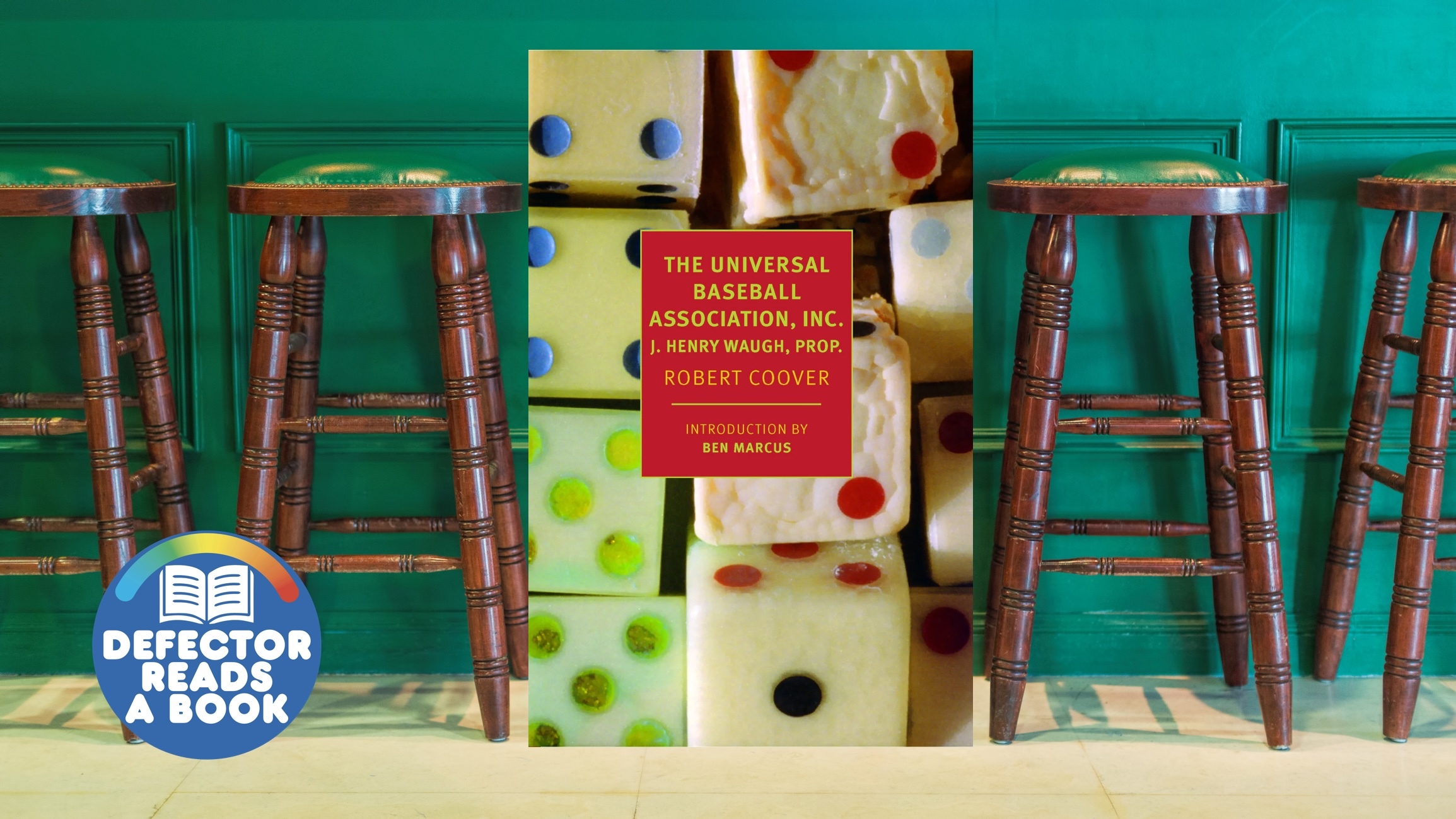
Robert Coover's 1968 novel The Universal Baseball Association, Inc., J. Henry Waugh, Prop. was one of those books, and a certified Big One For Me. It is not about baseball, although I think that comforting word there in the title made it easier for me to pick up what Coover was putting down at a time when I was only just coming to grips with how bored I'd become with all those familiar novelistic interiors. The Universal Baseball Association is, like a lot of the books that opened the way into a wider world of reading for me, a story about stories—what they do and what they're for, how they fit into and over everyday life, and who they serve and how.
Baseball's role in the story that J. Henry Waugh creates and curates with one dice-roll after another in his giddy post-work hours is mostly that of a framework, with the games themselves playing a sort of supporting role to the wild alternate reality that surrounds it. This makes for a vivid contrast with Waugh's flat, wan working life at first, and creates an inevitable conflict in the longer run. The reality he constructs around the stories and characters he creates is so much bigger—so much realer, and so much more fully felt—than the one he inhabits that it could hardly be otherwise. That central insight has proved prescient in a bunch of unsettling ways. I read this book before the culture collapsed fully into the recursive abstraction of online sociality and self-abnegating parasocial derangement, but the pull of that particular riptide was strong enough and scary enough to me 20 years ago. I'm very interested to see how it feels now, with all of us so much further out to sea.
And here's some good news on that front: For our next Defector Reads A Book, we're going to revisit Coover's masterpiece on the occasion of its new New York Review Of Books Classics edition, which comes with an introduction by Ben Marcus. We will be gathering to talk about it on May 29. We'll drop a reminder in the Cipher (you can subscribe to that here if you haven't already), and it will also be in the Defector Programming widget on the website. We'll see you at the (imaginary) ballpark.