

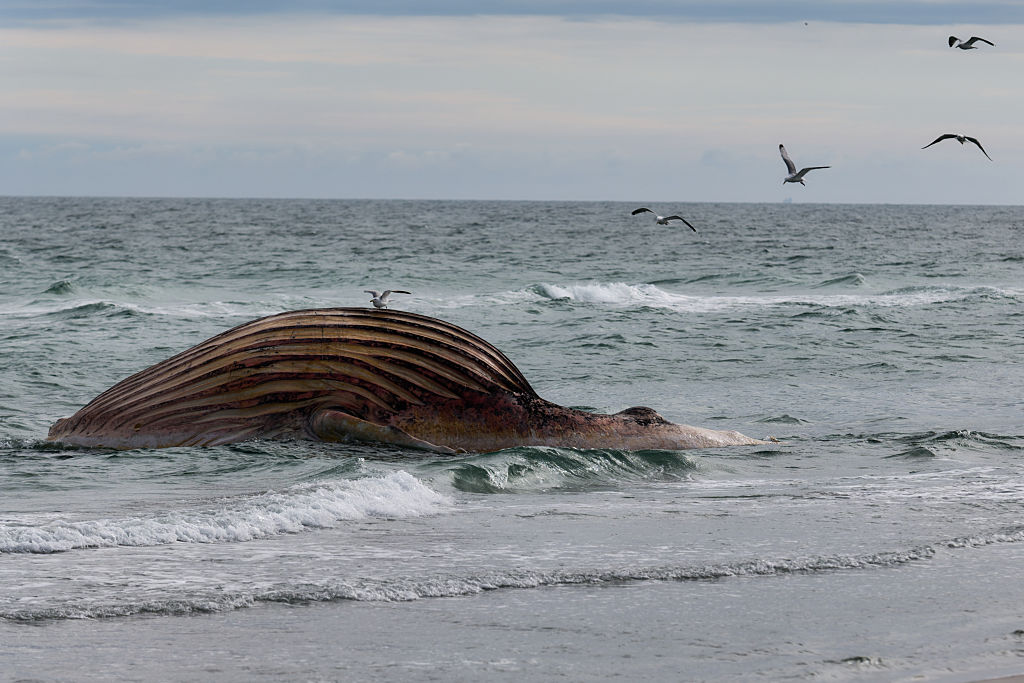
When the dead body of Timmy the humpback whale beached itself last week off the shores of the Danish island of Anholt, it was only a matter of time before Timmy would risk the fate that befalls many a beached whale:
https://t.co/zvxmHAeDHU pic.twitter.com/ZPRLdyV7qd
— Dr. Alex Zawacki (@achillghost) May 25, 2026
The residents of Anholt, per the BBC, have watched Timmy slowly balloon in size as its guts and stomach begin to decompose. Timmy's body, skin taut and distended by gases, now lolls around a sandbank a short distance from the beach and drifting in the shallow waves. As one German television channel aired a livestream of its dead body, the channel included the number of a suicide hotline.
The troubling saga of the newly tumefied Timmy raises many complicated questions. What happened to Timmy? How did we get here? Why is People Magazine reporting on a whale? Are people in Germany OK? (This, at least, is easy to answer: No.) If you too are confused about Timmy's timeline, allow me to explain it for you.
Who is Timmy?
In March, people staying at a hotel on Germany's Baltic Coast heard deep, distressing moans. The moans came from a young 33-foot-long humpback whale, stuck in the shallow waters of Timmendorfer Strand (hence "Timmy"). Timmy's condition was alarming. The whale, whose sex was never fully confirmed, looked sick and exhausted. It did not respond to the blaring noises of passing ships. Humpbacks are not found in the Baltic, a sea that is not deep or salty enough to sustain them. Local authorities attempted to help Timmy find its way back to the Atlantic, digging a channel and creating waves with a boat. But the odds were against Timmy. Even if the whale freed itself, it would need to swim about 310 miles through narrow straits to reach more hospitable waters. Timmy did manage to free itself, and was quickly ushered toward the Atlantic by guide boats. But the whale soon stranded again. When Timmy stranded for the third time, marine scientists told The Guardian: "The prognosis as a whole doesn’t look good."
This should have been the end of Timmy's tragic story. By the time a whale beaches, it is likely already dying. Once out of the water, the mammals' immense weight crushes their organs. Timmy had survived because it was slightly submerged. But the whale was extremely weak and unresponsive to immediate aid. It had lesions on its skin and had pieces of rope and net in its mouth and stomach, per Science. Experts agreed it would be extremely difficult to transport the whale back to the Atlantic, and on April 1 state-sponsored rescue efforts ceased.
Scientists decreed that the most humane course of action would be to let nature take its course. The International Whaling Commission issued a statement on April 7 that read: "For a whale of this size and condition, the chances of survival are now negligible, and further continued attempts to refloat would only cause additional suffering." From here on out, the Commission noted, palliative care would be the kindest route. Keep Timmy wet, and ensure its surroundings were calm and quiet.
So that's what they did, right?
No :(
The German people had become quite understandably attached to Timmy. Because the whale had been beached for so long, crowds had thronged to see it. Police maintained a perimeter around the whale, as some people attempted to swim in the frigid sea to get within yards of it. People shared AI-generated whale hymns, reported The European Correspondent. Conspiracy theories spread that a local museum wanted Timmy to die so that it could take its skeleton. (The museum would have kept the skeleton if Timmy died, but for research purposes.) After the director of that museum, the government's chief advisor on the whale, said he believed rescue efforts would be in vain, people began sending threats, including “May the seagulls peck you to pieces” and “May you suffer just like the whale," reported The Guardian.
Then some charlatans appeared amid the chaos, as charlatans are wont to do. A celebrity biologist named Robert Marc Lehmann had taken to Timmy, and was posting drone shots of the whale on his Instagram accompanied by captions like: "Even if the hope of success is extremely low, one must always try. Always. ❤️ 🩹 🐋." Two multimillionaires came forward and pitched a plan, which they called Operation Cushion, to save Timmy. The public, increasingly whipped up over Timmy, began to believe authorities had given up too early, reported The New Yorker. In the face of this mounting pressure, the government went back on its word and let them proceed with Operation Cushion.
So who are these millionaires, and what was Operation Cushion?
The rich saviors who stepped forward are Walter Gunz, the co-founder of the consumer electronic chain MediaMarkt, and German racehorse owner Karin Walter-Mommert. Together, with their utter lack of whale knowledge, they assembled a baffling rescue team that included a horse veterinarian, a 22-year-old mechanical engineering student, a spiritual author and motivational speaker named Sergio Bambarén Roggero who calls himself The Whale Whisperer, and a far-right German influencer and activist called Danny.Firstclass. Both the Whale Whisperer and Danny.Firstclass, it bears mentioning, believed they could communicate with the whale.
Operation Cushion was, unsurprisingly, a cushion-based operation. The team would lift the whale with inflatable cushions, stretch a net underneath it, and then tow it into deeper waters. This did not work, although it did allow the Whale Whisperer to whisper to the whale. "He was literally sticking his face in the water next to the whale, like making noises," a veterinarian who joined the rescue effort before abandoning it and calling it a "dumpster fire," told The New York Times.
Operation Cushion pivoted to a new strategy: drag the whale onto a transport barge using a hose tied to its fluke. "Rule No. 1 during a whale rescue, you never, never, ever pull a whale by its fluke," Fabian Ritter, a marine biologist at a nonprofit, told Science. The team would sail with the barge into the Atlantic Ocean and free Timmy there. At this point, another veterinarian on the team had a stroke and left for the hospital, and the rescue team barred yet another vet from witnessing the release attempt. The Times reported that some kind of fight broke out between the rescuers, and on May 2 Timmy was somehow released just off the northern tip of Denmark, a far shot from the planned destination. The team had attached a tracker to Timmy, which they said began transmitting data showing that the whale had made deep dives. But it stopped working within a week. Walter-Mommert and Gunz later released a statement distancing themselves from "the events and the manner in which the whale was abandoned." The whole initiative cost about €1.5 million.
Although marine scientists harshly condemned the entire debacle, many media outlets framed Timmy's release as a victory, even in the U.S. The AP called the rescue "spectacular and contentious," and NPR's headline declared Timmy "rescued." One expert even told the New Yorker that, if Timmy were to die, at least his body would become a whale fall and sustain a thriving community of deep-sea life. Then, on May 15, Timmy was found dead off Anholt.
What was Timmy's experience of all of this?
It is impossible to know what Timmy might have been thinking as a team of—let's be honest—idiots dragged its ailing body to and fro for weeks. The whale's experience after its release is also unknowable, in part given that its tracker broke so quickly, if it worked in the first place. It is clear that the operation prolonged the whale's physical suffering. But we can only wonder at Timmy's emotional experience of its final days and what the whale made of all the chaos.
I still don't understand why people got so crazy about this whale.
Whales are just one of those animals that make people crazy. They're big yet gentle. They are intelligent and social in many of the same ways we are. They breach, wail, and sing. It is understandable that people, upon seeing a whale beach itself, would want to help. It is even more understandable to want to help a whale that might have beached itself due to human causes. Timmy was tangled in gill nets, with rope caught in its baleen. But very few whales can recover from stranding. Whales strand when they are already sick, injured, or dying. In such cases, "rescue" attempts are not just futile, but a misnomer.
More specifically, however, it seems clear to me that many of the people involved in this saga were not acting in the whale's best interest, but rather toward personal gain. A celebrity whale biologist who is tantalizingly close to a million followers on Instagram surely knows what it would mean for his personal brand to champion an ailing whale. The Whale Whisperer wanted to whisper to a whale, and he got the chance. It is less clear to me what Danny.Firstclass, whose real name is Danny Hilse, wanted out of the situation. A Guardian investigation linked the rescue team to a group of far-right conspiracy theorists and COVID truthers who claimed "they can create an aura that reaches the whale and help to save it." Till Backhaus, a state environmental minister who greenlit the privately funded rescue plan, belongs to Germany's Social Democratic Party, which is trailing far-right politicians heading into upcoming elections. Backhaus, it seems, wanted to ally himself with public opinion despite going against the advice of every real marine scientist in Germany.
What did Timmy want? This is, of course, speculation, but it does not seem much of a stretch to suggest that Timmy simply wanted to die, which it could have done, much sooner, if we hadn't gotten in the way.