


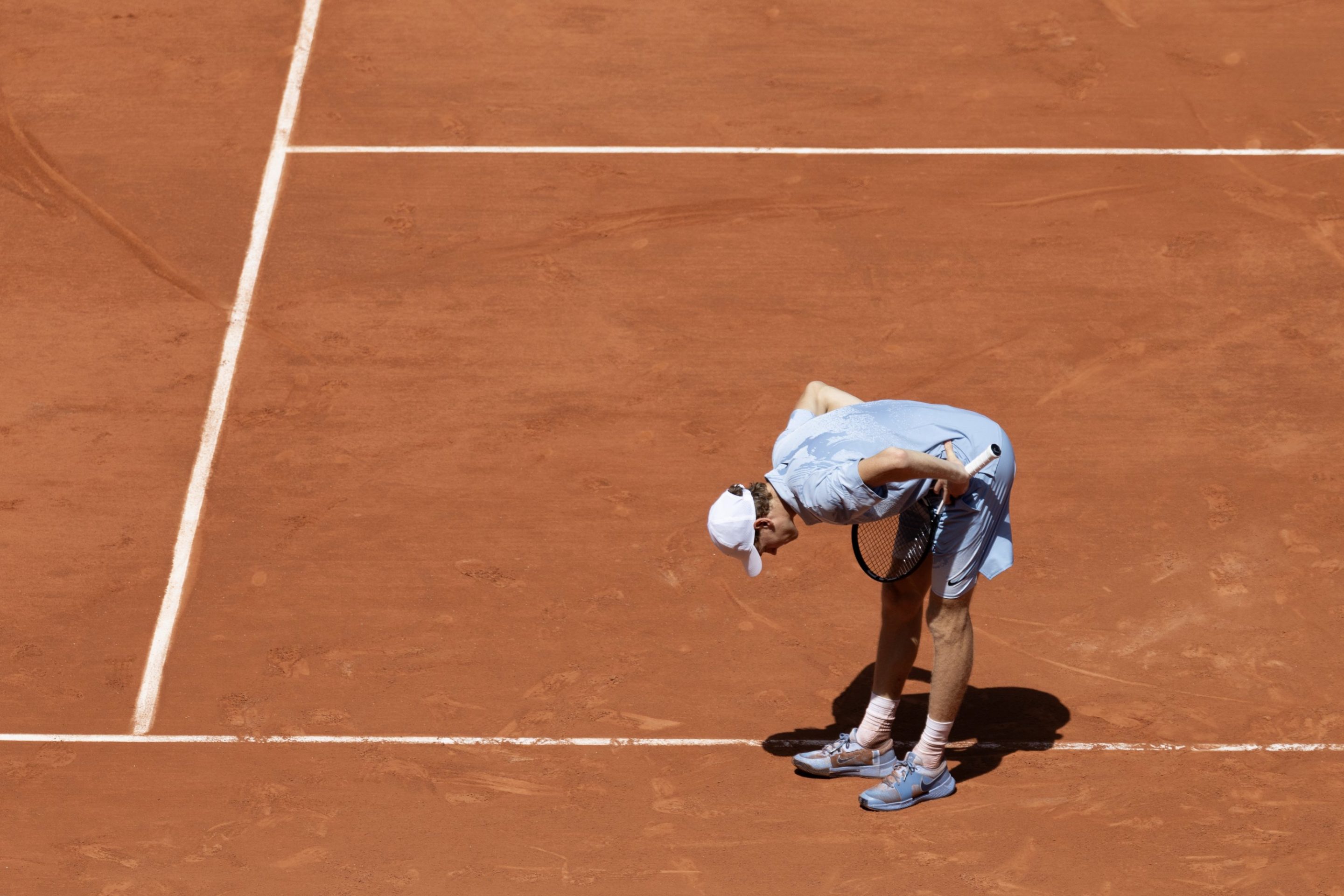
Going into Roland-Garros, there was clear consensus: The greatest threat to Jannik Sinner was the Sun itself. It's the type of snappy one-liner that gets slung on the TV broadcast a dozen times a day, but it wound up prescient as the No. 1 seed melted down Thursday in a stupefying second-round loss to Juan Manuel Cerundolo.
Outside of celestial bodies, the top men's player wasn't slated to face much of a threat at the clay Slam. His rival Carlos Alcaraz had recently announced that he would sit out the summer to recover from a wrist injury. Part-time tennis player Novak Djokovic had barely clocked in for work since his impressive win over Sinner in Australia in January. In the meantime, Sinner had regained the No. 1 ranking, stomped the tour, and racked up records. When he arrived in Paris, he was winding down one of the best clay seasons in tennis history, having swept the three Masters titles, a feat previously achieved by only Rafael Nadal. Along the way, Sinner dropped only one set. Zooming out slightly further, Sinner had strung together six Masters titles in a row, which had never been done. He became the second player to complete the full set of nine Masters trophies, and he accomplished it seven years faster than Djokovic. I could bore you with even more, but I'll leave you with this simple number: Sinner had a 30-match win streak heading into his second-round match at Roland-Garros. I expected that number to extend to 36, and for him to lift the title that brutally eluded him by just one point last season.
But let's get back to the Sun. It's been hot at Roland-Garros thus far. Sinner has struggled with heat in many high-profile matches, most conspicuously at this year's Australian Open, when a timely application of the heat rule allowed him to recover from a cramping jag in his third-round match. Fortunately for Sinner, tournament organizers will always accommodate the scheduling preferences of a superstar. In Paris, it was clear that he tried to dodge the hottest hours in the middle of the day. His first-round match was scheduled in the last slot, after the courts had cooled. Thursday's second-round bout was the opener on Court Philippe-Chatrier, which, as Ben Rothenberg laid out, was unusual scheduling for a men's match.
With an early start on the day and a pulverizing talent advantage, Sinner nearly finished a routine job. He was up 6-3, 6-2, 5-1 when he began to cramp. After losing three games in a row, there was an unusual exchange between Sinner and chair ump Aurelie Tourte, who walked over to help the suffering Italian navigate the uncertain situation instead of simply starting the serve clock. Even after taking a timeout, Sinner wound up losing the third set.
From that point onward, Sinner could barely move his legs. The fourth set slipped away and his condition didn't meaningfully improve. He couldn't move laterally, couldn't backpedal, couldn't time the ball. While it would be more compelling if we could credit world No. 56 Cerundolo for making the match physical and pushing Sinner beyond his limits, that's not really what happened on the court. Cerundolo did well to stay calm in bizarre circumstances, but he was playing a corpse who, after going up 5-1 in the third set, lost 18 of 20 games in one of the strangest upsets in recent tennis history.
The streak of nine Slams won by Sinner and Alcaraz now ends, albeit in unsatisfying fashion, less due to a challenger's excellence than to medical woes. In the course of writing and promoting a book about these two players, I've had to simplify shaggy storylines into clean talking points. I've had to exaggerate the differences between two players who actually have quite a bit in common, so that a reader or listener can more clearly delineate them. One thing I've said often, lightly eye-rolling at myself, is that Alcaraz is more likely to be undone by his own mind, and Sinner by his own body. But then we witness actual tennis matches that mirror the truisms with eerie clarity. This loss might as well be a caricature of Sinner losing to The Elements while on the doorstep of victory.
What happened today? Not even Sinner seemed to have a conclusive answer in his post-match press conference, but the facts can be arranged. He is 24 years old, the age when most players enter their physical prime. Though stamina was a glaring issue early in his career, he has improved on that front in recent years. Although he had the usual free week heading into Roland-Garros, he had played a staggering amount of tennis this spring, because nobody has been able to beat him and end his work weeks early.
"I played a lot and didn't have much time to recover," Sinner said after the loss. He observed that the conditions in the match today were "warm but not crazy warm," favorable compared to the loss to Tallon Griekspoor in last year in Shanghai, where humidity was higher, or the win over Eliot Spizzirri this year in Australia, where the hard court radiates heat from below. Sinner said he wasn't feeling great when he woke up in the morning, but played well until he "hit the wall." He did suggest that he might finally take a break from the tour until the start of Wimbledon.
As unpleasant of a viewing experience as this was, it did open a rich narrative vein. Stamina might be the last unsolved problem that tennis poses to Sinner. He now has a 6-12 record in five-set matches; three of those losses have taken place over the past three years at Roland-Garros, on the most physically demanding court surface. He has visibly cramped in many of these matches. Cramping is one of the biggest founts of pseudoscience and folk wisdom in all sports discourse, so I won't speculate about Sinner's genetics or pretend that there's a clear line between problems of physiology and psychology. What I can say is that he already spends a lot of time working on overall conditioning and training in hot locales, so it's not a straightforward oversight by his team. (Not to say that they're incapable of highly consequential oversights.) The weeks he spends away from the tour will be spent studying this loss, and reevaluating a training regimen that has already landed him in the sport's history books several times over. It might feel bizarre to say this after his recent run of dominance, but something about Jannik Sinner's preparation has to change.


![USA's Ben Shelton celebrates his win against Spain's Carlos Alcaraz during the men's singles quarter-final tennis match on day ten of the US Open tennis tournament at the USTA Billie Jean King National Tennis Center in New York City on September 9, 2026. (Photo by Leonardo MUNOZ / AFP) / “The erroneous mention[s] appearing in the metadata of this photo by Leonardo MUNOZ has been modified in AFP systems in the following manner: [USA's Ben Shelton] instead of [Spain's Carlos Alcaraz]. Please immediately remove the erroneous mention[s] from all your online services and delete it (them) from your servers. If you have been authorized by AFP to distribute it (them) to third parties, please ensure that the same actions are carried out by them. Failure to promptly comply with these instructions will entail liability on your part for any continued or post notification usage. Therefore we thank you very much for all your attention and prompt action. We are sorry for the inconvenience this notification may cause and remain at your disposal for any further information you may require.”](https://lede-admin.defector.com/wp-content/uploads/sites/28/2026/09/GettyImages-2293730421.jpg?resize=2880%2C1920)