


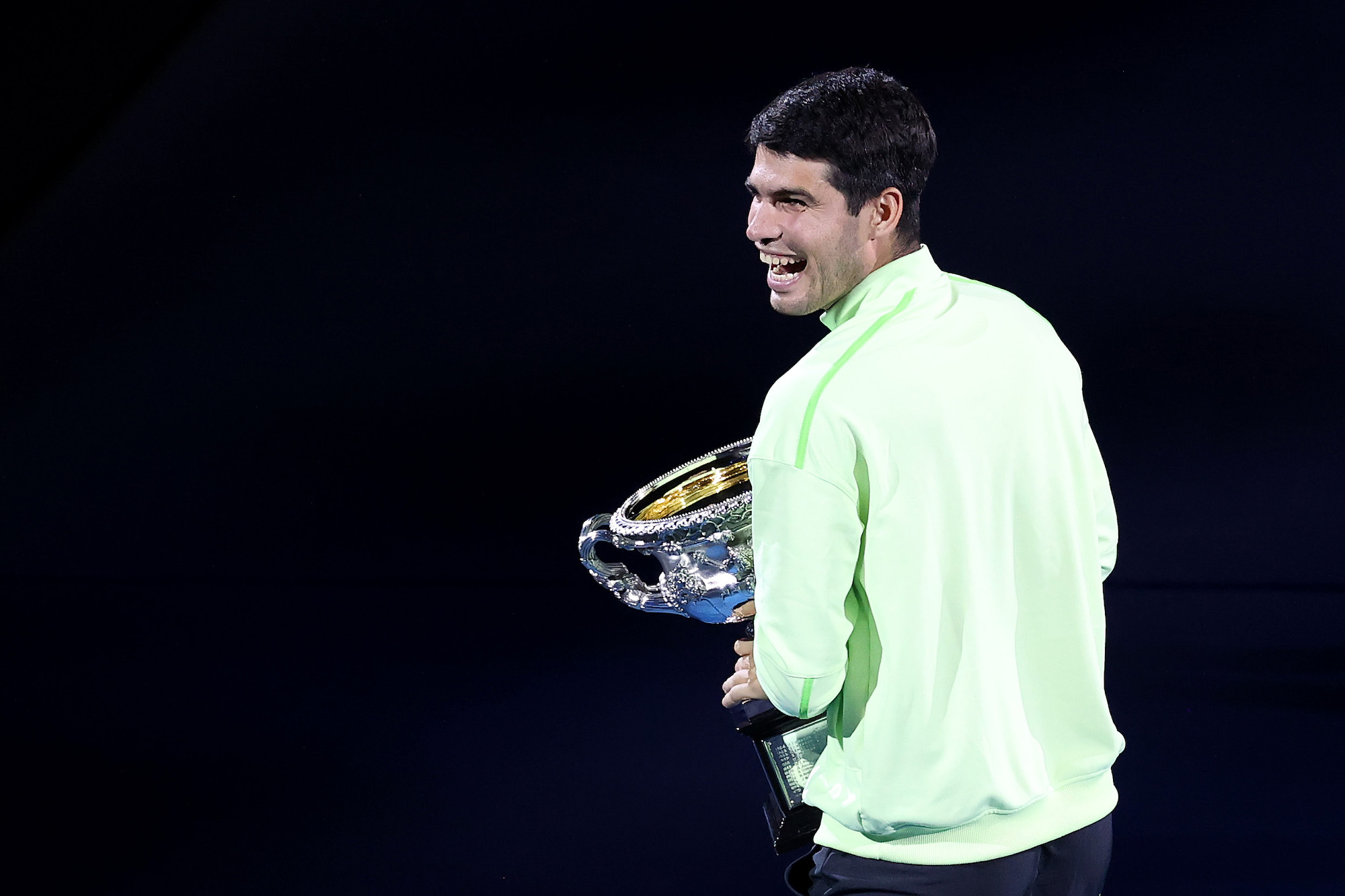
Thanks to the eerie longevity of its recent greats, men's tennis has been preoccupied with endings over the last few years. It's all about legacy, the decision to retire, the tally of major titles once the rackets have been set down for good. All of it is almost a little morbid. How refreshing that the game's greenest superstar is reorienting the conversation around beginnings instead, because no career in men's tennis has ever started quite like that of Carlos Alcaraz. No man had ever seized all four of the sport's biggest trophies by the age of 22, a labor that the Spaniard completed Sunday by defeating Novak Djokovic, 2-6, 6-3, 6-2, 7-5, to win the 2026 Australian Open.
Going into this season, Alcaraz had won the three other majors, twice apiece, but in Melbourne he had never advanced past the quarterfinal stage. There was no reason to think he couldn't; his success on outdoor hard courts had been demonstrated amply at other stops on tour. This year, he pushed through bodily distress and one of his most difficult opponents to finish the job and secure the career Grand Slam. To even think about a 22-year-old's "legacy" right now would feel wrongheaded. How can you be looking forward and not straight at him? His staggering talent, and his very style of play, demand that any observer stay locked into the present moment, so as not to miss a single swagger, smile, or deranged moment of improvisation.
Alcaraz's title run only ever looked in peril at two moments. The first occurred during his semifinal against Alexander Zverev, the opponent who cut short his 2024 run in Australia by serving him off the court. This year, Alcaraz had won his first 17 sets at the tournament, including the first two over Zverev in that semifinal. Carlitos seemed bound for straight-set victory when he started to cramp late in the third. He took a controversial medical timeout—cramps are not technically grounds for a medical timeout—vomited into a towel, drank some pickle juice, and proceeded to hobble around the court like a pirate for the better part of two sets. Zverev, dilly-dallying fatally, needed tiebreaks to win the third and fourth sets. He went up a break in the fifth and had an opportunity to serve out the match. Instead, the greatest mover on tour recovered the feeling in his legs and claimed the next three games to win in five hours and 27 minutes, the longest semifinal in tournament history and one of the strangest victories of his young career.
The second moment was right after the first set of yesterday's final against Novak Djokovic. It's worth pausing to marvel that this matchup was even possible. I wrote in 2023 that the rivalry between Alcaraz and Djokovic was precious because it was necessarily scarce. One was ascending to the summit, the other descending. In 2024, Alcaraz and rival Jannik Sinner locked Djokovic out of the major title race completely. In 2025, Djokovic managed one big-time victory over Alcaraz in Australia, but it came at the expense of his own hamstring, and he withdrew from his next match with injury.
Sinner in particular seemed to have solved the matchup against the GOAT, dominating Djokovic at the French Open and Wimbledon in 2025 without dropping a set. Alcaraz picked up where Sinner left off, dismissing his elder in straight sets at the U.S. Open. Djokovic, whose chief concern is adding major titles, and who could beat anyone else on tour, was being obsoleted by the emergence of these twin dynamos. His remarks on his own future prospects varied wildly by the day, swinging between cautious optimism and cool resignation.
Heading into 2026, I had assumed Djokovic's days of defeating Sincaraz in best-of-five formats were over. It would have been a sufficient feat, frankly, if all he had to do to win a major was show up and defeat Sinner and Alcaraz back to back, two days apart. Indeed, he got as close to that hypothetical as one reasonably could. Some excellent luck—an opponent's walkover, another opponent's brutally timed injury while leading by two sets—allowed Djokovic to advance from the third round to the semifinal without winning a single set of tennis. Though he'd entered previous encounters against Sinner and Alcaraz after multiple rounds of wear and tear, this year he came in far fresher. And that surely played a role in this unlikely win: a five-set semifinal victory over Sinner.
It's been said that Friday's match against Sinner was vintage Djokovic, but in truth it was a Djokovic I'd never seen before, and was astonished to witness. Vintage Djokovic would have trusted in his legs and overwhelmed his opponent with a cavalcade of perfectly measured risks, each ball placed as if on a single grain of rice, and not a mile per hour too fast. On Friday, Djokovic was done with all the careful measuring. He flattened out his forehand and boomed everything down the line, having realized that total aggression rather than slow attrition was required to defeat Sinner, who was 14 years younger and in possession of a style that could be described as "baseline Djokovic but someone's sitting on the remote's fast-forward button."
This low-margin tennis was a style I'd seen Djokovic dabble in earlier in his career, for brief passages of play, but I had never seen him stuck in that mode for five full sets. I wasn't sure he could redline for that long without losing any precision. The uncharacteristic assault seemed to rattle Sinner, whose rally ball lost its usual weight and pace, and who squandered 16 of 18 break point opportunities. Djokovic won and kept on redlining in Sunday's final, too. What worked against one wunderkind was his best tack for defeating the other. A stretch of immaculate, brutal tennis won him the first set, 6-2. He had Alcaraz out of rhythm. The Spaniard seemed intent on meeting Djokovic in a battle of hard-hitting, instead of using his historically singular blend of power and feel to keep changing up the balls. Sometimes all it takes is a quick observation to shift perspective. As Alcaraz said afterward in press, in the first game of the second set, he saw Djokovic make a few "easy mistakes," and this pushed him to stay positive and tweak the tactics that didn't work in the first set.
As the match went on, Alcaraz began to recover his identity, and Djokovic began to pick at his right hip with his hand and the butt of his racket. Alcaraz resolved the ambiguity in his young mind faster than Djokovic could win the race against his old body. There was another test of mettle, at 4-4 in the fourth, when Djokovic lined up a break point, but Alcaraz survived and closed out the match a few games later.
It would be difficult to overstate what Alcaraz has achieved just a month into the 2026 season. He quelled all doubts about his offseason split with longtime coach Juan Carlos Ferrero, with whom he'd enjoyed an unusually close bond. He extended his lead in the rankings as the No. 1 player in the world. He snatched both hard-court major titles away from his archrival Sinner, who was in the middle of one of the most dominant two-year stretches the surface has seen. He leveled his record with Djokovic to 5-5. He proved the versatility of his style, and the magnitude of his talent, by wrapping up the career Grand Slam even quicker than Rafael Nadal, the previous standard for all-terrain prodigy, who was in the stands on Sunday to see him to do it. And now, to put the achievement in ink, Alcaraz is going to get a kangaroo tattoo. Either on his right or left leg—he hasn't decided yet.


![USA's Ben Shelton celebrates his win against Spain's Carlos Alcaraz during the men's singles quarter-final tennis match on day ten of the US Open tennis tournament at the USTA Billie Jean King National Tennis Center in New York City on September 9, 2026. (Photo by Leonardo MUNOZ / AFP) / “The erroneous mention[s] appearing in the metadata of this photo by Leonardo MUNOZ has been modified in AFP systems in the following manner: [USA's Ben Shelton] instead of [Spain's Carlos Alcaraz]. Please immediately remove the erroneous mention[s] from all your online services and delete it (them) from your servers. If you have been authorized by AFP to distribute it (them) to third parties, please ensure that the same actions are carried out by them. Failure to promptly comply with these instructions will entail liability on your part for any continued or post notification usage. Therefore we thank you very much for all your attention and prompt action. We are sorry for the inconvenience this notification may cause and remain at your disposal for any further information you may require.”](https://lede-admin.defector.com/wp-content/uploads/sites/28/2026/09/GettyImages-2293730421.jpg?resize=2880%2C1920)