


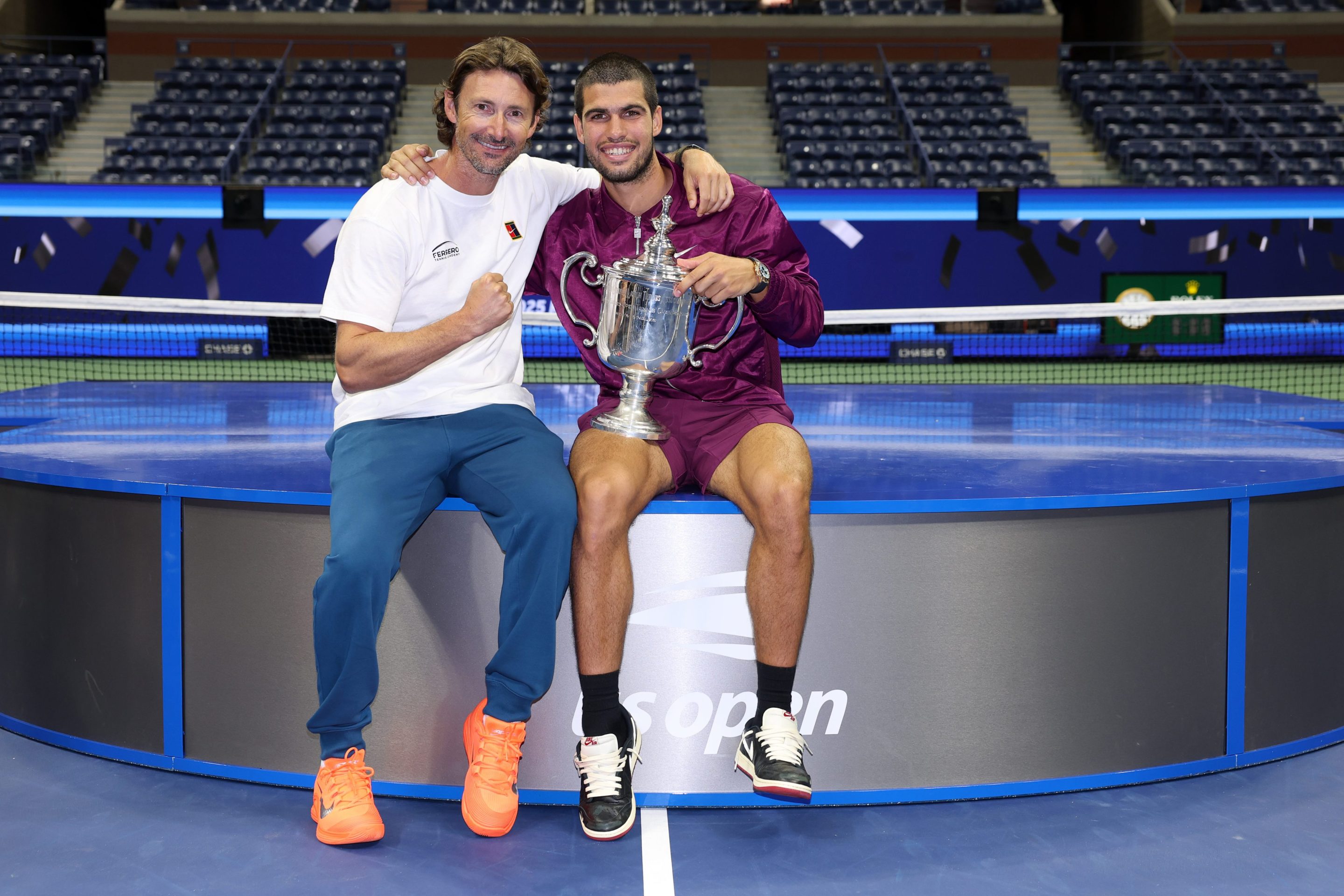
In a surprising offseason move, men's No. 1 Carlos Alcaraz has split with his coach Juan Carlos Ferrero, after seven years and six major titles. Thus ends one of the most successful and intimate partnerships in tennis. It began when Alcaraz was a teenager, traveling an hour from home to train at Ferrero's academy, and grew deep enough that Alcaraz often referred to Ferrero as his "second father."
In the relatively new era of legal on-court coaching, the two kept open a channel of nonstop chatter and gestures. A 19-year-old Alcaraz, on the cusp of his first major title in 2022, was still asking Ferrero where to serve at specific junctures in the match. Sometimes it seemed like Ferrero's chief task was emotional rather than technical: getting his overheated charge to simmer down and play simpler tennis in critical moments. This education worked. The 22-year-old Alcaraz of today is significantly better at self-soothing, and tennis at a whole.
Both player and coach acknowledged the move on social media Wednesday, and the phrasing of Ferrero's message suggested that it was not a mutual decision. "I wish I could have continued," he wrote. "I am convinced that good memories and good people always find a way to cross paths again."
Possibly their issues were financial or emotional, because it would be difficult to argue with the on-court results. Ferrero has been a responsible steward of one of the greatest raw talents the ATP has seen, advancing his game piece by piece. This time last year, the team tackled the one aspect of Alcaraz's tennis that still called for significant technical improvements: the serve. Those changes to his service motion bore fruit in the 2025 season, best seen in a U.S. Open run where Alcaraz saw his serve broken just three times. He described it as his "best tournament" ever. It was the first major title that he'd won so straightforwardly.
Ferrero also helped guide Alcaraz in the central rivalry of his career. After Alcaraz lost to Jannik Sinner in this year's Wimbledon final, player and coach entered a training block to address the specific skills he needed to win against that particular opponent. Weeks later, Alcaraz won their U.S. Open final comfortably. (Ferrero, pressed to reveal those details after that match, joked that he couldn't divulge because Sinner's coach was listening.) Alcaraz would lose to Sinner in the year's last match, an absolute barnburner at the ATP Finals, but in totality, 2025, like every other Carlos Alcaraz season to date, was an unequivocal success. He went 71-9, reclaimed the No. 1 ranking, controlled the Sinner head-to-head 4-2, won eight titles (including two majors), and even thrived on indoor hardcourt, a surface that had confounded him in the past.
In tennis, player-coach relationships generally end not for technical reasons, but because a motivational style stops working. Earlier this year, Daniil Medvedev split with Gilles Cervara—another partnership that achieved world No. 1 and a major title—and in an interview, the coach used an image that stuck with me:
A team around a player is like an engine—a complex machine that drives forward. When it runs at full power, you go fast. At some point the engine stops, but you don’t see it because the boat continues gliding. After a while, that energy is gone, and you’re stuck mid-sea, trying to restart that engine.
Ferrero, who is 45 and not far removed from a playing career in which he once reached world No. 1, will be one of the most sought-after coaches on the market. Alcaraz was just the second player he partnered with full-time. In 2017 and 2018, Ferrero worked a brief stint with Alexander Zverev, then a top-10 player seemingly headed for greatness. After that fizzled out, Ferrero was persuaded to head back down to the Futures and Challenger levels of the game, to work with a skinny kid from Murcia who seemed capable of everything.



![USA's Ben Shelton celebrates his win against Spain's Carlos Alcaraz during the men's singles quarter-final tennis match on day ten of the US Open tennis tournament at the USTA Billie Jean King National Tennis Center in New York City on September 9, 2026. (Photo by Leonardo MUNOZ / AFP) / “The erroneous mention[s] appearing in the metadata of this photo by Leonardo MUNOZ has been modified in AFP systems in the following manner: [USA's Ben Shelton] instead of [Spain's Carlos Alcaraz]. Please immediately remove the erroneous mention[s] from all your online services and delete it (them) from your servers. If you have been authorized by AFP to distribute it (them) to third parties, please ensure that the same actions are carried out by them. Failure to promptly comply with these instructions will entail liability on your part for any continued or post notification usage. Therefore we thank you very much for all your attention and prompt action. We are sorry for the inconvenience this notification may cause and remain at your disposal for any further information you may require.”](https://lede-admin.defector.com/wp-content/uploads/sites/28/2026/09/GettyImages-2293730421.jpg?resize=2880%2C1920)