

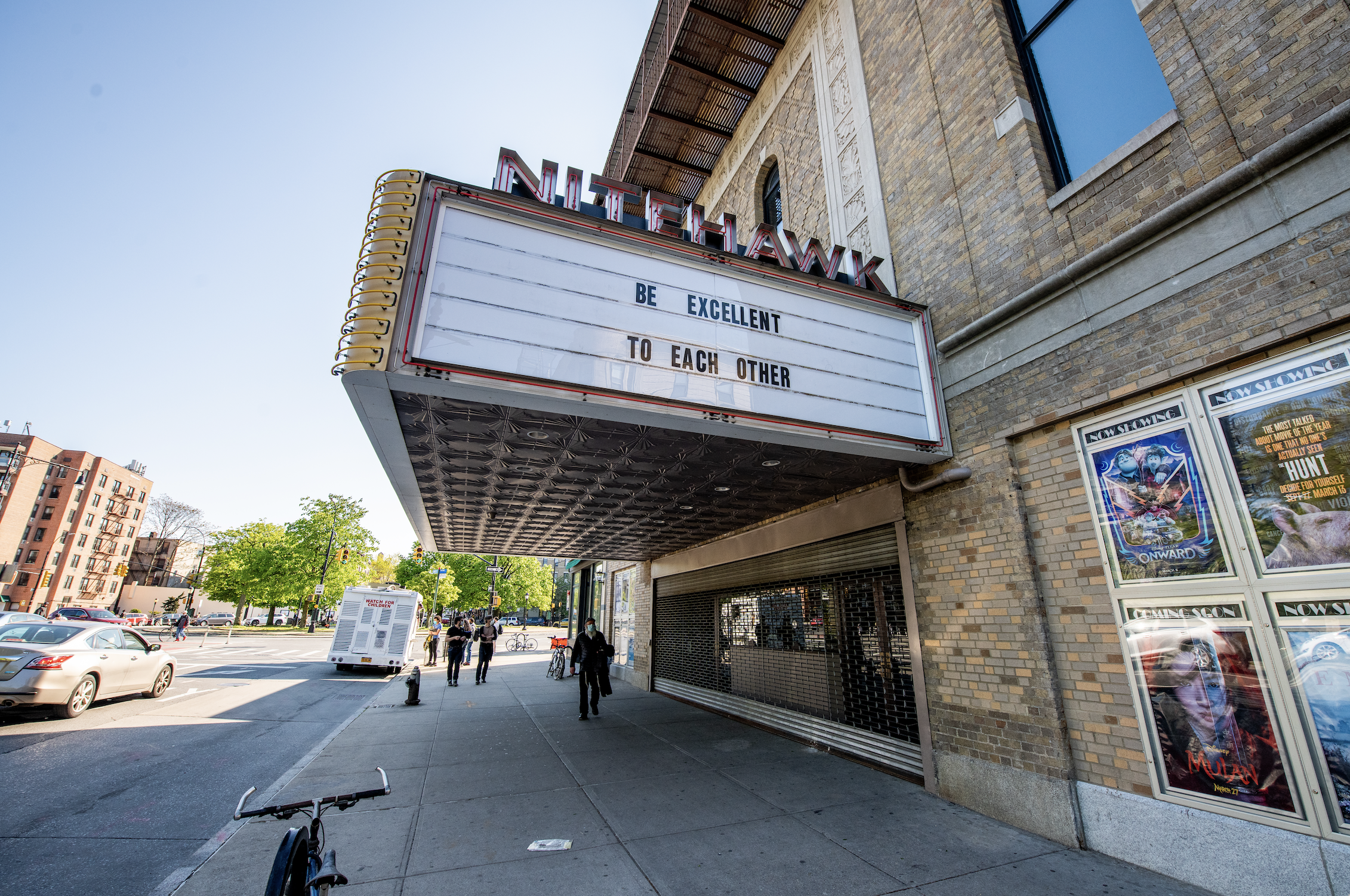
Half an hour into the Nitehawk Workers Union’s winter rally, 50 or so people had gathered across the street from the Nitehawk Prospect Park Theater to chant, hold signs, and shiver on a Friday too cold for the season. Most of them were your usual labor supporters—members of the UAW and Teamsters Local 804 were there, as was Congressional candidate Brad Lander. But during one early speech, a man ran across the street and nervously asked me what was going on. After explaining that they were service workers at the theater, rallying for better conditions, he looked crestfallen. “I go there for the movies,” he said. “I didn’t know that anything was wrong.”
Nitehawk is an independent theater in a tony section of Brooklyn, the kind of cinema that screens both Hoppers and a series devoted to the works of women cinematographers. It also operates on the full-service food model: You sit down, place an order on a piece of paper, and, as you take in the film, a fried chicken sandwich and a drink appear at the personal table attached to your seat, brought by a server moving as silently and swiftly as possible. “As the business model goes, it’s a logical extension of what movie theaters have always done, which is make the majority of their money off of concessions,” said Ben Sepinuck, a member of the Nitehawk Workers Union organizing committee. And it makes some intuitive sense for an industry clamoring to get people in the theater: Sure, you can stream Frankenstein at home, but can you enjoy it while in a lay-back chair with popcorn and cocktails on demand?
Nitehawk workers began organizing at the Prospect Park location in the summer of 2023 (its sister location, a few neighborhoods away, isn’t unionized). “A lot of restaurants in Brooklyn were unionizing at the time,” Sepinuck said, and workers saw themselves in the larger labor movement in the service industry. Like in a restaurant, the servers at theaters like Nitehawk are responsible for greeting guests, taking orders, running food, and collecting checks. But unlike at a restaurant, they have to do this around an experience guests don’t want interrupted.
“More times than not, the lights are off,” said Shannon (who asked that we use a pseudonym to protect her from potential retaliation), who has been working at Nitehawk for about a year, joking that servers have to wait for the “daytime parts” of Marty Supreme to see where they’re going. But they also have to make sure that they aren’t interrupting a film’s big climax to drop checks. “What I'm doing has to be the invisibilized secondary part of their experience.”
Much of what workers are fighting for are standard, reasonable asks in the service industry: safer working conditions, healthcare, fair pay, and, crucially, consistent and well-staffed schedules. The issue of understaffing came to a head as the Barbenheimer phenomenon descended on the theater in 2023. “We were completely slammed and understaffed every single day, and the company is making money hand over fist, and virtually none of that made it to the workers,” Sepinuck said. The understaffing meant workers were more prone to mistakes and missing orders, which meant more interruptions to the guest experience. Now, almost three years later, workers say management is stalling. “They finally gave us back a wage counter[offer], and it was to literally slash wages from where they currently are,” Sepinuck said. (Defector reached out to Nitehawk management for a statement on negotiations, and has not yet heard back.)
This comes at a time when a lot of people agree that movie theaters are in trouble, but opinions vary on how to “save” them, or if we should bother at all. According to a recent Pew Research Center survey, 53 percent of Americans said they’d seen a movie in the theater in the past year, but domestic ticket sales were down about 22 percent from pre-pandemic sales. There are also fewer theaters in the U.S. than there were pre-pandemic. The dine-in model has often been touted as a way to get people back, but it requires money and labor, two things corporations have historically not wanted to provide.
The dine-in model does appear to be popular, at least in theory—it’s what allowed the Alamo Drafthouse to grow from a single arthouse theater in Austin, Texas, to a national chain with over 40 locations across 13 states and Washington, D.C. Customers responded to the high-touch, personal service and strict no-phones-ever policy, a seeming commitment to the experience of seeing a movie in a theater. But the company recently announced it would be switching over to mobile ordering during screenings. In a press release, Alamo Drafthouse said, “Putting ordering control directly in our guests’ hands allows us to move faster and more efficiently, creating a smoother, more responsive experience without added distraction.” Of course, this means cutting worker hours in the process.
Maybe it’s no surprise that this change comes on the heels of Alamo Drafthouse filing for Chapter 11 bankruptcy protection in 2021, and the company being acquired by Sony Pictures in 2024. Shortly after the acquisition came mass layoffs, over which unionized workers in New York and Colorado went on strike. Language of “efficiency” from major corporations tends to be code for getting rid of pesky workers, who cost them money that could be saved for the C-suite.
What Alamo seems to miss is that swift, personalized service is exactly why people went there in the first place. So far, replacing servers with a QR code does not seem to be going well. Instagram user Nick Garza notes the irony that the theater, which would famously ban people if they texted during a movie, now alerts you with a text message when it’s time to pay for your food. The Alamo Drafthouse Reddit is lit up with people complaining about theaters filled with distracting phone use, or about having to take five minutes in the app to find out how to order a soda instead of just writing it on a card. “I hate to be dramatic, but Alamo was the last place I really felt like it was worth going to see a movie, specifically because I could count on them to minimize distractions. Now that I’ve dropped them like a bad habit, it’s likely home viewing only for me from here on out,” writes one user. “Alamo killed the Alamo.”
No such threat to the business model has been made for Nitehawk workers, though obviously they are aware of what similar businesses are doing. “I worry in a general sense because I don't like this being established as a precedent for any cutting of human workers in favor of using an app on your phone,” Shannon said. “Like, that’s dystopia, baby.”
Dine-in theaters aren’t the whole solution, but “specialty concessions,” which includes this full-service model, are what more theaters are turning to to find profits. “The challenge for the movie industry is to create a moment in time—the idea that you need to be there to experience it, right now,” Christopher Bridgland, a head of strategy for the ad agency Ogilvy, told the New York Times. And that experience, whether it’s a specialty drink that must be assembled behind a counter, or a bistro burger delivered to your seat, takes an investment in labor, which clearly these companies do not want to do.
It’s therefore worth asking if the ability to see movies in a public theater is actually what the movie industry wants. It’s easy to see a future in which, fed up with having to be on their phones, moviegoers stop going to Alamo, at which point Sony can dust off its hands and say, “See? No one wants to go to a theater anymore,” and shut them down. Netflix CEO Ted Sarandos recently called movie theaters “an outdated concept,” citing how few Americans live close to one. “If you’re fortunate enough to live in Manhattan, and you can walk to a multiplex and see a movie, that’s fantastic. Most of the country cannot,” he said.
Well, whose fault is that? It’s easy to claim low ticket sales as proof no one “wants” to go to movie theaters, but you can’t fairly blame the public for not using the service they don’t have access to. “Of course Netflix says that,” Sepinuck said. “That’s like Sam Altman saying everything is going to be AI in 10 years.”
As Angelica Jade Bastién writes in Vulture about Timothée Chalamet’s comments on the opera being something artists have to argue should be “kept alive” (he’s right, by the way, and everyone needs to get a grip), the threats to “moviegoing” are both external and internal, and have existed since movies themselves have: “Hays Code limitations, the end of the mighty classic studio system business approach due to antitrust decrees in 1948, McCarthyism, the popularity of television, the popularity of video games, the popularity of television again, the popularity of streaming sites like Twitch, the mounting encroachment of AI, and the public’s growing disinterest in the kind of stars Hollywood props up most fervently.” Against all that, why would anyone go to the movies? Why has anyone?
I can only answer for myself, but I like seeing things on a big screen, and the way popcorn tastes when I’m not in control of the butter and salt content. I like that I can’t pause the movie, and that being on your phone is (mostly) still frowned upon. I like when everyone in the audience laughs or gasps at the same time, making the feeling bigger for all of us. “People have been worrying about this for a long time, and it keeps chugging along,” Sepinuck said. Rather than being tempted away by TV and games, some segment of the population continues to want the theater, and is only thwarted by things like ticket prices, time, and a dearth of theaters.
Nitehawk, in its upper-middle class walkable locale, isn’t exactly representative of the American moviegoing public. But as the March rally went on, more people showed up, emerging from Prospect Park on a run, or a dog walk, or a stroll with friends. They grabbed fliers, chanted, or just gave a friendly thumbs-up while running by. One supporter, Dan, said he and his spouse live nearby, and go to Nitehawk a few times a month, even recently renting out the theater’s bar for their 10th wedding anniversary. “This is an important place to me,” he said. “I want the businesses I frequent to treat their workers well.”
And Shannon says there are plenty of hints that people still want a theatrical experience. Customers flood the theaters for family films like Wicked and Zootopia 2, as well as Oscar nominees like Hamnet, and she often sees teens and parents at the same showing but sitting apart, allowing the kids to test the waters of their independence. The Pew survey notes that two-thirds of 18 to 29-year-olds had seen a movie in theaters in the past year, higher than any other age group. Maybe it’s just the older CEOs who are out of touch.
Predicting the future of billion-dollar industries is a fool’s game, but the movie industry may be slowly realizing that it thrives because of the experience of moviegoing, not in spite of it. Recently, Universal Pictures said it would lengthen the amount of time movies played exclusively in theaters before becoming available on streaming services, a move that seems to recognize movies make more money the longer they are in theaters, because people will see them. Executives realize that releasing films in theaters only helps to grow streaming services. The consensus seems to be that moviegoers still enjoy an “experience,” and are willing to pay for the service.
At the rally, Nitehawk workers reminded everyone that they were not calling for a boycott. “We still need your tips!” one shouted. They just want recognition that to offer this experience requires money and care for workers. That’s never been something any industry has been great at understanding. But what else are the movies for, if not to dream?