What do you listen for in a great movie score? An iconic theme, perhaps, or a meaningful leitmotif that ties the film together. Maybe you want something innovative, compositions that make a film feel contemporary as they mine the cutting edge. Or maybe you just want a grand, sweeping throwback that plays every piece of the orchestra like in the good old days.
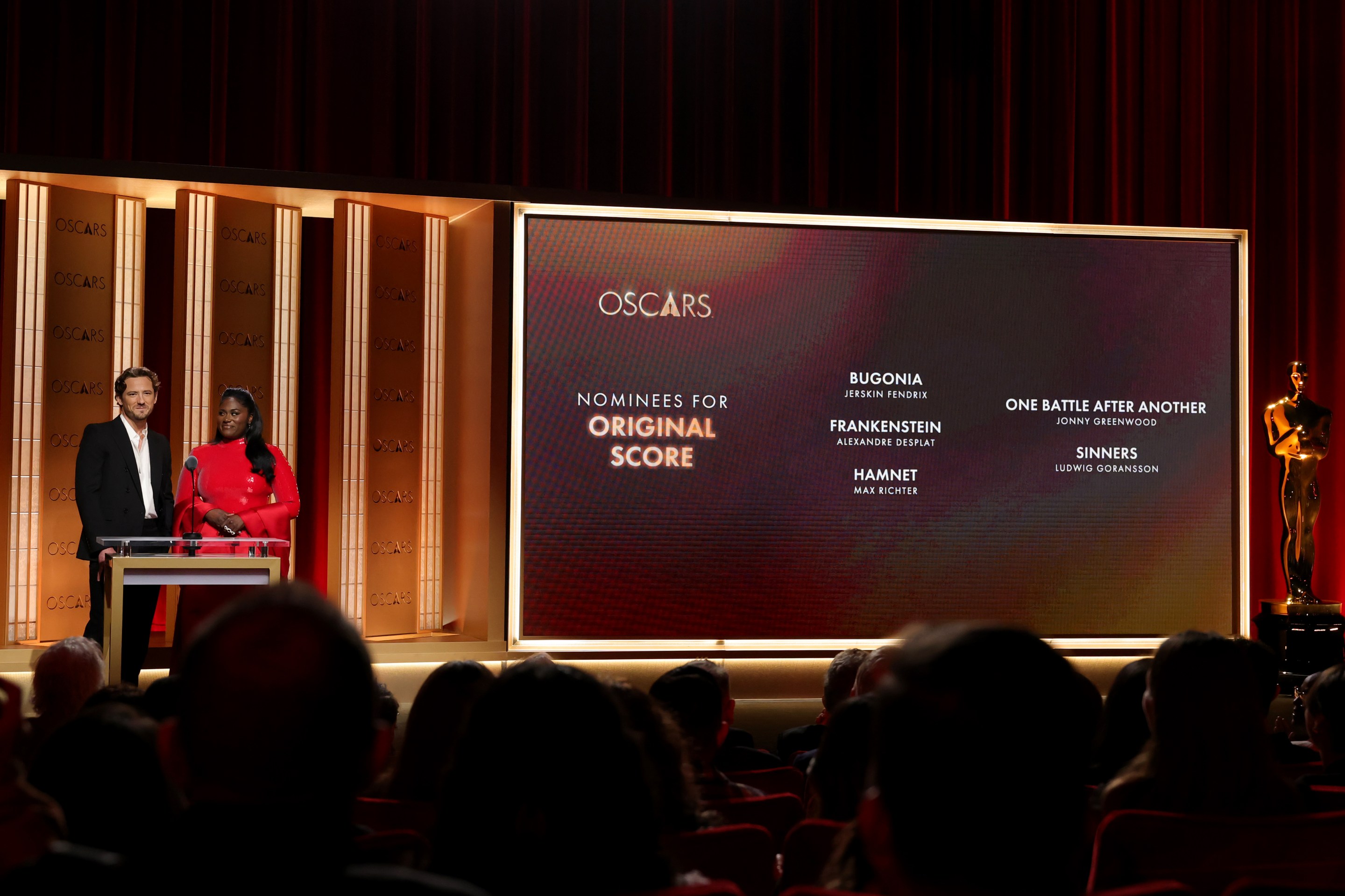
If you’re a member of the Academy of Motion Picture Arts and Sciences, you probably want a score so generic it can’t even be heard. This year was a fantastic year for film scores, but you wouldn’t know it by looking at the Oscar nominees. Between Max Richter’s anonymous, self-plagiarizing Hamnet score and Alexandre Desplat’s Frankenstein-sized participation trophy, we have Jerskin Fendrix’s music for Bugonia, a collection of screeching strings as pleasantly atonal and immediately forgettable as the movie they’ve soundtracked. There are some standouts, of course. Ludwig Göransson’s Sinners score freely blends blues, power metal, and turntabling with snatches of Irish folk and fingerstyle Appalachian bluegrass, embodying the kind of transcendent cultural fusionism that Ryan Coogler’s plot sometimes struggles to accomplish; it’s much more exciting (and deserving) than his Oscar-winning work for Oppenheimer. Meanwhile, Johnny Greenwood has constructed a real-deal Hollywood score for One Battle After Another, leveraging the full orchestra for moments of grand-scale impact without ever tipping over into bombast.
It would be easy to rag on the Oscars for its boring taste; I’ve just done it, and I’ll keep going. For one, they have long had a complicated relationship between music and merit. The first Academy Award for Best Original Score was given to the “Columbia Studio Music Department” in 1934, for the opera-set musical romance One Night of Love. For long stretches, the Academy gave out separate awards for musicals and non-musicals, or combined the musical and original song categories. As late as 1998 they still gave out one award for Original Musical or Comedy Score, and another for Original Dramatic Score, implying an innate distinction between the two.
Plenty of deserving scores have won Oscars, many of them classics: Jaws, Star Wars, E.T., others not composed by John Williams. Sometimes, like with Ryuichi Sakamoto’s 1987 win for The Last Emperor, the Oscars have awarded the right composer at basically the right time. But like with the acting categories, they tend to arrive decades too late, if at all. No one really believes that Hans Zimmer did his best work in Denis Villeneuve’s Dune, or that Ennio Morricone finally deserved to win for The Hateful Eight. Carter Burwell has been nominated twice for his work with Martin McDonagh, but never with the Coen Brothers. Indie musicians have been ripping off John Carpenter for nearly five decades now, yet the man was never nominated, and never expected to be.
I’m not saying the Academy never awards great music, but it tends to be the exception. Lately they have favored massive, thudding, electronics-assisted orchestral scores—what the film critic David Sims once described as “the typewriter” for their lumbering, clacking cadences. Please, take a break right now and hum a few bars of Volker Bertelmann’s All Quiet on the Western Front score, or Hildur Guðnadóttir’s searingly humorless music for Joker. These scores mean to bludgeon the viewer into submission, to bust through phone speakers and budget soundbars and remind you to PAY ATTENTION YOU ARE WATCHING A MOVIE RIGHT NOW. They are composition as pure spectacle.
Thankfully, as with all good things, we need not turn to the Academy for quality. 2025 was an unusually good year for film music. If I were standing beside Helen Mirren, onstage at the Oscars, I might say something like: Some of these composers called back to the most beloved and most iconic scores in cinema history, while others pushed the boundaries of filmic composition. In the process, they showed us all that original scores can and should do. So without further ado, the alternative nominees are:
Young Fathers – 28 Years Later
Danny Boyle’s return to the 28 [Blank] Later franchise was full of strong, imaginative creative choices. Among them: drafting the Scottish alt-hip-hop group Young Fathers to take on the score. Mirroring Boyle’s bugnuts digital experimentation, the Fathers project the stuff of contemporary horror music—screeching strings, low-end hums, overwhelming static washes—through their voice-heavy prism, crafting a full set of honest-to-god songs that call back to film music classics while achieving a singular balance of beauty and menace. There are jams here (“Promised Land”), and grand, sweeping statements (“Remember”), often accompanied by distorted, sampled vocals that lay down an important theme—“Remember me when I go”—but so obliquely as to blend with Boyle’s grand psychedelic palette.
Kangding Ray – Sirāt
I knew I would love Sirāt from the moment I heard the tagline: a group of ravers traveling through the Moroccan desert, in search of one party at the end of the world. I did not anticipate how completely the German DJ Kangding Ray’s four-on-the-floor techno score would form the heart of the movie, providing literal marching beats for this apocalyptic quest. Where a more tentative composer (or director) would have hewed towards the Tangerine Dream scores of old, Ray turns their death-trip into a party, stripping away the flash and flourish of EDM in favor of relentlessly pulsing beats and ping-ponging high-end, a totally man-made match for the desert’s natural desolation, dancing on and on and on, into oblivion.
Daniel Blumberg – The Testament of Ann Lee
One-time indie rock wunderkind Blumberg won an Oscar last year for his alternately sleek and bombastic score for Brady Corbet’s The Brutalist. He deserves another for Brutalist co-writer Mona Fastvold’s The Testament of Ann Lee, a considerably knottier proposition on all counts. To tell the life of the Shaker mystic Ann Lee, Fastvold has made a musical, conveying the profound spiritual yearning of Lee and her flock through song and dance. Beginning with Shaker hymns and period instrumentation, Blumberg constructs an avant-garde symphony, a Sinners-style tour through the American musical canon. We have liturgical bells, scraping strings, pounding rhythms and searing swells of electric guitar, a wild combination of ecstasy and desolation that manages, through all those voices joined, to convey the great Shaker aspiration of being one, together.
Daniel Lopatin – Marty Supreme
Marty Supreme marks the third impeccable score that Lopatin (alias Oneohtrix Point Never) has composed for a Safdie Brothers project. If I slightly prefer the chiptune freakouts of his music for 2017’s Good Time, that’s no slight on his work here. Though set in the 1950s, Supreme feels like a Reagan-era sports movie turned inside out, and Lopatin draws from a full spectrum of ’80s music—British dream pop, American jock jams, masters of Japanese new age—in his quest to channel and pervert that Tony Scott feeling. His score expresses the nonstop keyed-up anxiety of the striving scam artist, and the jammed-up inner life of a man whose aspirations reach toward a future era of fluid social access and rampant amorality. It even makes table tennis feel propulsive.
Rob Mazurek – The Mastermind
Kelly Reichardt’s filmography might best be known for its quietude, but she has a tradition of sneaky good scores. Yo La Tengo, William Tyler, Ethan Rose, and even Andre Benjamin have all contributed massively iconic (and at times career-best) work to her character studies of American loners, and the avant-jazz cornetist Rob Mazurek has continued the trend. Heavy on skittering drums and lonesome horns, Mazurek’s compositions embody the inner life of The Mastermind’s opaque protagonist, kicking in whenever the ostensible art thief J.B. Mooney sleepwalks himself into yet another jam. The music says what he can and will not: that any thrill, no matter how minor, will always outrank loyalty and responsibility—that you should get yours at whatever the cost. It’s as all-American a theme as you’re likely to find.
No matter what you’re looking for, whether acoustic or electronic, contemporary or old-fashioned, grand-scale or small, we are living in a golden age of film music, full of game composers willing to tug the form into the meeting house, or onto the dance floor. And you don’t need me, or Helen Mirren, or even the actual Academy to tell you that.