


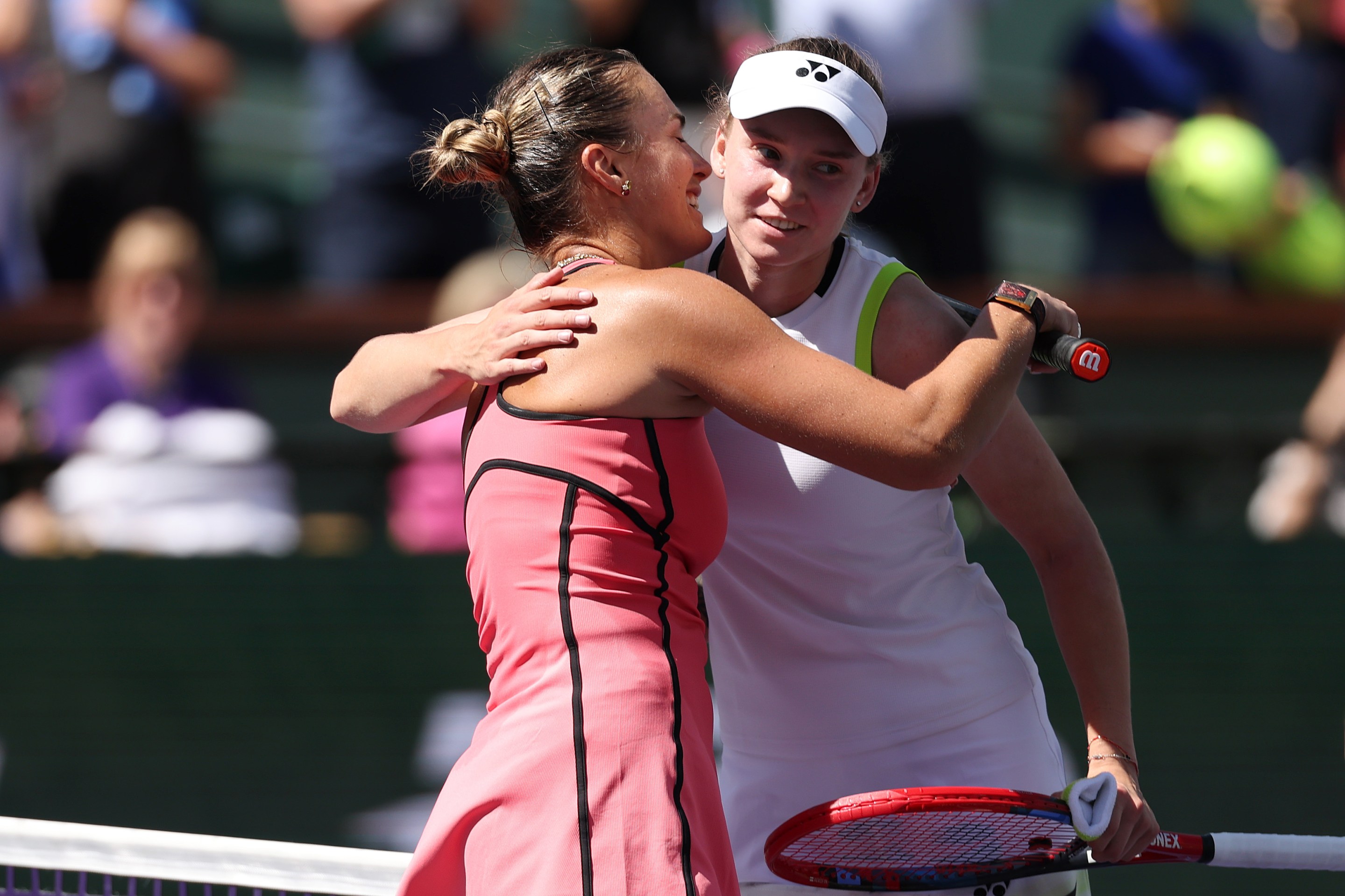
Raw power is winning out these days. While one of the great pleasures of the sport is watching the intersection of sharply contrasting styles of play, I have temporarily set aside all those nuances. The main matchup I want to watch right now involves two players with almost identical agendas: Hit the winner at the soonest opportunity. We're not here for the drawn-out rallies and defensive maneuvering, but the simple race to land a lethal strike. In the 16th installment of this rivalry, Aryna Sabalenka fended off one Elena Rybakina match point in the deciding tiebreak, and went on to claim her first-ever title at Indian Wells.
There was plenty of narrative baggage for Sabalenka heading into Sunday's final. Despite being unambiguously the best player on the tour for a while now—she's now held the No. 1 ranking for 81 consecutive weeks, and she is the most consistent performer at the majors—her title haul doesn't quite live up to her reputation. From the start of the 2025 season up to the 2026 Indian Wells final, Sabalenka had played in 11 finals and won just five of them. Two of those losses were weighty ones delivered by Rybakina, who won at the 2025 WTA Finals (one-way traffic) and at the 2026 Australian Open final (constant momentum swings). Rybakina has also been the best player in the world when pitted against top-10 players, having won 12 such matches in a row, a level of invulnerability versus the elite that Sabalenka hadn't managed to reach despite her stranglehold on the No. 1 ranking.
Even at its best, Sabalenka's tennis is a volatile compound. Self-implosion is always on the menu. World-beating tennis and abject misery are separated by perhaps two ill-timed unforced errors. Sabalenka has point-ending power, some of the best the WTA has ever seen, but she rather vividly illustrates that this can also be a curse: The onus is almost always on her to finish the rally. Her matchup against Coco Gauff makes this dynamic especially clear, as Gauff sets up her defensive forcefield and asks Sabalenka to hit one more ball, over and over, until the little grain of doubt sets into Sabalenka's mind and unravels her technique. That's when the match reduces to Sabalenka spraying errors on her forehand and periodically slapping herself on the forehead.
But when Sabalenka is against Rybakina, it's symmetric warfare. They're both most comfortable on hard court, too, so the differences are mostly superficial: Rybakina's tour-best serve versus Sabalenka's slightly better movement and return, Rybakina's ability to change the direction in a rally versus Sabalenka's greater comfort changing pace with a slice or drop shot, Rybakina's flatter ball flight versus Sabalenka's dipping topspin, Rybakina's affective void versus Sabalenka's canvas of despair. It must be clarifying for Sabalenka, in a way, to know that there will be no profound tactical twists and turns, that a tennis match can really boil down to the race to hit a winner. But these players always play close ones; 10 of their 16 matches have been three-setters; they've played six tiebreak sets and much of the rest were decided by a single break of serve. Going into this weekend's final, the head-to-head was 8-7 in favor of Sabalenka.
When the tactical differences and talent margins are so tiny, the challenge as always is managing the psychology of the match. Sabalenka hasn't always carried her leads to the finish line. That was her undoing in Australia in January, where she led 3-0 in the third set, only to lose five games in a row to Rybakina, then the championship. At Indian Wells this past weekend, Sabalenka led the entirety of the third set and squandered a chance to serve out the match at 5-4; the echo of Australia was audible, however faintly. I imagine these closing stretches of a match can be absolutely harrowing for a fan of Sabalenka, as she tries to keep her mind in order. But they moved on to a tiebreak of incredible quality, where Rybakina lined up a match point on her own serve. In a match where she'd won 62 percent of her first serve points and a staggering 70 percent of her second serve points, I thought she was about to close, but Sabalenka read the first serve, returned it deep, and followed up with a crosscourt backhand winner that will surely enter her career highlight reel.
Because Iga Swiatek ceded ground in the rankings this week, Sabalenka and Rybakina respectively became No. 1 and No. 2 in the world, giving numerical weight to the glaring on-court truth: This is the best matchup on tour, and each meeting between them is part of ongoing struggle to determine the best power player of this generation. If it stays this good, I'd gladly accept a standing appointment in the final of every tournament for the next five seasons.


![USA's Ben Shelton celebrates his win against Spain's Carlos Alcaraz during the men's singles quarter-final tennis match on day ten of the US Open tennis tournament at the USTA Billie Jean King National Tennis Center in New York City on September 9, 2026. (Photo by Leonardo MUNOZ / AFP) / “The erroneous mention[s] appearing in the metadata of this photo by Leonardo MUNOZ has been modified in AFP systems in the following manner: [USA's Ben Shelton] instead of [Spain's Carlos Alcaraz]. Please immediately remove the erroneous mention[s] from all your online services and delete it (them) from your servers. If you have been authorized by AFP to distribute it (them) to third parties, please ensure that the same actions are carried out by them. Failure to promptly comply with these instructions will entail liability on your part for any continued or post notification usage. Therefore we thank you very much for all your attention and prompt action. We are sorry for the inconvenience this notification may cause and remain at your disposal for any further information you may require.”](https://lede-admin.defector.com/wp-content/uploads/sites/28/2026/09/GettyImages-2293730421.jpg?resize=2880%2C1920)