
At approximately 11 p.m. on Dec. 13, 2025, I thought I’d lost it all. I found myself at the Williamsburg location of Barcade—a combination bar and vintage arcade—for my J-school’s end-of-semester party. No particular part of me wanted to spend the night in Williamsburg or at an arcade, let alone both at once. But I needed to make more friends at school. Recently, after a professor offered me some advice, she recommended I also consult my “J-school besties.” When I thought to myself, “Girl, that’s you,” I realized I had a problem.
Thus, Barcade, along with pleasantries about the upcoming winter break, travel plans, and holiday traditions. When someone asked if I wanted to grab a drink, I offered a friendly “Yes!” and ordered a Sam Adams “Just The Haze” non-alcoholic IPA.
It tasted so good—so IPA-like—that I thought the bartender accidentally served me alcohol, less than a month away from my one-year sober anniversary. Bready fizz pooled at the back of my throat while I considered how upset to feel about 337 days of hard work gone in an instant—at a locale named Barcade, of all places. Does an accidental sip count as a relapse? I turned to the bartender, who saw the look of alarm in my eyes and immediately anticipated my concern. “It’s really good, right? Almost tastes too much like the real thing?”
As of writing this, I am 515 days into my alcohol sobriety. Many NA drinks carried me to this moment, including plenty of shockingly good NA beers. However, I have yet to try an NA wine that is preferable to Welch’s grape juice.
Alcohol-removed wine and wine proxies lag behind their hoppy counterparts, both in quality and in sales. NA beer accounts for as much as 83 percent of NA drink sales, compared to 11.2 percent for NA wine. (Though beer is certainly more popular than wine in the U.S., the sales gap between the two is less extreme in their original forms.) Nothing better demonstrates the difference in quality than the landscape of celebrity NA brands. Tom Holland has “Bero.” George Clooney created the “Crazy Mountain Non-Alc” brew after selling Casamigos for a billi. John Mulaney is a co-owner of a Midwestern NA brew called Years. These famous boys sell NA beer, and famous girls—like Blake Lively, Katy Perry, and Bella Hadid—sell … NA spritzers, apéritifs, and tonics.
Despite the difference in quality, sales of both are surging. NA drinks overall experienced double-digit growth each year for at least the past four years. A total of 484 NA brands currently compete for the attention of the growing share of Americans—around 46 percent—who abstain from alcohol altogether.
Still, as someone whose interest in beer never extended much further than calibrating how masculine to come off in any given situation, the quality differential sucks. A devotion to a bold, dry red is basically a family heirloom. My family loves red wine so much that our only real Christmas tradition is a cutthroat family wine competition. Every drinking-aged person shows up with a bottle; then, a couple dozen aunties, uncles, and their (college or above) kids polish off as many bottles of Cabernet as there are participants in the competition.
After emptying the bottles, participants blind rank each, and whoever brought the highest-ranked wine wins. People are so committed to it that it’s usually how we find out when someone is with child. “Oh, not participating in the wine competition? What are you, pregnant?” (I have been alerted to the impending arrival of at least three little cousins this way.) I wish there was an NA wine worthy of the game, or at least one that would not get me ridiculed for the entire calendar year following the competition. But unlike in beer, alcohol acts as an irreplaceable ingredient in wine.
The most common method for creating NA beer involves de-alcoholizing the beer once it’s brewed. Sometimes that means placing the beer in a vacuum chamber and heating it until the alcohol burns off. Or it may involve pushing the beer through a special membrane filter that separates water and alcohol molecules, resulting in an alcohol-free beer concentrate. Sam Adams makes use of low-alcohol-producing yeast alongside a vacuum de-alcoholizer to create the Just the Haze IPA.
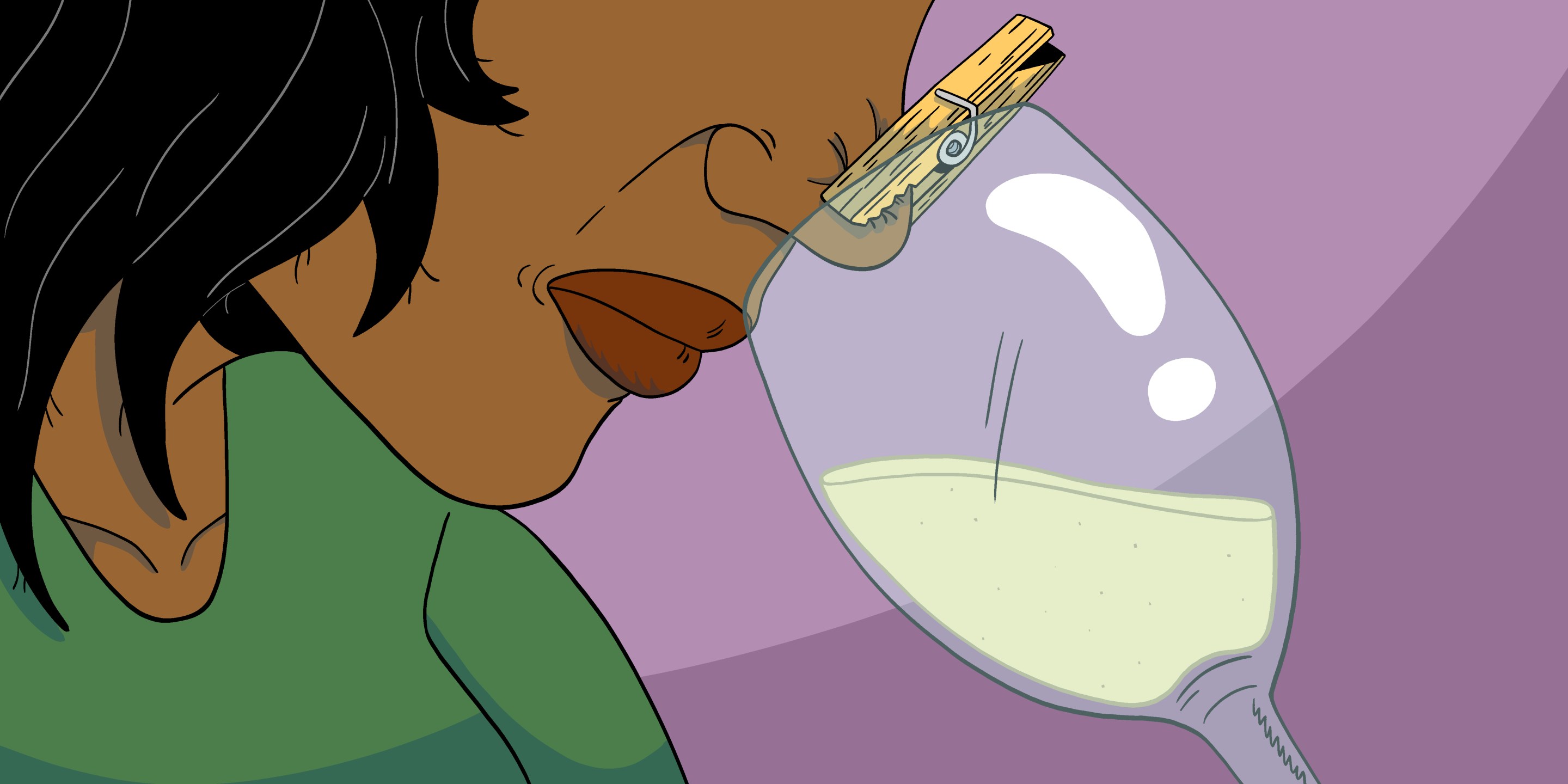
You can also de-alcoholize wine, just less successfully. For one thing, alcohol constitutes 12 to 15 percent of a glass of wine, whereas most beer ranges from four to seven percent. Wine also gets its flavor from an extended aging and fermentation process that requires alcohol to act as a preservative. You can make good beer much faster than you can make good wine. Plus, anyone who drinks wine can tell you that sniffing it and huffing the aromas is half the experience. Those aromas are alcoholic ones.
When wine is de-alcoholized, the alcohol is replaced with sugars, juice, and grape concentrate to make up for the lost flavors—meaning that NA wine tastes like grape juice because it basically is grape juice. Some NA winemakers avoid this by avoiding de-alcoholizing altogether, resorting to sterilizing grape juice and adding additional ingredients to attempt to imitate the feel and flavor of wine. Ersatz, I guess, does kind of sound like a vineyard.
Though I’m a black sheep in my family for a few reasons, at least among some of my cousins, the fact that I don’t drink is perhaps more baffling than the fact that I’m transgender. That’s probably why I physically transitioned years before I managed to string together 365 days of sobriety. Over the course of my life, I have hidden myself in many successive closets. “Alcoholic” was the final one to go.
Who knows what innovations await the NA wine space—whether winemakers will get better at taking out the key ingredient but still preserving wine’s overall effect, or find a new combination of nonalcoholic ingredients that more closely approximate the original. I have a feeling, though, that the best NA drinks will always be those with their own definitive character—neither the original with one fewer ingredient, or an imitation, but something else altogether. The NA drinks that propelled me to sobriety, like the "Isabella Rossellini" at my local Italian spot or a nice and viscous bodega mango juice, don’t attempt to recreate the glory of another drink.
It matches, in a sense, how I feel after the last 515 days. Drunkenness seems far away. Weekends of blacking out are more like lore than actual memories. It’s all stories to me now. At this point in my sobriety, I’m not trying to be as close to my old self as possible, with one fewer bad habit. Or to recreate that person with a collection of new habits. I am someone altogether different, newly my own.
Cheers.