In 2011, a Princeton Borough police officer gave me a public urination ticket as I was on my way to go drinking. I went home with someone that night and forgot about the ticket in my crumpled pants pocket. Weeks later I paid it off in a panic, hours before my delinquency would have added me to a New Jersey sex offender registry. For no particular reason, I was reminded about that while watching a femme top squat over a girl lying across a storm drain in the courtyard of a Holiday Inn in central Jersey. It took her a little while to find her stream, but she got there.
While I’ve had interesting desires all the way back to my days furtively printing Final Fantasy fetish erotica off the family Epson, I’ve only been in the queer leather world for a few years now. Like many trans folks, turning myself into a girl destabilized my sense of my desires for the better. Cocksucking, anal bottoming, violence: These have become fixtures in my sex life, where before they were fantasies punctuated by shame spirals. But becoming what a good chunk of your country views as a pervert freak is a good way to force yourself to consider whether you might actually be a pervert freak. This is how I became one of 1,100 other pervert freaks converging on a Holiday Inn over a long April weekend for the 40th International Ms. Leather and 27th International Ms. Bootblack, a leatherdyke convention and celebration of kink and community.
My first thought rolling up to the low and liminal three-story office park hotel we’re taking over is, Wow, look at all those dykes. Dykes behind registration desks, verifying COVID rapid test results, directing other dykes with luggage carts spilling over with duffels, hardshell Pelican cases, and sporting goods bags filled with what cannot be sporting goods. Dykes I know and don’t. Boy dykes and girl dykes and men who used to be dykes and dykes who used to be men, innumerable shades of exuberant faggotry, with canes and wheelchairs and mobility aids, some in leather vests dense with pins and patches, some in titleholder sashes, some in sweats and full beats. They embrace in many-way hugs and scream upon seeing each other, like sophomores back from summer. Across the parking lot, a pair of hoss-type white guys in performance basics are practicing golf swings. They’re there for hours, swinging and swinging in a perverse durational scene.
Eventually I clock the reflective insulation taped over the ground-floor doors and windows, sealing out the outer world. And yet, from the registration desk just a few feet inside, I can already see someone fully naked getting flogged in the courtyard. Within the hotel, we are hypervisible to each other. Outfits are maximally minimal; play is happening everywhere. We are placing our trust in each other just by being here together, buttressed by strict photo and consent policies. The vast majority of what happens this weekend will go deliberately undocumented. As the lobby doors slide closed behind me, I’m hit with the first of many waves of misgiving about writing about IMsLBB as a reporter, or at all. Personal writing always involves some amount of plucking at the social fabric, but the last thing I want to do is unravel anyone’s safety net, mine included. Scribbling notes, I feel like a spy, or a scheming eunuch.
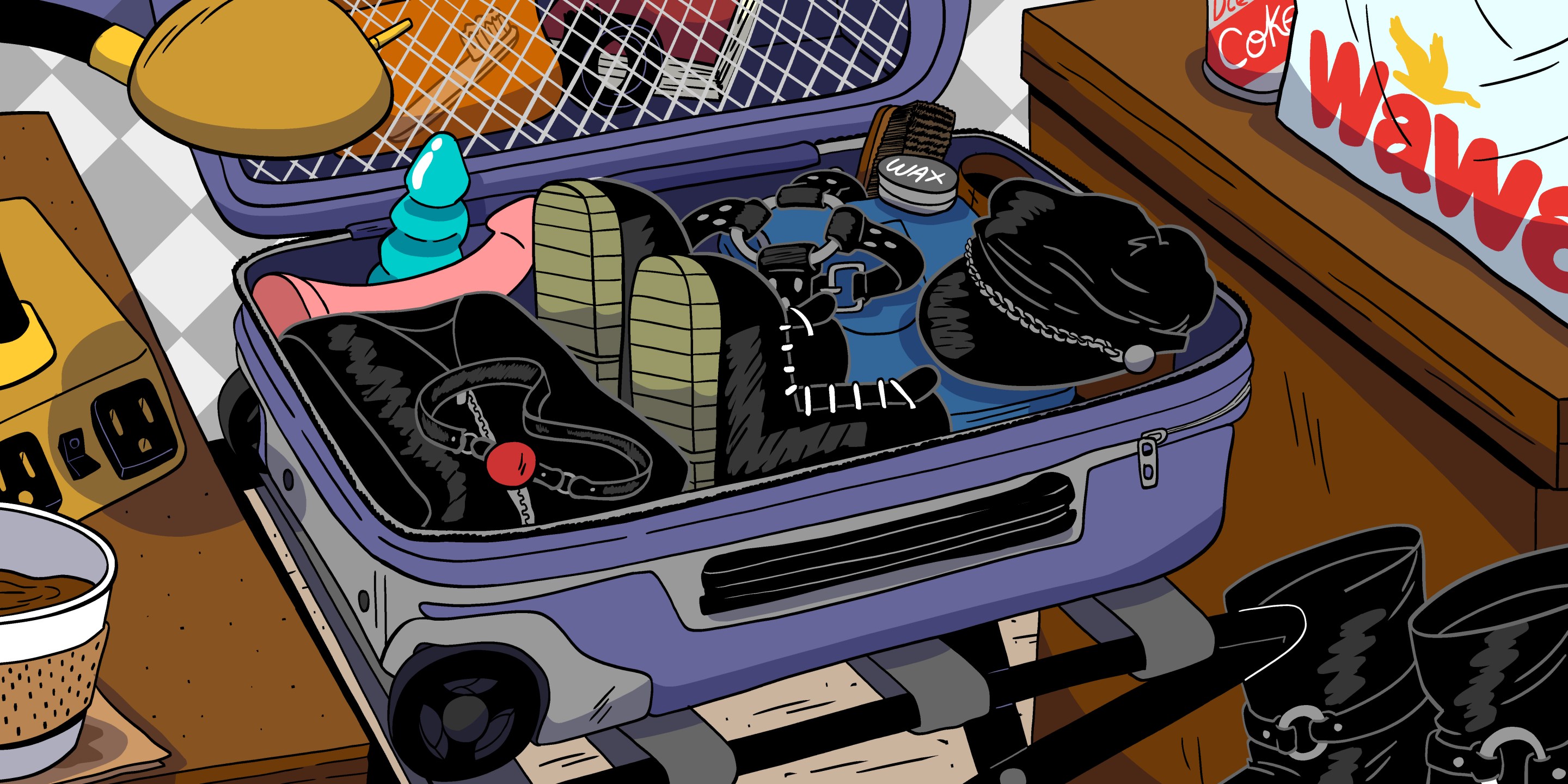
Up in our room, my boyfriend and I unpack: toiletries, comfy clothes, sexy outfits, collars, chains, cuffs. Exactly one hundred clothespins. A plastic mallet for breaking in baseball gloves. Rolls of flesh-toned vet wrap. Their flogger, my flogger. Meat tenderizers in hammer and brass knuckle form. A variety of toys in a variety of colors, sizes, and materials. Arranged artfully on the wheeled desk, it looks like a very sensual serial killer’s kit, or a scene from a John Wick porn parody. John Fuck.
Thursday is light on programming and heavy on enthusiasm. While the dungeon can’t escape its vanilla life as a Holiday Inn function room, with a weird monastic silence and what one friend calls “homophobic lighting,” the courtyard is fizzing. Picnic blankets of chatting queers sit alongside fisting scenes in collapsible sex swings. Every tree is prime real estate for restraint. On one table, there’s a personal library of vintage lesbian magazines, issues of On Our Backs, Lezzie, and Bad Attitude (one cover advertises both “FINDING THE GODDESS WITHIN” and “VAMPIRES”). There are so many trans people, so many visible surgery scars and bulges and voices in various stages of retraining. I spend the weekend peeing at urinals, joyously and unselfconsciously.
As a voyeur both sexually and creatively, being here is like drinking from the firehose. There are so many tableaus, so much eavesdropping, so many plotlines. The heartbeat of it all, though, is laughter. It sounds like a playground, the same aural collage of terrified shrieks, explosive laughter, and spontaneous vocalizations, just in post-pubescent registers. Later in the weekend, a harmonica will be bandaged into my mouth as a gag, and my laughter will come out musical, which only makes me laugh harder.
In the sympathetic vanilla imagination, kink is understood as escapism: The self-possessed girlboss by day unwinds by being a submissive painslut by night. But here the full-throated laughter doesn't so much indicate escape as total engagement, a way to be nowhere other than your body and mind, here and now, on your own terms, in a space transformed for our own purposes.
That evening, there’s a mass hormone shot under the waxing moon to bless the weekend. Its organizer says grace in elaborate black lingerie, quoting Octavia Butler: “All that you touch, you change. All that you change, changes you. The only lasting truth is change. God is change.” We toast with our syringes; needle tops provide cute bandages and sharps disposal containers, laid out on the picnic tables.
My night winds down with a fisting train in the gazebo—I’m fist No. 11—and I turn to take in the courtyard beyond its railings. In one direction, I can see a candlelit picnic date on the lawn, and tender sex; I identify the lovers by their hip tattoos. In the other, more candlelight, this to drip wax on someone mummified in pallet wrap. In the back of the courtyard, someone hangs alone in a meditative self-suspension, half-sprawled on the grass. Nearby, someone is naked on a picnic blanket, being mouthfucked by feet and boots and cigarettes ashed onto their tongue, propped against someone else’s body. In the grid of courtyard-facing windows, someone’s getting flogged in perfect profile, like a performer in a proscenium. All these parallel scenes, with their own public private sweet intensity.
The twink bottoming for the train breaks his record: 13 people’s fists. We cheer. We’re really proud. Some of us go to bed and some of us go to Wawa.
Friday is supposed to be the last nice day of weather, so the courtyard is churning by noon, when I’m meeting Alethea, my blondest friend. Ahead of the weekend, I’d sent her a notebook page filled with my desires. Many of them involved roleplay.
Growing up, my formative kink was transformation: boys becoming girls, girls becoming different, the horror and fascination of passing beyond the opaque veil of a transformative experience, being forced to submit to your own desires and wear them on your body. In message boards and chatrooms, I enacted fantasies on and with strangers, some of whom are likely here this weekend. I haven’t much engaged with roleplay in my adult leather life; anyone can stomp me into the mud, but there is something strangely vulnerable about indulging old desire. For decades I ached to be a girl, which I told myself was unrealistic, unrealizable, dead on arrival. I’m still working on letting myself want again.
“I really like the idea of correcting, teaching, training, and testing,” Alethea had texted, and here in the courtyard she explains what’s about to happen. I’m in finishing school, she says, as I change into the tiny black corseted Mugler dress and too-big heels she’s brought me. I’m to address her as "prefect" or "head girl," and she’s training me to be a proper slut. She has the build and presence of a valkyrie, and my breath keeps catching as she cuffs my hands behind my back, then wraps a leather strap around my thighs and a spiked strap around my quad, spikes in. The spikes are already biting.
She places a copy of Bulfinch’s Mythology on my head. Every time it falls, she’ll add a hit. I’m to walk toward her, one foot in front of the other, heel to toe, a proper lady’s gait. I’m to visualize a purple thread pulling the crown of my head up. She let me choose the color.
We are playing, but the scene gains reality fast. The fear I’m feeling is real. Alethea uses silence well and holds her gaze intensely; keeping the book on my head demands my full attention, a form of sensory deprivation. The pride I feel in keeping the book balanced is real, too. As the scene progresses, people pause to watch or sit on the grass, snacking on fruit and discussing me. I’m heckled. When the book falls again, there are mocking “aww”s. I feel the thrill of being entertainment to some and background noise to others. We only pause once, briefly, so my boyfriend can keep my blood sugar up with bites of a breakfast sandwich and sips of iced coffee.
The hits Alethea doles out are wildly painful, slow and meticulous, especially when she hits the spiked strap, especially because the heels force my legs to tense, making it impossible to relax into the hit. I whimper and quiver against them and in anticipation of them. I cannot be anywhere but my body, trying to be the most proprioceptive girl in New Jersey.
I feel beautiful and pathetic. Throughout the weekend, people tell me how hot my scene was, how it’s burned into their mind. The spikes in my thigh draw blood, little vampire bites which bruises form around. Afterward, Alethea disinfects and bandages them, then strokes my head and tells me how well I’ve done.
In the days since, I’ve wondered what we get to keep from these scenes. I have the dress, charged now with meaning. I wore it to a straight wedding recently. The courtyard’s a strict no-photo zone, so all we have is one picture my boyfriend took, my pale cleavage as I bend over, a tripled trail of fingernail gouges down it. There are my bruises, a raised wash of purples and browns. We digitize them with a handheld scanner at a barbecue later. Alethea sends me a video of the dents in the book cover, evidence of my training. I feel proud and straighten my posture.
Some scenes live on in collective memory, spread by word of mouth, become shorthand: the mud scene, the Laura Palmer scene, the pizza party, the witch trial. Some will become jackoff material, some anecdotes, some photo albums, some just memories. Elements will linger in the body—scars, hyperpigmentation, my boyfriend’s "DYKE" stick-and-poke on their inner thigh, a UTI—while others live elsewhere: stains on clothes and notebook pages, a bag of bloody hair and needles, scuffs on boots.
The Holiday Inn will reset completely, though. The rooms turned over, the grass re-landscaped. There are cruising and update boards in the lobby, but they’re dry-erase. My bruises have already mostly faded. I heal too well. Thanks to morality raids in the ’80s and the atomizing “consenting adults behind closed doors” rhetoric of the ’90s and ’00s, leatherdyke spaces—ones which belong to us and hold our memorabilia and graffiti—are today extremely few and far between. Instead we’re perpetual renters, carrying our history on our vests and in our duffels.
History is the drumbeat of the ceremonial portion of this weekend, the International Ms. Leather and Ms. Bootblack competitions. “Welcome home,” declares Patty, the MC and herself International Ms. Leather 2014, to a ballroom of leather-, latex- and rubber-wrapped queers, some on laps or on their knees, early Friday night. To the first-timers, she adds, “Welcome to your new home.” Patty is charming, confident and self-effacing. An enormous Leather Pride flag forms the stage’s backdrop, while another wraps the podium.
The ballroom is one of the few spaces where pictures are allowed, though only of the stage. There’s an official event photographer; another died suddenly shortly before this year’s convention, and she’s tearfully memorialized by her mentor. She financially supported a family in Palestine, so a Leather Pride flag skirt is auctioned off to raise them money. When the bid gets too high for any one person to beat, audience members stand up to chip in on top of it. The skirt ends up selling for mid four figures. It’s unclear who will actually take it home, but I’ll remember that auction.
“We’re here because we know that we have to let the world know that we’re here,” said Judy Tallwing McCarthy in her 1987 victory speech, after being crowned the first International Ms. Leather, speaking as both an Apache and a leatherdyke. “An invisible minority leaves itself open as easy prey for those individuals who would deny us our freedom, our very existence. And we’re here tonight being very visible.”
Forty years later, we queers are both hypervisible and back in the crosshairs, subject to rotting Reagan-era moral panics driven by rotting Reagan-era guys. I feel a bittersweetness in Tallwing McCarthy’s strident clarity. The arc of history is long, but apparently it just kinda loops back around. Can any of what went on this weekend be historicized in a world that will seize any opportunity to brand us as violent, perverse, indulgent, gross, strange? Because we are all those things; it’s just not a big deal. We feed each other fruit afterward and get drive-thru Wendy’s for our friends.
But there are 40 years of leather history between Tallwing McCarthy then and me now, so I go digging, to try to see how our community has navigated the knife’s edge of visibility and survival. What I find are fragments: personal blogs, partially digitized archives of defunct publications, camcorder rips with fuzzy sound, HTML jank, and lots of dead links and dead ends.
Instead I find myself tracing threads, following stories nested within stories until I reach their source or something like it. I find a 2011 IMsL history panel with nine former titleholders from that year’s convention, including IMsL Nos. 1, 2, and 4. In the video, an older Tallwing McCarthy talked about the origins of the contest, spurred in part by The Outcasts, a West Coast lesbian S/M org.
“The Outcasts came in support of IMsL saying we needed something like this, we need to make leather women visible,” she said. “And I kept bitching, because I kept judging these frickin’ contests, and these little 'stand and model' girls would come and win ‘em, and I said, 'Where’s the damn leatherdykes? I know there’s a ton of us, where the hell are they?'” (“Stand and model” is a slam on S/M poseurs; being haters is a rich part of our tradition.) The contests she described were local competitions around the Northwest, mostly held at men’s leather bars due to a lack of women’s establishments.
The Outcasts were themselves successors to Samois, the short-lived but pivotal lesbian activist organization, social organizers, fighters of the bruising second-wave sex wars, and authors of the seminal dyke BDSM collection Coming To Power. In the introduction to his collection Public Sex, published in 1994, Samois co-founder Patrick Califia described outing himself as a leatherdyke to a BDSM-hostile public, both queer and straight, by publishing “A Secret Side Of Lesbian Sexuality” in The Advocate in 1979: “I was terrified when I wrote it. I kept getting up in the middle of typing to lie down until my nausea subsided and my hands stopped shaking.”
His fears were reasonable. In the ’70s, outing yourself as into kink meant risking harassment, vandalism, death threats, and even assault, especially as a woman, and especially from other women whose feminism conflated heavy play with rape, assault, and patriarchal capitulation. “While other attendees enjoyed the [Michigan Womyn’s Music] festival’s ‘erotic lesbian paradise,’” Stephen K. Stein wrote in Sadomasochism and the BDSM Community in the United States, “BDSM women traveled in groups and arranged their own security patrols to keep themselves safe.”
Nevertheless, we persisted. As Califia continued, his essay and Tallwing McCarthy’s speech echoed each other: “Why write and publish something that felt so dangerous?... I was tired of being alone, and I knew there would never be a leatherdyke community if somebody didn't announce that one already existed. I figured if I was public enough about being into leathersex, either I would get squashed and my misery would be over, or other perverse girls would find me, and then I wouldn't be so lonely.”
This is our atomic unit: one leatherdyke connecting with another, forming something together. In the 2011 panel, Tallwing McCarthy described making her leathers the night before the contest, in her partner Sashie Hyatt’s hospital room while she was undergoing chemo. Other titleholders kept mentioning the personal provenance of their own leathers, too. She offhandedly mentions she built the competition stage. Shann Carr (IMsL 1988) did production backstage, and described being bullied into competing the following year, being shamelessly berated by an increasingly sick Sashie in her Jewish New Yorker accent: “I’m gonna die, and [IMsL]’s gonna die too, and it’s all gonna be your fault.”
Amy Marie Meek (IMsL 1993 and owner-producer from 1994 to 2006) read a letter she wrote to the board when rumor spread that the 1993 contest wouldn’t happen: “Without a major title to work towards, some local titles will not continue to exist,” she recited. “We who are pained by the ugly face of separatism should not induce it upon ourselves.” Local titles bring leatherdykes together in cities and beyond, give them somewhere to find each other, touch each other, tell tales, exchange and build power. Without that: isolation, dissolution, assimilation, loneliness.
“It’s not about who wins,” Meek said later in the panel, talking about each year’s contestant class. “It’s about the teams that are created.” The other IMsLs jumped in to commemorate contestants in their class whom they’ve lost over the years. The titleholders, by virtue of being titleholders, are the ones who get archived, the bone in the fossil record. Their names are recorded, their speeches are (somewhat) preserved, and they’re interviewed and photographed. But titleholders also serve as both gatherers and sowers of memory.
That role was baked into IMsL’s founding: “The organizers … launched their event in 1987 with the expectations contestants were already politically active,” Stein wrote. “Speaking at local and regional title contests, they disseminated political information and encouraged activism and fundraising for social and political causes.” Ideally, titleholders create focal points of community visibility and knowledge, without exposing all of us or airing our very stained laundry to a public that has fluctuated over the decades from fetishizing (derogatory) to overtly hostile. I think of how Akasha (not yet IMsL 2026) happened to spot my friend reading Leatherfolk in the courtyard and recommended The Mayor of Folsom Street as a follow-up. We are portals to each other.
For her 2016 IMsLBB keynote address, V. M. Johnson, cofounder of the Carter Johnson Leather Library and Collection with her wife Jill Carter (IMsL 1996)—and, I’m delighted to learn, a vampire loreologist—also nests her stories. Johnson talked about the leatherdykes she came up hearing about, and described being laced into her first corset as an induction, being told, “As of now, your body is your own. Do with it what you will. Modify it how you choose. And give it to the person you love no matter what the legislature says.” She talked about the moment of realization that she was now an actor in leather history, and a peer to all those proper nouns, not just an inheritor of it.
“I think you want to know your heroes, but no one has bothered to tell you the stories,” Johnson said, settling into an armchair on stage. “The difference is they are not remote people. They are here in this room.” She devotes the rest of her speech to their oral histories. It’s an imperfect record, of course. We’re only human. Johnson's mic discipline is not great; I have trouble catching some names and quotes because of how far she held it from her face. I find an interview with Sarge (IMsL 2015), who said she plans to write a book on the history of IMsL, “interviewing, photographing and documenting the amazing women who have paved the way for the current class.” As far as I can tell, the book exists only in these interviews.
Another 2015 Bay Area Reporter article that mentioned Sarge’s book plans also covered programming that honored Rich Stadtmiller, a scene photographer with an enormous bank of pictures from decades of leather events. Nobody is identified in his photos, but I recognize people all the same: There’s Patty the MC, a decade younger; there’s Spencer (IMsL 1994), the first trans person to hold a leather title. The article talked about the origins of his photography: “Like other veterans of the early HIV/AIDs era, [Stadtmiller] had done his best to kill off any memories of that time—to the point of forgetting that the ones he loved ever existed. … As Rich put it, ‘I would hate for anybody to experience such loss again. Instead I want to provide an abundance of memories. I hoped people would realize their value.’”
AIDS erased individuals, institutions, the stories they held, and the evidence that they ever existed. Accelerating that erasure was the release of a report on pornography by Edwin Meese, Reagan’s attorney general, whose investigation unleashed a wave of police raids on sex and BDSM clubs, adult bookstores, bathhouses, leather bars, and even private play parties, intensified and legitimized by AIDS fears from both the straight and more “respectable” queer community. And yet, International Ms. Leather was born under that assault. The original contest was initially a one-off fundraiser for AIDS charities, with all the proceeds donated. For the next few years, each contest would start with nothing in the bank, having donated everything the year before. Fighting discontinuity can take everything.
IMsL has a nomadic history as well. It spent its first eight years in San Francisco; after Meek took over, it was hosted in a different city every year as a way to showcase and juice the local scene, including Chicago—home of International Mr. Leather—and Vegas, Toronto, and Dallas. (International Ms. Bootblack was incorporated in 1999, and I apologize deeply to the bootblack community for not being able to offer them more history in this already overstuffed piece.) That span also saw the national leather scene foundering, as internet decentralization and declining persecution contributed to BDSM organizations demobilizing politically and withering in membership. “It has become increasingly difficult to find contestants for IMsL (as it has for many other leather contests),” wrote Steve Lenius, Lavender Magazine’s recently retired leather columnist, in his 2006 piece on IMsL’s 20th anniversary. “Fewer local and regional women’s leather contests mean fewer winners to go onto to [sic] compete in the IMsL contest. In 1999, IMsL had fourteen [contestants]; that number had fallen to five by 2002.” In 2026, there are two.
After a cost-saving stretch in Omaha, Meek’s hometown, IMsL returned to San Francisco in 2007, soaring from its bar origins to—what else—a Holiday Inn. It would move to a San Jose Doubletree in 2014, but otherwise stay in the Bay until moving to New Jersey in the wake of the pandemic. By far the most perverse thing I find in all of my research comes in a scan of the 2008 IMsLBB booklet: a photo and signed letter from the mayor of San Francisco, welcoming “these women of the world back.”
“My office is committed to supporting and recognizing the leather community for its exceptional contributions,” said none other than Gavin Newsom, offering attendees at the Holiday Inn Golden Gateway his warmest regards. Years later, as governor, he would veto protections for trans Californians, while calling for his political party to be more “culturally normal.”
This dubious acceptance is not lost on the community. “We’re mainstream, and yet we are not mainstream, because when people want to turn on you, they still can,” Carter said in the 2011 panel. Shifting cultural landscapes may give us a bunch of IMsLs laughing about their first time hearing Rihanna’s “S&M” on the radio, but laws against most of the sexual practices of a given IMsL weekend remain on the books in many states, allowing for selective enforcement and persecution if, say, a cadre of cynical, evangelically allied right-wingers come to power. You can build power within contingent safety, but you lose sight of its contingence at your own risk.
“When the internet exploded, we lost the checks and balances at the door that let us trust people,” said Megan Martin (IMsL 1998) on the 2011 panel. When she first read through the extensive rules for the playspace at a recent IMsL, she reacted with disgust, before realizing “it’s because we don’t know who’s coming in, we don’t know who’s playing, we don’t know who they know or who they learned from.” The panel suggested that the scene used to be kept in check by the threat of your misdeeds showing up in print, particularly by Marcus Hernandez, a.k.a. Mr. Marcus, who wrote a gossip-spiced leather column for the Bay Area Reporter from 1971 until his death in 2009.
Look, I don’t want to take what the IMsLs are saying at face value, even though they’re very hot and charismatic. They represent a particular position within the scene, one both gifted with and freighted by history; they’re not immune to aging, nostalgia, social media derangement, or the lure of the dhampir. But as I go digging, the need for connection between us, whatever the public may think of us, is hammered home. “These events should have thousands of people!” Martin said. “Because it’s face to face that you’re learning this stuff.” For whatever it’s worth, there were 1,100 of us at IMsLBB 2026, and what was most meaningful about my experience had a lot less to do with our visibility outside the sliding doors covered in reflective insulation, and more to each other. Over the course of the weekend, I saw over and over that we were here not just to share space, but to touch each other, in some cases as deeply as possible, in as many ways as possible.
Anonymity might be shelter, but visibility and outreach to our fellows is an act of service, too, even if our hands are trembling. Our community history is only so accessible from a safe remove, and besides, knowing the history only goes so far. Sharing it matters more, as an act of both service and communion—one leatherdyke connecting with another, forming something together. To survive, literally survive, we need to be crafty and open-hearted enough to build things together, from contest stages to sadistic rope predicaments to durable networks of political power and solidarity as bulwarks against our eternal enemies and fairweather friends. Most of all, we need to touch each other, with whatever methods and capacity we have: digitally (computer) or digitally (second base); orally (verbal), orally (first base), or orally (third base). Or just—“just”!—to touch ourselves, to say, I’m here, you’re still here, I’ll be here when you need me.
Back on stage in 2026, International Ms. Bootblack contestant No. 2 has a shy, sweet energy. Her speech is focused on lineage in leather, the way it carries history physically in both its wear and tear and its maintenance. As a bootblack, laying her hands on leather in care and attention is a way of communing with that history, the physical story encoded in the material.
You could see leathercare as a form of erasure, undoing the evidence of time and use, but there’s only so much even the best bootblack can do. Eventually, leather accumulates age, coming to reflect its life. I think about my transformation kink, the idea of being shaped by forces beyond me into a reflection of desire, the syringes of estrogen I plunge into my thigh, and the tattoos and piercings I’ve allowed myself to get once I finally accepted stewardship of my body. Leather touches skin, skin touches leather, and both come away changed.
Patty the MC introduces one of the judges by saying her 20-plus years in the leather and kink scene is “as long as some of you have been alive.” The crowd reacts, but she’s quick to jump in. “That’s a good thing!” she insists. “Some of us didn’t think we would be alive this long.” To care enough for something to ensure it has a future doesn’t come naturally for many of us. It’s something we’re here to help each other learn, and to find in ourselves.
The phantom haunting the weekend is the drop, the depressive slump that hits on returning to a world full of emails and state legislatures. Holding onto these scenes feels like trying to bring deep sea fish back to the surface intact; the pressure change turns them to goop. The more time I spend in these spaces, the harder it’s become to share about them to my straight, cis friends, whose experiences are far more legible to each other than mine are to them. I reach for analogies to try and sell the appeal, usually something like the gym or sauna, and people nod. Those forms of pleasurable intensity make sense to them.
What’s harder to convey is the word at the center of it all: play. The practice of kink is play. People you play with a lot become play partners. Spontaneous play is pickup play, as though you’re rolling up a game of 3-on-3 hoops. You negotiate a scene beforehand: the goals, the roles, the limits and boundaries. It can be whatever you want or need it to be. Together you create a container to hold whatever you want to bring in and filter whatever you want to leave out. It’s an imperfect seal, but so are cell membranes, and their permeability is life-sustaining. Then you fuck around in there.
It’s easy to dismiss this as a childish regression, and yes, everything profoundly meaningful about this weekend is nestled intimately alongside the parts that are very stupid. There is no way to overlook that the hottest scene of your life is happening in a fuck-ass Holiday Inn. To me, that makes it more trustworthy. Anything that purports to be meaningful without foregrounding the ways it's stupid is suspect in my book.
Four days of play is exhausting—all that communicating, navigating, checking in, aftercare, messy and unexpected feelings—but it’s also four days in a reality we get to create for ourselves, tailored to each other’s desires and physical, emotional, and accessibility needs. Four days of freedom, with the opportunity to care for each other throughout: When have you experienced that? Where? What did it feel like, and how did it change you? Really, I want to know.
Ms. Leather and Ms. Bootblack 2026 both burst into tears when they win during the Saturday night closing ceremonies. In their press photo, they look overwhelmed and ecstatic. “This is our community!” Patty cries. “We will not be going away! We will not be silenced!” We’re quickly herded out of the ballroom so it can be restructured around an inflatable wrestling ring. It’s time for the Masochist vs. Masochist fight club.
Each of the 16 fighters had to earn an entry ticket from a different sadist. The event’s announcer and referee (also the convention’s head medic) interviews each fighter about what they endured. One was tickle-tortured and made to walk around with lube-soaked socks in his boots. The audience bleats a collective “euuughhh.” I earned my ticket proving that finishing school made me a proper lady who can keep mud off my dress while chained up and stomped on. My dress did get muddy.
Entering the fight is an insanely bad idea. I’m paired with a beloved NYC bimbo, one of the few fighters with a longer reach than me, cute in her lacy pink negligee. I ask her if she fights, and she says she fought at this last year. I ask how she did. She laughs, the tiniest little heh. “Good,” she says. I am athletic and scrappy, and over a year out from a back surgery. I’m fucked.
My 2024 began with a debilitating back spasm; MRIs showed a massive L5-S1 disc herniation. I couldn’t comfortably sit, stand, or lie down. I was sleeping four hours a night, pushing my sobriety with cocktails of muscle relaxants, on- and off-label pain meds, and supplements, pacing at 3 a.m. in hopes of flossing my nerves enough to doze.
My reintroduction to consensual pain came a year and a half later, after months of post-op rehab. I was gently, slowly co-topped on a friend’s bed. They checked in every few hits; we changed positions regularly. It was nerve-racking at first, then a relief to find I could still lean into the pleasure of the anticipation and the stingy afterglow. Anchored by trust and love, my body knows the difference between pain I don’t choose and pain I do, as much as it knows the difference between drowning and diving.
Now I am stepping onto the inflatable mat in my little Adidas slut dress as the PA blasts "Thunderstruck" and the crowd roars my opponent’s name. “MAKE MOMMY PROUD,” a handmade sign reads. The other fights have been vicious, complete with takedowns and holds, meat slamming meat. The fighters are judged on style and ferocity; after each match, they have to make up. Most make out.
My fight starts, and I am pinned almost immediately, but I thrash, bite, dig my nails into her tit, fling myself around. She wins, but I make her earn it. Her lip is split and bleeding as we face each other, awaiting judgment. After we make up, I dab my finger in her blood and mark my forehead with it. It just feels like the right thing to do. She’ll go on to the semifinals, and watching her fight, it’s clear how little hope I had. The rest of the night, friends tell me how impressed they were, how well I held my own, how strong and brave I am. In my notes, I write, “I love violence!!!”
The champion is a wrecking ball of power and charisma. She is fat and gorgeous; between matches, she grabs the mic to holler about the beauty of fat dyke bodies. The audience goes truly wild. She has an asthma attack during her final fight, and her inhaler is rushed to the ring. While she recovers, the ref interviews her dom. She’d earned her ticket by getting beat on while saying nice things about herself, to show her how strong and capable she is, how much she can take. She gets up and fights the next round.
There’s no way to talk about this kind of consensual violence without summoning the specter of self-harm. After all, isn’t all this a form of self-destruction by proxy? The question’s rarely asked in good faith, but there’s still something to be chewed on here. Passive ideation was part of the background noise of my brain for as long as I can remember, until I'd accumulated some sober time in my late 20s. I didn’t want to die, exactly, but I didn’t want to live. If a car clipped me, I’d have appreciated it. Knowing how not-alone I am in this, among my fellow attendees, fills me with both profound relief and overwhelming grief. We don’t all make it.
I've come to believe that self-harm is really just the tip of the spike heel on our necks breaking skin. A world that insists you're worthless shouldn’t be surprised when we hurt ourselves to fulfill that pronouncement, or to cope long enough to disprove it. Over the weekend, I see arms and legs covered with scars. It’s pretty common in queer and kink spaces. They might be from self-harm or from play. I can't necessarily differentiate just by looking, but the person wearing them could absolutely tell you which is which. Self-harm is an expression of distance and isolation, the anguish of disconnection. At IMsLBB, violence is contact, intimacy, togetherness in a bond of shared trust. I try not to pathologize kink, but hurt people hurting people can be a profoundly beautiful thing. This weekend, the part of us that wants to live is winning over the part that wants to die. If the body keeps the score, we might as well at least take the field.
The weekend ends quietly, with hugs and goodbyes, and exchanges of Signals and Instagrams. Sunday is beautiful, and the courtyard is full again. There’s still plenty of play happening as we load the rental car. Most of it, we’ll never know about. Maybe that's OK; it will leave the marks it needs to. As we pull away, I realize that I never made time to sit at the bootblack station. I really should have. My boots got scuffed.