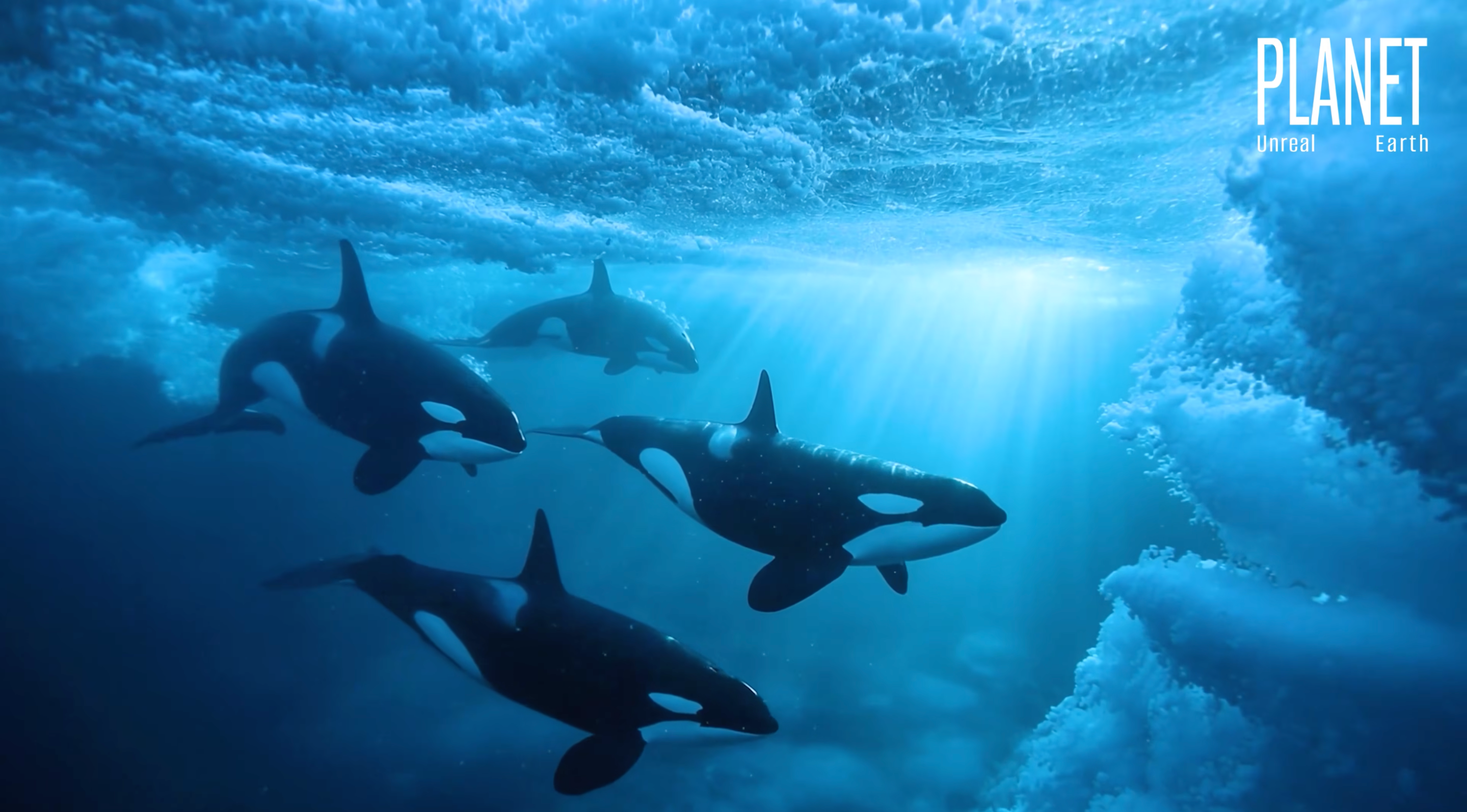
Recently, while picking up a banh mi in my neighborhood, I found myself transfixed by a TV in the restaurant showing what I assumed was a nature documentary. At first the footage soothed: Gentle humpback whales sailing through hazy blue waters and killer whales gliding in packs under glacial ice. But the longer I waited for my banh mi, which was not very long at all, the more unsettling the video became. When a fleet of eight or so orcas moved in uncanny alignment under ice that looked a little too crystalline, I realized the video was AI, a realization that felt first bleak but then reassuring for my ability to detect such things. I was re-unsettled when the video then cut to footage that looked absolutely real. It was another humpback gliding through murky, sun-drizzled sea, its grizzled jaw scarred and encrusted with barnacles. When I suggested this footage might be real, I got into an argument with my friend, who insisted the entire video was AI. Surely it couldn't be, because this whale looked real to me.
The nature of my job means that friends and strangers will often show me videos of animals that stir in them feelings of awe, wonder, surprise, disgust, fear, loathing, or confusion. For years, this was a delight, a banquet of beautiful creatures personally curated for me. My Instagram DMs teemed with blue dragon sea slugs feasting on blue bottle jellyfish and the unreal, telescopic eyes of a strawberry conch. I loved learning about the new animals my friends had chanced upon: the female Boulenger's backpack frog, who carries her eggs on her back until they hatch into froglets, or the Yucatán casque-headed tree frog, whose bony head is large and almost like that of a duck. (Frogs starred in a lot of these videos for reasons that are unknown but pleasing to me, and a testament to the amphibians' universal good vibes.) I even appreciated the honorary creatures, such as the pulsing plasmodium of this slime mold, or this ceramic effigy vessel of a land crab.
In the past few years, something shifted. At first the slop was sloppy. The animals had extra tentacles or anime eyes. They glitched as they moved. Sometimes they found themselves in surreal circumstances, such as in a video claiming to depict a giant squid being "cleaned and rescued" off the coast of California. But gradually, almost beyond my notice, the fake animals got more real. Their fur bristled. They scampered more naturally. The video quality got fuzzier, mimicking nature's often imperfect lighting conditions. But I was still able to spot them, or at least I thought I was. I began opening the links my friends sent me with an ambient dread, afraid of having to break the news that they'd been duped by AI, or afraid that I'd be duped, too.
As someone who looks at dozens of photos of animals every day for work, I had always considered myself an expert in the field of looking at animals. But I had begun to doubt my own perception. As the AI seeped in, I found the wonder and awe I felt about the natural world morph into a reluctant suspicion. Brow furrowed, I would study each glossy frog and prickly bug until I was sure they were real. Any strange animal had to pass the sniff test for me to celebrate its strangeness. And then I found myself in the Vietnamese restaurant, glued to the TV screen and untethered from reality. The veins of my forehead may well have been pulsating as I glared at these whales, which looked both real and unreal, searching desperately for a clue that would unmask the cetaceans as an AI sham. But the clue did not come in the whales. Rather, the video had a title in the corner reading "Unreal Planet Earth."
Unreal Planet Earth uploads approximately one AI-generated nature documentary a day with baffling, stilted, and derivative titles like "Inside the Deep | Where Every Layer Reveals a World of Creatures That Shouldn’t Be Real" and "Ocean Depths | A Journey Where Every Depth Holds a Different World of Life." The artificially generated narrator of these videos talks almost like a human, with admittedly soothing intonation, but the emphasis is off. And what it says is barely disguised baloney. How much more obvious can an AI video get? I had lost the argument. Why would a "documentary" like this even bother with the imperfect, grainy footage of the real world, which can be prohibitively expensive to shoot, requiring travel to remote locations and a deep knowledge of those animals' daily lives, when it could simply generate a near-facsimile of the animals viewers wanted to see? It seems obvious now that none of it was real. But I just wanted to believe.
As a kid in the '90s and early 2000s, I learned to appreciate wild animals through TV series like those on Animal Planet, whose battery of shows promised animals so extreme or strange that you couldn't believe they were real: color-changing chameleons, bioluminescent fish, birds doing insane sexy dances. Opulent, high-budget series like Planet Earth and Blue Planet made nature even more unbelievable, revealing the astonishing pageant of life and death that plays out in what remains of our wilderness.
This is what I always believed to be the purpose of a nature documentary: to show people the beauty of the planet in the hopes that they might be moved to help save it. But maybe this was only true in the '90s, a decade that brought us the Rainforest Cafe and Free Willy and Captain Planet and shirts warning us that time was running out to save the Earth, shirts that now abound as vintages on eBay. Perhaps this was naive, the thinking of a child who had yet to become a cynic. To some people, the purpose of a nature documentary is simply to entertain. And if it's entertaining enough, maybe those people don't care if it's not real.
Now, it seems, more and more people are viewing nature through Instagram reels and TikTok, which present unvetted short-form videos. Although I appreciated when people would send these videos to me—it is always an honor to be thought of!—I never sought them out on my own. At best, these animal videos lack context. At worst, they spread misinformation, either in the caption or the footage itself. They often exaggerate the facts of the animal or the situation to make the video appear more dramatic, and therefore more worthy of your clicks. It was inevitable that AI would prey upon what I believe to be a deeply human instinct: our desire to learn more about what else lives on our planet.
I don't doubt that these videos bring some people pleasure, even those who might recognize them for what they are. But of course this is not the mission of the humans who prompt these AI videos into being and then upload them to monetizable social media platforms. Their mission is getting paid. A 2025 paper warned of the many misuses of generative AI of wildlife: creating fake species, stoking fears of human-wildlife conflict, or misleading people into believing it is a good idea to pet a polar bear. There is a brutal irony in a video of an artificially generated chameleon changing colors, one that might teach people to care about nature by offering an uncanny simulacrum of it, being created by the very forces that threaten to destroy the chameleon's livelihood. Each AI video of an animal requires gallons of fresh water and creates carbon emissions that warm the the planet upon which real chameleons depend.
Nature documentaries conjure such universal awe in people precisely because of their reality. The diversity of life on Earth is so grand, bizarre, and sprawling that even the existence of a single beetle can make your head spin. But it needs to exist. The very concept of an artificially generated video of wildlife is profane, operating on a level of self-interest that I struggle to comprehend. These videos make me fear the future, a world in which I am the geriatric scrolling through videos of a polar bear giving her cub a piggyback ride among the ice floes. At least I'll be able to know for sure the videos are AI, because all the real glaciers will have melted.