

MELBOURNE — What they say is true: You watch less tennis when you cover a major tournament in person. I can tell you that 15 journalists piled into Sorana Cirstea’s press conference after her three-set loss to Naomi Osaka, which featured some celebration etiquette-related beef and a particularly salty handshake. I can tell you that Cirstea downplayed the exchange. After the third straight question about it, her eyes widened, her voice heightened, and she said “Is this the big thing that happened tonight?!” in a tone that will swim around my head until I expire. I can tell you how I felt when Carlos Alcaraz raised his arms to the sky in a semifinal-grade celebration after his first and second-round victories, neither of which were competitive enough to beget catharsis (surprised—maybe he’s emphasizing that he doesn’t need Juan Carlos Ferrero to win?). I can tell you my most surreal moment of the tournament: A fan asked Observer writer George Simms to take a picture of him during the first-round match between Daniil Medvedev and Jesper de Jong when Simms was working in the media section; Simms gamely obliged, only for the fan to critique the way he cropped the picture, on and off, for the next five minutes. This narrowly beat out Maria Sakkari’s epic slice return winner and the moment I realized the milkshakes at Australia’s first Shake Shacks—exclusive to the Australian Open—were not only one-third more expensive than their American counterparts, but the cups were a third smaller, for quantities of pinch me.
My read of the tournament’s general flow, though, has been compromised by writing, scurrying around to press conferences, occasionally remembering that I need to eat and drink, and reapplying sunscreen at the rate of a Novak Djokovic ball bounce. People feel this Australian Open is a bit underwhelming through the first week and a half in terms of pure match quality, I think? I have found it enthralling and all-consuming despite all the blowouts, though perhaps not always for the right reasons.
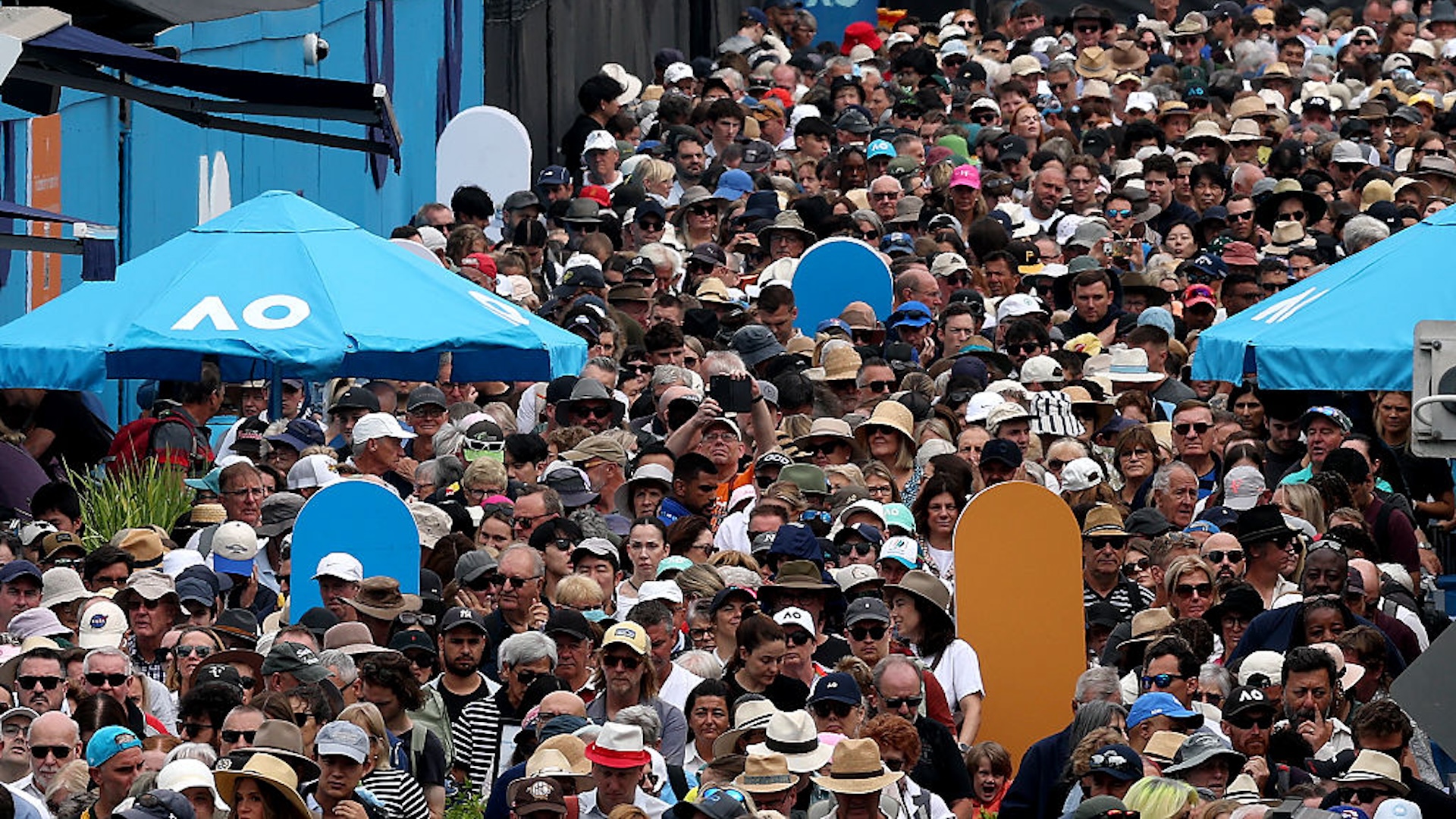
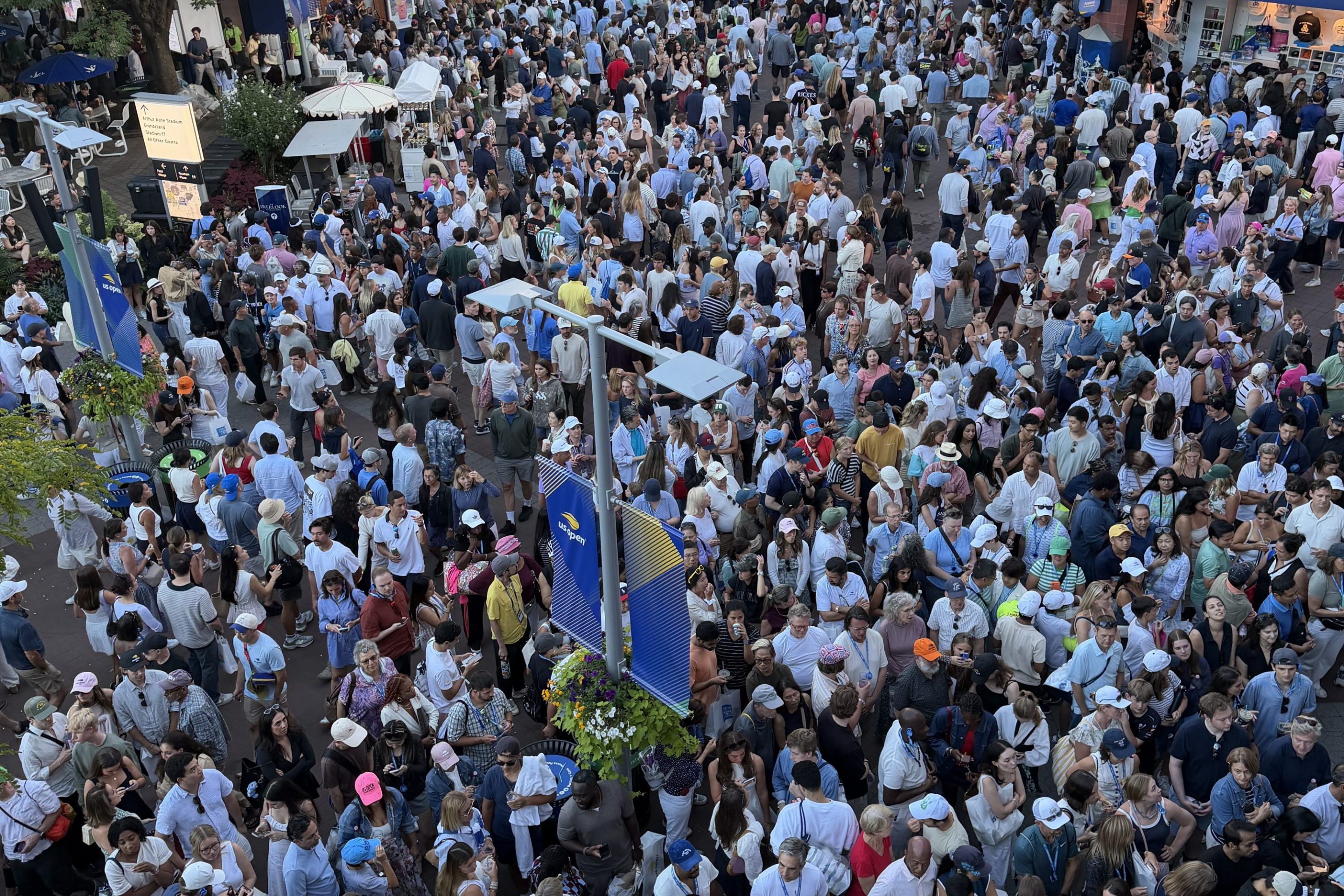
Let’s start with the crowds. More than 100,000 people walked Melbourne Park on the first day of the 2026 Australian, mainly because the powers that be decided to sell grounds passes without limit, as long as there was demand. Demand was such that the ground would have been invisible to any aliens who may have been spying from outer space. I peeked into John Cain Arena to gauge the line to Shake Shack and was met with a shuffling crowd so dense it felt like a singular mass, as if five feet of liquid were sloshing around the stadium. The overpriced sugar drink would have to come later. In Rod Laver Arena the first few days of the tournament, it was impossible not to notice the swaths of empty seats right behind the baseline, the priciest tickets going unsold.
During qualifying, I poked my head into the AO shop, a little dark blue capsule in Federation Square. (Lines on following days would stretch a good quarter mile, two or three people wide, all the way to Fed Square.) While admiring some abstract tennis-themed prints, a diligent tournament employee informed me that the $129 AUD pieces came in two versions: the original colors, or “AO blue.”
Commodifying a color! I hope I hid my gasp. A journalist told me before the tournament that the Australian Open is, sneakily, the most commercial of the four majors, because three of its stadiums are named for brands. Watching Elias Ymer beat Alex Bolt in the second qualifying round from one such arena, I counted 22 Kia logos in my field of vision alone. The Australian Open seems too big to suffer even a marginal drop in ticket sales due to the quality of the experience, much less to fail. But the Happy Slam is too crowded now, and less happy for it.
The product on court remains unchanged and fantastic. The singles draws at a major are essentially 256 players scything down each other’s dreams, while performing spectacular athletic feats, defying their own limits, or succumbing to emotion. Can’t beat it. Sometimes I think it is insane that the dimensions of the service boxes are the same now, with players serving at the speeds of a race car to precise targets, as when the old guard spun puffballs into play with wooden rackets. A single rally between Learner Tien and Medvedev is enough to change my mind. Fans behind me at the first match I watched all tournament, Australian Talia Gibson against Anna Blinkova, were decked out in green and gold. (Clearly Blinkova fans.) The first point of that match was appropriately messy: Gibson easily beat Blinkova for firepower and dominated the rally, only to hit several would-be winners directly at her opponent until Blinkova finally missed. The crowd went nuts.
It’s this kind of spirit that animates an individual fan to start shrill “AUSSIE, AUSSIE, AUSSIE” chants after the majority of the points in Alcaraz’s first-round match against home favorite Adam Walton. “You got this, Adam!” he shrieked in the third set, when Alcaraz led by two sets and a break. From my amused glances up at this fan (other, perhaps more jaded, media members’ looks ranged from irritated to “I should have just been an accountant”), I saw he was grinning at his friend after the chants, so I suspect he was trolling, but I choose to believe he was not. Loving a player enough to truly believe that they “got this” while hopelessly behind against the best player in the world is an almost unbearably sweet sentiment.
In-person tennis has other charms. You do not have to hear a commentator intone “Have you ever seen anything like it,” after every highlight-reel rally; if you are a dedicated watcher, usually you have seen something like it, yesterday, and will again tomorrow. Betting odds are mercifully absent. On Rod Laver Arena, you are treated to the “AO Light Show” before players walk out for each day and night session (which gets less entertaining each time), and PNAU’s amusingly titled “Go Bang” as they warm up (which gets catchier each time). You learn how to gauge the quality of an Aryna Sabalenka groundstroke by which audible emotion appears in the second syllable of her grunt. Jannik Sinner might walk past you on his way to a press conference, looking at his phone and wearing an olive-colored outfit that appeared to be made entirely out of stiff khaki. You can eat a fragrant and refreshing peach-and-vanilla twist ice cream, crusted with raspberry crumbs, from Peach Melbourne, for a kinder price than Shake Shack.
But there is also the heat. I have written about the Melburnian weather before, but a day topping out at 101 degrees Fahrenheit will make a writer revisit their subject. Last year’s Open was treacherous for the lack of shade, making an 80-degree sun feel like a laser beam; 101 is something else. The air was extremely hot, yes, but also seemed to exert inward pressure. It thrust Sinner into his token hell match at a major: He played abysmally, suffered cramps in multiple body parts, hit several serves that one of the 6-year-olds who played on mini-nets before the matches got going the next day could have crushed for winners, and won in four sets. As Eliot Spizzirri was in the process of breaking Sinner’s serve early in the third set, the Australian Open’s Heat Stress Scale ticked up to the requisite 5.0 threshold to close the roof and blast the AC. Moments before, cramps had sufficient hold of Sinner that he told his coaching team, “I’m fucked.” Under controlled conditions, Sinner gradually drew closer to his ideal level until he reached a state of grace that Spizzirri couldn’t match. There was an immediate debate over whether Sinner, as one of the two faces of the ATP and a big ticket-seller, had gotten favorable treatment, though the tournament had followed protocol exactly. Really, I think nobody should be playing tennis in this weather at all.
I saw two separate medical emergencies from a distance while watching matches in Rod Laver Arena, though neither was on the brutally hot Saturday. Faces in the crowd changed from passive-consumption mode to concern; a group of people gathered around the afflicted and called for a medic. Matches paused, once for 15 minutes during a tiebreak between Alcaraz and Tommy Paul. Alcaraz had his hands on his hips for some of the interruption. Tennis is these players’ lives, but to those who watch, it’s entertainment, and they have lives of their own. When I walked out of the media center to go home Saturday night, the smell of bushfire smoke was inescapable, lingering even on our 24th-floor rental. Fire might not have been visible from the city, but it was in the air. The roof discussions seemed trivial after that. Such days are better spent inside, from morning to night.
Tuesday topped out at 114 degrees, Melbourne’s hottest day since 2009. Tournament staff handed out free ice cream in the press room; my Connoisseur cookies and cream bar mysteriously seemed to displace itself into my stomach at double the usual rate. Walking around felt like living in the patch of air in front of an open oven door. Attendance during the day session barely scraped 21,000 people, down almost 30,000 from Saturday, itself down from every other day so far. Turns out there is one thing that can clear the crowds; you’d think these photos I took smack in the middle of the first quarterfinal day were from before the tournament started.
Sabalenka and Iva Jovic played the first marquee match of the day beneath an open roof, when the temperature was in the mere 90s. Shortly after that, the tournament suspended matches on outer courts and closed the Rod Laver Arena roof until a little after 8:00 p.m. (Temperature check when they did: 107 degrees, even in faded sunlight.) Twenty minutes later, as Alcaraz and Alex de Minaur raced up and down the court in increasingly superhuman ways, the heat poured into the stadium’s open mouth. “Where’s the roof?” a fan yelled. Tennis pundits love to bandy about “the future of the sport,” usually as it relates to a telegenic and unproven prospect. Whoever the real future of tennis is will probably have to do a lot of their proving indoors.
There’s no escaping the heat, at least not outside. But, and I say this with my tongue only brushing my cheek, I think the seagulls have figured out the rest of this tennis-watching thing. They gather atop Rod Laver Arena at night; they seem attracted to the stadium’s light. It’s only a couple at first, then a flock. They stand on the huge bars that loom over the retractable roof, the best seats in the house. Sometimes they fly languidly over the top of the arena, just watching the players do their dance. Then they settle back on the bars—dozens of them, I counted 50 one night—and grow still. They don’t have to struggle for space up there, or pay for admission; they just fall asleep to the sweet music below.


![USA's Ben Shelton celebrates his win against Spain's Carlos Alcaraz during the men's singles quarter-final tennis match on day ten of the US Open tennis tournament at the USTA Billie Jean King National Tennis Center in New York City on September 9, 2026. (Photo by Leonardo MUNOZ / AFP) / “The erroneous mention[s] appearing in the metadata of this photo by Leonardo MUNOZ has been modified in AFP systems in the following manner: [USA's Ben Shelton] instead of [Spain's Carlos Alcaraz]. Please immediately remove the erroneous mention[s] from all your online services and delete it (them) from your servers. If you have been authorized by AFP to distribute it (them) to third parties, please ensure that the same actions are carried out by them. Failure to promptly comply with these instructions will entail liability on your part for any continued or post notification usage. Therefore we thank you very much for all your attention and prompt action. We are sorry for the inconvenience this notification may cause and remain at your disposal for any further information you may require.”](https://lede-admin.defector.com/wp-content/uploads/sites/28/2026/09/GettyImages-2293730421.jpg?resize=2880%2C1920)