

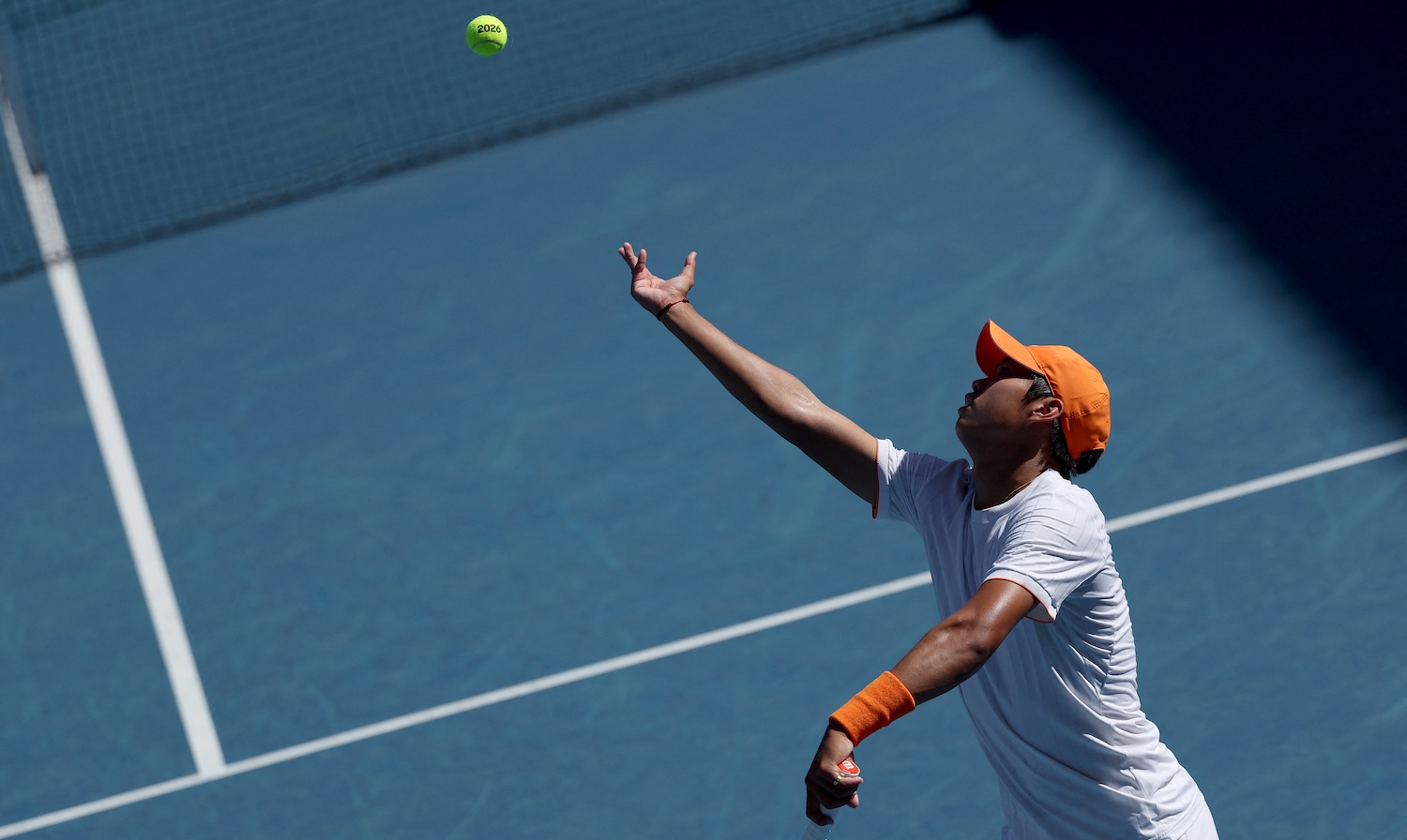
You will notice the announcer of the following highlight reel continually returns to one word to describe Learner Tien's performance against Alexander Shevchenko in the second round of the Australian Open: control. On Wednesday the 20-year-old American tidily dispatched Shevchenko in two quick hours, half of which the Kazakh spent in apparent physical agony and the entirety of which Tien spent in command. The further rallies progressed, the more pronounced Tien's advantage became, on and on through the four brief sets until the 25th seed rolled.
Tien is one of my favorite players to watch in men's tennis. That's because, among the really great and really young players in the game, Tien has a unique blend of strengths and weaknesses. Really, it's weakness, singular: Tien's serve, the most important shot in tennis, is a liability. In a tour otherwise populated with monstrously powerful servers, Tien's first serve hovers around 110-115 mph—roughly a dozen mph slower than the tour's biggest guns—on a good day.
It's not his fault. Tien is 5-foot-11 (USC's website quite generously lists him two inches taller) with relatively short arms, so the power deficit means his second serve gets feasted upon while the first serve needs to be extremely accurate in order for him to get free points. Per ATP stats, Tien averaged as many aces as double faults over the past year, and he wins 78.1 percent of his service games, 64th on the Tour.
If anything, that should be a case for cautious optimism. Tien turned 20 last month, right before winning Next Gen Finals. Barring injury, he will only improve as an athlete. He is also only improving as a server: A slightly deeper loading position, a new pinpoint stance, and an increasingly sophisticated grasp of how to surprise opponents have helped him to 30 aces and 12 double faults through two rounds in Australia. Also remember, the woes his serve causes him are far surpassed by the skill and craft of his striking.
The thing that leaps off the screen is Tien's phenomenal touch. The ball does what he wants it to do; it's as if he can find the corners by will. He is a sudden enough athlete to get away with a deep windup, making him a tremendous counterpuncher. Hard shots that would deny space to taller players for anything but a defensive shot, Tien redirects with purpose. It's not so much hitting those for winners as seizing advantages, and off both wings. When he's rolling, Tien's looping lefty forehand arcs the ball through the air with a certainty behind it. His compact backhand is extremely sturdy, the stroke swinging with the crisp ease of someone chopping dry wood.
Which is to say, he's a very fun to watch. Tien has style, and when he plays someone like Shevchenko who can't overpower him, who is then forced to sit in on longer rallies, the youngster builds some stunning points. He will initiate and win cross-court backhand exchanges and end them with a slick inside-out forehand up the line against an opponent running the other way. He will loft drop shots knowing exactly how they will be returned, to a spot to which he's already relocated. He will smack the forehand from corner to corner, draining tremendous amounts of energy. Tien is not as aggressive getting forward as the other top Americans are, but he can more than handle himself at the net. Tien is a great athlete, always hitting out of an open stance and maintaining various conjoined equlibria while at a dead sprint.
The problem, ultimately, is that Tien's weak serve gives him an often uncomfortably slim margin for error. If he is not playing close to his best stuff, he can easily fall victim to the type of trouble that big servers can shoot their way out of. He was not playing close to his best stuff in the first round against Marcos Giron, spraying errors, wrongfooted by Giron's peskiness more than anything. Giron refused to get into probing exchanges with Tien, insisting upon a level of variety that even Tien wasn't always comfortable with. In a strange inversion, Tien's serve occasionally bailed him out of trouble, especially in the big moments. He was able to win the fourth-set tiebreak and dominate in the fifth. Tien keeps getting into epics: Three of his six wins at Slams have been five-setters, and he's never lost in five.
Consider Tien's telegenic qualities alongside others his age. Jakub Mensik is the highest-ranked player under 22, and he earned that ranking and a Masters 1000 title last season by pounding a huge serve. It's not much fun to watch, or, to his credit, play against. Joao Fonseca, another favorite around these parts, is right ahead of Tien in the rankings. He booms huge shots as if powered by a cannon, though he is confoundingly inconsistent: Earlier this week, he lost to Eliot Spizzirri while looking equal parts out of shape and bad. Fonseca can be as fun to watch or as bad to watch as anyone right now, which itself is, oddly, kind of fun. Just below Tien are Alex Michelsen (mostly not fun), Arthur Fils (fun), Ethan Quinn (fun, plays Mensik on Friday), and the triad of Alexander Blockx, Dino Prizmic, and Rafael Jodar (none quite good enough to be fun yet, but hopefully soon?). It's a potentially cool cohort, but nobody there really plays like Tien.
Tien and his coach Michael Chang are aware of the weaponry gap, and Tien's ceiling will be defined by how much more dangerous he can be at the start of rallies. "I think I was a major pusher last year," Tien recently said on Nothing Major, to which one of the hosts countered, "You've got sneaky power." That's true. I don't watch Tien and see someone who is either risk-averse or feather-armed; I see a player who is exactly as patient as he should be.
His patience got him some big wins last year, the first over then-defending finalist Daniil Medvedev at this very tournament, in one of the best matches of the season. He followed that up by beating Alexander Zverev in Acapulco, making it to fourth round of two 1000s, beating Lorenzo Musetti, reaching a final against Jannik Sinner, and playing the second and third legs of what would turn out to be an unlikely, incredible trilogy with Medvedev.
"We played only three matches, but they were all unreal," Medvedev said when asked about Tien this week. "Our games connect, on some level. [...] Both of us, we kind of cannot hit a winner, so we have to fight for every point." Brutal self- and Tien-assessments aside, Medvedev is correct in identifying a synergy. The aesthetic precursors of the two players' games could not be more different—huge, octopian, autodidact-looking-game-ass, lanky Russian right-hander with a self-harm follow-through against undersized, harmonious, tiny American lefty with perfect technique—but what they share is power of insight. Both Tien and Medvedev can build points from a long way out, both have the ability to draw opponents into exchanges only they can win, and both are comfortable on the grind. As it happens, they are one round away from a rematch. If the tennis gods are kind, they will strike down Nuno Borges and Fabian Marozsan, respectively, later today.


![USA's Ben Shelton celebrates his win against Spain's Carlos Alcaraz during the men's singles quarter-final tennis match on day ten of the US Open tennis tournament at the USTA Billie Jean King National Tennis Center in New York City on September 9, 2026. (Photo by Leonardo MUNOZ / AFP) / “The erroneous mention[s] appearing in the metadata of this photo by Leonardo MUNOZ has been modified in AFP systems in the following manner: [USA's Ben Shelton] instead of [Spain's Carlos Alcaraz]. Please immediately remove the erroneous mention[s] from all your online services and delete it (them) from your servers. If you have been authorized by AFP to distribute it (them) to third parties, please ensure that the same actions are carried out by them. Failure to promptly comply with these instructions will entail liability on your part for any continued or post notification usage. Therefore we thank you very much for all your attention and prompt action. We are sorry for the inconvenience this notification may cause and remain at your disposal for any further information you may require.”](https://lede-admin.defector.com/wp-content/uploads/sites/28/2026/09/GettyImages-2293730421.jpg?resize=2880%2C1920)