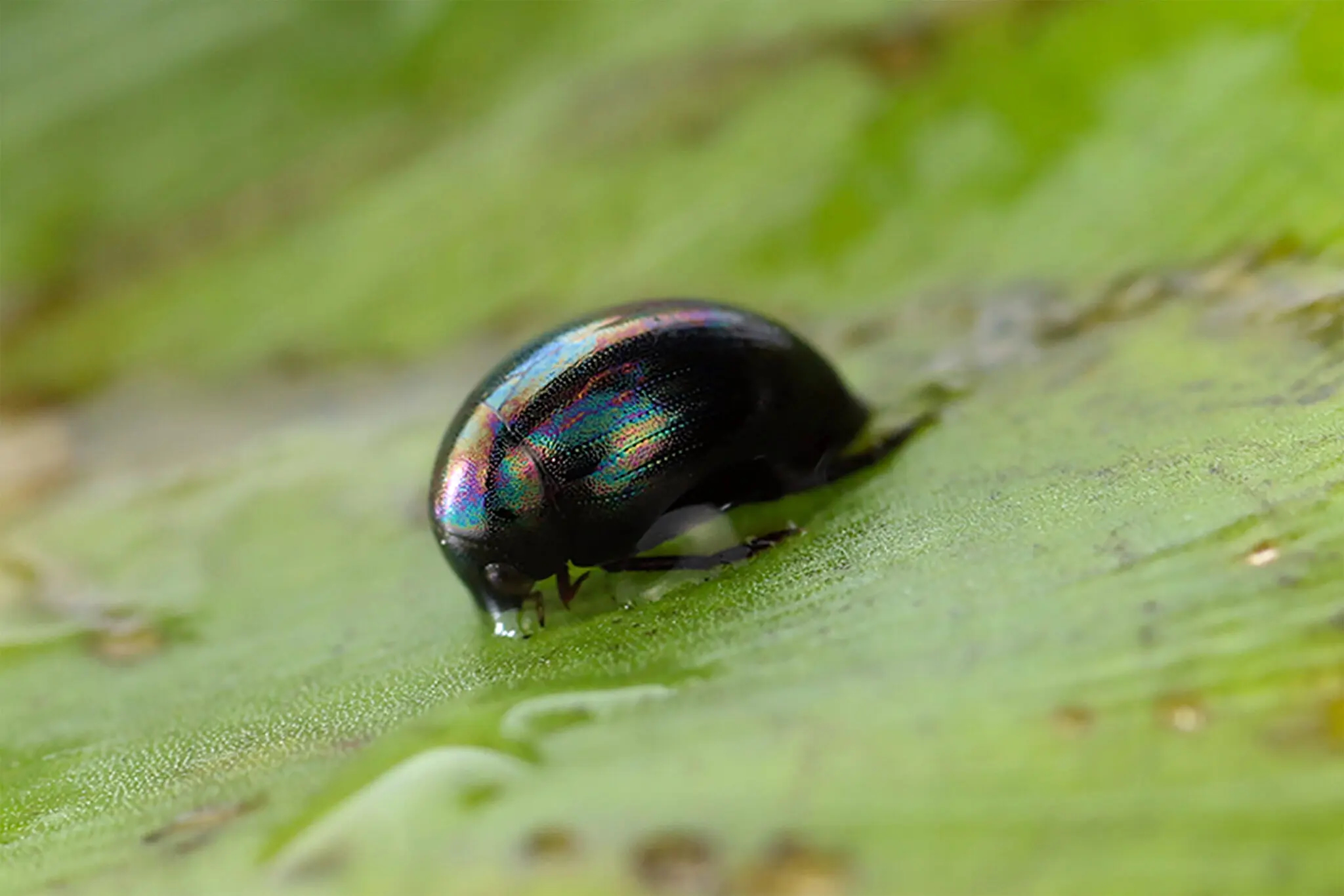
At a glance, the Japanese water scavenger beetle Regimbartia attenuata looks like any other beetle. It is small, black, and pleasantly round. It has your standard set of beetle legs (six) and is otherwise unassuming. It is, you might imagine, the exact kind of bug that a frog would seek as a snack. But this water scavenger beetle is impervious to trials and tribulations that would kill any other insect. For one, it can pass through one end of a frog and emerge, utterly unscathed, out the other end.
Shinji Sugiura, an ecologist at Kobe University, first learned of the beetle's abilities while investigating how insects defend themselves against frogs. He collected a variety of insects found in a frog-filled paddy field and fed them to his amphibians in the lab. When a frog ate any other species of beetle, it defecated the insect, several days later, as a carcass. This was perhaps to be expected. But the water scavenger beetle had other plans. If the beetle is swallowed by a frog, it can zoom on through the digestive system and be excreted within six minutes, alive and apparently none the worse for wear. Sugiura found that 90 percent of water scavenger beetles clawed their way out the frog's derrière alive, according to the 2020 paper he published in Current Biology.
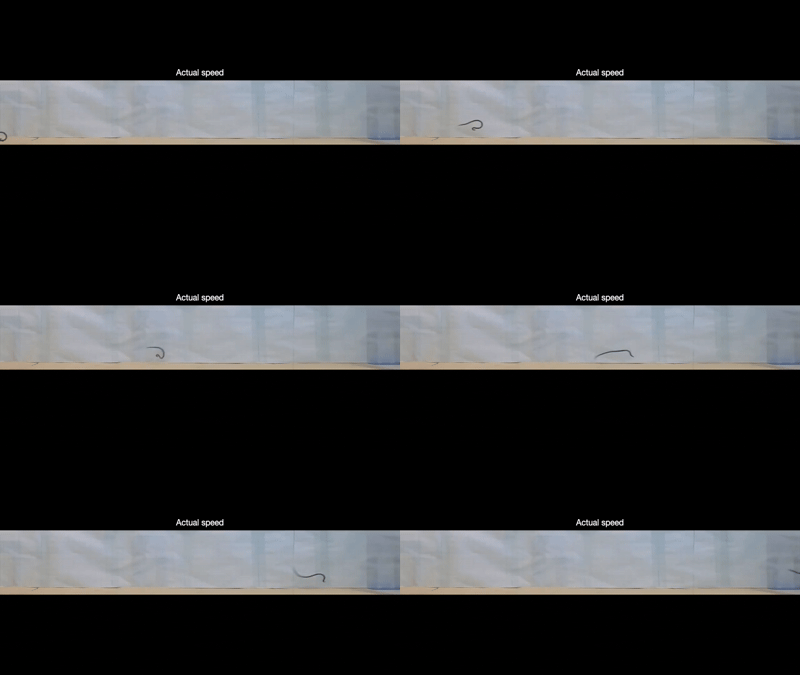
As you enjoy footage of the following experience, please note the nonchalant nature of the beetle and the freaked-out vibe of the frog.
Some water scavenger beetles took a more leisurely route out of the frog, emerging alive up to six hours after being swallowed. But the journey is impressive no matter the time it takes. The bug must navigate through a twisting tube of intestines large and small. And a frog's intestines represent their best stab at killing prey, given the fact that most frogs have no teeth or means with which to kill a beetle before swallowing it. Sugiura suspects that the beetles must be using their legs to make their way through the frog.
It is also no easy feat to pop open the pursed hole of a frog's all-purpose cloaca. The average frog has a powerful sphincter muscle that keeps its hole sealed off from the outside world. But Sugiura believes the water scavenger beetle might use its legs to stimulate the hole and coax it open. When he amputated the legs of the water scavenger beetles, they were excreted as corpses like any other bug. But those that survived appeared entirely unharmed after their brush with digestion. Many lived for months afterward, scurrying and scuttling like any other bug.
After the frog experiments, Sugiura was curious to learn if the water scavenger beetle's abilities held up to animals that were not frogs. "I became interested in whether it could also escape from other predators that coexist in the same habitat," he wrote in an email. He turned his gaze toward the Japanese common catfish, Silurus asotus. The catfish lives in rivers, ponds, and lakes throughout East Asia and feeds on smaller creatures like aquatic insects and crustaceans. Sugiura dropped eight aquatic beetles of varying sizes into a tank with a catfish and watched to see who was eaten, and who might emerge through the (considerably longer) digestive tract of the catfish alive.
Unfortunately, the water scavenger beetles never made it to the catfish's butthole alive. "I had somewhat expected that R. attenuata might also be able to escape alive through the fish’s cloaca, so I was a little disappointed that none did," Sugiura said. In the study, he concluded that "that cloacal escape is a frog-specific defense strategy."
Fortunately, the beetles found another, less harrowing strategy for survival. "I noticed that catfish quickly spat out R. attenuata after capture," Sugiura said. He watched as the catfish chomped on the bigger beetles and slurped up the smaller beetles via suction. Although the catfish succeeded in getting all the beetles into their mouths, the smaller beetle species were more frequently spat out.
When Sugiura turned to his tried-and-true method of amputating the legs of the water scavenger beetles, the vast majority of the water scavenger beetles were successfully eaten, suggesting the beetles use their legs in some way to provoke the catfish to spit them out. The specifics of this strategy—whether they wriggle their legs with abandon or cling to the fish's tongue—remain unknown (to Sugiura; presumably the beetles and the catfish know).
What is clear is that water scavenger beetles are far from defenseless from the predators of the paddy fields. "Even after being captured, small beetles can resist effectively and become difficult for the fish to consume," Sugiura said. Whenever a big and hungry mouth looms above this beetle, all is not lost. Even when menacing jaws, toothed or toothless, clamp down over this beetle and ensconce it in dank darkness, the beetle's story has not yet come to an end. Its legs whir into action, doing whatever they do, until an opening reveals itself, and the beetle wriggles back into the light.