


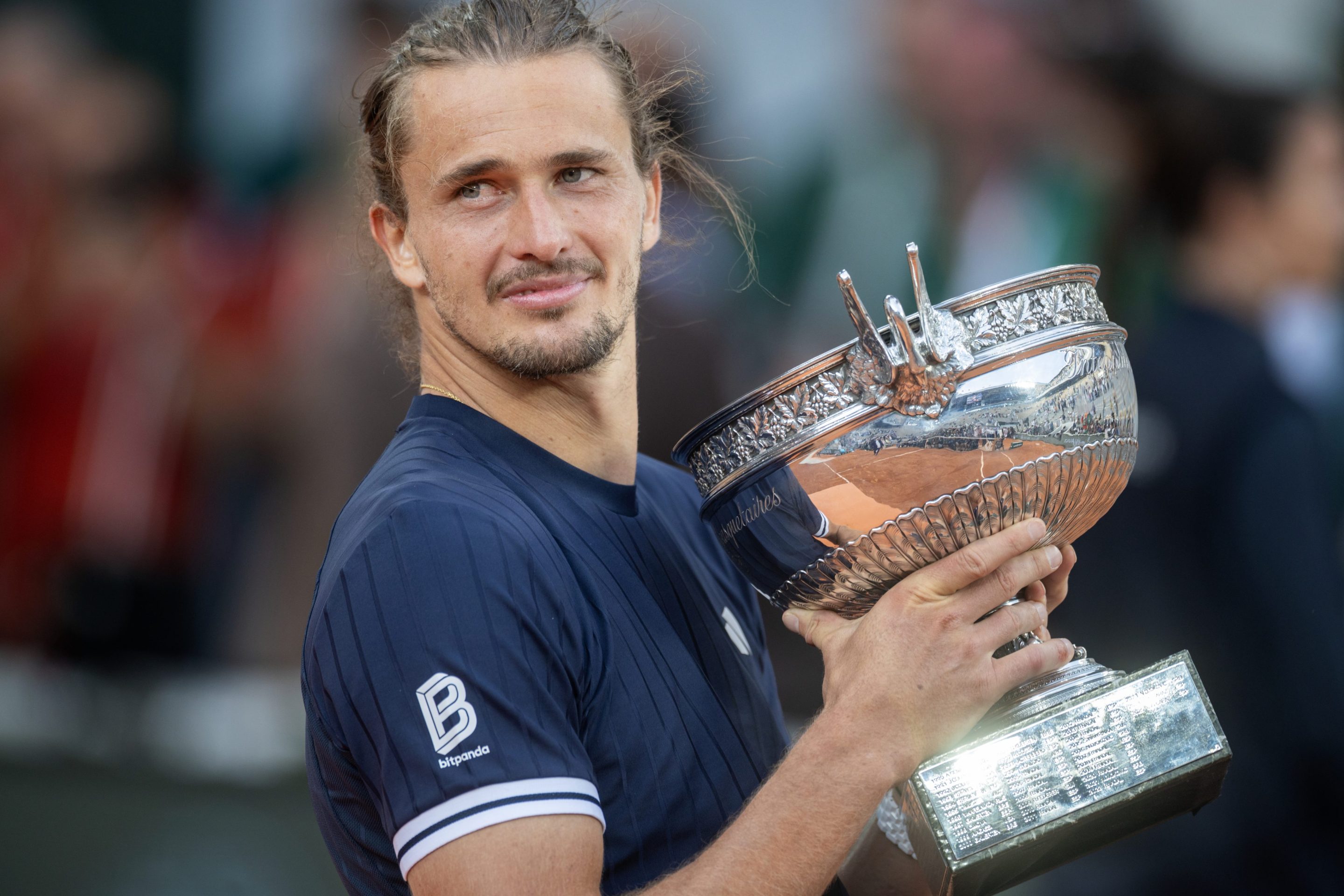
This past Sunday, Alexander Zverev won his first major title. On the surface, the 29-year-old's Roland-Garros victory is the story of a player who, after roughly a decade of high expectations, accomplished the signature feat in his sport while benefiting from injuries and early upsets that removed the biggest obstacles in the men's bracket from his path. Perhaps it's the story of an elite athlete succeeding despite a childhood type-1 diabetes diagnosis that requires him to regulate his blood sugar levels during competition, or the story of a player who finally conquered the nerves that previously undermined his talent once he arrived at the late stage of a major. But for many journalists and a large swath of the tennis-watching public, it's also the story of a player who has faced allegations of domestic violence from two previous partners.
The first accuser, Olya Sharypova, took her allegations public in 2020 through interviews with journalist Ben Rothenberg. Sharypova accused Zverev of repeated instances of physical abuse, including him punching and choking her. There were no legal charges; the ATP commissioned an independent investigation and concluded that there was "insufficient evidence" to substantiate the allegations. (Zverev filed a lawsuit against Rothenberg in German court over the reporting; the case is "winding down," according to Rothenberg.)
Brenda Patea, the second accuser and mother of Zverev's daughter, took him to trial in Germany. Court records obtained by German newspaper Süddeutsche Zeitung said that Patea accused Zverev of pushing and strangling her. At every turn, Zverev has claimed that the allegations are false, and, as recently as this past weekend, he has claimed that he has been proven innocent in court, even though the 2024 out-of-court settlement does not constitute a ruling on his innocence or guilt.
Amid these allegations and the subsequent legal activity, Zverev was still elected by his fellow players to the Player Advisory Council in 2024—the governing body which theoretically would make decisions about his fitness to play, under the clause in the ATP rulebook dealing with "conduct contrary to the integrity of the game." WTA players Iga Swiatek and Sloane Stephens diplomatically criticized the ATP players' choice. "For sure, it's not good when a player who's facing charges like that is kind of being promoted," Swiatek said at the time.
Despite it all, Zverev has remained a popular figure in the men's locker room. His win at Roland-Garros was praised by all-time greats like Novak Djokovic (who has advised Zverev extensively throughout his career), Carlos Alcaraz (whom he has cited as one of his close friends on tour), and Rafael Nadal (who treated a slumping Zverev in 2025 to pep talks in Mallorca that the younger player has fondly described). Though a segment of tennis's online fanbase has vocally stated its misgivings about Zverev, when it comes to the actual crowds at tournaments, fans cheer him on as they would any other top player. Perhaps they know about the allegations and don't care, or perhaps the media they consume has omitted the topic altogether. As Rothenberg recently laid out, television broadcasts in the U.S. have largely danced around Zverev's allegations. (I would add that it was different a couple of years ago, albeit briefly: Ahead of Zverev's 2024 Australian Open semifinal, ESPN displayed an infographic on the allegations, and broadcaster Chris Fowler talked through its bullet points.)
For every tennis writer I know, the allegations against Zverev have colored the approach to writing about him. How their internal thoughts shape the external published work depends lot on their outlet's house style, politics, and scope of coverage, but it's on everyone's mind. How could it not be? In 2019, he had scratches on his neck while competing and winning on the court, marks which Sharypova said she had left while defending herself during their fight. If at some point in the past you've noticed the tennis media's lack of fulsome appreciation of Zverev, his off-court behavior is a key factor, though perhaps not the only reason; his on-court shortcomings and tantrums have also played a role.
The last time I wrote about Zverev's tennis at length was for a 2017 essay for the Washington Post magazine, when I thought he was an imminent major champion, and I was busy haranguing his then-coach Juan Carlos Ferrero after practice for a good quote about his two-handed backhand. I spent a week at the Citi Open, waiting through long rain delays and late match finishes in hopes of arranging a one-on-one with Zverev, which eventually did take place, though I can't say it illuminated much beyond what it's like to speak to a visibly bored and professionally obligated athlete. Even when he has succeeded in the years since, I have tended to focus on other storylines. While writing my book covering the 2024 season, I spent about as much time mentioning the ongoing trial as I did describing his playing style. I once asked him a question for a 2025 feature on the state of a tennis ball, due to his position on the players' council. In an appearance last year on The Tennis Podcast, I predicted, correctly if joylessly, that the first player to break the Sincaraz streak of men's Slam wins would be Zverev.
Journalists who covered Roland-Garros this year told me that the closer Zverev got to the title, the more conversations there were in the press room about how to responsibly cover his success. Post-championship stories published at mainstream outlets like Tennis.com, The Guardian, and The Athletic have foregrounded the allegations. France's leading sports outlet, L'Equipe, made its editorial choice quite clear: The post-championship issue, which has historically given over the cover story to the men's champion, instead relegated Zverev's triumph to the top-left corner of the page. In the accompanying article, Quentin Moynet described how his interview was abruptly cut short when he asked Zverev about the media's response to the allegations against him. Zverev questioned the nature of the interview, and his agent soon intervened as well. Moynet said the end of their car ride together was spent in "an icy silence."
I admit that I don't always know the ideal way to write about a player like this in times of success, when coverage is unavoidable. The ambiguity of the legal outcome adds to the unease. Not that any country's judicial system is a perfect arrow aimed at the truth, but a ruling might at least provide an anchor for further discussion, and might have made more facts known to the public. Because the trial ended in a settlement, and because Zverev hasn't discussed the relationships or allegations in any detail beyond flat rejection, there is nothing else to latch onto. Should these allegations influence all future coverage of Zverev until the end of his playing days? In a hypothetical world where tennis fans were perfectly informed, it might not be necessary to do so. In the actual world we live in—rife with disinformation, incuriosity, rank misogyny, and a general lack of social consequences for sufficiently lawyered-up men—it would be irresponsible to ignore his past.
On a certain restorative logic, Zverev would not be forever defined by his alleged worst deeds, but that grace would only be possible with his acknowledgement and transparency. The realm of celebrity crisis PR is not designed to produce either. Closure is nowhere on the horizon. At 29, now having won his first major title and living comfortably in a tier beneath Sincaraz and above of the rest of the tour, Zverev remains a fixture of men's tennis. He isn't going anywhere. The question of how he'll be remembered in the future is one that will be collectively answered by fans and journalists alike. It's almost impossible to imagine that the disquiet around Zverev ever dissipates.



![USA's Ben Shelton celebrates his win against Spain's Carlos Alcaraz during the men's singles quarter-final tennis match on day ten of the US Open tennis tournament at the USTA Billie Jean King National Tennis Center in New York City on September 9, 2026. (Photo by Leonardo MUNOZ / AFP) / “The erroneous mention[s] appearing in the metadata of this photo by Leonardo MUNOZ has been modified in AFP systems in the following manner: [USA's Ben Shelton] instead of [Spain's Carlos Alcaraz]. Please immediately remove the erroneous mention[s] from all your online services and delete it (them) from your servers. If you have been authorized by AFP to distribute it (them) to third parties, please ensure that the same actions are carried out by them. Failure to promptly comply with these instructions will entail liability on your part for any continued or post notification usage. Therefore we thank you very much for all your attention and prompt action. We are sorry for the inconvenience this notification may cause and remain at your disposal for any further information you may require.”](https://lede-admin.defector.com/wp-content/uploads/sites/28/2026/09/GettyImages-2293730421.jpg?resize=2880%2C1920)