


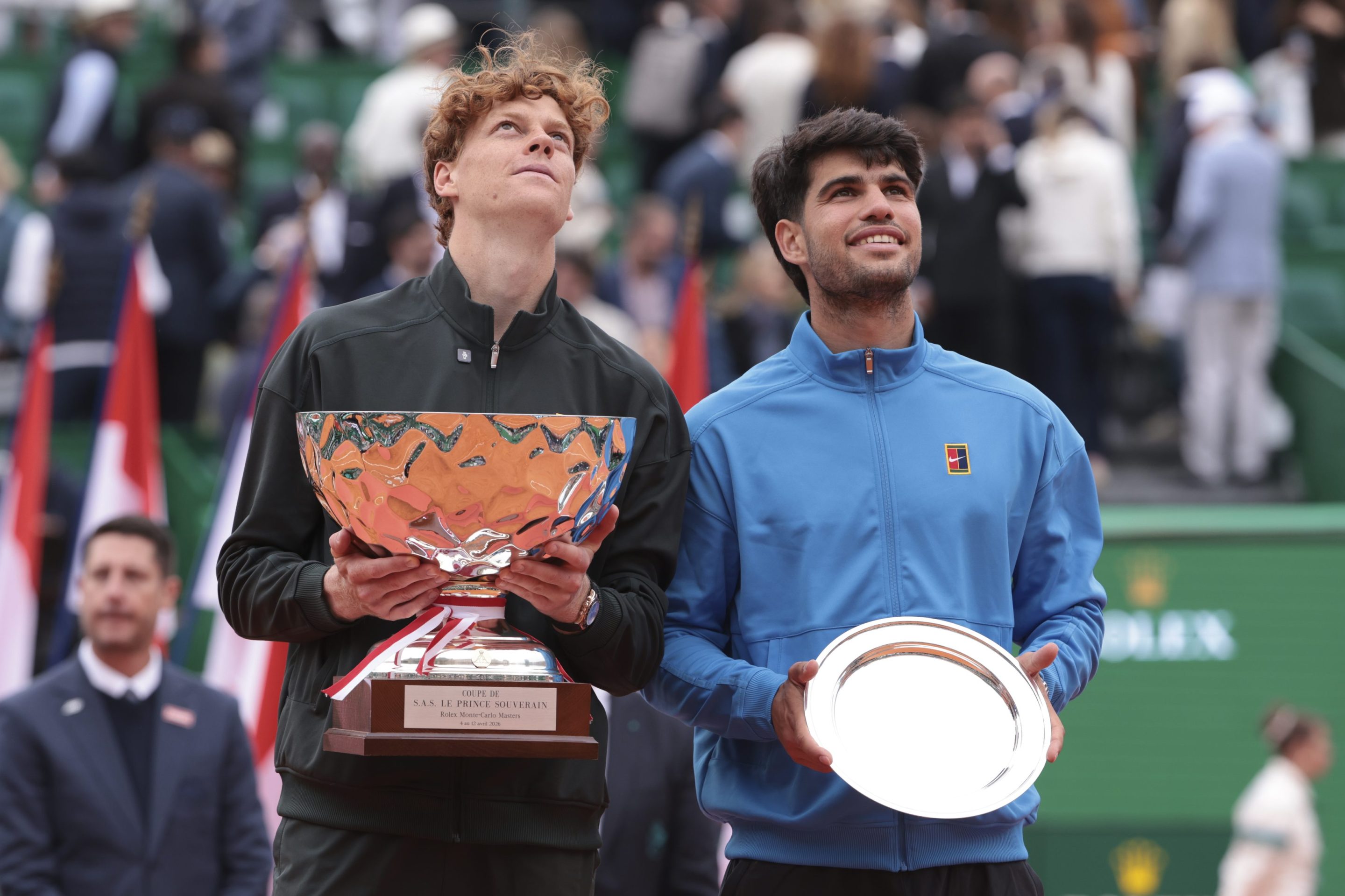
Sea, trees, and hills make Monte Carlo the prettiest stop on the tennis tour, but for Sunday's championship, it did its best to dull itself. The singles final featured gray sky, chilly air, and gusts tossing the ball around unpredictably. It was sure to be a rough outing at the Monte-Carlo Country Club, no matter the faces on court or the stakes of the match. The two era-defining players in men's tennis, scrapping for the world's top ranking, could not overcome the weather and redeem the day. Even with Carlos Alcaraz and Jannik Sinner out there—or precisely because each was playing against the other—there were wild wind-borne errors and moments of uncharacteristic anti-clutch. Not every installment in a classic rivalry is itself a classic, but Sinner's 7-6(5), 6-3 victory, which snagged his first big clay-court title and let him regain the No. 1 ranking, still left me with plenty to chew on.
One of the most surprising aspects of this matchup is that it took until April 12 for it to happen. Throughout 2025, Sinner and Alcaraz effectively had a standing date in the final of every big event. Because no other player seemed good enough yet to interfere, this pattern was expected to continue in 2026. At the start of this season, they narrowly missed one another in the Australian Open final, thanks to a blazing performance from late-stage Novak Djokovic. Then came another miss in the Indian Wells final, as occasional interloper Daniil Medvedev got out of his funk to beat Alcaraz. (Firmly back in his funk, Medvedev lost his first match in Monte Carlo 6-0, 6-0, and smashed his racket seven times.)
Upsets for Sinner in Doha and Alcaraz in Miami prevented a clash between the top two seeds in those locales, too. All told, it had been about four months since they last met in the championship match of the ATP Finals. After such a lengthy tolerance break, I expected to have my mind lit up by an encounter on clay, the surface that most emphasizes their physicality and point construction, best seen in their generational duel at the French Open last year. That was not the match we got at Monte Carlo. The conditions were just too disruptive, and the players could never settle into enough of rhythm, instead providing a twitchy battle that still had plenty of tension to it, if not rallies constructed like epic poems.
The best way to look at this match is to consider what it says about the state of the arms race between these two. Sinner tends to serve poorly against Alcaraz. This is one of the main features of their dynamic in recent matches; his first-serve percentage dips well under his season averages. Presumably this is because of the pressure Alcaraz applies with his returning skill and mind-reading anticipation. Sinner feels compelled to go bigger, and his accuracy suffers, and thus one of the advantages he has on Alcaraz for the rest of the season—the serve, as an isolated shot—is dampened when they actually play. But Sinner has also been in the lab improving that shot. After losing to Alcaraz at the U.S. Open on an especially bad serving day, he tweaked his service motion once again. Now approaching servebot status, Sinner won Indian Wells and Miami without dropping a set, and seeing his serve broken only three times across those 24 sets. He's getting more first serves in, and hitting more aces than he did in 2025, which was already the best serving season of his career.
And yet, well into Sunday's match, it appeared that Sinner had reverted to the old story of this rivalry. When he stepped to the line to serve at 6-5 in the first set, Sinner had put only 39 percent of his first serves into play. That's not sustainable against a returner of Alcaraz's caliber, who had been experimenting from Medvedvian deep-court positions, disappearing from view on the broadcast, and doing well with it. But from that point onward, Sinner closed out the set on a tear, including making six of six first serves in the tiebreak, concentrating all his best serves into the most pivotal passage. It didn't last. In the second set, he was again putting in first serves at just a 47 percent clip, but by that time he'd taken the upper hand in the baseline exchanges and was surprisingly winning even more of his second-serve points (69 percent) than first-serve points (57 percent).
One of the ways Sinner dominated the baseline was by running around his backhand to hit more forehands from the ad corner. If you'd asked me, I would've said that this is a misguided tactic for Sinner in particular. He is the owner of the best offensive backhand on tour, an eerily symmetrical player who can do nearly equivalent damage on both wings. Why should he sacrifice court position to hit more forehands when his backhand is already so good? Why would you give Alcaraz more open space to work with, when he is perhaps the most gifted player ever at instantly exploiting that space? But rivalry is all about experimentation, and the Sinner camp is smarter than me, because this pattern worked really well for him in this match. Perhaps it could be a point of emphasis in their future matchups on slower surfaces, too.
This was a loose match, given the conditions. Both players let big opportunities slip. Both shanked a few off their frames. Alcaraz's drop shot had its moments, but otherwise wasn't operating at its usual level; it's hard to play off-speed stuff in that much wind. Nor could Sinner always punish the poor drop shots: He tracked down several short balls that could have been putaways, but couldn't even keep them in the court, perhaps because he felt the pressure of Alcaraz's reflexes at net. One such easy putaway came on set point in the first, only for him to dump it into the net, only for Alcaraz to return favor with his own double-fault.
Alcaraz applied steady pressure on return, but, by his own admission, couldn't capitalize on the openings he gave himself. They produced just one point that will enter the Sincaraz highlight reel. It was a sequence of absurd Alcaraz defense from corner to corner, culminating in a nasty continental-grip passing shot poked down the line to break serve in the second set. But he only won one more game in the match after that.
Alcaraz was the defending champ in Monte Carlo, and handing those ranking points off to Sinner was enough for them to swap the top two slots in the rankings, an exchange that will surely play out countless times in the years ahead. The win narrows the gap in their career head-to-head, which is still 10-7 in Alcaraz's favor. They came into the match tied with 66 weeks spent at No. 1 apiece, and Sinner now will break that tie this week. At the post-match handshake, Alcaraz complimented his rival on how tough he is to beat across court surfaces. In a tidy encapsulation of modern-day tennis rivalry—which is not so much mortal struggle as it is a benign coworker relationship with enormous mutual commercial opportunity—Alcaraz even filmed his rival's celebratory dip in the pool.
With the win, Sinner secured the first three Masters events of the season, a feat that only Djokovic in 2015 had previously accomplished. Sinner is on a tear and serving better than ever, but not so long ago Alcaraz was opening the season on a 16-match win streak. It is often surprising to see how many tennis analysts sound trapped in the present moment. As recently as early March, a story on Tennis.com, citing three mainstream pundits, wondered if Alcaraz was pulling away from Sinner for good. Fans waxed catastrophic after Alcaraz lost to Seb Korda in Miami a few weeks later.
Even the best players in history lose tennis matches, sometimes to players who are not also the best players in history, and it is funny to treat those losses as a mark of existential crisis. Zoom out and look at the overall arc of both careers. While there have been a few discrete moments in the last two seasons when one of these players looked to be taking control, this rivalry will always have its reversals of fortune. If either of these two starts to run away with everything, I'll eat my shoe, or my book.


![USA's Ben Shelton celebrates his win against Spain's Carlos Alcaraz during the men's singles quarter-final tennis match on day ten of the US Open tennis tournament at the USTA Billie Jean King National Tennis Center in New York City on September 9, 2026. (Photo by Leonardo MUNOZ / AFP) / “The erroneous mention[s] appearing in the metadata of this photo by Leonardo MUNOZ has been modified in AFP systems in the following manner: [USA's Ben Shelton] instead of [Spain's Carlos Alcaraz]. Please immediately remove the erroneous mention[s] from all your online services and delete it (them) from your servers. If you have been authorized by AFP to distribute it (them) to third parties, please ensure that the same actions are carried out by them. Failure to promptly comply with these instructions will entail liability on your part for any continued or post notification usage. Therefore we thank you very much for all your attention and prompt action. We are sorry for the inconvenience this notification may cause and remain at your disposal for any further information you may require.”](https://lede-admin.defector.com/wp-content/uploads/sites/28/2026/09/GettyImages-2293730421.jpg?resize=2880%2C1920)