

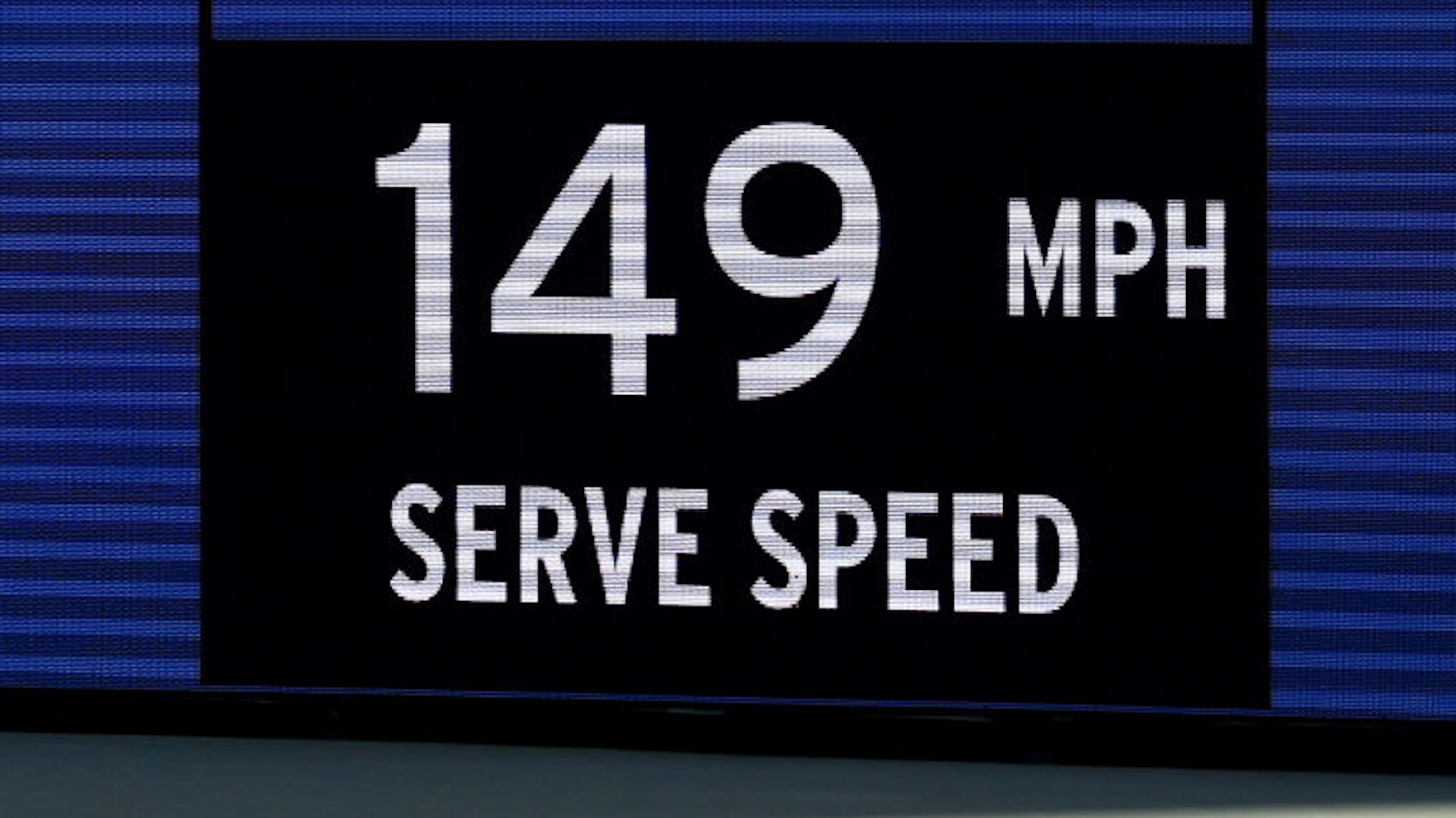
Complaints that men’s tennis is too fast go back further than I do. “Aces, Aces…men’s tennis too fast for its own good,” reads the headline to a 1992 Associated Press story that, to help make its point, begins with a quote from Casablanca. “Well, you just have to guess where the ball is going to go and pray,” Carlos Moya said in 1998 after a befuddling U.S. Open semifinal loss to Mark Philippoussis and his huge serve. “Because even if you know where the ball is going, it’s not easy to put it back.” A 1994 AP story in the Salina Journal cited Dutch fans chanting “boring” as Pete Sampras served aces against their Richard Krajicek at the Davis Cup. (It worked; Krajicek won.) The Daily Mirror once nicknamed Sampras “Samprazzz,” since his matches at Wimbledon, even finals, tended to be so straightforwardly serve-centric. One article advocated for a return to wooden rackets. The Philadelphia News headline in advance of the 1994 Wimbledon final: “Sampras, Ivanisevic advance to (yawn) Wimbledon final.” The Star, postmatch: “Sampras sees off Ivanisevic in boring game,” under the much larger heading, “BIG SLEEP.” This piece came on a page whose left side was plastered with a variety of sex ads, numbers for anyone from “BORED WIFE” to “IN THE SHOWER” to “Susi & Mary” to—yikes—“18 Year Old Students.” Perhaps someone thought it appropriate to spice up an otherwise snoozy page.
Today, the movies are worse and the newspapers are endangered, but the tennis gripe should be the same. To read how Jim Courier described playing and losing to Sampras in the 1993 Wimbledon final—“If he starts hitting his second serve around 95 to 100 miles per hour, putting it in the corners, it's pretty unstoppable”—is to realize how most current ATP players worth their salt do the same thing. Players can hit forehands faster than some first serves. The current meta is power; the mindset is relentless aggression. Merely returning a serve won’t get you into a point if the return isn’t hard to attack, too.
Tall task! The best first serves these days paint the lines at high speeds, with motions that effectively disguise which corner the server is aiming at. On top of all that, the ATP is populated with returners who range from mediocre to miserable (Lorenzo Musetti, Felix Auger-Aliassime, Taylor Fritz, Ben Shelton, go down the list). At the Miami Open, finalists Jannik Sinner and Jiri Lehecka had their serves broken a combined three times all tournament. (Sinner scored two of those breaks in the final.) The Indian Wells final between Sinner and Daniil Medvedev saw zero breaks of serve and only two break points. Carlos Alcaraz won the 2025 U.S. Open, seven matches, after being broken just three times (and once in his first five matches combined). Even in his most dominant Wimbledon runs, Sampras was never broken fewer than seven times. The tennis writer Matthew Willis has observed that on hard courts, Casper Ruud—whose serve is probably a candidate for the least-discussed shot on tour, somewhere up there with Andrey Rublev’s backhand or your brother’s forehand volley—is holding serve on hard courts lately at a higher rate than Sampras did in 1994. Willis also posted a graph of top-50 ATP players’ service hold rate, dating back to 1992; they’re now holding more often than at any other point in that span.
Part of this is thanks to technology: Ever-evolving rackets can impart more pace and spin on the ball than the sticks of yesteryear. Court surfaces have also helped facilitate this change. Hard courts, which make up eight of the 14 annual big tournaments on the ATP and most of the tour as a whole, are now more often than not medium-fast. The Australian Open has played fast since 2017, the molasses-slow courts of the late 2000s and early 2010s a distant memory. The U.S. Open is slower than the Australian, but not by much. The indoor year-end championships are notoriously serve-dominant; newer fans will be shocked to know those courts were relatively slow for much of the early 2010s. Indian Wells, which can usually be counted on to play slow and gritty like a clay court, was quicker and slicker this year. (Hence those break point stats in the men’s final.) Grass courts have slowed down from their greased-lightning years in the ‘90s after Wimbledon changed its blend from ryegrass and creeping red fescue to pure ryegrass, but bounces remain fairly low, slick, and imperfect; most players also struggle to defend more on grass than other surfaces. Clay courts do blunt the impact of a serve, but it’s only from April (yay!) to early June that red-dirt enthusiasts can feast.
Fast tennis can be electrifying. It’s fun to watch a player sock a forehand so hard that it appears to thwack the back wall before their opponent has even registered its flight path. It’s very fun to watch points like this one between Iga Swiatek and Eva Lys, a succession of groundstrokes struck with such mathematical perfection, each somehow building upon the last, that Lys couldn’t help but joyfully clap her hand over her mouth afterward. On a highlight reel, fast tennis can be downright euphoric, a glimpse into a futuristic, borderline supernatural brand of the sport.
But it also has its issues, as the ink-stained tennis pundits of old knew well. The joy of the sport is the possibility that a player will do something spectacular at any given moment. Fast tennis flattens that possibility into the space of just a couple shots, which fly over the net with such pace and weight that they’re hard to transform into unexpected brilliance. Point to point, outside the curated dopamine of a highlight reel, the service winners and serve-plus-ones can get tedious. Rallies and service games are staccato, predictable, and sometimes insanity-inducing. It can feel inevitable that sets will end in tiebreaks. The tactical ripples of a long rally are smoothed over. There is a place for this kind of tennis on tour; the back end of the season practically demands it, given the attrition of its first eight or nine months. For it to become the norm, though, would threaten the loveliest quirks and features of the game.
All this is far more of a problem on the ATP than the WTA, where the returners are better and the serves less obliterating. Aryna Sabalenka leads the top 50 women in service hold rate so far in 2026, at a healthy but hardly inevitable 73.4 percent. Elena Rybakina, whose serve is, pound for pound, as good as any but one or two of the men, is holding at a 72.5 percent rate. (In the past 52 weeks, Sinner is holding at a 92.2 percent rate, Alcaraz is at 88.7 percent, and Novak Djokovic is at 87.5 percent. It is an event when these guys drop serve.) And yet, the WTA too might benefit from slowing down. I thoroughly enjoy the current crop of players and their many compelling rivalries, but when the U.S. Open recently released a full replay of the 2000 semifinal between Venus Williams and Martina Hingis, I couldn’t look away. As both players’ remarkable defense extended rallies into far more exhilarating and strange places than points between today’s hard-hitters go, I found myself in full-on “they don’t make tennis like this anymore” mode.
But it’s the dudes whose core product is under a more serious threat. Take the Alcaraz-Sinner rivalry, the ATP’s brightest jewel, and what is expected to power the men’s game for the foreseeable future. These lads have produced two all-time classics: the 2022 U.S. Open quarterfinal, when neither man’s serve was remotely close to what it is today, and the 2025 Roland-Garros final, which they played on slow clay that reduced the impact of their improved serves. (Honorable mention goes to the 2024 Beijing final, played on a slower hard court.) Since the latter, Sinner and Alcaraz have played three completed matches, and all of them have orbited tightly around the serve. At Wimbledon, Alcaraz couldn’t break Sinner in the last three sets of the match. At the U.S. Open, Sinner could only produce a break point in one out of 17 return games. These matches have not been uncompelling, but at least to me, have served as an alarming preview of the future of the rivalry. It's not a good thing when the result of a service game in the best matchup on tour is practically a given, despite both men being excellent returners. It’s less that their matches haven’t reached the heights of the Roland-Garros final than that the speed of the play hasn’t given them the chance.
The ATP might be able to take a lesson from the past, here. Spooked by the sleepiness of fast ‘90s tennis, the tour made a concerted effort to slow the game down. Within a year of Wimbledon changing its grass blend, Lleyton Hewitt and David Nalbandian played a final there that didn’t feature a single serve-and-volley. S&V as a meta strategy died; one-handed backhands grew scarce. This irked a few traditionalists and even a few players for whom aggression was the name of the game. But the trend soon coincided with the rise of Roger Federer, Rafael Nadal, Novak Djokovic, and Andy Murray, remarkable athletes who produced more violent and varied baseline exchanges than had ever existed before. Their serves relied more on precision than sheer power, and while Federer or late-career Djokovic could serve a rival off the court, the speed of the surfaces usually didn’t allow it. Fans feasted as the Big Four played epics on everything from the 100 percent ryegrass courts to slow hard courts to clay. The slow courts enabled players to win points through means besides sheer aggression, like gradually opening up the court, or simply outlasting the opponent over a grueling point. Sometimes it felt like you’d just seen the five best shots of your life. Other times, the defensive heroics felt more like an ecstatic blend of track and gymnastics than familiar tennis shots. This era is widely considered the best in ATP history, and remains beloved. The tour was certainly blessed with special talents like the Big Four, without whom the era would have been radically different, but it’s difficult to argue that slowing down the courts was a mistake.
So the courts largely speeding up again while the game itself has accelerated is a particularly grave threat to the ATP’s current era. We’re not back in the ‘90s in every sense—the shots are more gasp-inducing, the movement is far more explosive. But the proliferation of enormous serves or huge forehands often comes at the expense of angles, net play, or a rally with a few different acts, simply because it’s too hard to do anything but block the ball back when it comes flying at you at or near triple digits. Though Sinner and Alcaraz have already proven themselves to be all-time greats, the conditions in which they or their peers play aren’t usually conducive to their most entertaining brand of tennis.
I am open to solutions. Clay courts spawn excellent matches but are also easier on players’ bodies than hard courts; moving more tournaments to the dirt could help the men’s game slow down. The size of the service boxes have remained the same as serves have evolved from point-starters to lethal weapons; given the ensuing changes to the game, maybe the boxes need to shrink. I’m up for throwing out the first serve entirely, so that a player trying to end a point in one stroke comes with a more potent dose of risk, and they’d more often elect to start a rally on safer, more even terms. Maybe the old heads were right, and racket tech really has gone too far. I’m not saying to bring back wooden rackets, but let’s hold off on throwing out the 2010 models. Maybe none of these ideas would work, maybe they’d make the game worse, but men’s tennis needs to slow down somehow, and fast.


![USA's Ben Shelton celebrates his win against Spain's Carlos Alcaraz during the men's singles quarter-final tennis match on day ten of the US Open tennis tournament at the USTA Billie Jean King National Tennis Center in New York City on September 9, 2026. (Photo by Leonardo MUNOZ / AFP) / “The erroneous mention[s] appearing in the metadata of this photo by Leonardo MUNOZ has been modified in AFP systems in the following manner: [USA's Ben Shelton] instead of [Spain's Carlos Alcaraz]. Please immediately remove the erroneous mention[s] from all your online services and delete it (them) from your servers. If you have been authorized by AFP to distribute it (them) to third parties, please ensure that the same actions are carried out by them. Failure to promptly comply with these instructions will entail liability on your part for any continued or post notification usage. Therefore we thank you very much for all your attention and prompt action. We are sorry for the inconvenience this notification may cause and remain at your disposal for any further information you may require.”](https://lede-admin.defector.com/wp-content/uploads/sites/28/2026/09/GettyImages-2293730421.jpg?resize=2880%2C1920)