


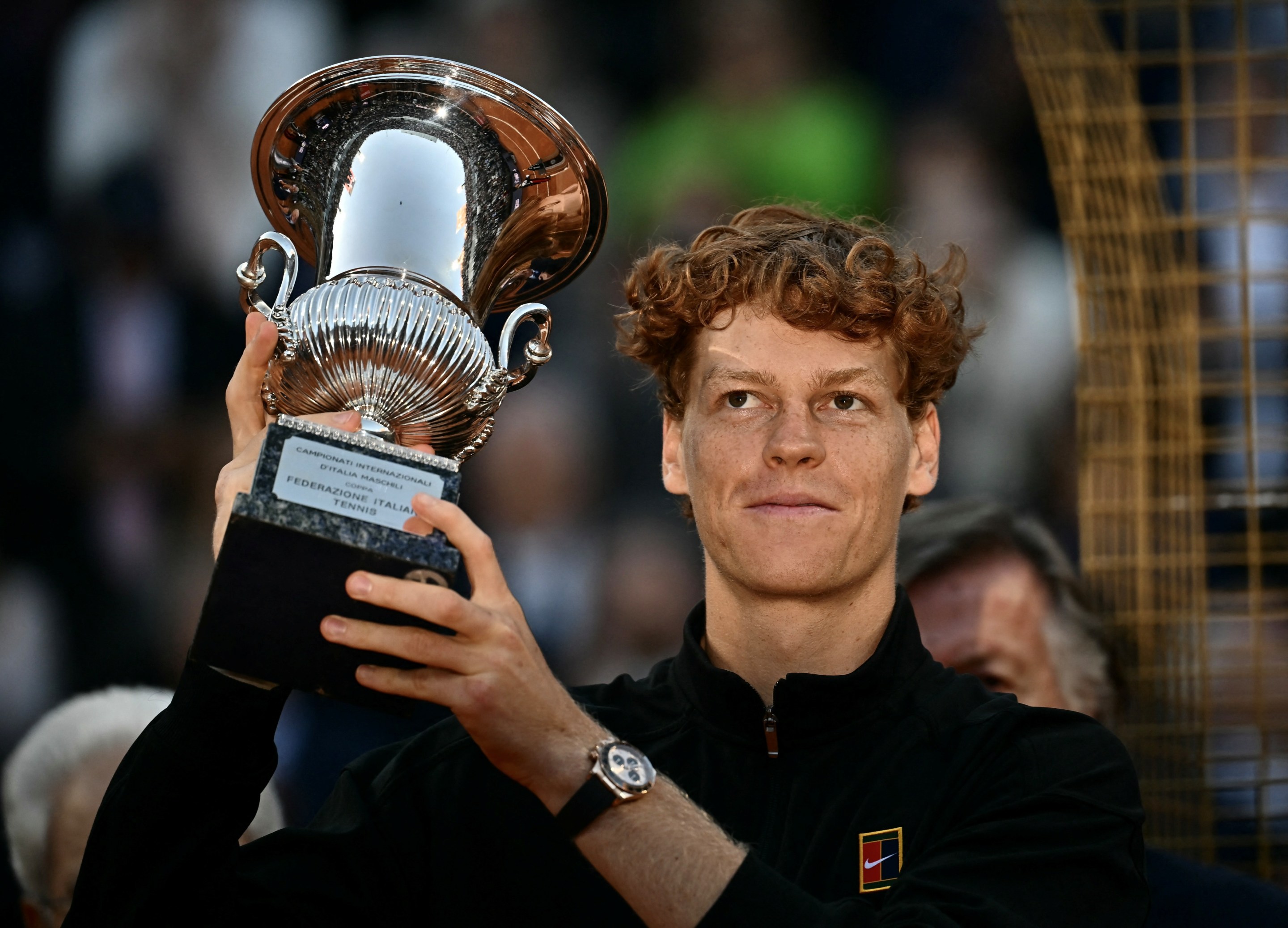
For tennis fans who do not know how to be normal (i.e., me), rooting for Jannik Sinner is as comforting as it can get. There is an aspirational calmness in Sinner's rituals—not elaborate enough to be Nadal-like, but consistent enough to be a little Nadal-lite—that, though it can't eliminate fan neuroses, at least soothes them. He goes to the towel after making a poor error. One can count as he bounces the ball seven times on first serve (four bounces, a glance up at the opponent, then three more) and five times on second serve (three, glance, two). Also, at some point this year, he forgot how to lose.
Sinner beat Casper Ruud 6-4, 6-4 at the Italian Open on Sunday. It was his first-ever victory at his home tournament, following a loss to Alcaraz in the final last year. Sinner became the first Italian man to win the tournament since Adriano Panatta did 50 years ago. He also became: the second- and, at age 24, youngest-ever man to win the full set of Masters 1000s (Novak Djokovic did it first, at age 31); the first to win six straight Masters 1000s; the second ever to sweep the three clay-court Masters (after Nadal); and the first ever to win the Sunshine Double and sweep the clay-court Masters in a year. These are records that feel more impressive with more investment in the sport, but he also has some numbers that are easier to understand: He has a 29-match win streak. In that time period, he has lost three sets, by scores of 7-6(3), 7-6(6), and 7-5.
The last time Sinner played Ruud in Rome, it was effectively a public execution. The final on Sunday was a different story: Sinner started the match looking as nervous as he gets, usually a quality reserved in response to Carlos Alcaraz. He missed his first seven first serves and went for huge margins, pumping what would normally be comfortable put-away forehands down the center of the court instead of into the corners. Ruud got off to an early break, which was already a better start than last year's match, then Sinner immediately broke back by cracking a backhand down the line. As the match progressed, Sinner settled down. He delivered a feast of gorgeous leaping backhands. His first-serve percentage crept back up above 60 percent. After he hit an even better backhand down the line to open the second set with a break, the match lay securely in his hands.
To Ruud's credit, he hung in there. While Alexander Zverev effectively rolled over and died against Sinner in the Madrid Open final, Ruud never quite let Sinner run away with the match. His efforts even earned him a break point down 4-3 in the second set, after Sinner shanked a smash, à la Djokovic. Maybe Sinner would get in his head about the error. If Ruud could get a second serve and a rally, he could have a shot. Then Sinner made a 124-mph first serve down the T (breaking from his pattern of going wide for much of the match), and smoked a 103-mph forehand winner off the return. Ah! Well. Nevertheless.
It speaks to the current landscape of men's tennis that players can receive kudos for simply keeping a Jannik Sinner victory to a relatively close two-setter. With the exception of the Djokovic Anomaly, there is a sea dividing Sinner and Alcaraz from the rest of the contenders, represented well in the current ATP point totals. With Alcaraz out with injury at least through Wimbledon, there is simply no ecological competition for Sinner on tour.
At the same time, I balk at taking as a given that if one of the top two players in the world is out, the other will win everything; historically, this has only been true for one of the two. It is undeniable that Sinner has racked up wins 18 through 29 of the streak in Alcaraz's absence, but he got wins 1–17 while Alcaraz was on tour. That he only played Alcaraz once during that stretch was because Alcaraz, who has not quite figured out how to smother pesky over-performing opponents dead, was losing to a mild proliferation of Roger Federers. As the old adage goes, you can only play who's in front of you.
In sports with far more variance than tennis, coaches occasionally lament that their teams need to figure out how to be good more consistently. This particular phrasing has always felt silly, as though consistency is a totally separate characteristic that can be adjusted on a slider, rather than a product and particular subsection of "being good." There will always be some level of insurmountable luck, but the coveted high floor limits the impact luck can have. In tennis, the favorite is so favored and matchups so insurmountable that variance plays far less of a role, but this still holds true for when it does occasionally poke its nasty little head in: a redlining opponent, a sequence of net cords, calls within a margin of error, poor weather conditions, exhaustion.
What the non-Alcaraz field has to fear from Sinner is not how he performs at his peak—very, very well—but that Sinner's game ever since he lost to Jakub Mensik in Doha has enough failsafes to make his floor obscenely high. Sinner's strengths are replicable. On a bad day, if his baseline game is not clicking, as it wasn't for much of the Sunshine Double, his newly improved first serve is good enough for him to servebot his way through matches. If his first serve is not clicking, he is the best baseliner in the world. The combination of both so far in 2026 has led to a hold percentage of 94.2 percent; for comparison, true servebots like Ivo Karlovic and John Isner have career hold percentages around 92 percent. Sinner's backhand is so solid and reliable, especially in comparison to the rest of the field, that he can put even Carlos Alcaraz in cross-court backhand jail.
If Alcaraz is the master of playing tennis as a spectacle, Sinner has—with the necessary qualifier of "so far"—mastered playing tennis as a contest to be won. Sinner's former long-time coach Riccardo Piatti has described Sinner's motivation behind his talent as "a competitive arrogance, bordering on ruthlessness." In the same interview, he laid out a funny and no longer true read on Alcaraz: "Sinner has always known who he is ... Alcaraz knows it on alternating days." If getting more consistent is a subcategory of improvement, then Alcaraz, who is still two years younger than Sinner, has plenty of time to catch up; he has already become more consistent since the start of 2025.
The structure of tennis tournaments means that winning more theoretically makes winning harder. Before playing Sinner at Rome, Andrey Rublev gave a candid interview where he said he felt "fine" about his upcoming match. He also said, "He wins, how many, 20-something matches in a row? So he's getting closer to lose, finally." Rublev's statement follows more along the lines of predetermination than sporting logic—Sinner cannot win every match from now until the heat death of the universe; ergo, each win brings him one match closer to his eventual next loss—but however you read the sentiment, it is true. The longer the streak goes, the more pressure a player feels and the more exhaustion, mental and physical, compounds from playing so many matches. Unfortunately for the rest of the tour, Sinner appears inured to both pressure and mental exhaustion. Fortunately for the rest of the tour, some physical cracks started to show in Rome.
After comfortably losing the first set to Sinner in their semifinal match, Daniil Medvedev turned the second set into a gross, all-out physical torture chamber. He didn't rope winners, but he hit the ball hard, did not miss, and turned Sinner's ability to get the ball back against him, running Sinner from sideline to sideline until he simply broke. It was an astonishing affair: Sinner, who is 6-foot-3 and 90 percent limb, having to bend down to catch Medvedev's flat backhands, even slicing some rather than doing his typical open-stance slide; demonstrating some impressive pain tolerance by running for each ball despite gasping like a landed fish after each brutal rally; getting broken when he was trying to serve out to a tiebreak. It was a match tight enough and intriguing enough that I have it on good authority that Owen Lewis enjoyed watching it.
Partway through the third set, rain started pouring in Rome, which was simultaneously lucky and unlucky for Sinner. He was obviously gassed, but Medvedev couldn't keep redlining, and Sinner was up a break and putting pressure on each service game. He came back the next morning and closed out the match.
Then again, there is some more bad news. The delay and shortened rest—Sinner said, after winning against Medvedev, that he had trouble sleeping the prior night—should have hurt Sinner going into the final. He showed up and beat Ruud in two.
So who will eventually beat Jannik Sinner, and how, and when? He is entering the French Open as the prohibitive favorite with his 29-match win streak. Sinner has been vulnerable when pushed to five sets, but first you have to get him there. Rome should've been a proving ground for his purported young challengers (Mensik, Arthur Fils, Ben Shelton), as he drew nearly all of them into his quarter, but all of them and then some (Joao Fonseca, Rafael Jodar) lost before they could face him—not currently a great sign for the consistency-is-a-skillset crowd. If it looks like anyone, or at least anything, will take Sinner out right now, it would be climate change, exhaustion, or both. Those are fine, well-established nemeses. They're just not quite human ones.


![USA's Ben Shelton celebrates his win against Spain's Carlos Alcaraz during the men's singles quarter-final tennis match on day ten of the US Open tennis tournament at the USTA Billie Jean King National Tennis Center in New York City on September 9, 2026. (Photo by Leonardo MUNOZ / AFP) / “The erroneous mention[s] appearing in the metadata of this photo by Leonardo MUNOZ has been modified in AFP systems in the following manner: [USA's Ben Shelton] instead of [Spain's Carlos Alcaraz]. Please immediately remove the erroneous mention[s] from all your online services and delete it (them) from your servers. If you have been authorized by AFP to distribute it (them) to third parties, please ensure that the same actions are carried out by them. Failure to promptly comply with these instructions will entail liability on your part for any continued or post notification usage. Therefore we thank you very much for all your attention and prompt action. We are sorry for the inconvenience this notification may cause and remain at your disposal for any further information you may require.”](https://lede-admin.defector.com/wp-content/uploads/sites/28/2026/09/GettyImages-2293730421.jpg?resize=2880%2C1920)