


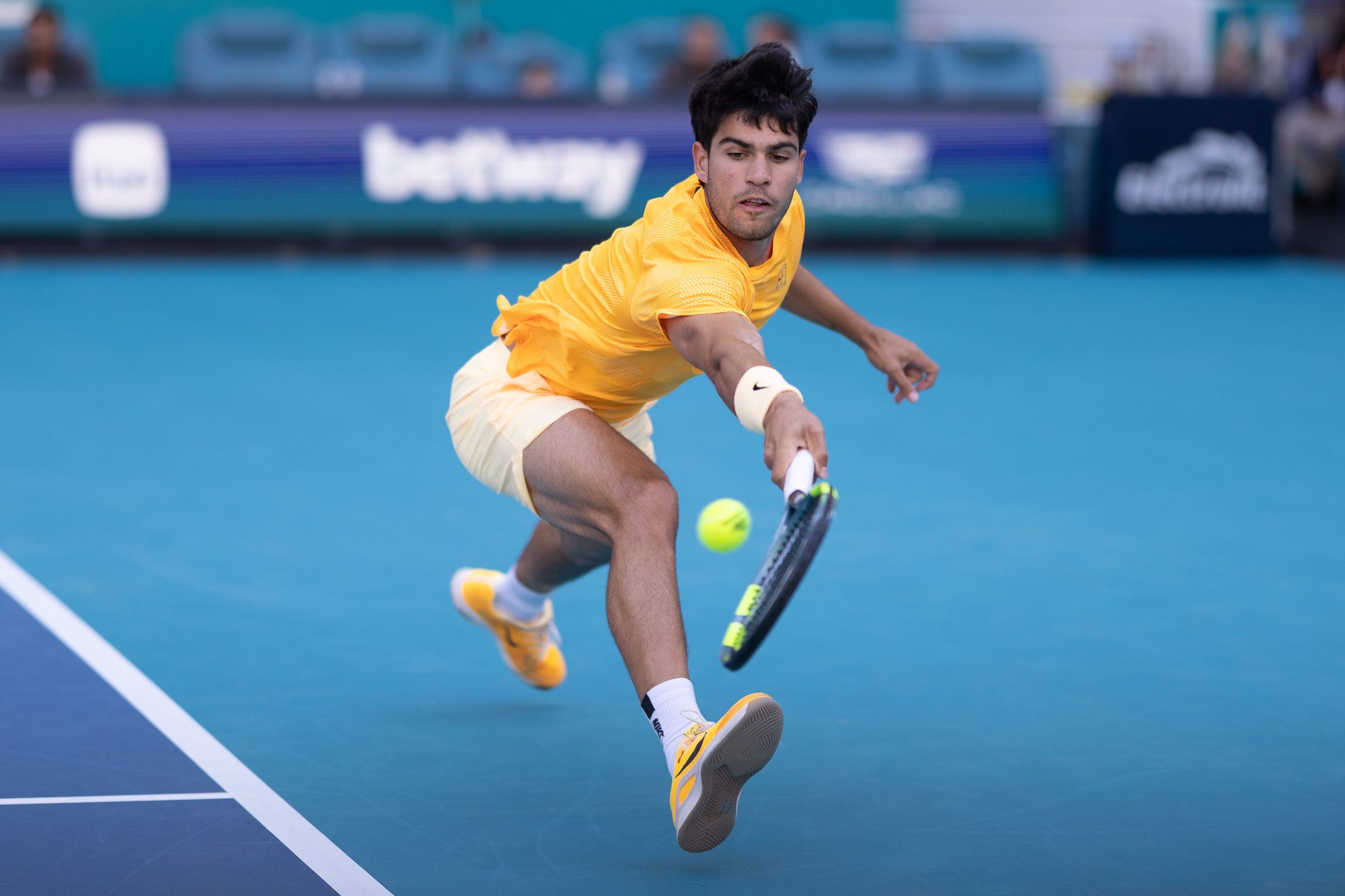
In what could be filed under a statistically unlikely outcome, Carlos Alcaraz suffered his second loss in three matches. The world No. 1 was upset Sunday in the third round of the Miami Open by Sebastian Korda, who once looked to be one of the top prospects of the current American generation. In that 6-3, 5-7, 6-4 victory, Korda served for the match in the second set and flinched, making three untimely errors, but in the deciding set the world No. 36 managed to complete arguably the toughest task in men's tennis.
Along the way to his win, Korda flexed the muscle that made him such an appealing talent in the first place: his ability to stand on top of the baseline and take every ball on the rise, with clean contact on both wings. He's a gifted ball-striker, and once you add in some superb spot serving, that's a difficult opponent to beat. This wasn't the erratic Carlitos that sporadically rears its head in moments of burnout; Alcaraz played a focused match and fought back from the cusp of defeat. The 25-year-old Korda simply played the best match of his career.
As it turns out, a lot of tennis players seem to be delivering the match of their careers when pitted against Alcaraz lately. That is, of course, one's lot in life as as the top men's player on the planet. The lesser opponent steps onto the court with minimal pressure and commits to an uncharacteristically aggressive game plan, because going on court and playing at his normal level would be futile. That's what makes, say, Novak Djokovic so miraculous: the way he absorbed the best efforts of so many generations of tennis players, most of them playing at full tilt, over the better part of two decades, with only rare hiccups.
Alcaraz is only 22 years old and already having to get used to this lifestyle. En route to his title in Qatar in February, Alcaraz survived astounding performances from every opponent—until the final, when he finally enjoyed a breezy 50-minute rout of Arthur Fils. At Alcaraz's very next tournament in Indian Wells, he had a rematch against one of his opponents in Qatar: Arthur Rinderknech, who this time managed to scrape a set off of the world's top player. Alcaraz was asked at the time how it felt to be playing against those who were playing so well:
Today and in Qatar, it feels like you're playing against guys who are playing at crazy high level, and you were able to ride that out. Seemed like you just trust that you'll be able to stay in it, and come back and win. Is that something you think consciously about, when you're in a situation when you're playing somebody who is playing so well?
Well, to be honest, I just sometimes get tired about playing Roger Federer every round. [laughing] Yeah, sometimes just feel like, yeah, they playing really an insane level.
I don't know if I'm feeling not the right way, but I feel it's just against me. All the time, if they play like, you know, that level every match, they should be higher in the ranking. But, you know, obviously is something that concern me, when I'm just playing, I think about that.
You know, all can I do is just accept it, keep it going, trying to do different things in the match, try not to let him be aggressive or playing his style, trying to put my style, my tennis, my level into the match, and trying to turn around the things that I try to do. But obviously the first thing is just accept it.
Alcaraz went on to lose to a resurgent Daniil Medvedev in the semifinal at Indian Wells. After a first-round bye, he opened up his Miami campaign with a comfortable win over Joao Fonseca, offering the 19-year-old phenom some advice on shot selection after the match. Then came this Korda upset. After the match, Alcaraz was asked a similar question, and it sounds as if he's adjusting to his new reality:
There were times when you were obviously frustrated on the court. When you're facing opponents who are obviously playing way above their normal level, how challenging is it to accept that and keep on finding a way through?
Well, it's not really good, to be honest. [smiling] It's a bit annoying. But you have to accept it. You have to keep it going and try your best. I feel luckily I have a lot of weapons, I have a lot of things that I can do on the court trying to let him uncomfortable, which today, to be honest, I couldn't find that way.
But I know from now on, I know they are going to play like that. I just gotta be ready, as I said. Even though he was playing, I would say, above his normal level, I was there. A lot of 30-All, a lot of 40-All, break points to me. I didn't make it, but I just got to see that point of view.
For the next matches, you know, to think like they are going to play like that, even though I'm just going to have my chances. I will try to play better on those moments, on those points. I will try not to let them stay in all the match. I will try to push them to the limit even more.
After starting the year on a 16-match winning streak, Alcaraz now sits at 17-2. Given that this kid just completed the earliest career Grand Slam in tour history and nimbly mastered every challenge the sport has set before him, I bet that he'll get a lot better at destabilizing opponents who are playing at the fringes of their skill level. That's a skillset in itself, but he correctly notes that he has all the "weapons" imaginable needed to do it. Get in those upsets while you still can.





![USA's Ben Shelton celebrates his win against Spain's Carlos Alcaraz during the men's singles quarter-final tennis match on day ten of the US Open tennis tournament at the USTA Billie Jean King National Tennis Center in New York City on September 9, 2026. (Photo by Leonardo MUNOZ / AFP) / “The erroneous mention[s] appearing in the metadata of this photo by Leonardo MUNOZ has been modified in AFP systems in the following manner: [USA's Ben Shelton] instead of [Spain's Carlos Alcaraz]. Please immediately remove the erroneous mention[s] from all your online services and delete it (them) from your servers. If you have been authorized by AFP to distribute it (them) to third parties, please ensure that the same actions are carried out by them. Failure to promptly comply with these instructions will entail liability on your part for any continued or post notification usage. Therefore we thank you very much for all your attention and prompt action. We are sorry for the inconvenience this notification may cause and remain at your disposal for any further information you may require.”](https://lede-admin.defector.com/wp-content/uploads/sites/28/2026/09/GettyImages-2293730421.jpg?resize=2880%2C1920)