
After federal law enforcement officers shot and killed two people in Minnesota earlier this year, Maryland Governor Wes Moore got busy talking and typing.
Moore went on Fox News to blast the DHS forces as "untrained, unaccountable, and unqualified—and, by the way, armed." He brought the same wording and vitriol to MS NOW. He posted on Instagram about the "reckless pattern of violence" by the agency's cops. Moore told D.C. CBS affiliate WUSA-9 that tax money should only fund a force that "actually aligns with de-escalation and not with escalation."
The governor, who during his Minneapolis-inspired media blitz denied any plan to run for president, and whose job includes overseeing the Maryland State Police, bragged that troopers on his watch have none of the recklessness or disregard for human life flaunted by the feds. "When I think about the state policemen that we put out on the streets in the state of Maryland, these are people who are well-trained, that we can stand behind their training," Moore said. "That they are ready to respond to any situation."
But to the family of Peyton Ham—a 16-year-old Marylander shot dead by a state police trooper—those proclamations meant less than nothing.
"It happened here," said Keith Raley, a lifelong resident of Southern Maryland and Ham's grandfather. "It was a murder."
Ham was gunned down by Maryland State Trooper Joseph Azzari five years ago this spring in Leonardtown. Three witnesses told Defector in 2021 that they saw Ham on his knees in a gravel driveway when the trooper killed him. Azzari was never charged with any crimes or formally punished. A civil case filed against Azzari is still alive in federal court, with the trooper mounting a vigorous defense funded by Maryland taxpayers. And Azzari is still an armed member of the Maryland State Police, a force whose troopers, as Governor Moore tells it, are all well-trained to respond to anything, aligned with de-escalation, and accountable.
On the afternoon of April 13, 2021, Azzari responded to two 911 calls reporting that a guy was "acting suspicious" and possibly armed at Ham’s address, which was on the same street as the state police barrack where Azzari was stationed. Investigators later determined that the 10th-grader had made the 911 calls himself, during what his family told me was an apparent "mental crisis."
Unlike in Minnesota, there is no video footage of the shooting. Azzari was not wearing a body cam; because he did not turn on his siren when responding to the 911 call, his SUV's dashboard cam was not activated. Maryland State Police were not required to wear cameras at the time of the shooting. Three days before Ham's killing, state legislators enacted the Maryland Police Accountability Act of 2021, part of which mandated that all state troopers have body cams, but that wasn't in effect at the time.
Nobody but Azzari saw the earliest portions of his deadly encounter with Ham. Azzari said when he arrived at the location and got out of his police SUV, he saw Ham walking toward him and pointing what turned out to be a toy gun. Audio of the shooting, first obtained by The St. Mary's County Times, was captured by the security system of a nearby home and provided to Defector by Ham's family. The recording indicates that Azzari, in what would be the first of two fusillades of bullets from the trooper, fired 11 shots at Ham. At least one of those bullets hit the teenager on his right side. Some of Azzari’s other shots struck a nearby tree and houses hundreds feet away—according to a state police report, one of the "errant rounds" was found "1,417 feet from scene"—and sent scared neighbors scurrying in fear.
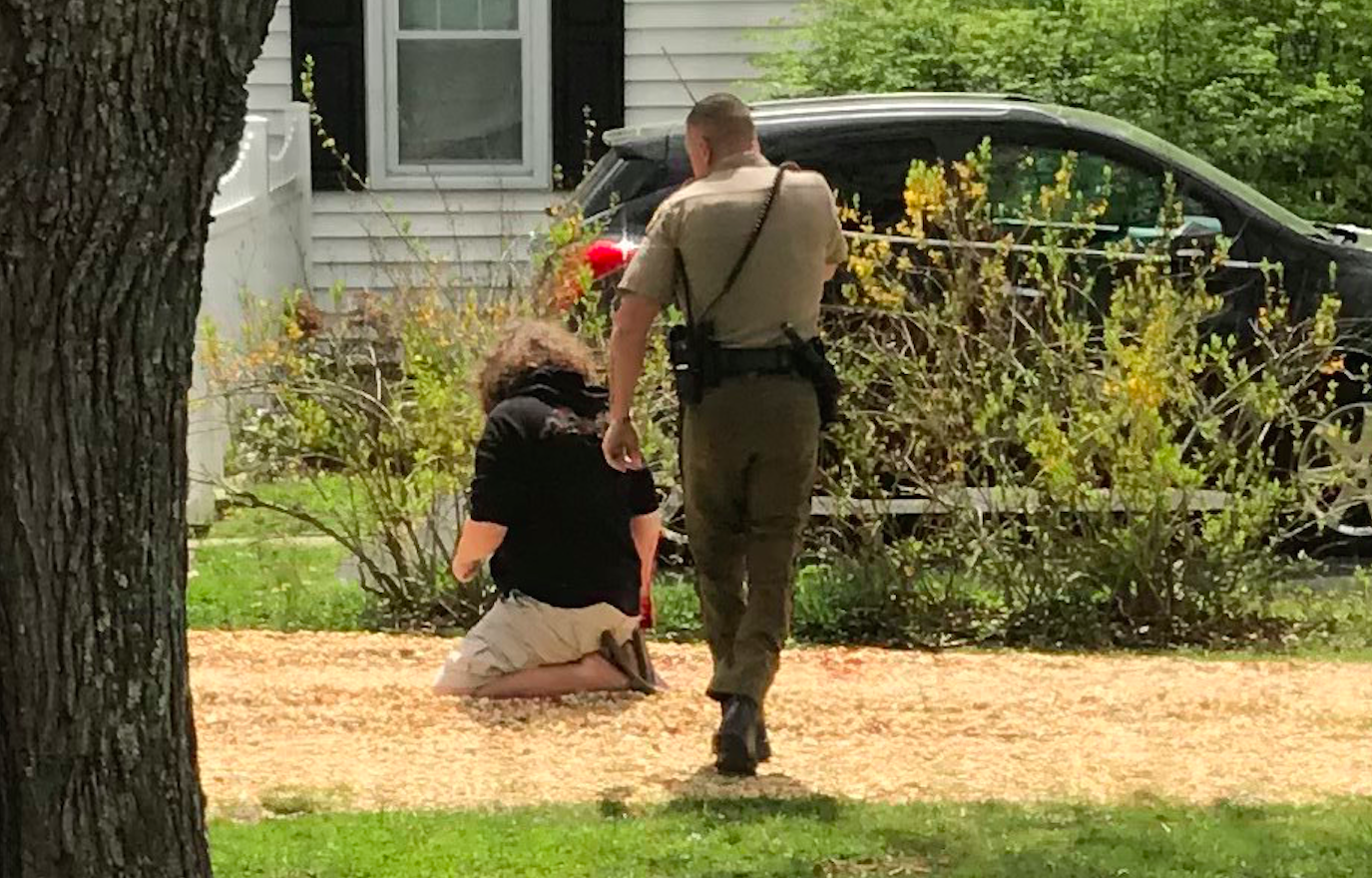
About one minute after the last shot of that 11-shot salvo, Azzari fired another barrage at Ham. There were witnesses to the latter fusillade, and some visual evidence of what took place in between. Ham's next-door neighbor, Michelle Mills, ran to her bedroom window after hearing gunfire outside her house. She took a photo that showed Azzari with his gun drawn standing behind and over Ham, who was on his knees and had blood running down his right arm from wounds from the first round of gunfire. A patrol car with its siren on can be seen in the background.
Azzari didn't wait for backup to arrive. Based on the timestamp on the Mills photo, the security system audio, eyewitness accounts, and court records, about 40 seconds after Mills snapped that picture, Azzari backed away from Ham—a distance of "approximately 15 to 25 feet away," according to a federal court filing in the civil case—and fired four more shots into Ham’s neck and chest, killing him.
According to police reports, Azzari told a fellow state trooper shortly after the shooting that he fired the fatal second salvo of shots after Ham "charged me" with a knife. A pocket knife with a 2.75-inch blade was found in the driveway near Ham’s body; his family said the knife was a gift he'd received years earlier. The toy gun was also recovered on the scene.
Mills told Defector in November 2021 that Ham's body fell in the same spot where he was when she took the photo. She was adamant that Ham had posed no danger to Azzari when the trooper fired the second fusillade.
"Peyton was murdered in my driveway," she said.
Two other people, Mills's daughter and Ham’s grandmother, also told Defector that they saw Ham get shot while on his knees.
Despite the obvious conflict of interest, the homicide unit of the Maryland State Police, Azzari's employer, quickly took control of the shooting investigation from the St. Mary's County Sheriff's Office. To this day, Azzari’s colleagues conducted the only public investigation of Ham’s killing. The same Maryland Police Accountability Act of 2021 that mandates troopers wear body cams also now prohibits state police from handling investigations of one of their own when a trooper's use of force causes "death or serious injury" to a civilian, but, again, that law was not yet in effect when Azzari shot Ham.
The Maryland State Police report said that investigators found "multiple anti-authority/government items" in his bedroom after the shooting. According to his family, the allegedly subversive materials included a copy of a 2010 Tom Clancy thriller novel titled Dead or Alive and a Gadsden flag. In an interview with state police colleagues days after the shooting, a recording of which was obtained by Defector, Azzari said he "had no other choice" but to kill Ham.
"I was in fear for my life," Azzari said to state police investigators, in a cadence that sounded as if he were reading from a prepared statement. "Deadly force at that time was the only option presented."
The Maryland medical examiner’s autopsy report, some portions of which were obtained by Defector, showed that Ham had been hit by seven shots. The final four bullets fired by Azzari traveled "downward" after entering Ham’s neck and torso. That finding would seem to support what the witnesses told Defector—that Ham, who was several inches taller than Azzari, was killed while on his knees. There was no blood trail found in the gravel, and all the blood stains were pooled in the same part of the driveway where Ham died, which would also seem to refute any claim that he ever charged Azzari.
Maryland State Police remains the only agency to do a criminal investigation into the killing of Peyton Ham. For months after his death, Ham’s family members kept quiet, declining media requests for interviews, believing that would get in the way of the official investigation. Shortly after the five-year anniversary of Ham's death, Brenda Raley, Ham’s maternal grandmother, told me she still regrets not sending the photo Mills took of her grandson on his knees to news organizations immediately, instead of trusting police and prosecutors to see that justice was done.
"It might have made a difference," she told me recently. "We were trying to do the right thing and let the justice system do its thing. We knew this guy was going to be held accountable. Of course he's going to be held accountable! Right?"
By the time that lone and devastating visual document of her grandson's last moments alive was seen by folks other than law enforcement, the official narrative had been set. In October 2021, St. Mary’s County prosecutor Richard Fritz announced that Azzari would face no charges. In a statement that showed absolute faith in the police officer's version of the killing and the state police’s report, Fritz declared that the gathered evidence "supports the conclusion that trooper Azzari's use of deadly force was reasonable under Maryland law," and therefore the case would be "closed without prosecution."
In the months after the non-prosecution decision was announced, Ham’s relatives and loved ones began occasionally showing up outside the county courthouse to protest. Keith Raley often came to the demonstrations carrying a placard he made with “MURDER” written on it. "I still have it," he told me recently.
Fritz, who had been the state's attorney since 1998 and was long considered the most powerful politician in the county, was voted out of office a year later. He got just 29 percent of the vote in the Republican primary. Several acquaintances of Fritz told Defector the now-former prosecutor blames his landslide defeat on the Ham case.
When Fritz announced he would face no charges, Azzari posted a photo of himself in uniform on Facebook with a note celebrating that he was "back to doing what I love," and advising fellow law enforcement officers to "get home to your families no matter what." The Maryland State Police would later also go to Facebook to ask followers to "please join us in congratulating" Azzari for his "successful completion of the Southern Maryland Crisis Intervention Team (CIT) training!" The blurb, posted Oct. 31, 2022, said the course teaches troopers "how to assist persons experiencing a mental health crisis with an efficient, respectful and compassionate approach." Azzari's schooling came a year and a half after shooting Ham. (A disclaimer on the post said the state police had limited who could comment.)
Azzari was never publicly sanctioned by the Maryland State Police.
Just before the one-year anniversary of Ham's killing, his mother Kristee Boyle filed a lawsuit against Azzari on behalf of her son's estate, in a federal court in Maryland. It said: "Azzari's use of unreasonable, unnecessary, and excessive force, violated decedents, clearly established constitutional rights and was not objectively reasonable in light of the circumstances." The complaint primarily focuses on Azzari's final, fatal fusillade.
Facts and eyewitness testimony notwithstanding, Boyle's side seems legally overmatched. Christopher Longmore, a Lexington Park, Md., lawyer who is handling the case by himself, is related to Ham by marriage. Boyle's family is paying his fees, as well as all costs to get expert witnesses to testify about such things as ballistics and the autopsy.
Azzari has no such financial burden. Under state law, Maryland's Office of the Attorney General (OAG) handles a state trooper's defense in an on-the-job shooting civil case. Anthony Brown, who was inaugurated as state attorney general at the same time as Moore took office, heads up a team of at least five state-funded attorneys (Kyle Ashe, Amy Hott, Phillip Pickus, and Guy Saint Pol Maydieu, all with the OAG, are the others) who show up on recent case filings working on Azzari's behalf.
Boyle v. Azzari was initially dismissed on Jan. 10, 2023. U.S. District Judge George Hazel accepted Azzari's lawyer's plea for summary judgment before the plaintiffs were allowed any discovery; the state was refusing to provide the family with Azzari's training records and even the full autopsy report at the time of the dismissal.
Judge Hazel specifically denied the plaintiff's request for access to "information as to Defendant’s training," and the right to depose Azzari. Hazel wrote that Azzari's "belief that [Ham] was dangerous" at the time of the shooting rendered it legally immaterial whether Ham was on his knees when he was killed. To Hazel, those fears meant the trooper "acted reasonably in using deadly force," and nothing found in the discovery process would change that.
Boyle appealed Hazel’s dismissal to the U.S. Court of Appeals for the Fourth Circuit. Despite the size of the adversary's tax-subsidized gaggle of lawyers, Longmore won the day. He told the appellate panel that because no discovery was allowed, and Azzari's colleagues conducted a compromised and conflicted investigation, only the shooter's version of events had been considered by the lower court when the case was dismissed. Ham's side had been given no chance to learn what actually happened in that Leonardtown driveway.
Pickus led Azzari’s defense at the Richmond hearing, and repeatedly referenced "qualified immunity." That’s a legal doctrine that was introduced by the U.S. Supreme Court in a 1967 civil rights case, Pierson v. Ray, and ever since has been used to shield cops who kill on the job from civil lawsuits or other forms of accountability.
Pickus told the three-judge appeals court panel that because Azzari's story was that he feared for his life when he killed Ham—the very same defense used by the federal government to excuse the killings of Alex Pretti and Renee Good in Minneapolis—qualified immunity protections rendered him essentially untouchable under the law.
"The Supreme Court has told us many times that we are not supposed to second-guess Trooper Azzari in hindsight," Pickus said.
Pickus argued that Azzari's immunity was so complete that the plaintiffs had no right to discovery in the case. Transcripts and recordings of the Richmond hearing show that at least two of the judges were skeptical of Pickus's stance and put off by his certitude. Circuit Judge Roger Gregory seemed perturbed when Pickus claimed the state did not even know how many of Azzari's first wave of bullets hit Ham. Gregory also asked Pickus if he was arguing the law held that Azzari could shoot a "5-year-old" under similar circumstances.
"It’s theoretically possible," Pickus said.
The appeals court panel rejected Pickus's argument about the scope of Azzari's legal immunity. In a ruling issued July 9, 2024, the panel overturned Judge Hazel's previous dismissal. "[W]e conclude that discoverable evidence could create a material dispute of fact and thus the district court abused its discretion in denying Boyle an opportunity to conduct discovery," the appellate court ruled.
The judges sent Ham's case back to a lower court, and allowed for, among other things, the plaintiffs to get access to all autopsy records and deposition of Azzari under oath.
Longmore did not respond to a request for an interview. Through Keith Raley, Boyle declined to be interviewed for this story, citing the pending litigation. Pickus did not respond to Defector’s request for comment on the Ham litigation, but forwarded the request to Brown’s office. The attorney general's spokesperson, Aleithea Warmack, declined to comment.
The state has already shown it intends to stick with the blanket immunity defense. In a response to the lawsuit filed after the appeals panel remanded the case to district court, the Maryland attorney general argued that the law of the land was that Azzari didn't have to face such litigation.
"Plaintiffs' claims are barred, in whole or in part, by the doctrine of immunity, including sovereign immunity, governmental immunity, qualified immunity, Eleventh Amendment immunity, and public official immunity," Brown wrote.
According to the latest scheduling order from U.S. District Judge Lydia Kay Griggsby, who was assigned the case after Judge Hazel's retirement, all depositions and other discovery must be completed by both sides by June 12, 2026. Sources close to the litigation told Defector that Azzari has already been deposed.
Azzari is still a trooper with the Maryland State Police. Because of a transfer, however, he is no longer stationed down the street from Ham's former home.
Boyle's lawsuit requests her side's legal fees be paid, too, but in court filings, Brown has denied that the family has any right to have their fight for justice subsidized. Ham's family remains appalled by the performance of the army of civil servants working on Azzari's behalf and their dime.
"What really pisses me off is I'm paying [Azzari's lawyers'] goddamn salary with my tax money," Brenda Raley said. "That really bites my ass. I can see why people just give up. You’re beating your head against a cinderblock wall."