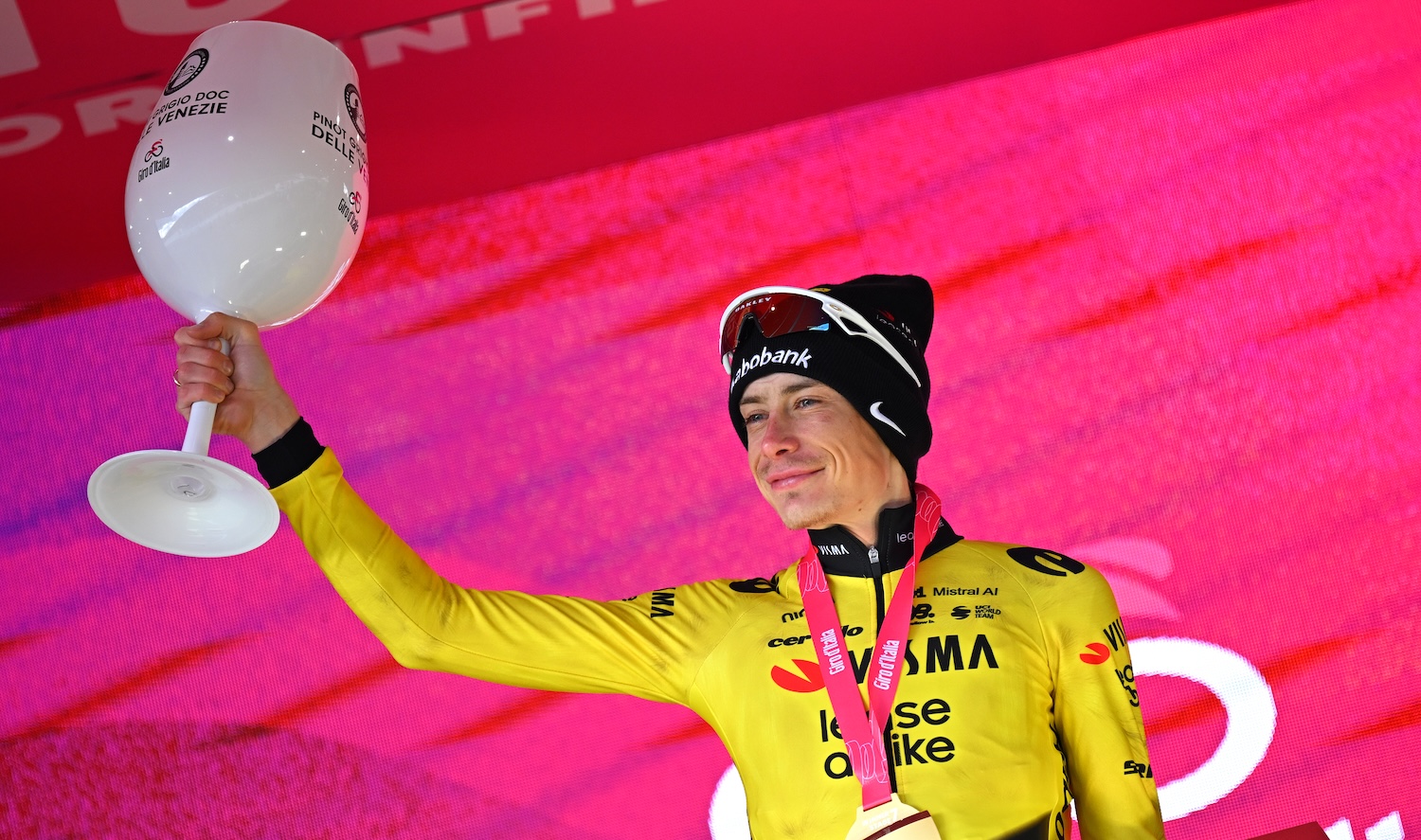
From the Adriatic Sea up into the heart of the Tuscan-Emilian Apennines, the peloton tirelessly chased the breakaway. Stage 9 of the 2026 Giro d'Italia tempted a strong, organized group up the road and away from the bunch, yet Felix Gall's Decathlon CMA CGM team invested heavily in bringing them back in order to set things up for their leader. With three kilometers left and only a flagging Giulio Ciccone up the road, Gall made his move. The maglia rosa was shot out the back, along with every other general classification contender except for Jonas Vingegaard. Gall spent the next two kilometers turning around in a futile attempt to get Vingegaard to work with him, which he did not, only going to the front with 800 meters left to drop Gall like a stone. It was exactly how Vingegaard likes to race: clinical, efficient, and ruthless.
Depending on how you look at it, Vingegaard is either settling in to an impressive ride for the pink jersey, or he's confirming to the world that he no longer has it. He is either flying toward a sweep of all three Grand Tours, or he's cementing his status as a second-tier contender by failing to win the race against Tadej Pogacar's ghost. As we hit the second of somehow three rest days, Vingegaard is first among GC contenders, with 35 seconds on Gall and more than two minutes on the rest of a below-average pack of hopefuls. He's taken both summit finishes. In terms of the 2026 Giro alone, he's crushing it. The problem is, he's going to be judged against the impossible standard of Pogacar's 2024 Giro.
Most Tour de France contenders do not race the Giro. Better to spend those three weeks in monastic isolation somewhere at altitude than nervously snorkeling through adversarial conditions in Italy. In fact, the trend in Tour prep over the last few years has moved toward fewer races and more finely optimized training blocks. Remco Evenepoel is not racing for more than two months, while everyone else who is serious about winning the Tour—from guys who've enjoyed charmed seasons like Pogacar and Paul Seixas, to accursed riders like Oscar Onley and Juan Ayuso—will go away until late June before revealing their form at one of the two traditional pre-Tour tuneup races. Not only does the Giro present considerable risks, it also demands a different pattern of form. Go all-out to win in Rome in May, and you might be exhausted by the time the Tour gets to Paris in July.
But Vingegaard is going for it. His motivations are twofold: become the eighth cyclist to win the Giro, Tour, and Vuelta, and switch things up ahead of Round Six this July in France. As to the former, that's a worthy goal on its own, and he is flying. His Visma team has suffered in the wild conditions, as he lost Wilco Kelderman before the race even left Bulgaria, but when the race has been difficult, he's shone. The first big test was at the Blockhaus, a barren mountain that was so windy it forced echelon tactics and had riders attempting to use their jerseys as sails. Vingegaard attacked first, and though nobody could hold his wheel, Gall made up 13 seconds in the last few kilometers. He doubled up on Sunday, and he's probably going to move Tuesday into a commanding GC lead after a long, flat time trial all but designed to kill Gall's Giro.
The latter part of that plan is cribbed from Pogacar, who used this very strategy to defeat Vingegaard two years ago. Pogacar took the startline of the 2024 Giro having been humbled by Vingegaard twice in a row, and it worked splendidly for him. He won the GC by 10 minutes, taking six stages along the way, and debuting the new, best version of himself that has now dominated everything in cycling over the past three seasons, including the last two Tours. Pogacar's 2024 and 2025 Tour wins were decisive, Vingegaard rendered a bystander. With new contenders finally emerging, I like the plan to switch things up. But there's a reason why it took 26 years for someone to match Marco Pantani's 1998 Giro-Tour double. Alberto Contador tried and failed, as did Chris Froome. The Giro takes a toll, so while it worked for Pogacar, it's a risk. However, this year is a great year to make this particular gamble, as the Giro is a relatively light one and the Tour's biggest challenges comes in the third week.
It's an especially intriguing choice for Vingegaard, as he tends to build his entire season around the Tour in a way no other modern contenders do. While Evenepoel, Pogacar, and Seixas spend the spring doing one-day races in Belgium, Vingegaard has opted to do a few smaller stage races and then mostly chill until July. Any change to Vingegaard's calendar is an interesting one, especially when it involves the guy who never races choosing to race the longest pre-Tour event in the sport.
My point here is that it's useless to compare his race to Pogacar's 2024 Giro. When Vingegaard shipped a few seconds back to Gall on the Blockhaus, I felt a twinge of concern. Would the Dane not even complete the first part of the Giro-Tour double? We're not quite halfway yet, but I don't think there's any reason to be concerned. He is racing his sort of race, as he showed on Stage 9. Vingegaard's style is totally different than Pogacar's. He is far more patient, attacking when he needs to, and almost always dropping his rivals when he goes, but not one to try stuff just for the sake of it. It's worth making the comparison in the macro sense, but Jonas Vingegaard is doing his own race.