
By their very nature, cup finals do not necessarily make for exciting matches. For every 2022 World Cup final, there are 15 2019 Champions League finals. That does not excuse what happened on Saturday in Budapest, though. Over 120 minutes, Arsenal forced Paris Saint-Germain into a torture rack of Mikel Arteta's creation, and the result was a tense and relatively even affair. Ah, who am I kidding? The result was a big ol' piece-of-crap match that was excruciating to watch, a perfect distillation of every critique I (and others) have had about Arsenal's style of play this season.
Saturday's Champions League final did buck one trend, though, as Arsenal was not ultimately rewarded for its offensively defensive performance. PSG came back from an early and nearly match-killing 1-0 deficit to first even things up and then win in a penalty shootout. Oh, and don't worry: The penalty shootout was also terrible.
Arsenal was not particularly wrong for playing the final like it did. PSG creates the most difficult challenge in Europe for opposing defenses, thanks to a front three (Ousmane Dembélé, Désiré Doué, and Khvicha Kvaratskhelia) and a midfield (João Neves, Vitinha, and Fabián Ruiz) packed with players that move in perfect, terrifying sync, particularly into open spaces on the counter-attack. The best way to beat that is to just not give them any room to operate, to choke the life out of them at every turn. I can only think of one team in Europe this year that even has the ability to do that, and it is Arsenal. This is the best defense in the continent by a sizable margin, and Arteta puts them to work with his stifling game plans. It was impressive to watch just how futile PSG's attack became on Saturday, all thanks to Arsenal's rigidity.
That doesn't mean I have to like watching it, though. It started well, as Arsenal came out pressing PSG hard and forcing a bit of a back-and-forth, but as soon as Kai Havertz jumped on a fortunate deflection created by PSG captain Marquinhos, ran into the box unopposed, and scored the opener, the fun stopped.
The worst thing that could have happened for a neutral was an early Arsenal goal, because an early Arsenal goal meant that the Gunners could retreat into a shell. They could park the bus, and park it they did. From the moment Havertz scored until PSG's equalizer, Arsenal conceded 80 percent of the possession, attempted two off-target shots, and tallied two total dribbles as a team, both from center back William Saliba. To say that it was a defensive performance is to assume that offense was ever an option, but up 1-0, that was never the case. For most of the following hour, Arsenal had 10 men back behind the ball playing narrowly, forcing PSG to try to move out wide. At one point, I counted eight Arsenal players forming a phalanx in the center of its half of the field, with zero PSG players standing inside of that formation. It was ridiculous.
To Arsenal's credit, PSG's wide forays didn't work for what felt like an endless amount of time. The overlaps that PSG tried to put together were easily covered by the combos of Bukayo Saka-Cristhian Mosquera and Leandro Trossard-Piero Hincapié. When a PSG attacking move got any space, it would run into a charging Declan Rice or an excellent Myles Lewis-Skelly. It was ruthless efficiency, a suffocating symphony of enclosed spaces.
Then PSG scored. It was, as it seemed to have to be, from a wide position: A give-and-go between Dembélé and Kvaratskhelia ended in the Georgian getting brought down with a clear foul by Mosquera. (A weirdly protracted VAR check confirmed what anyone with eyes saw in one replay.) Dembélé stepped up and sent David Raya the wrong way, 1-1.
To everyone's credit, Dembélé's equalizer did liven things up, for a bit. From that moment until the end of regular time, Arsenal came out of its shell, overcame some ... questionable substitutions, and actually brought the game to PSG. The stats don't really back up what the eye test made clear; Arsenal only mustered up 0.1 xG from halftime until the end of extra time, but it was clear that, at least for about half an hour, the Gunners did not want to go to extra time in search of their first Champions League title. PSG, for its part, kept doing the same thing, largely abandoning the midfield and pushing Joao Neves and Vitinha out into mezzala roles to interplay with the three forwards. It didn't work for either side; Arsenal just didn't have that final oomph to break down PSG on the rare occasions it tried, and PSG ran out of ideas long before the game ticked into extra time. The best chance of the remainder of regular time came from Bradley Barcola, but the PSG substitute hit the side netting off of a counter-attack in the 97th minute. And so, tick into extra time the game did, to the chagrin to everyone watching.
There's just not much to say about the 30 minutes of extra time, because nothing really happened. Arsenal had a couple of half-chances, PSG passed the ball around a lot without probing into the box, and time marched on slowly. So slowly. The final open play statistics are shocking for their one-sidedness: Arsenal completed under 200 passes for the entire 120 minutes, and only managed one shot on target. PSG had 72 percent of the possession and didn't do much better, putting three shots on the frame. It was nasty soccer to watch, and no one really came out of it the better. By the time Arsenal (rather surprisingly) failed to score a winner off a 120th-minute corner kick, I was ready to throw this whole thing in the bin.
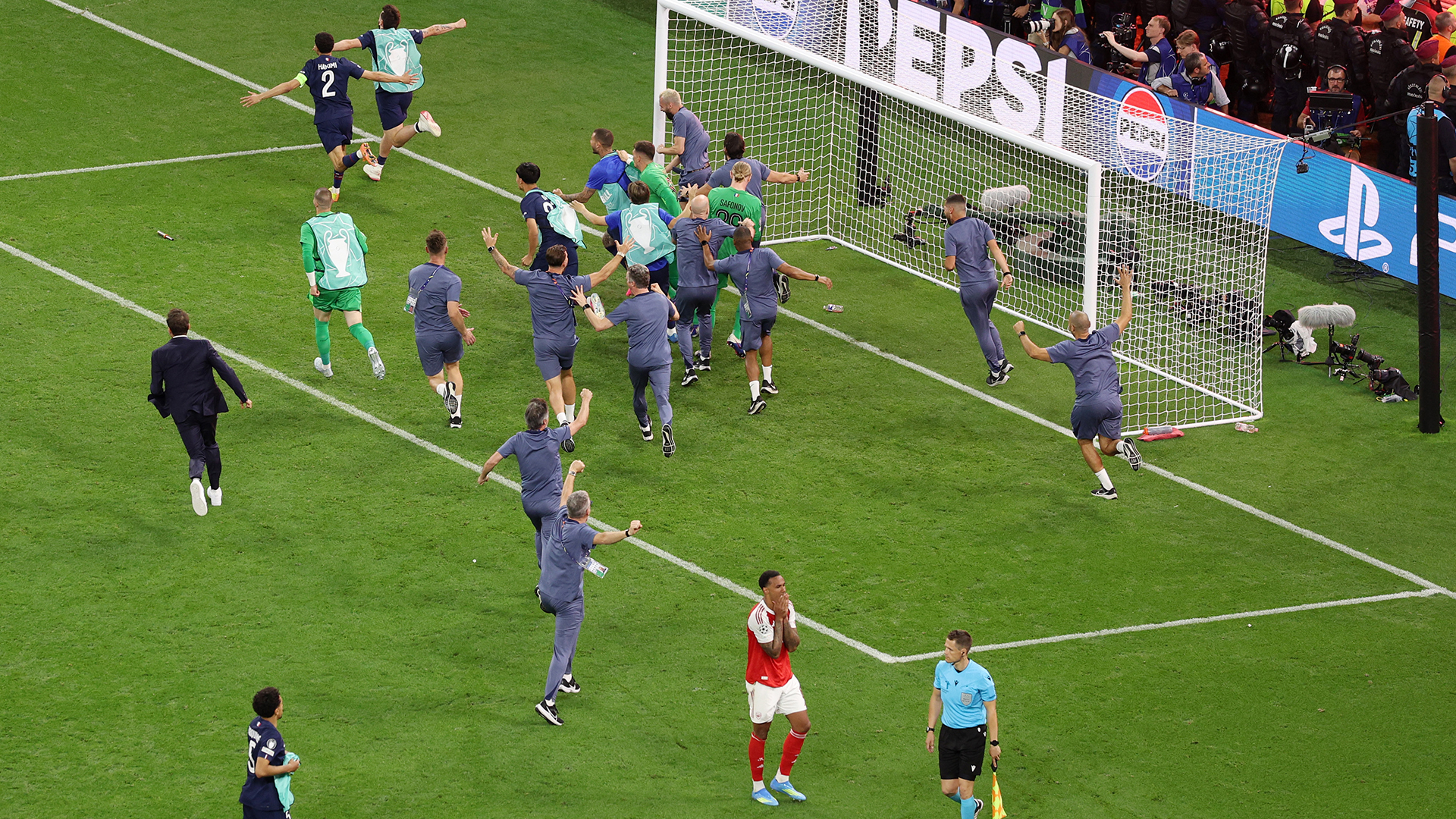
As for the penalties: PSG won despite goalie Matvei Safonov not making a single save, while Raya did manage to keep out Nuno Mendes's weak attempt. PSG won because Arsenal lost, because Eberechi Eze stuttered and stuttered and stuttered his steps, hoping to make Safonov dive the wrong way, and when the Russian did not, Eze panicked and shot the ball left of the goal frame entirely. Arsenal lost because, for some reason, Arteta had center back Gabriel come up fifth, the pivotal spot, and the Brazilian blasted the ball over the goal's right half.
If winning justifies itself, then losing in this way is a fitting coda to this Arsenal season as well. The club's style of play is strong enough to win both the Premier League, as it did, and the Champions League, where Arsenal was able to reduce the variance in the final down to a few half-chances and a penalty shootout. If Gabriel or Eze shoot on target in the shootout—Safonov wasn't going to save a penalty if his life depended on it—or if someone other than a center back who isn't known for his on-ball skills had stepped up to shoot the pivotal fifth spot kick, then winning would have justified itself once more. In losing, though, it is easy and perhaps correct to critique Arsenal for parking the bus for about 90 of the 120 minutes. Wouldn't more chances going forward have increased the possibility of avoiding the random number generator of penalties? Maybe, maybe not, but that's not who Arsenal was this season.
As for PSG, the Parisians become the first team to repeat as Champions League winners since Real Madrid's triple from 2016 to 2018, but there was no dominance here. Certainly not like last year's demolition of Inter Milan, and if PSG had lost on Saturday, it wouldn't have been entirely undeserved. A team with so much talent ran out of ideas so early, and let Arsenal drag it into the mud. Penalties are a crapshoot, and PSG's number came up on the good side, but it's hard to feel like this was an announcement of continued excellence. One bad final performance doesn't necessarily put a damper on PSG's season, or mean that this mini-dynasty has a black mark. It just means that nobody is going to be talking about this game years from now, and for good reason.