

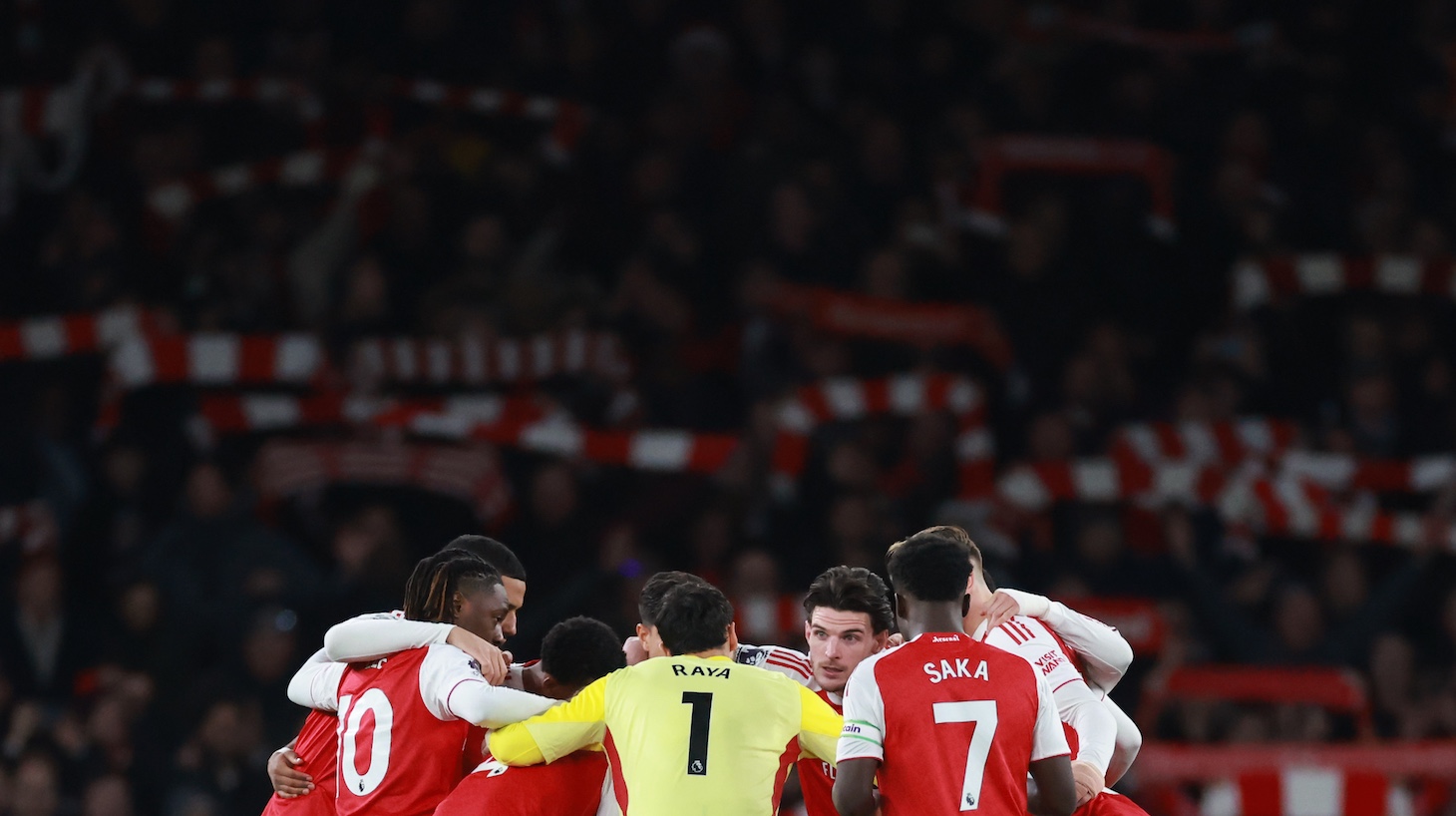
These are heady days for Arsenal fans. After three consecutive years as the Premier League's designated nearly men, the Gunners finally look poised to win the title, ending a dry spell that has lasted more than 20 years now. Though dominant domestic campaigns are often accompanied by lackluster continental showings, Arsenal has to be considered one of the big favorites on that front too, their 3-1 home win over Bayern Munich last month still standing as the single most impressive result of this Champions League season. The team has earned this favorite status at home and abroad on the strength of the strongest, deepest, most complimentary roster in Europe, which they have placed in the hands of one of the game's few legitimate difference-makers at the managerial position, Mikel Arteta.
And the good times for Arsenal fans aren't just limited to what's happening on the pitch, either. If Zohran Mamdani is now internationally known mostly for running a wildly successful, potentially paradigm-shifting leftist campaign that shocked the world by winning him the mayoralty of New York City, a non-negligible amount of his coolness comes from his endearingly dedicated Arsenal fandom. Hell, even outside the worlds of sports and politics, it seems like the entire internet can't stop talking about Gooners. As a neutral who nonetheless has a bit of a soft spot for the club, I am happy that Arsenal fans are enjoying the unceasing cycle of pleasure that comes with rooting for a team that can truly win it all. However, I'd be remiss if I didn't point out that the team's hyper effective style of play is remarkably joyless, and produces the kinds of spectacles that only hardcore Gooners would drop their pants for.
Arsenal's past month makes for a solid microcosm of the team's overall deal this season, for good and for bad. The highs have been high: the aforementioned Bayern win, the 4-1 North London Derby beatdown a few days before that one, a golazo-laden 3-0 win over Brugge in the Champions League. The lows have been rare and also not terribly low: in the seven matches since the November international break, the Gunners have dropped points just twice, a 2-1 loss to Aston Villa and a 1-1 draw with Chelsea, both games away, neither a particularly embarrassing result. But for all the points and the goals and the almost unerring sense that Arsenal is in control of practically every minute of every game, there are hardly any stretches of play that would qualify as particularly entertaining.
This is a matter of design. For all the Pep Guardiola comparisons that came Mikel Arteta's way when he first traded the Man City assistant gig for the top job at Arsenal, it should be clear by now that the mentor who Arteta's coaching style most resembles is his old Everton boss's, David Moyes. Arteta's Arsenal has been easily the most impressive out-of-possession team in the world for a couple years now. As a defensive block the team is impossibly compact and well-coordinated, moving in perfect unison to present the opposing attack an impermeable rock that is always thickest right where the attack would most like to go. The cornerstones of the defense are William Saliba and Gabriel Magalhães, the best center-back tandem in the world, but the entire lineup works together to ensure most opposition moves don't even reach Saliba's and Gabriel's zone. They do this with a squad absolutely loaded with huge, strong, fast, high-endurance guys, whom Arteta, with impressive persuasiveness, has convinced to spend 90 straight minutes running their legs off, doing the kind of off-ball dirty work that many great players could not be bothered with. (Sorry, Xabi.)
If you try to bring the ball out from the back against them, the Gunners will flatten your buildup play with the best high press in Europe. If you try to avoid the press by playing a long ball over it, the Gunners' array of huge strong guys will sail over yours to win the header, while the other fast guys will swarm the knock-down to gobble up the second ball. If you make it past the press, Arsenal's hybrid zonal/man-to-man marking system will hound you wherever you go. If somehow you get past all that and make it into the penalty box, the center backs—be it the two world-class ones I already named, their two outstanding backups (Cristhian Mosquera and Piero Hincapié), or any of the three natural center backs who Arteta plays as full backs (Jurriën Timber, Riccardo Calafiori, Ben White)—will nick the ball off you and clobber it clear. There are genuinely no weaknesses to the Arsenal defense.
But as they say in Spain, soccer is a short-blanket sport. You can cover your toes or you can cover your head, but you can't do both at the same time. What this means in Arsenal's case is that all the defensive focus comes at the expense of their attacking fluidity. Arteta's team is built upside down compared to the way big teams tend to look. Most big-team managers put enormous pressure on their star defenders, tasking them with bailing the team out in situations of inferiority so as to commit more numbers, time, and attention to helping the attack flow. Returning to the blanket metaphor, it's usually the toes that are exposed. Arteta, in contrast, puts enormous pressure on his star attackers, tasking them with conjuring goals out of nothing with as little support as possible so as to commit more numbers, time, and attention to protecting the defense. It's because of that that Arsenal's toes are toasty but its attacks so often leave you cold.
It's not that Arsenal is never aggressive with the ball. The Gunners do, well, gun it toward goal after a successful pressure-induced turnover or if they pick up a second ball in a promising position. And because the squad does feature some legitimately cool players, they also aren't strangers to pretty goals—the best testament to that being Eberechi Eze's hat trick against Tottenham, which feature a handful of sumptuous touches.
The issue is that those moments of thrilling play are almost always just that—mere moments. Arsenal's more patient possessions tend to be sterile and remarkably risk averse. The pattern is the same nearly every single time: work the ball out wide, almost always to Bukayo Saka on the right, give him time to size up his surroundings and decide if he wants to run at or avoid the two defenders in his vicinity, cycle an overlapping and/or underlapping run behind his back and/or through the channel in front of him to try to create a window of space either for him or one of the lappers, and see if Saka, with this meager support, can pull a rabbit out of his hat. There is very little off-the-cuff interplay between teammates, very little dynamic movement, very little action taking place in the center of the field. It really feels like the guiding principle of Arsenal's positional attack isn't so much to score a goal, but rather to minimize the danger of a turnover and maintain the team's shape in preparation for the coming defensive transition—or else to earn a foul or a corner, which then leads to the only things Arsenal does bring some innovation and creativity to the pursuit of a goal: set pieces. It's uncanny how prominent set pieces are in even the extended highlight videos of Arsenal's games. It's all incredibly, tediously conservative.
To be clear, I don't really mean any of this to be a criticism of Arsenal or even Arteta. The system is well-drilled, implemented to perfection, and clearly effective at winning games and, fingers crossed, major trophies. If I were an Arsenal fan, I wouldn't have much trouble getting onboard with the plan. Whatever aesthetic druthers I might have about the strategy, being so close to the league title after some 20 years without winning it would convince me to put everything else aside for the chance at glory. At a certain point, I'd rather win ugly than lose beautifully—especially at the club most consistently defined over the past two decades as the beautiful losers.
That being said, the enjoyment of the sport is not solely reserved for fans of the teams involved, and Arsenal's way of playing offers very little to anyone without a direct rooting interest. I can appreciate Arsenal's defensive soundness and recognize how that soundness will likely lead the team to silverware, but it's still the case that the best thing about soccer is what players and teams are able to do with the ball at their feet. And it's one thing to pull for a defense-first team to win something when said team is a big underdog (think Leicester City in 2016 or Atlético Madrid in 2014), but it's another when you're talking about a team like Arsenal that has spent a zillion dollars over the past few years, dropping most of it on high-quality replacement parts to make sure Arteta's Fordist model keeps on whirring should any of the interchangeable cogs breakdown. The Gunners have the makings of an exciting team (and I'm still holding out hope that they'll play some more attractive footie if/when they start to incorporate Martin Odegaard and Eze on the pitch together), but at the moment Arteta is content with being a merely, albeit highly, functional one. I'll be happy for the Gooners if that bland functionality brings a trophy or two, but I'll be happiest when Arsenal tries something different.