The bad thing about the NBA regular season is that it's too long. The good thing about it is that it's long enough for rich, intriguing storylines to develop. Consider the case of the best team in basketball.
One month ago, the dialogue around the Oklahoma City Thunder centered not on their chances of repeating as champions, the certainty of which was already established as a discursive given, but on whether they could mount a serious assault on the 2016 Golden State Warriors' mythic 73-win season. The latter is the most difficult team accomplishment in basketball, and yet it still wasn't a heretical topic, because the Thunder had so completely dominated the first third of the NBA season, posting a 24-1 record, a plus-17.2 net rating, and a defense so good that the gap between itself and the second-best unit (7.4 points per 100) was wider than the gap between second place and 24th.
They were doing it all with Jalen Williams sitting out the first month, would-be backup point guard Nikola Topic getting diagnosed with cancer, and a generally dinged-up bench that saw guys like Chris Youngblood and Brooks Barnhizer getting real run. They were so good that when Giannis Antetokounmpo kinda-sorta-not-really-but-all-the-same-maybe-yeah-really hit the trade market, the wised-up read was that even a Rockets or Spurs trade for one of the best players on the planet wouldn't be enough, as if Antetokounmpo were a mere deck chair awaiting the icy bottom of the North Atlantic.
It is worth establishing all that context so as not to overreact to what has followed: a sudden, alarming lurch into mediocrity, in which the Thunder are presently mired. Since beating the Phoenix Suns by 49 points on Dec. 10, the Thunder are 8-6. They lost a close one to the Minnesota Timberwolves, in a game in which nobody aside from Shai Gilgeous-Alexander could score, and they lost to the Spurs three times in 12 days, at the hands of Victor Wembanyama, Keldon Johnson, and De'Aaron Fox, respectively. They appeared to stabilize after the third of those, with four straight double-digit wins against mediocre teams. At this point one week ago, the reasonable takeaway from the swoon was more that the Spurs were contenders, rather than that the Thunder were freshly wobbly.
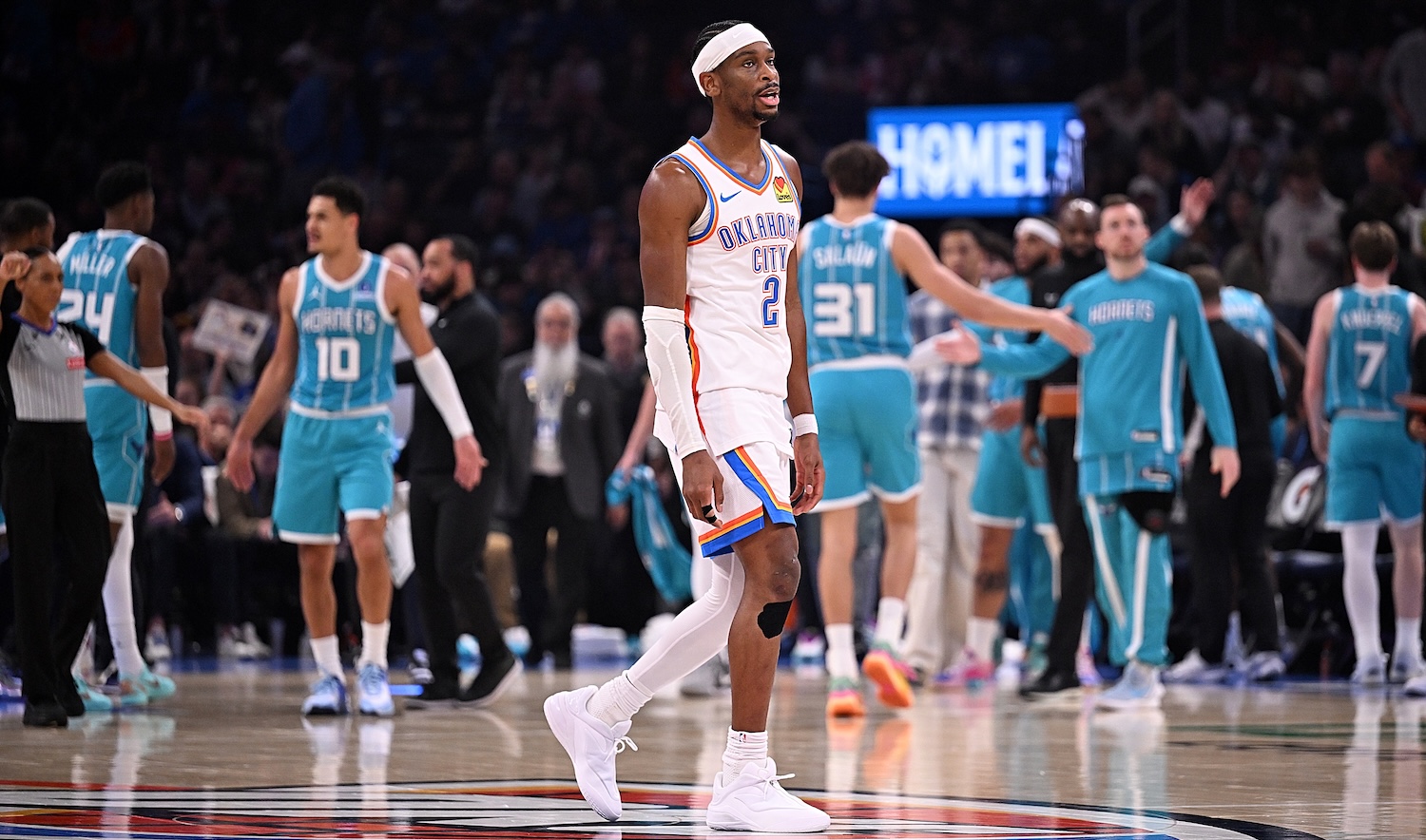
One week later, the wobbliness seems to have compounded. Oklahoma City blew an 18-point first-half lead to the Suns on, well, Sunday, then got pounded by 27 by the dismal Charlotte Hornets at home. Two days later, in what should have been a get-right game against the Utah Jazz, the Thunder trailed by eight with five minutes left and needed both a timely Jazz collapse and a Gilgeous-Alexander buzzer-beater to reach overtime (where, to their credit, they put the Jazz away).
So what is going on? Mostly, other people grabbing rebounds. In the games since they reached their high-water mark of 24-1 (in that 49-point win over Phoenix on Dec. 10), the Thunder are 28th in total rebound percentage. The Suns out-rebounded them by 20, the Hornets by 19, and the Jazz by 14. Phoenix's comeback involved a lot of Mark Williams and Oso Ighodaro crashing hard and either pushing Chet Holmgren out of the way or simply skying above Lu Dort. Charlotte's offensive rebounding specialist center Moussa Diabate mashed everyone inside. Utah's Jusuf Nurkic was huge in the both literal and figurative senses on Wednesday.
This is not a new theme for this group. When Oklahoma City first earned the No. 1 seed two years ago, the Thunder also earned skepticism from the established graybeards of the Western Conference, who correctly diagnosed that they could be taken advantage of on the glass in the postseason, when rebounding matters way more. After getting the eventual conference-champion Dallas Mavericks to 2-2 in their second-round series, the Thunder were out-rebounded by 29 over the course of the next two losses.
That was the problem they brought center Isaiah Hartenstein aboard to fix the following offseason, and he basically did. The Thunder are still not a great offensive rebounding team overall, mostly because they don't have much size on the wing to crash with, but Hartenstein is a great offensive rebounder and he gets them all sorts of free buckets. Hartenstein has also been in and out of the lineup for a month due to injury, and while Oklahoma City still can beat anyone without him, it's less clear whether they can still beat everyone without him.
Oklahoma City also isn't scoring like a contending team. Since Dec. 11, the Thunder are 20th in offense. This swoon also brings back an old ghost, which is that the Thunder's half-court offense depends on Gilgeous-Alexander's individual brilliance to a perhaps uncomfortable degree. The team spends a lot of minutes on Cason Wallace, Lu Dort, and Alex Caruso, defensive geniuses who don't do much on offense besides spotting up for open looks. When those guys don't hit their shots, Gilgeous-Alexander is increasingly isolated and subject to pressure, and right now those guys are not hitting their shots.
Chet Holmgren is having his best season, though he is not a creator. Ajay Mitchell is weirdly important to this team for his rare dribbling ability, particularly with Jalen Williams clearly still getting back into shape after missing roughly the entire first month of the season. An offseason wrist surgery on one's shooting hand is a serious thing, and from what I've seen of Williams, he's clearly fit and remembers how to make plays for his teammates, but his confidence as a shooter and driver isn't there. Oklahoma City needs him to play like a star in order to keep scoring at an elite rate, and more importantly, to keep Gilgeous-Alexander reasonably fresh.
The seeming inevitability of Williams's return to form should be encouraging, as should a critical disparity. In the relevant stretch here, Oklahoma City is 28th in the league in three-point accuracy, at 31.8 percent. Their opponents are fourth, at 38.3 percent. That indicates some healthy shooting luck against them—Phoenix's Jordan Goodwin made eight threes on Sunday, and Charlotte's Brandon Miller hit seven on Monday—though I will note that the Thunder's defense always gives up a lot of attempts from three, simply because those are the shots that don't require opponents to drive into the steals-and-layups-machine defense.
I am not worried about the Thunder. I still think they are the favorites to win the title. I am, however, relieved that the list of hypothetical contenders is now longer than one; I have seen enough to feel reasonably confident that the Nuggets, Spurs, and Rockets will not simply get rolled over, as many feared in November. But what we've seen over the past month is not a fatal flaw revealing itself, so much as it's a young team that played well into June last year hitting a wall of sorts. They will be fine by spring. The Thunder are mortal, but that doesn't mean they'll die.