


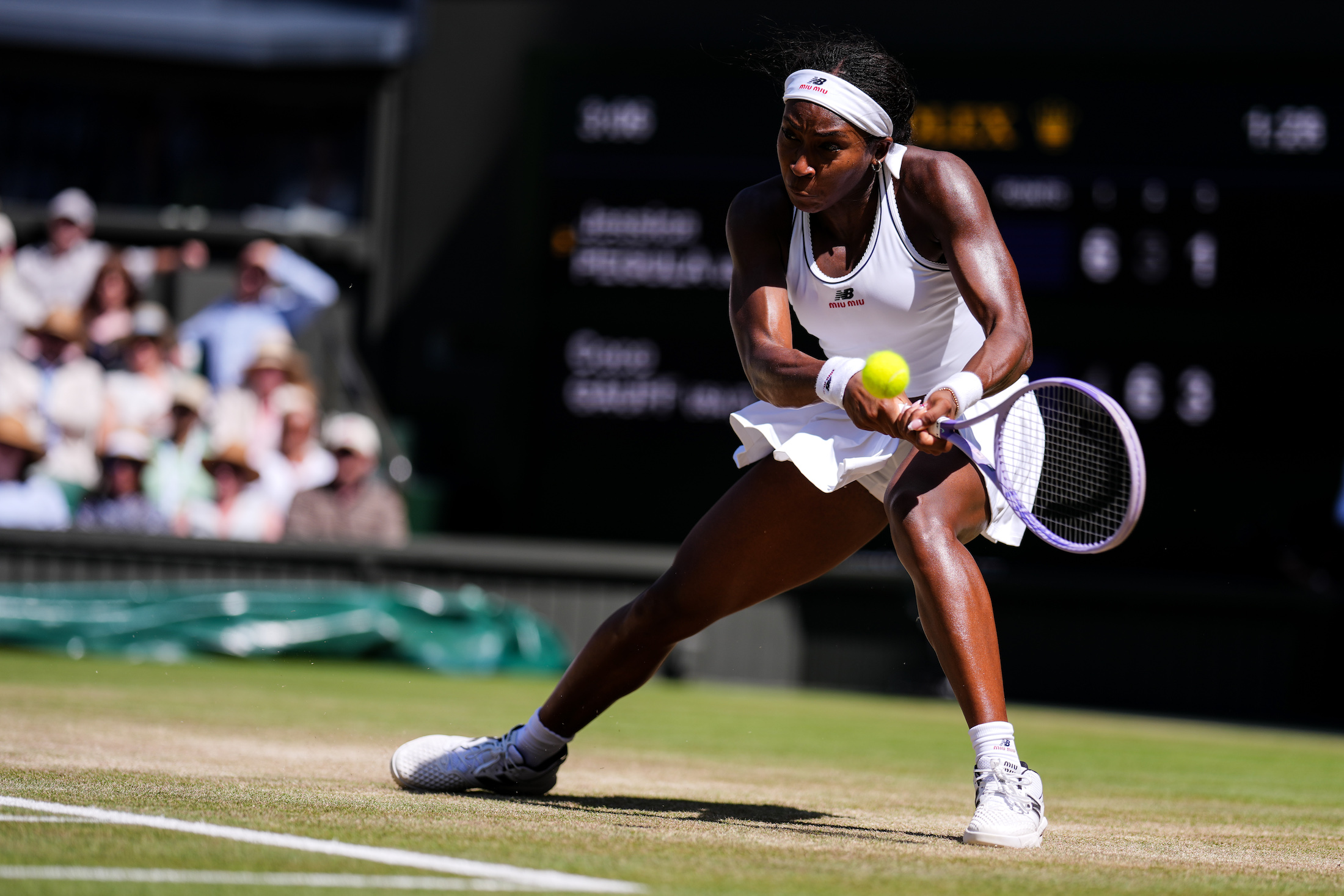
Heading into this year's Wimbledon, neither Coco Gauff nor Naomi Osaka had made a deep run at the tournament, despite winning a total of six Slams elsewhere. Gauff had peaked at the fourth round, and Osaka at the third round, three times apiece for both players. An observer trying to make sense of this history could argue that their styles of play weren't flattered by the demands of grass-court tennis. Osaka's power game relies on rhythm, which she gets from the ball's consistent and reliable bounces off a hard court; Gauff's raw foot speed and rally tolerance aren't great competitive advantages on a surface where it's so slippery and difficult to defend.
They weren't alone in their struggles. For the majority of pro tennis players on both tours, grass appears to be a surface they learn to tolerate rather than one to relish, despite Wimbledon being the most prestigious tournament in the sport. Grass gets a short stint on the calendar, typically just one or two tournaments for most players, and it demands a bit of adaptation. The dominant mode of tennis these players have learned and played all their lives—high-topspin baselining, enabled by polyester strings, fast swings, and explosive lateral movement—are not as viable when the ball's bounces are so low and unpredictable.
We should celebrate the vanishingly small number of true grass-court specialists out there, those who lean into the surface's eccentricities and are indeed empowered by them. For example, take the slice-master Tatjana Maria on the women's side, whose big results on grass—the 2022 Wimbledon semifinals, a Queen's Club title in 2025—stand stark against her journeywoman career. On the men's side this year, there was Shintaro Mochizuki, a net-rushing demon who ran from qualifiers all the way to a fourth-round loss to Jannik Sinner, unable to hit any given ball all that hard but able to place every single one on a designated blade of grass. That's real tennis, and these are real ballers. In an ideal world, grass season would be dominated by players with great hands and that numinous quality called "court sense," which might be a mix of ball control, anticipation, and pattern recognition. I would accept any amount of tinkering with the parameters of the sport—string bans, ball quality, court speed—to make this style of play viable again. This phase of the tennis season would be a delight.
Until then, grass season will be the story of which players can tweak or contort their existing games to make it work well enough. This is a process that can happen elegantly, or not. This year, Osaka has been an incredible example of the former. In the leadup to Wimbledon, she made it to the final at the WTA 500 at Bad Homburg, her first-ever grass-court final, although she had to retire from the match with a foot injury. Through four rounds of Wimbledon, she was the best player in the draw. Osaka didn't drop a set, serving well and still finding that unbeatable baseline rhythm despite the lower-bouncing balls. The peak of her grass career to date was her fourth-round defeat of No. 1 seed Aryna Sabalenka, a three-time semifinalist at Wimbledon. After beating Sabalenka, Osaka said that the nature of the surface made her focus on her serve, and she credited her coach Tomasz Wiktorowski.
Unusually, their preparation for grass season didn't actually involve training on grass courts. "I would say [Wiktorowski] challenges me a lot to think outside the box," Osaka said after her third-round win. "We were doing a lot of things on the hard court—because where I train, they don't have a grass court—we were just doing a lot of different things. It's kind of made me understand grass-court tennis a lot more. I think when I was younger, I was a little bit more stubborn on how I wanted to play on this surface, but I realize it's a lot more free-flowing."
If you've watched Osaka long enough, you've probably caught a glimpse of her looking comically out of sorts at the net, but they worked on that, too: "Tomasz is doing a lot of really weird drills that [mean] I have to come forward. I was never one that was too comfortable coming forward. It forced me to see the ball, or see the speed of the ball. It's just a bunch of different training drills that made my mind more aware of the depth of the ball and things like that." I do think Osaka has made a critical breakthrough on grass, even if she was disappointed by Tuesday's quarterfinal loss to No. 10 Karolina Muchova—another top player with a track record of underperformance on grass, though all the more mystifying because her handsy all-court game is perfectly suited to the surface.
Muchova's next opponent will be Gauff, who has also been on the Wimbledon run of a lifetime. She pushed past Jessica Pegula on Tuesday to advance to her first-ever semifinal. Wimbledon was the site of her grand debut: a fourth-round appearance back in 2019, when she was just 15 years old, taking the torch from Venus Williams. But Gauff hadn't won a grass-court match in two years before this year's tournament. Her serve has become more of a liability since her breakout, which also complicates matters on grass.
"We don't have the best relationship," Gauff said of grass courts, the day before Wimbledon. "I don't think it's a natural surface for me, but we're going to make it natural." That sums up the Gauff tennis philosophy: Find a route to victory at all costs, powering through any fundamental flaws. The peak moments of her career have been instances of winning ugly, and now she has managed to carry that over to the surface where it is arguably hardest to win ugly.
On paper, Gauff's loopy topspin forehand, an inconsistent shot that bedevils her on every surface, is even harder for her to hit cleanly on grass, and less damaging to her opponents on arrival because it bounces at unthreatening heights. It's a shot she often hits while backpedaling, looping it up to buy her time to recover in the rally, which is not the ideal tactic on a surface that rewards players who can flatten out their strokes and hit through the court. But she has nevertheless found a way through four consecutive three-setters, and expressed various forms of disbelief along the way. After Tuesday's win, Gauff ascribed her success this year to a few different factors, including a shorter Roland-Garros run that left her more time to prep for the specific footwork needed in grass season, and "trusting that my groundstrokes are good enough to be with anyone on this surface."
She acknowledged the "commentary on my game" and how it doesn't mesh with grass, but described a changing mindset after her quarterfinal win. "I felt like in the first set, I was maybe rushing out of some points too early, either trying to either get out of the rally or overhit too much," she said in her press conference, when asked to sum up her newfound success. "Towards the end, I just really honed in on my game and realized I don't have to play a spectacular point every time to win, even though there were some spectacular points." At age 22, Gauff is now the youngest player to make all four Slam semifinals since Maria Sharapova did it in 2007. That fact puts this whole Gauff-on-grass discourse into perspective: How could anyone rule out surface-specific improvements for one of the tour's best athletes, who had two Slams to her name by age 21? And right after the supposedly grass-averse Iga Swiatek won Wimbledon last year, too? If the player is that talented, and the stakes are this high, she will always find a way.


![USA's Ben Shelton celebrates his win against Spain's Carlos Alcaraz during the men's singles quarter-final tennis match on day ten of the US Open tennis tournament at the USTA Billie Jean King National Tennis Center in New York City on September 9, 2026. (Photo by Leonardo MUNOZ / AFP) / “The erroneous mention[s] appearing in the metadata of this photo by Leonardo MUNOZ has been modified in AFP systems in the following manner: [USA's Ben Shelton] instead of [Spain's Carlos Alcaraz]. Please immediately remove the erroneous mention[s] from all your online services and delete it (them) from your servers. If you have been authorized by AFP to distribute it (them) to third parties, please ensure that the same actions are carried out by them. Failure to promptly comply with these instructions will entail liability on your part for any continued or post notification usage. Therefore we thank you very much for all your attention and prompt action. We are sorry for the inconvenience this notification may cause and remain at your disposal for any further information you may require.”](https://lede-admin.defector.com/wp-content/uploads/sites/28/2026/09/GettyImages-2293730421.jpg?resize=2880%2C1920)