

Given that tennis is effectively professionalized, legalized psychological torture, a choke and an epic comeback often go hand-in-hand. Take, say, when Zheng Qinwen faced Madison Keys at the U.S. Open on Saturday. Zheng won a match in which she was down 6-1, 6(3)-7, 5-1 and had to save a match point on her opponent's serve. A comeback, absolutely, but also, perhaps, a choke on Key's part. So: yea or nay?
If one were to point to said match to support the case for "yea"—shown in the extraordinarily meager and insufficient official highlights here at 2:18—it would not be because Keys lost that point but because of how she lost it. Viewed in isolation, the match point looks like it was lost after a good return on an 85-mph second serve. In context, it is worse: Keys caught her first ball toss, then decided to more or less just kick in an 85-mph first serve. Zheng made a backhand return that was deep but not necessarily unmanageable, but Keys's feet got stuck as she hit a backhand into the net. Deuce. Zheng returned a 105-mph first serve on the next point, then finished a brief rally by smashing an off backhand that hit the line. On break point, Zheng made a weak, shallow return that Keys misread, hitting a weak forehand up the middle rather than a plus-one winner. That limp forehand allowed Zheng to wrestle control of, and ultimately win, the point.
Zheng Qinwen would not lose another game for the rest of the match; conversely, Madison Keys would not win another one. After Keys was broken for a third consecutive time to go down 6-5 in the final set, she smacked her head with her racket several times. On Zheng's own match point at 6-5, 40-30, she successfully wrestled a backhand down the line off a strong Keys return, and Keys hit a running forehand error. Game, set, match.
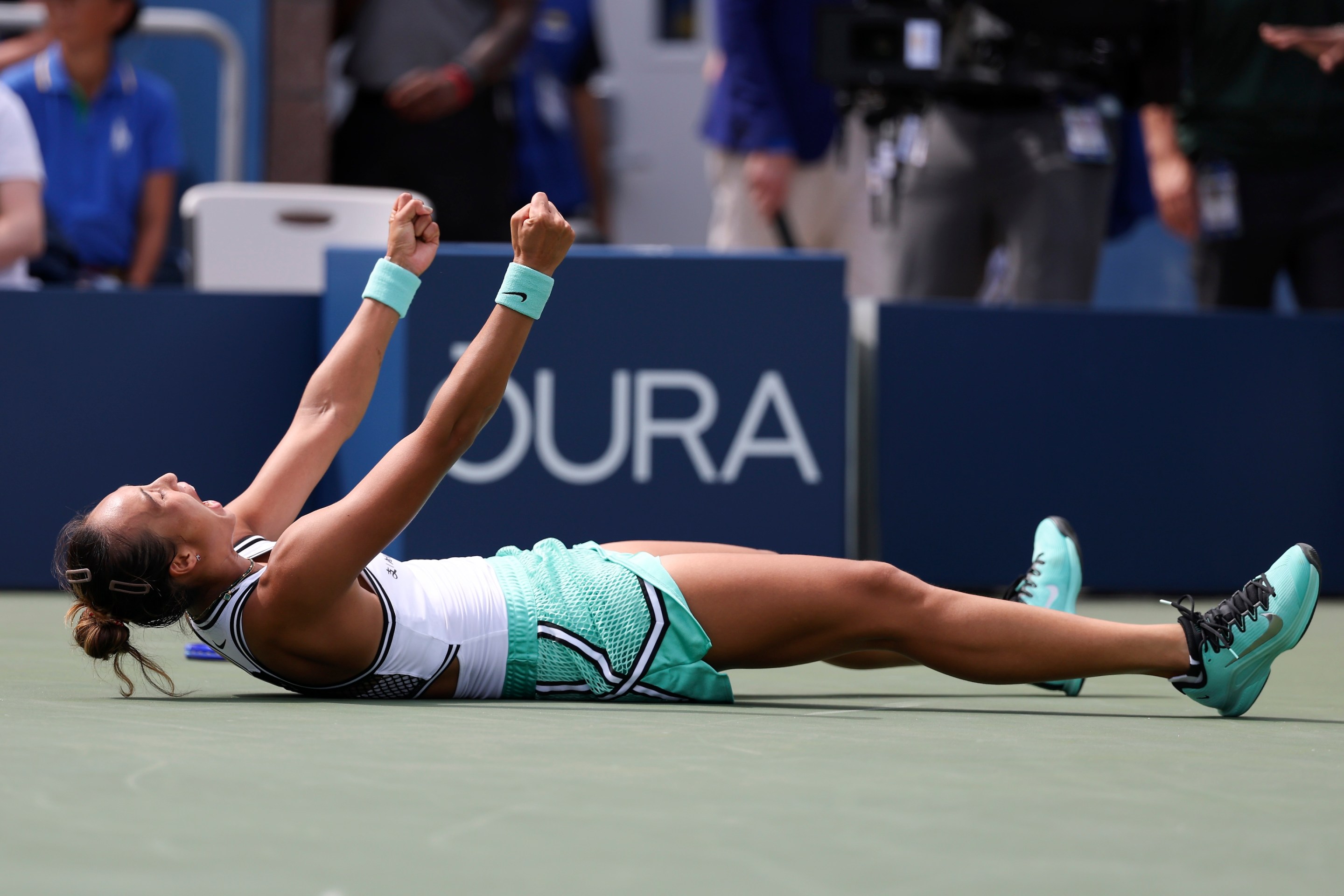
It would be easy to represent this loss as being worse than it was. Keys came into the U.S. Open as the 22nd seed. Zheng came in ranked outside the top 100 and had to play qualifying to get into the main draw. That Zheng even accomplished that was a meaningful feat, not least of which to Zheng herself. After she won her last qualifying match against Elena Pridankina in three sets, she fell to the ground in celebration.
There is some important context to know here, however. Zheng has been ranked as high as No. 4 in the world, and has an Australian Open final and Olympic gold medal under her belt. Her 2025 was abbreviated by elbow surgery, though she was never gone for long enough to have a protected ranking. This year, Zheng has struggled chaining together enough match wins to rebuild her ranking, which is why she entered the U.S. Open as a qualifier. Still, even with her historical success, Zheng has some hefty head-to-head disparities against fellow top players and hard hitters. She is 1-8 against Aryna Sabalenka, 1-4 against Elena Rybakina, and 1-7 against Iga Swiatek, though the one win there came en route to Zheng's Olympic gold medal.
Zheng doesn't have as much history against Keys—they had played only twice before meeting on Saturday, and split the pair—though her victory over Keys in Miami this year is telling of Zheng's historical strategy against huge hitters. That strategy, more or less, is to hit harder, which is certainly one way of trying to control your own destiny against a player who, win or lose, will tend to dictate the outcome herself. Even in the case of a choke, the other player has to be there to receive the gift; both parties get a vote. This victory was even more significant than the Miami one for Zheng, who now has a chance to further rebuild her ranking and work on improving that head-to-head record against Iga Swiatek, a proper contender to win the whole event.
As for Keys, she will have to recoup. In her previous round's victory against Anna Bondár, Keys was down 5-2 and saved five match points before coming back to win in a match tiebreaker. In her very next match, she would be on the opposite end of the epic comeback–choke spectrum. Tennis gives, and tennis takes. It's a funny sport that way, if you have a sense of humor dark enough.



![USA's Ben Shelton celebrates his win against Spain's Carlos Alcaraz during the men's singles quarter-final tennis match on day ten of the US Open tennis tournament at the USTA Billie Jean King National Tennis Center in New York City on September 9, 2026. (Photo by Leonardo MUNOZ / AFP) / “The erroneous mention[s] appearing in the metadata of this photo by Leonardo MUNOZ has been modified in AFP systems in the following manner: [USA's Ben Shelton] instead of [Spain's Carlos Alcaraz]. Please immediately remove the erroneous mention[s] from all your online services and delete it (them) from your servers. If you have been authorized by AFP to distribute it (them) to third parties, please ensure that the same actions are carried out by them. Failure to promptly comply with these instructions will entail liability on your part for any continued or post notification usage. Therefore we thank you very much for all your attention and prompt action. We are sorry for the inconvenience this notification may cause and remain at your disposal for any further information you may require.”](https://lede-admin.defector.com/wp-content/uploads/sites/28/2026/09/GettyImages-2293730421.jpg?resize=2880%2C1920)