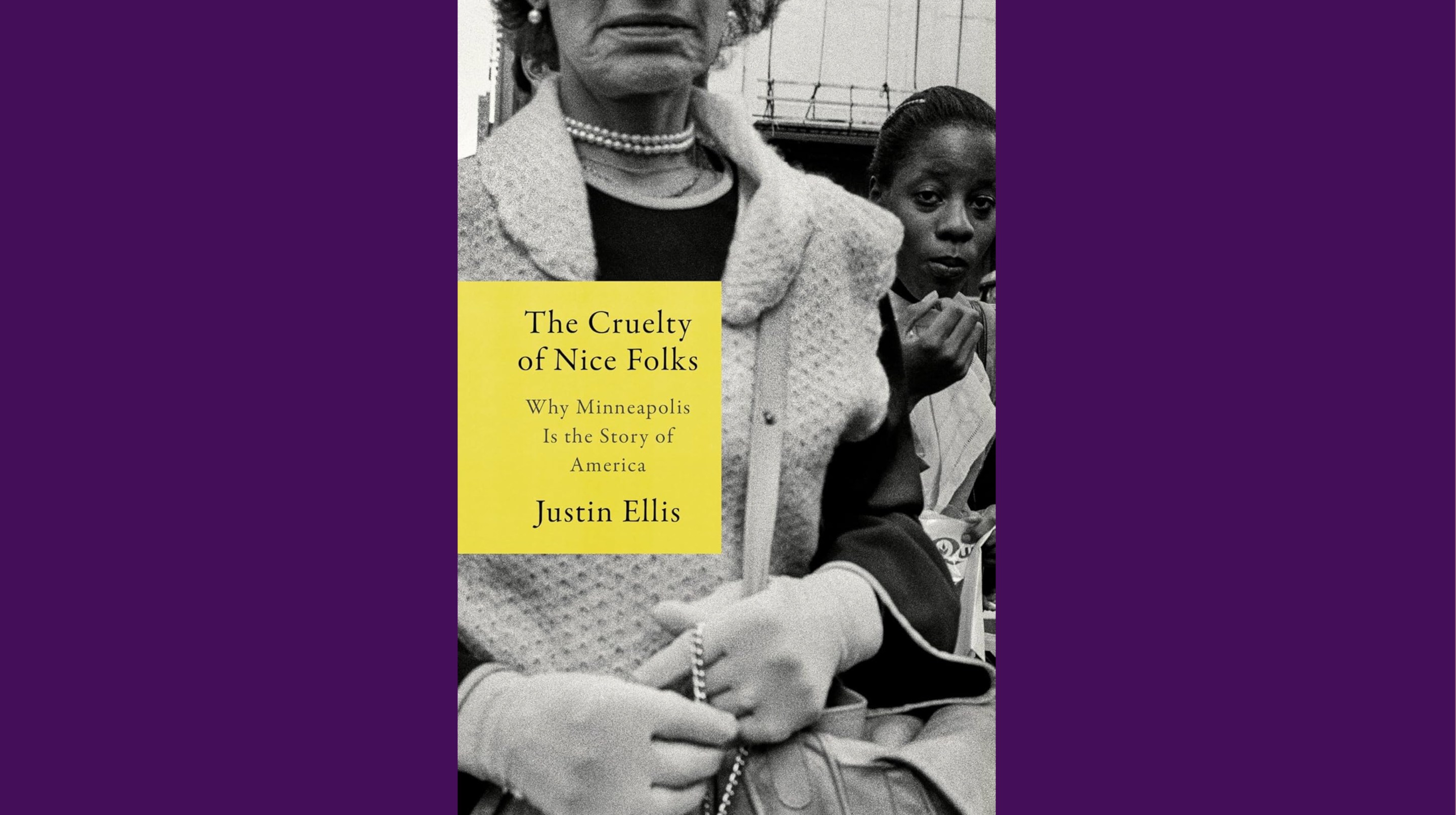
In late 2020, months after the murder of George Floyd, our colleague Justin Ellis moved back to his hometown of Minneapolis to begin work on a book about black life in the city, where promises of racial harmony have gone unkept to generations of black residents. The city's good, neighborly intentions are alluded to in that classic phrase, Minnesota nice. "But good intentions find a way to devastate Black lives all the same," Justin writes. His brilliant new book, The Cruelty of Nice Folks: Why Minneapolis Is the Story of America, is in bookstores now. It asks readers to consider what nice really means. Floyd's death, Justin writes, is less a departure from nice than a consequence of nice, a culmination of too many conversations avoided and too many problems swept under the rug.
Inevitably, this became a personal project for Justin. He spent his year in Minneapolis also taking care of his mother, Viki, as she underwent cancer treatment. (You might recall reading his beautiful tribute to her at Defector a few years ago.) As Justin sought to understand how his family's "insistence on an ordinary life could be a skeleton key to understanding Minneapolis," Viki became a vital source. Woven through this rigorous urban history about the city's constraints on black life is the moving personal story of how three generations of the Ellis family lived in and adapted to them: "When the world was not enough, or it asked for patience, they found a way to make it work."
Last week, the busy father of two was generous enough to grant Defector an interview. We talked about the "actively managed" myth of Minneapolis, the challenges of writing such a personal book, the legacy of the summer of 2020, and what lies ahead for Minneapolis in the wake of the monumental anti-ICE protests that swept the city earlier this year. The interview has been edited and condensed for length and clarity.
You've written an exceptional book that also at its core follows a very normal adult search, one of looking back at your upbringing or home and trying to parse which parts of it were "normal" and which parts were not. The big question of the book is How exceptional, really, is Minneapolis in America? By focusing on it, you do have to argue for its significance. But you're also arguing against the myths of Minneapolis, the happy white myths of the place. So how exceptional is Minneapolis, really? And what, if anything, is?
I struggled with this a little bit. In writing the book, I think there were times when I didn't maybe linger enough with some of the things that I really enjoyed about growing up in Minneapolis. For some reason, I feel like I should have found a way to shoehorn in how much I love the Minnesota State Fair, and the cheesiness of it all, the deep-fried foods, and foods on a stick. The ridiculousness of seeing, like, grain art that has been made to look like a Prince album. That definitely is Minnesota exceptionalism. Getting a giant bucket of mini donuts and going to see the cow burping tent is Minnesota exceptionalism.
This is a place that means a lot to me. I have a lot of love for Minneapolis. When I was writing the book, I often would think about the way it felt when I would fly back, especially when I was in my 20s and my career had taken me further and further away from Minneapolis. Thinking about the feeling of when you come down over the city and see the landscape. I see the neighborhoods, and I recognize the ballparks, and I recognize businesses and the outline of the skyscrapers. It had a very romantic feeling to me. I think it's the same way a lot of people would feel about their hometown, especially if they've gotten away from it. But I think that being away also was the thing that helped me have this sharper perspective, that there can still be a lot of things that eat away and rot away at something that is beautiful and important to you. I think the process of writing the book and especially of the five years working on it after George Floyd's death is seeing in some ways what that beauty masks, and the purposeful ways that it covers up the shortcomings, the ways in which it makes people say, We have all these other great things. Don't rock the boat. And I think that just made me angry over time.
Right, that feeling culminates in the great conclusion of the book—well, first, I was going to ask if you have a particular favorite fried food at the Minnesota State Fair.
Always the cheese curds. I have very strong memories about going there with my mom and other family. You can get cheese curds in a lot of places, but there's this place that's in this massive food hall that has lines that will literally wrap through the building just so you can get this bucket. You sit down to pick apart this molten hot cheese. Trying to cool it off with dipping it in ketchup is such a very strong memory to me. I still love it now, even though as an adult, there are times when I sit down to eat that, and am like, This doesn't feel good for my body.
I just had cheese curds at a bar while watching the game, and I will count that in favor of Midwest exceptionalism.
Absolutely.
We did kind of cook with that. I was looking through the acknowledgments and there was a mention of your wife, Mitu, encouraging you to take the book in a more personal direction. The book is now a blend of reporting and personal history. Did you have reservations about making yourself and your family such a big part of it?
I absolutely did. My editor was the first one to suggest this notion of alternating the historical and contemporary and the historical and personal, but I was fighting against that for a long time. The earliest drafts of this were just a down-the-line history book. I think that's what happens when you spend time with all these primary documents and you're reading all these other history books, reading about redlining and about school desegregation. It was taking too long to get to modern-day Minneapolis or to specifically what happened with George Floyd, or to why I'm the one doing all of this.
Because Mitu had read so much of it as I was working on it, she was like, You gotta put yourself in here, dummy. You have to be a character in this. I struggle with that to some extent because of the whole lifelong journalist bullshit of it all: I'm not the story. This isn't about me. But it so clearly was. The thing that really unlocked the book was not just talking about my own family and trying to confront what I remembered about the past—Were we working class? Were we bougie? How did all these things matter?—but also seeing how that fit together with the journey with my mom's health. There was this arc that came out of that, this process of learning about my family's history, thinking more about how about how I grew up, thinking about the situations and ways that my mom grew up, the ways in which there were these three generations of the Ellis family that all had a lot of similar things they were facing in just trying to have a normal life.
This is also one of the pernicious ways that white supremacy works, right? The idea that just to survive is not exceptional, when in reality, because of the ways that structural racism impacts our lives—that it literally defines the neighborhoods that we live in, the opportunities our families can have—that's just not the case. Every family that is marginalized is a success, is a celebration. That was another part to me that rang out. Just because you didn't have someone that was the first of something, someone that ran for office, someone that founded a business—and there are a lot of those people in this book—you didn't have relationships with the powerful, you didn't suffer at the hands of the police, that doesn't make your story or your family any less important.
You mentioned working with primary sources. There's so much great scholarship—I think of Saidiya Hartman "working with and against the archive"—about the omissions and erasures of black life in archival material. Certain people get to produce history; certain people don't. There's a climactic moment in the book when you learn the fate of your great-grandfather Charles Ellis from the newspaper archives, and it appears in a "short item, barely more than a few sentences." What were the challenges of working with primary sources, given the oppressive ways archives are constructed and maintained?
I kept coming back to this thought that if I hadn't been a journalist and had a career where I know about the ways in which you look for primary documents, or the ways that you could daisy-chain one thing you find to another, that it would be an impossibility. I found this history of all these black newspapers in Minneapolis and St. Paul that I hadn't really known about before, and that in some ways was just a revelation, that these were the lives that people lived. You didn't see them in other places, you wouldn't have seen them back when Minneapolis was a multiple newspaper town. You could see the wedding announcements and the graduation announcements and all the parties and different functions and all these things that the people were involved in, captains of industry running various things—but it was always white families.
It could make you feel conspiracy-minded when you look at some of the primary documents that you find that spell out, yes, you know what, the Ku Klux Klan did exist and took root in Minnesota. They have their fucking newsletters in some of these archives. It was very similar to the case about the lynchings that took place in the city of Duluth, in northern Minnesota. These are stories that existed in some primary documents and newspaper files, but things that were lost to time. You see this pattern over and over again. It just sort of tells you, it is the story of who the victors are and what people think is important. The myth of Minneapolis was something that was actively managed. It was crazy-making at times.
Some of the primary sources you were able to access were pretty fascinating to me. There's a description of a map made by this man named Clarence Miller, who constructed a "memory map," basically with his life and the social geography of North Minneapolis mapped out. I wanted to ask if you had any memory mapping process of your own. It's a structurally complex book with all these threads you're weaving together. How did you go about putting your Minneapolis on the page?
That was absolutely the hardest part. It was after some early drafts that I realized that for it to really work, the book would have to pop back and forth, and that really meant, in some ways, exploding a lot of the chapters in the book to think about what was happening during the year that we were there, what was happening with the Derek Chauvin case, what research I was doing at the time and then trying to figure out how I put that all down in a narrative way.
I had these notebooks where I was writing everything down for my mom's treatment. And over time, it was not just writing about her treatment, but it was also turning into journaling. I was using all of those things and looking back at newspaper clips from that year, even old tweets. My camera roll on my phone became indispensable. I basically ended up with something closer to the police serial killer board: trying to color-code what was historical, what was a contemporary city story, what was a personal story, and then all the ways that all those things connected. I still don't know if I got it entirely right, but I made peace with all the places that it went.
Your note about keeping a treatment notebook interested me, because a theme that came up in every part of the book was this tension with bureaucracy. Certainly in the healthcare system, where you have to be an advocate for yourself to navigate it—one moment I did just laugh out loud was this part where your mom has written a note to her care team and includes a comment on the snacks and food she's being given, and it just says, in parentheses, "atrocious."
The other bit about her that made me laugh was just the phrase about her "beef with Coretta Scott King." I do not think that line will soon escape my brain.
When I learned that, I laughed about that for days, and just [thought], I got to find a way to get it in.
A teaser for readers: An explanation of this beef awaits you in the book. But bureaucracy—you spend some time on Hubert Humphrey, a more technocratic figure whose ideas for remedying racism in Minneapolis as mayor resemble ideas we still hear about today, like anti-bias training or community discussion groups. You trace this impulse through the end, when reforming or restructuring or abolishing the police department becomes an issue that the city discusses.
The role of the "administrative state" seemed to loom large over the book. I can see some value to, say, a commission looking into a problem and coming away with concrete findings, like "X percentage of black residents of Minneapolis are having problems finding housing." Or I think even of the makeup of the bureaucracy itself, and the civil service often being credited with creating a black middle class because of its workplace protections and promotion schedules. But I wonder what your feelings are on the role of the bureaucracy to advance racial justice. There are lots of commissions and panels and proposals, but as you also show, they don't necessarily equal progress.
We talked before about what the Midwest has given the world, in terms of cheese curds, but I think this is another one: the kind of technocratic liberalism that says it's important to study the problem before you try to tackle the problem, that you need people who are compassionate, but also analytical and maybe even academic to help understand the needs of people. And that also you need people who believe that it's the role of the state or the city to actually jump in and help people with their problems. On paper, all those things are absolutely good.
I really struggled with Hubert Humphrey in this book. He's one of the biggest figures in American liberalism in the last century and obviously one of the biggest in Minnesota's history. A lot of those ideas and the structures that he had in mind were good. But I think it fell short in that, for a lot of them, it was at the stage of window dressing before he moved on to bigger things.
I feel like what Minneapolis and Minnesota settled on is this thing that became this broader project of liberal thinking and liberal governing, that you view racism through these public-private partnerships or that you do it through these byzantine systems where you look at things like tax credits or vouchers as ways to have the state help people. You're identifying people's needs, but you're doing it in this way that is confusing and oftentimes creates more work for people when they just have simple problems that they want addressed. That's a thing I did not know I was going to be confronting in the book. I was trying to navigate the shitty bureaucracy of the healthcare system with my mom's care; I hadn't really thought about how that paralleled the ways in which Minneapolis has thought about how to address the problems of structural inequity and racism.
I know that physical distance from Minneapolis gave you some more perspective, but I wanted to ask about the hindsight of time. It struck me while reading that your life has dramatically changed since this book began!
To say the least.
And there's an afterword you wrote, about the city's reaction to the Trump administration's ICE deployments in December, and the killings of Renée Good and Alex Pretti. I imagine it was written much later than everything else in the book. As you sat down to write it, how did you feel like you'd changed, and how had your perception of this story shifted since writing the earliest parts of it?
One of the things that was really hard about this project is that I was working on this from the time before I learned that my mom was sick, through her treatment, and to when she died. And I was still working on it in this long period of mourning, often just pushing myself to get back into the work, to try to find the routines. But that was also hard because she was so integral to the research in this and to my own understanding of my family's past.
I was in a place of feeling like there was so much that I didn't know, and there was so much left unsaid, and there was so much that I couldn't get back. And I try to get at that in the book—I'm working through this as I'm still trying to write it and still trying to research, as I'm becoming a father for the first time, as I'm walking in the same footsteps back in my hometown, where my mother raised me.
Over time, I was slowly able to confront that time with my mom, able to sit with all the diaries and the journals that I had, able to listen to her voice and the recordings that I had and the interviews that we did. Sometimes it wasn't even interviews. There's a lot of tape of just the two of us riding in the car, bullshitting as we're driving back and forth to various appointments. It brought me to a place of realizing that I was very lucky that this project brought us back together during the last year of my mother's life, and that I was able to turn it into a story that I got to share with people. That was really a big turning point for me.
Especially as I got further into the future after the referendum on policing in Minneapolis, and the fact that so little was changing in Minneapolis after Floyd's death. It was what made me realize that in the end, it is about your people. It is about your family and your loved ones, and how you celebrate them, how you make those stories live on, and how you make those stories matter. It's also about how you sit with the things that you don't know and that you'll never know. That was all really useful to me, because I didn't know how this book was going to end for a very long time. I knew it was not going to end on Justin's five-point plan to solve structural racism and inequality in Minneapolis and turn around the rotting ship that is American liberalism.
That'll be in the paperback edition.
Yeah, that's the update. I was also reading other books and other authors and realizing it is foolish to fall into this trap that often happens to writers of color where we have to be the ones to synthesize and then fix these broader structural problems that are not of our making.
The epilogue was difficult for a number of reasons. We had put this book to bed in early January of this year, and then Trump sends ICE to Minneapolis. They start taking down doors, they start disappearing people. Obviously, this is the playbook that we saw deployed in a lot of places already at this point. But I remember very early on that it was starting to feel very eerie, the parallels that I was seeing to what happened after Floyd was killed. And specifically in the killings of Renée Good and Alex Pretti, there was this unorganized but collective response that was forming, and then there was also this sort of powerlessness of the local government and the local police.
People were applying the lessons that happened from Floyd, through the year of Floyd and from the pandemic, and using them in different ways, using them to protect people and not just go out and wave signs, which is the way I tend to think about upper Midwestern liberalism. People were literally putting their lives on the line. People were literally out there in the streets trying to chase around and tail ICE agents. People were risking being locked up in this facility that was on the land where there had been, more or less, an internment camp for Native American tribes back in the early founding of Minnesota.
I wanted to acknowledge that there were these parallels and practical lessons in the ways that people were organizing, the ways that they were using Signal groups to organize things, the ways that mutual aid became important. But there were things that were different in terms of this knuckled-up kind of liberalism—literally, in the case of Ilhan Omar. It was something that was different than the kind words and well-meaning gestures of the past.
It felt like white folks were actually sitting with I have this level of protection that other people aren't afforded, and I'm actually gonna put skin in the game for that. At the same time, I also didn't want to write something that felt like I was letting people off the hook, that I was coming around and saying white people in Minnesota did figure it out after all.
Epilogue: "Never mind."
"And you know what? It all worked out." Because it still felt uncertain. Things feel uncertain right now. Today, as we speak, ICE is still doing things in Minneapolis, they're just doing it much more quietly. The city is grappling with the fact that the police chief who was supposed to be changing the department has resigned under scandal. The mayor who was supposed to be leading the charge and making Minneapolis turn the corner is still embattled and in conflict with a city council that wants to be more progressive and try to deal with George Floyd Square, not just the physical space, but also the memory of what happened. There's a lot that still feels like it's up in the air. Some things have changed, and it's important to acknowledge that, but it's this longer project that seems like it's uncertain. It's a question of: What kind of Minneapolis do people actually want to build? Is it one where the status quo will always win out? Or is it one where they're actually going to take some of these things that people were doing radically when ICE was busting down doors, and actually change the city?
This was great. Thanks for talking to me. I'm glad you're on the other side of this now, because I know writing this has been a long journey and you've had so much going on. So congratulations, I'm very proud of you, as I know we all are.
Thank you.
My final question for you: Who is the best defensive player in Timberwolves history?
It's gotta be Jaden McDaniels. He's just—
[Gasp] Over Rudy AND KG?!
I have a lot of love for KG, and I should probably say—you know what, yes, I'll say that it is a close competition between Kevin Garnett and Jaden. That's probably a more charitable answer. I shouldn't be too recency-biased.
That's a coward answer.
I think both sides played well.