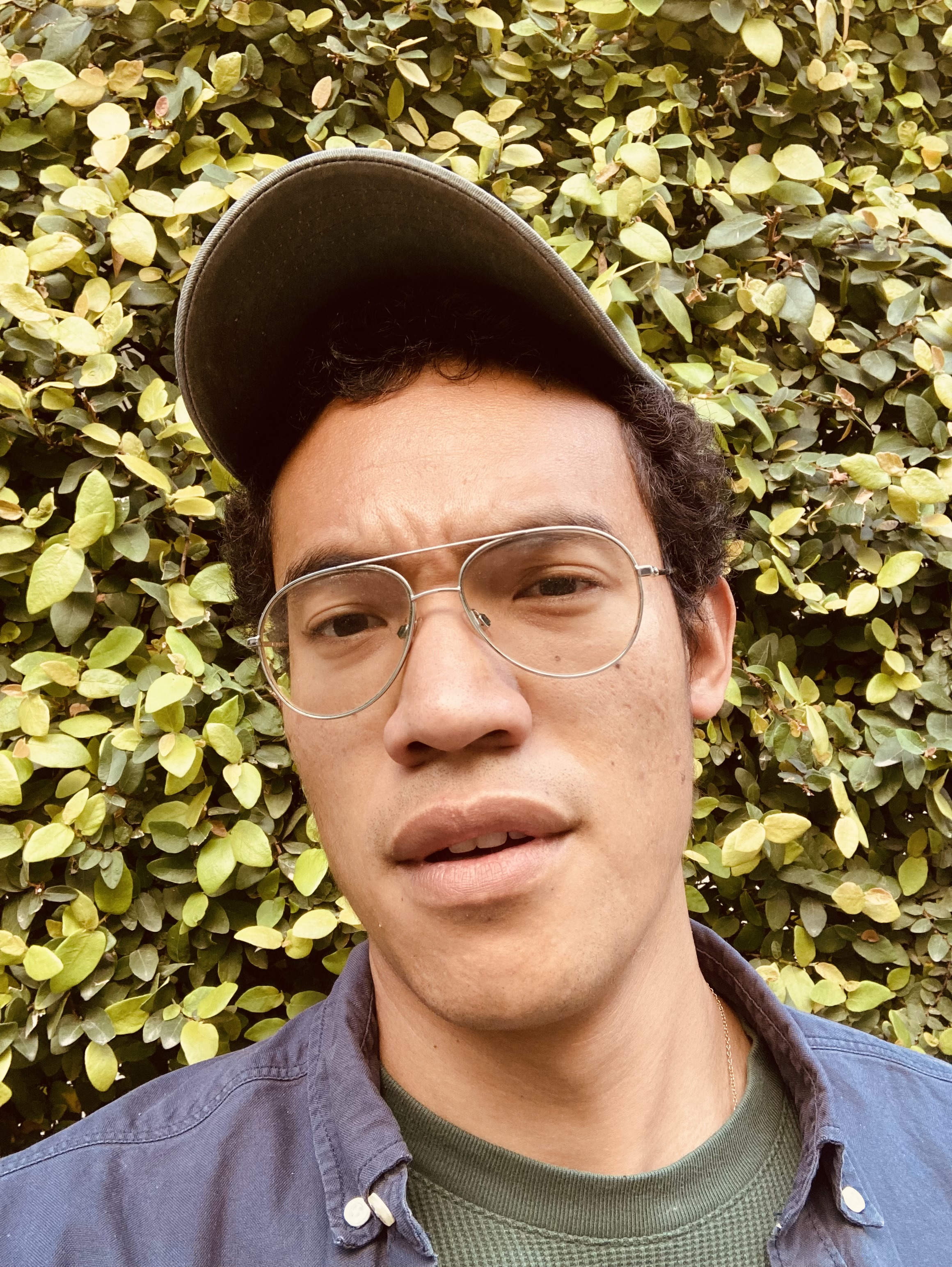
John Early has one of the most expressive faces of any actor working today. You've almost certainly seen it. The 38-year-old comedian, born and raised in Nashville, has had many small breaks into the zeitgeist over the past decade or so. His voice might also be familiar to you: He's worked on a gamut of animated shows including Bob's Burgers, Tuca & Bertie, The Great North, and Summer Camp Island (a personal favorite). He appeared most recently and prominently in the A24 comedy Eternity, but also in Tim Robinson's I Think You Should Leave, Julio Torres' Los Espookys, and the wildly underrated HBO series Search Party. It's this latter show where I first saw Early, not by actually watching an episode, but from clips circulating on Twitter.
Indeed, this is how I came to be familiar with several of Early's peers, alt comedians like Jo Firestone, Patti Harrison, and Conner O'Malley, whose brilliant, keenly observed work seems to live timelessly on the internet. But Early has always communicated an old soul, duly inspired by his friends and colleagues, but also the movement and spectacle of Bob Fosse, the melodrama of cult classics like Showgirls, and, as evidenced by his directorial debut masterpiece, '80s TV movies like Kate's Secret.
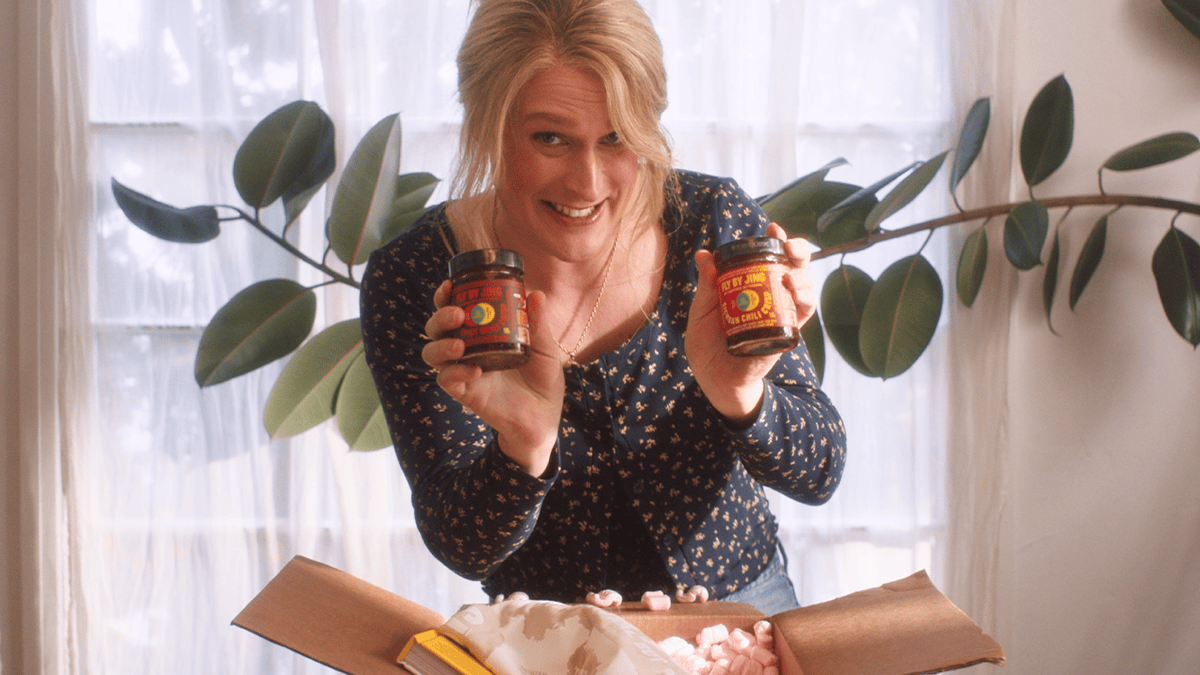
Early's film, Maddie's Secret, is not a retelling of that 1986 film, which follows a bulimic woman as she faces pressures both familial and psychological, though there are commonalities: a blonde lead, an eating disorder, the anxiety of a life lived under scrutiny. But Maddie's Secret is something entirely unique and surprisingly moving, a melodrama following the eponymous Maddie (Early), a dishwasher at the fictional Conde Nast magazine Gourmaybe, who is one day thrown into the spotlight when a video of one of her homemade dishes goes viral. As her fame increases, so does the burden of keeping Maddie's harrowing past trauma, and the eating disorder that manifests because of it, at bay. In Maddie's Secret, comedy and severity go hand in hand. Humor lives alongside and within the very real drama performed and staged by Early and his longtime professional partner, Kate Berlant. Maddie's Secret showcases not only Early's many talents as a performer, but his instincts as a filmmaker, one deeply attuned to the inner lives of women in friendship and in crisis.
I talked to Early over the phone about his new film. Among other things, we discussed sincerity, the line between vulgarity and crudeness, what it means to commit to a performance, a concept, a way of going about one's life, and, of course, Showgirls. Our conversation has been lightly edited.
Congrats on making the movie of the year.
It's official?!
It's official, yeah. I just got a text about it.
Oh my god.
There was an element in this movie that I was … it's not that I was worried about it, but I was curious as to how you would frame the bulimia. But you never show Maddie actually vomiting; it's always before or after. Can you talk a bit about that? It's a dignifying choice.
There was never any question for me. When I came up with this premise, I came up with it very quickly. This movie was made very, very quickly. That was by design. I wanted to make something kind of crude, not disgusting, but elementally kind of crude and blunt and direct and expressive. I figured if I just made it very quickly, that would be a good way for something exciting to happen that I maybe didn't have that much control over.
But it was a strange thing where I was like, Oh, I've chosen this premise that, on paper, seems provocative. And it of course is, and there's clearly some part of me that needs to be provocative. But I also think that's part of what gives this movie a special kind of charge. There's always this potential to be provocative. At every point in the movie, it could tip over into something that's mocking or kind of suffocatingly ironic or even grotesque. I personally don't think we tip over into that side. I mean, it's not for me to be the judge of, but that was what I was trying to do, and instead to always protect it and keep it sincere. I don't think the emotion would be felt if that potential wasn't right next to it.
I think this is a perfect example: You read the logline, you see the trailer, you know it's about bulimia, you're expecting there to be some sort of scene where you see her vomiting. But I think it's more interesting to not do that. Also, I couldn't be less interested. I wasn't holding back some sick desire to show it: I did not want to see that at all on screen. I would rather die than people describe this movie as like, queer body horror. I can't take another queer body horror movie!
[laughs] Me neither.
I can't take it. Bulimia interested me on a symbolic level. It interested me on a genre level. I just immediately, within like four seconds of writing this movie, felt a very intense protectiveness over Maddie, and I wanted to preserve her dignity. I didn't want to see her in that situation.
That's of a piece with how you've previously talked about irony, sincerity, camp, the line between these things. Maddie's Secret is a movie where there is no line. I feel like a crucial part of that is the fact that you start with Maddie as a character, as a woman, first. Everything spirals outward from there. I wonder if you can talk a little bit about performance, acting, embodiment of character. I forgot it was you playing her about 10 minutes into the movie. Ironically, I was thinking of your "Rock the Boat" video during this film. Obviously for the dancing, but also your total commitment to movement and persona. It's where the humor comes from.
I've played women before. I've done a lot of characters for a long time where the goal was a certain kind of realism, a kind of lace-front realism. I love broad sketch comedy, and I do it and I don't bring it up pejoratively.
It's more that I've always been compelled by doing something that could be seen as sketch comedy, but filming it in a way that actually allows for a certain kind of cinematic feeling, of emotion and nuance. I really believed that we could achieve that. I really believed that if you just gave me five minutes, that people will buy into this illusion, and that if they buy into this illusion, if their hearts are open to me as Maddie, then their hearts will be open to the rest of the stylistic extremes of this movie.
People have said to me that they forget that it's me, and that's so exciting. Because, who cares about me? That's the problem too. I'm so sick of seeing the same fucking actors in everything, the same actors who are on the very, very short list of people who can get things financed. I want to see new faces. It's also, like—I really love fully transforming, you know. Something like dance or something like playing a woman, these are very extreme things physically. They require you to fully commit. I deliberately am drawn to things like that because they don't let you off the hook. In order to pull them off, you have to fully dance. And in order to play Maddie, I couldn't send it up. If I were playing someone who looked like me, I can see it kind of deflating the tension. I need the gunpoint, for some reason.
Was Maddie always a woman?
No. Once I was writing the script, she was a woman. When I first thought of the premise, I was like, It's a gay food influencer. He was bulimic too, but I was being pulled by these women's pictures, these eating movies, these melodramas.
The archetype came first. First it was just: ingenue. So there was a certain rhythm of speaking, a certain attitude. And when I was trying to put that in a gay man's body, as in my own, it just wasn't working. I would love to change that, or I would love to try to push through it, but I wasn't ready to do that, I guess. It felt too ironic.
That feels fair, though.
It felt more ironic to play a gay guy who had this kind of sunny disposition. It felt like I was doing something caustic, and I can't explain why. The character being a girl was just pounding at the door and I was like, Yeah. That seemed kind of scary, but the second I opened the door, all of this color and emotion and expressiveness just rushed in. It was beautiful. The second I allowed myself to do what I actually wanted to do, it went from being this kind of ratty, angry movie to being something full of feeling.
There's obviously the Showgirls element. I'm based in and from Vegas, where there's that line between irony and commitment. Maybe what gets lost in certain reappraisals of Showgirls is the fact that Paul Verhoeven is, like, not joking. [laughs]
There's footage of Paul Verhoeven directing those actors where he's like ... [mimes pulling exaggerated faces] He's really encouraging them to be very stylistically kind of operatic and orgasmic, you know? Obviously Elizabeth Berkeley is taking that direction and is going there. It makes people laugh, I think, out of discomfort, and I think the laugh after is the reaction that you have right before you cross the threshold.
Absolutely.
That, to me, is almost the whole point of this movie. I wanted there to be something very moving that I was holding up in front of the audience, that they have time to approach with laughter. They might be kicking and screaming but a good portion of them, I felt in screenings, do cross the threshold and yield to the emotion in the movie. If people don't cross the threshold and want to keep laughing the whole time, that is totally OK, and there's certainly things to laugh at through the very end.
But I do think that my experience is, often when I'm cracking up at something, it's because I'm uncomfortable.
Well, especially in the case of Maddie's Secret, laughter feels good after you let yourself cry.
And crying feels a little bit better after you've kind of opened your lungs from laughing.