

The American military has always maintained a relatively strong grip on its public perception. Its most essential message—internally and externally, during peace time and active conflict, under presidents Republican and Democratic—is the necessity of its sprawling, expensive, and secretive imperial apparatus as a means of defending the nation and the very concept of freedom. It doesn’t hurt that the media is often only too happy to play along.
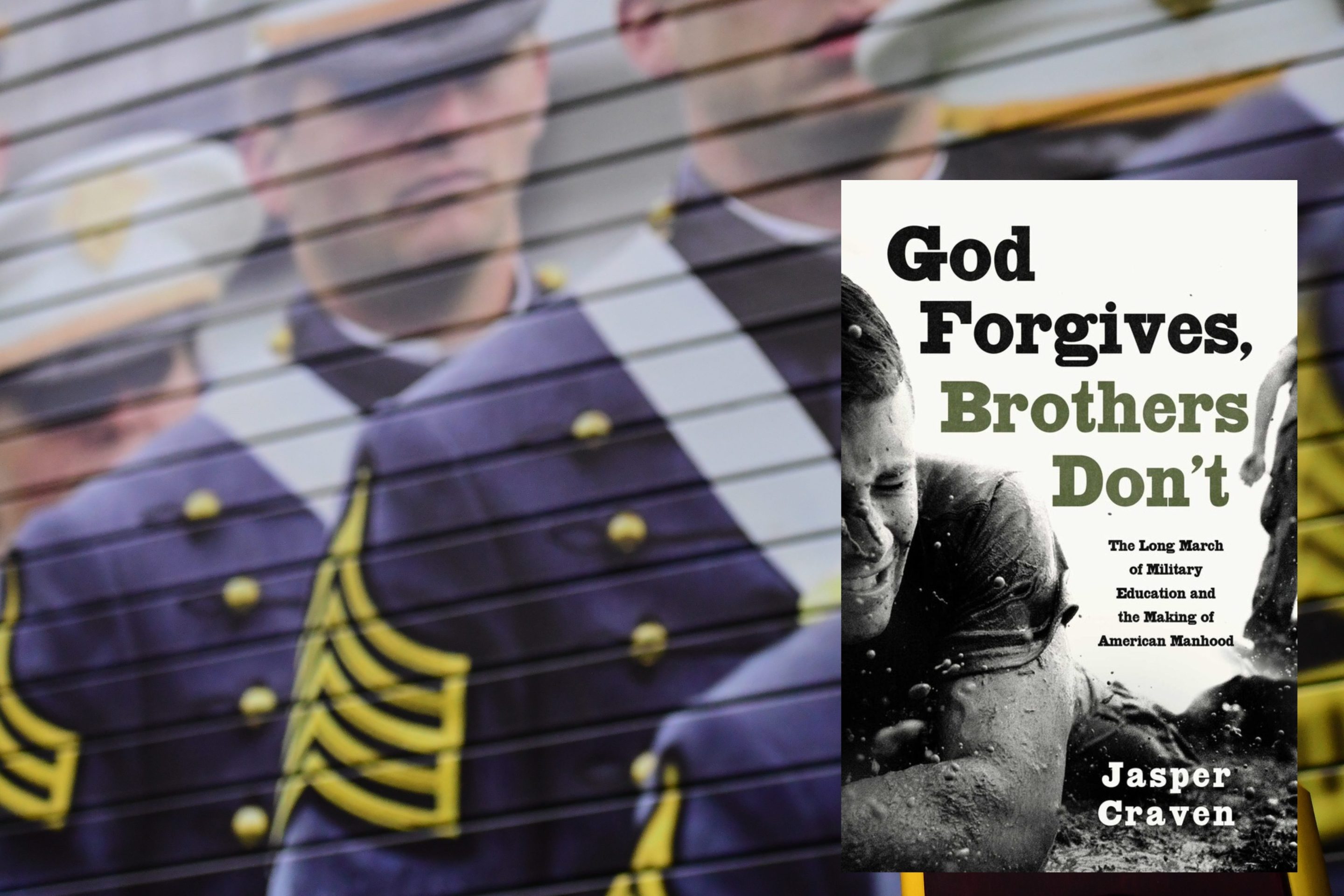
In his new book God Forgives, Brothers Don’t: The Long March of Military Education and the Making of American Manhood, journalist Jasper Craven takes a detailed and unflinching look at the bedrock of American military training: the military academy as a locus for and proving ground of antagonistic military policy. America’s war-hungry ethos, embodied to an embarrassingly literal degree by the hare-brained conduct and childish grandiosity of Secretary of War Pete Hegseth, has only recently embraced the enfranchisement of all able-bodied Americans, regardless of gender, race, or creed, to this mission.
Still, the underlying social and cultural principle of the American military has always idolized rugged masculinity—essentializing violence and dominance as natural to the very purpose of manhood. As Craven writes, “the military’s masculine archetype has become one of America’s most coveted assets. Like warfare itself, it is ever evolving. A diluted form of military manliness can be replicated in the civilian world, though it is always a clear knockoff. It lacks the high-and-tight haircut, the posture, the gaze, the mythic war stories of conquest, destruction, and dominance.”
Over the phone, Craven and I discussed many topics covered in his book, from the enduring myth of George Washington’s bravery to Trump’s military schooling to the long shadow of Vietnam. We talked about the evergreen prescience of critiques of American war culture, particularly in relation to the ongoing war in Iran, and attempted to imagine what a differently structured society, one predicated on peace rather than power, might look like. Our conversation has been lightly edited.
I imagine every day is a vindication of what this book is about. Maybe a good place to start is with your view of how the American military has shifted its PR strategy in the wake of 9/11. Concurrent with Seth Harp’s analysis of Fort Bragg and a greater interest in JSOC/Special Forces, there’s an interesting ramping up of this hyper-technical, very kitted-out idea of the American soldier. As opposed to how we imagine soldiers in WWII or Vietnam.
Military soldier masculinity is always mutating.
There were foundational ideas laid out during the Revolutionary War, and you can trace our current iteration of the soldier archetype to many of those ideas. Things have become a lot darker since then. There's a sort of rising fatalism, extremism, and moral vacuum that marks the American soldier today and that is very well exemplified by the special operator.
There's a number of forces that led us to this moment. I think one major element is the fact that, for at least a half century, really since the end of World War II, American warmaking has lacked a moral center. You can debate the sort of morality of other American conflicts. Certainly the massacre of indigenous people is a foundational violent stain on this country, but in the modern idea of the American soldier, the Cold War creates newly extreme conditions because the people who served in the various skirmishes during that time had no higher ideal to grasp onto.
So really they began to embrace cynical ideas around violence. Violence became what military service was about. It was sort of the beginning and the end. Valor was no longer equated with broader goals of democracy and humanity and modernity or whatever, it was really just body counts. And that leads to this pivot to personal values and violence and building up your body and adopting the attitude of the mercenary. It's a kind of divorce from the broader ideals of this country, flawed or thin as they are.
I think the chronological aspect of your book sheds light on aspects of the military, particularly its foundation in military schools, that I didn't know anything about. I'd be interested to hear you talk about George Washington, his mythology and enduring but false persona in our country’s history.
I sold this book on a premise, which was: The military has been shaping core ideals of American masculinity for its entire existence. So once I got the deal, I started looking through the dusty old history books at the New York Public Library and, to my great relief, what I found was a story told best through the Founding Fathers. These were men who were deeply skeptical of military power, who had traumatic experiences living under the British occupation, and exerted real energy in the early days of American independence to sharply curtail the power of the American military.
Many of them wrote eloquently about the need to never elevate the soldier above the citizen. An original draft of the Second Amendment would have allowed citizens to refuse military service, should they have moral objections to it. After the Revolutionary War, the standing army was all but abolished. There was this little residual force that was stationed at West Point, from which I argue the military industrial complex and this military manhood evolves or grows from.
These were powerful men who had experienced warfare, who aimed to diminish or reduce their status so they weren't equated to kings. At the same time, they nurtured and encouraged a mythology to be built around them. That is very clearly seen in Washington, who is remembered as this strapping, fearless man who can hurl a silver dollar over a mile. Washington receives two very fawning military funerals that basically borrow the traditions that laid Genghis Khan to rest. If we're trying to put ourselves in that moment, countless boys of that time looked up to the Founding Fathers as these figures who had freed them from oppression and forged democracy. So when there's all these other ideas wrapped up around military valor and strength, a foundational idea of what a true man is concerns core military precepts.
Something I found refreshing about your book, along with the fact that you never capitulate to this idea that violence is inherently necessary, is your emphasis on the cost of advocating for peace and how that has become a feminized goal in order to defang and discredit it. I'm curious what pointed you towards the project of this book in that regard.
I appreciate you picking up on the underlying argument here, which is that none of this is inevitable and frankly far too much of it has been romanticized, even in what are putatively harsh journalistic accounts of conflict and its impacts on the American man. Suffering and sacrifice have been so valorized in countless books about military service. Even PTSD, in some strange way, has morphed into a sort of badge of honor or proof of the ability to endure. It’s the ultimate evidence that you're a true veteran man who, in an age of increasingly technocratic warfare, has actually seen what the men on the beaches of Normandy saw.
My argument here is that men are not inherently violent, that the military has very explicitly sold these ideas and packaged them as core elements of manhood so that it can have a reliable stream of young boys seeking to validate those ideas. But there are myriad other ways to prove your manhood and they're not simply being emotionally vulnerable or non-violent. You can actually fight for things, fight for peace, be a little risky, be a little reckless, break the law, put your body on the line. If it's around a morally sound mission, that can feel incredibly validating in a way that military service doesn't.
The back story here is that my father was a prominent anti-war activist during Vietnam. This was a moment, really the only moment, where these hip, cool masculine archetypes flipped entirely and it went from strong, strapping, high and tight-haircut white guy in the army to the shaggy, pot-smoking, righteous peacenik. My dad was one of those people. He endured a lot, he was constantly under FBI surveillance. He was arrested multiple times. The FBI raided his apartment and took all of his prized possessions. But he really believed in something. He was building solidarity. He was looking out for other people in the movement and trying to protect them. He was being subversive.
So how do we get to where we’re at today? It’s a broad question, but I mean specifically with a second Trump administration and its mandate of pointless foreign intervention and this warped sense of national pride.
There is something enticing about domination and power and revenge, and Trump and many Republicans understand that. They’ve basically pivoted to a foreign policy of—let's just say achievable micro-conflicts that signal a certain triumphalism and a certain dominance that is clearly at odds with this declining civilization. The forces that have been at play since 9/11, these very self-destructive forces, we're at a point now where we are cannibalizing our ideals more than ever. The violent blowback from the forever wars has firmly taken hold. Military service is the number one predictor of violent extremism in America. I think the American people understand this and frankly most of them have not wanted any of this. Obviously there are these initial heady moments after 9/11 where the country rallies around the flag and supports military adventurism. But I don’t think voters are inherently violent, I don't think they want to wage war.
At the same time, in a country where so many other priorities and initiatives are budgetarily and culturally starved, this is sort of the last signature work that America has, which is building weapons and using them. There's this very shallow, but also loud and boisterous jingoism that can be marshaled to some extent by Vance and Trump. People, even if they're against it, have been so conditioned over the last half-century to expect that our boys are kicking down doors and busting skulls that there’s a sort of reflexive permissive attitude towards it.
It’s difficult not to think of this perception that gun violence by men in America is accelerating under this administration. Maybe it’s just that these high-profile cases, like the White House dinner attempt or the man who killed his children and himself in Louisiana or even Charlie Kirk’s assassination, feel symptomatic of something.
There’s that old adage everybody turns to: When diplomacy fails, force must be considered. We don't live by this rule, but war is the last resort after every other option has been exhausted. You can apply those same lines of thinking to American citizens today, and American men especially. What we have seen is a relentless cultural environment, disabusing young boys of really valuable traits like emotional vulnerability and expression and softness. We’ve set impossibly high expectations that are tortuous to try to understand. If men are expected to defend their country and sacrifice themselves on the altar of freedom and be unfailingly disciplined and strong—these are big ideas.
I think many men feel like they have failed because these expectations are so often intrinsically tied to domestic success and safety. And amid all these forces colliding, men feel increasingly fatalistic, like any attempts to secure stability or find love or do whatever else are just not working. Then the gun becomes the last best resort. The political ideologies and backgrounds with these different shooters run the gamut. Nikolas Cruz was a JROTC sniper before undertaking the Parkland shooting, which remains the deadliest school shooting in American history. He was profoundly alone and felt like nobody loved him. That's why he did what he did on Valentine's Day.
Blowback is often discussed in terms of how a country is impacted after the guns are put down. We are experiencing intense sustained blowback from two and a half decades of conflict, many more centuries of fighting and warfare. Man's defining vocation has been as a soldier for so long. Rather than enrich soldiers, what the military does is make them feel empty and angry and inculcate a specific mindset to see targets and enemies. It takes a lot to offer an alternative vision.
It’s the 250th anniversary soon. Memorial Day is coming up. America is arguably at its nadir. I wonder where you’re interested in going in your work after this book. You’ve written widely about war and the military for a while now. Are there subjects you feel you haven’t explored yet?
I'm hoping to write a story soon about this innovative domestic violence accountability program in which convicted male abusers straight out of prison are put into immersive group therapy programs for several weeks. A unifying struggle is that they're all dealing with violence and anger. The program has been wildly successful. I'm still learning about and speaking to these men about what has worked and how they're able to give penance in a real way and grow. I understand at this point that many men feel hard and angry and violent. I feel like there just haven't been real efforts to really meet them where they’re at.
You see someone like Richard Reeves, who wrote a big book about men a few years ago. He rightfully talked about how men should become teachers and nurses and get into care professions. And I think that's all really good. But there's also this clearly stubborn strain of American men who are just at another level where they need real intervention and real wraparound support. I'm interested in how you get through to those sorts of people and build something positive from that. How to be militant in positive ways, and how to leverage man's recklessness or thrill-seeking in ways that can push for positive aims.