

In the Western Baltic Sea, fisheries target migrating mackerel and needlefish with pound nets, which funnel passing shoals into a series of smaller nets until they are trapped. The traps are emptied every few days, but as the caught fish idle in the nets, they become quite attractive to passing seabirds, such as cormorants, gulls, and terns. The cormorants sample the fish like a charcuterie board and various enterprising gulls steal the cormorants' catches. Several dozen birds can likely be found loitering near any particular pound net, and their ravenous appetites result in real losses for the fisheries.
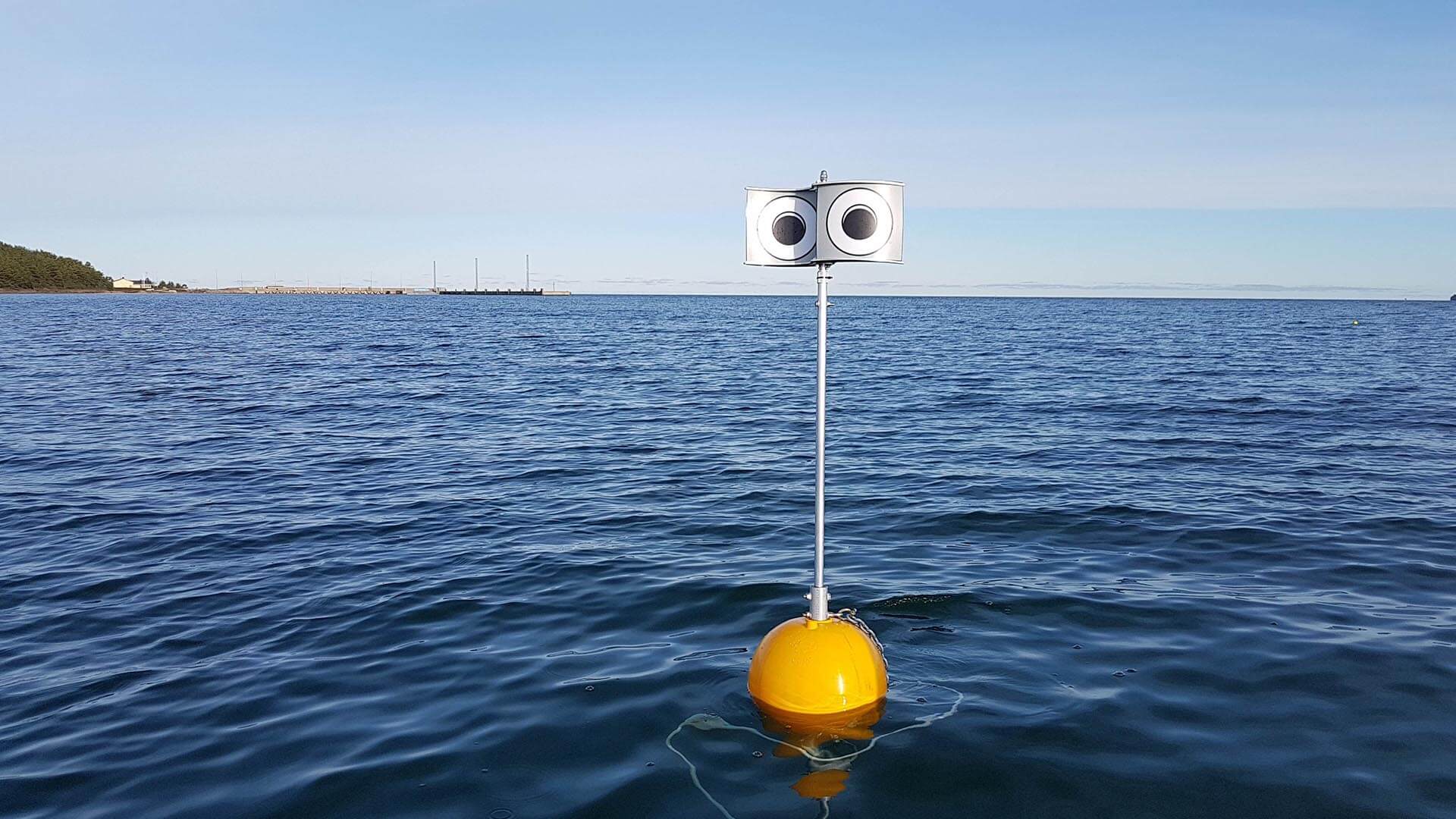
This battle between pound net fishers and seabirds has been ongoing for decades, and fishers have attempted to fight back in various ways. They've tried covering their catch with a netted cover or providing the fish artificial refuges. But the birds are relentless, and the agile cormorants simply entered the pound nets from below. And the more protective netting the fishers added, the more they found tangled or drowned seabirds alongside their catch. A paper from 2021 estimated that 400,000 seabirds are killed by diving into gillnets each year. As such, scientists have been cooking up new strategies to reduce the number of seabirds snacking on and dying in pound nets. They tried high-contrast panels and bright LED lights, but nothing seemed to work. That is, until Bobby the buoy entered the picture. Here is a buoy similar to Bobby:
Bobby is a device called a "looming eyes buoy," which scientists invented to exploit the idea that a conspicuous pair of eyes is likely to deter birds by triggering a collision-risk signal in their brains. The wind makes the eyes move, giving the impression that the eye size is changing, like a predator approaching. Now witness the fearsome nature of Bobby!
Scientists have tested out looming eyes at airports, where they have successfully deterred raptors, corvids, and other birds from drawing too near. So it seemed only logical to bring these buoys to the Baltic Sea and stop the gulls and other birds from eating the fish and save them from getting tangled in the nets. Except, as Bethany Brookshire reported for Science News, this was not what happened.
Per a paper recently published in Royal Society Open Science, the researcher Gildas Glemarec and colleagues from the Technical University of Denmark set up a looming eyes buoy they nicknamed Bobby alongside pound nets trapping needlefish. There they let Bobby bob for 46 days and waited to see if the birds would flee from his presence. In the first few weeks, fewer cormorants and large gulls visited the nets. But by day 46, the number of hungry birds had returned to pre-buoy levels, suggesting the animals had become desensitized to those alarming eyes. The verdict was in: Bobby was a failure!
This was surely disappointing to the researchers and the fisheries (the fish probably have no opinion). But was it really surprising? Just look at Bobby. Would you trust this guy to watch over your nets?
Bobby's job is, essentially, to be a scarecrow. Perhaps there would be no need to overengineer such a buoy, no need to delve into the evolutionary hard-wiring of a gull's brain, if we could only identify an object with such universally rancid vibes so as to deter animals of any kind. Consider, for example, this statue of Cristiano Ronaldo. I am no gull. But I wouldn't go near this guy!
There are so many possible contenders. The Big Pigeon, but even Bigger? The golden Trump statue that is actually made of bronze? "Dwyane Wade"? This genuinely haunting graphic rendition of Robert F. Kennedy Jr. animorphing into meat?
Or, to up the ante, we might consider a scarecrow that carries both aesthetic and moral repugnance, determined to disgust us on multiple levels. We might recall the infamous ode to Nathan Bedford Forrest that once sat on the edge of I-65 outside of Nashville, which depicted a deranged-looking tin man astride a dolphin-smooth golden horse. Forrest was a Confederate officer, the Grand Wizard of the Ku Klux Klan, and, I learned upon writing this, the namesake of Forrest Gump. The statue is certainly scary. It is inarguably ugly. It emanates a miasma of horror so potent that it might be detected by other species. And it was removed in 2020 when its owner died, meaning it might be available for use. This is way scarier than poor old Bobby.
Or maybe a gull will only go away if it sees a scarecrow that has done real, material harm to its community. Gulls are not dumb. Remember those gulls in France who learned the route to the potato chip factory? Remember the gull from California who rode a garbage truck from San Francisco to a compost facility in the Central Valley? Gulls do not forget their food. Would they be so foolish as to forget a foe? Consider, then, a scarecrow of Randy Johnson, who 25 years ago exploded a luckless mourning dove with a fastball. Or Yankees outfielder Dave Winfield, who in 1983 killed a gull with a warm-up ball. Certainly effigies of these men—known bird-killers—would startle even the meanest cormorant. If you give a gull a nemesis, the bird will have no choice but to skedaddle outta there.