
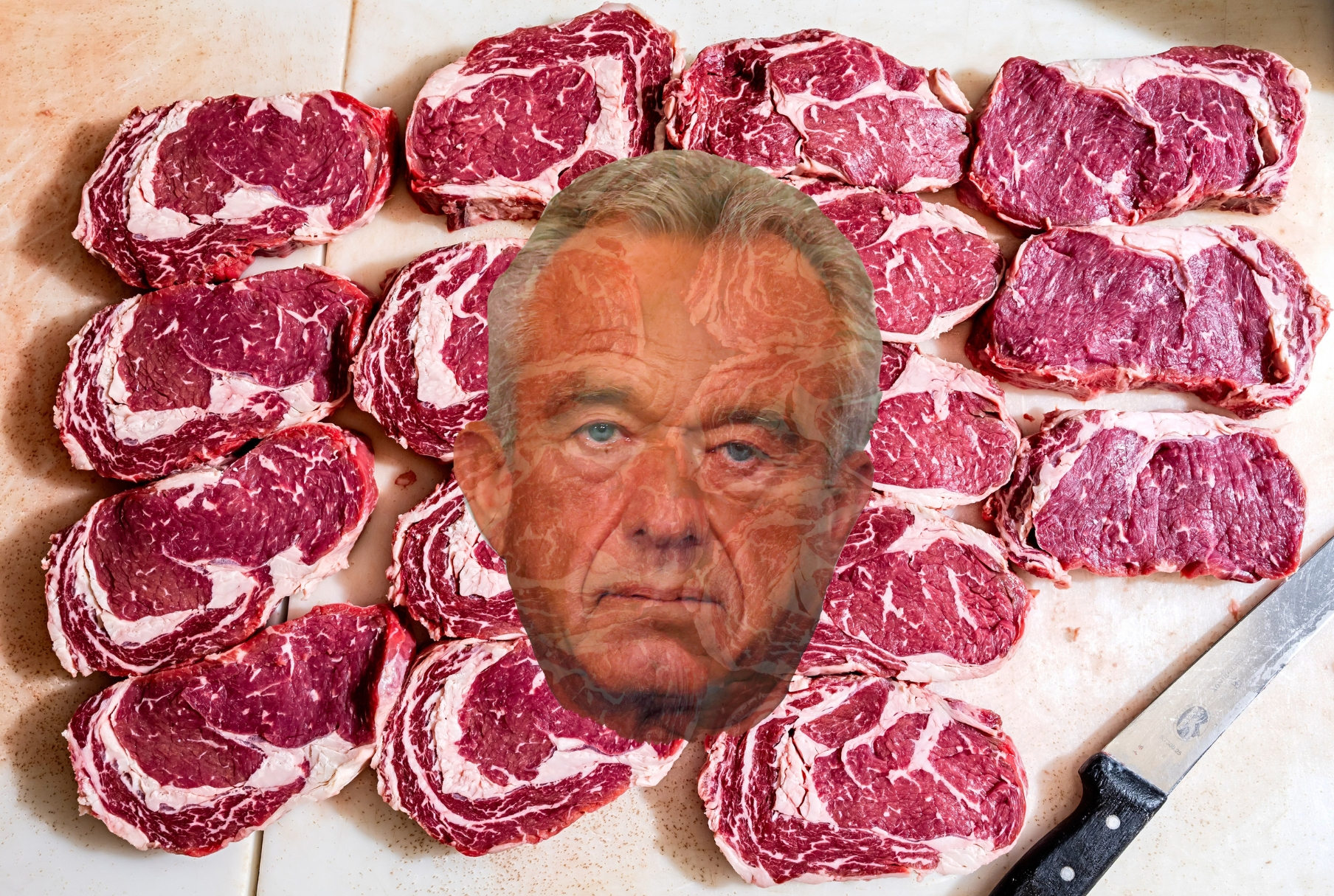
In the supermarket or at the taco truck, whether it's government subsidies for agriculture or the working conditions of food workers, food and politics are never far apart. Under the second Trump administration, the government has used food stamps as a political football, showing a willingness to expose poorer Americans to malnutrition to score political points. ICE agents have kidnapped street vendors in Los Angeles, leaving hot dogs sizzling on unattended griddles. As of this writing, American attacks on Iran make fertilizer much more expensive for American farmers, since not just oil but also fertilizer ingredients must transit the Strait of Hormuz. And, of course, food prices in American supermarkets continue to climb, in part due to tariffs whose legality and constitutionality seem dubious. Between January 2025 and January 2026, the average cost of ground beef went up from $5.54 per pound to $6.75, even as Donald Trump, in his State of the Union address, insisted that the price of beef is going down. This is the most Americans have ever paid for their hamburgers, and yet Secretary of Health and Human Services Robert F. Kennedy Jr. is urging all Americans to eat more meat.
The Trump administration seems to break new things every week. The things Kennedy has helped to break so far include our collective herd immunity by vaccination, and the Centers for Disease Control and Prevention itself, firing thousands of employees there. He has now moved on to breaking our understanding of the relationship between food, personal health, and collective health. Kennedy's interest in meat—he has stated that he eats a "carnivore" diet consisting of meat and fermented foods like sauerkraut, fasts intermittently, and touches no processed foods—is so larded with symbolism and minimally marbled with facts that it deserves special attention.
Insisting on meat, to the point of recommending offal if we cannot buy steak, RFK Jr. has also unearthed that well-known diagram, the food pyramid, which was abandoned under the Obama administration in 2011 and replaced with a plate subdivided into types of foods. But this new pyramid is flipped: Grains are at the pyramid’s tiny pointed bottom, and meat, along with vegetables, is at the broad top. If Kennedy's offal advice is a comic turn, the inverted food pyramid attempts to institutionalize the MAHA dietary agenda with potentially serious consequences.
"We are reclaiming the food pyramid and returning it to its true purpose of educating and nourishing all Americans," wrote Kennedy along with Agriculture Secretary Brooke Rollins, in their "Dietary Guidelines for Americans," a pamphlet available online. As food policy scholar Marion Nestle explains in her book Food Politics, the adoption of the original American food pyramid in 1992 was itself political in character. "Food politics" is Nestle's phrase for studying the "social, commercial, and institutional influences on food choice," with her special interest being the influence of the big processed food conglomerates on what Americans eat. The original pyramid emerged out of—and in some ways, despite—arguments involving nutritionists, politicians, and the paid lobbyists of agribusiness companies, anxious that Americans might be warned away. Indeed, meat and dairy producers complained to the USDA that their products were placed in the more slender upper reaches of the old pyramid. The new pyramid is political in a different sense because it is an effort to press a particular diet, and a particular worldview, on the American people.
At first, I was a little confused by the symbolism of the pyramid's inversion. Why not just create a broad foundation of meat and put bread at the top, the way fats, oils, and sweets were at the "use sparingly" top of the old pyramid? Perhaps Kennedy and his MAHA allies are so literal-minded that they need to make sure meat "wins" visually, over grain as represented by a loaf of bread. The rhetoric of reclamation and return—of turning things around—is in keeping with the MAHA agenda, and with the cultural logic of restoration that helped lift Trump into his second term. Eating liver, with all that cholesterol? What a way to return to the 1950s, or to an imagined version of that decade of ascendant American global power and, for some, domestic prosperity.
Promoting meat at politically salient moments is nothing new, nor is it uniquely American. To a food historian, the denigration of grain must recall the Italian Futurist (and fascist) Filippo Marinetti insisting in his Futurist Cookbook that Italians abandon pasta and eat foods that conjured speed and modernity, like the aerodynamic and highly phallic sausage. Making Americans healthy again seems to emphasize minimizing elements of our diet that are imagined to be harmful, like bread and rice, and maximizing those that are imagined to build and maintain muscle, like meat. Early in 1872, the Japanese Emperor ate beef in public, part of an effort to encourage the Japanese people—whose meat consumption had been at relatively low levels for generations, guided by Buddhism and selective government bans on meat-eating—to eat terrestrial mammals and become strong, as Westerners were thought to be strong because of the animals they ate. While the origins of the name "Beefeater," used for the English royal guards, are unclear, the place of beef in the British national self-image is not—even if Britons now eat more curry than roast beef, as noted by Ben Rodgers, author of Beef and Liberty. When Thomas Robert Malthus meditated on food and demography at the end of the 18th century, he used the "beefsteak" as the measure of a healthy diet, seeing the rice-based diets of Asian laborers as beneath consideration. These cases of meat promotion, in which foods like beans, vegetables, and starches are associated with low status or bad eating, are often misguided. The historian Hasia R. Diner has pointed out that Italian peasant immigrants to the U.S. were often better off eating their cucina povera than the heavier and meatier diet their children eventually enjoyed.
The MAHA movement has considerable overlap with versions of food activism not linked with Trump. Kennedy and Rollins write "The message is simple—eat real food," recalling the now-clichéd advice to "eat food, not too much, mostly plants," given to us by journalist Michael Pollan, advice associated with tote bag-carrying progressives who congregate at farmer’s markets. MAHA activists oppose ultra-processed foods, just as progressive and leftist critics of big agribusiness often do. MAHA recommendations have included some things about which progressive food activists might agree, like getting rid of food dyes, arriving at a better definition of ultraprocessed foods, and interrogating a regulatory category that food companies have relied on to get their products approved: "Generally Recognized as Safe" (GRAS). Kennedy has promoted regenerative or biodynamic farming. Other MAHA ideas that may seem inoffensive include streamlining the credentialing process for organic farms, and promoting soil health.
The MAHA movement thus reminds us that one can arrive at a preference for whole foods and organic farming from a conservative political position as easily as from a progressive or left one. But there are features of the MAHA agenda that seem distinctively individualist, such as the idea of the potential purity of the human body if we avoid foods that have "inflammatory" qualities. The collective dimensions of health, such as herd immunity, are deemphasized, replaced by the idea of the individual body strengthened through diet and exercise.
Meat is a strange prescription for our broken food system. At the scale of the individual eater, the health implications of a "carnivore" diet (really, omnivorous but heavy on meat) are unclear at best. If we zoom out to capture wider scales—the scale of society, the scale of the natural environment—meat is trouble. Industrial animal agriculture casts a long, dark environmental shadow as one of the largest contributors to greenhouse gas production per annum, among other forms of pollution. In her 1971 book Diet for a Small Planet, Frances Moore Lappé reminded us of a fact observed since the Greeks: It takes far more land to raise cattle than to grow healthy vegetables. If we listen to animal protection activists, then industrial animal agriculture casts a similar moral shadow as well. Simply put, meat does not "scale" well. Eating lots of meat may help add muscle to the individual body (think of RFK Jr.’s strange videos of himself exercising half-naked, a kind of beefcake performance piece), but increased meat consumption is not good for us as a global collectivity. Such a consideration—of the welfare not of a single national community, but of people working and eating across borders, connected by shipping networks in a globalized food system, struggling to live within the limits of a fragile ecosystem—is not what I have come to expect from the Trump administration.
Kennedy’s long-established stance against vaccines has found concrete expression in the decimation of the CDC. With two relevant exceptions being Kennedy's efforts to change SNAP benefits so they cannot be used to purchase sugary sodas, and the new inverted food pyramid, there has been no parallel realization of a MAHA program for food and farming. Perhaps there cannot be, since the Trump administration's interest in deregulation aligns with the interests of big agribusiness, which produces the very products that the MAHA movement would like to criticize and regulate. The EPA, weakened and reorganized under Trump, has approved the use of new pesticides, placing us on a path to become potentially less healthy than we were before, even given our consumption of high-fructose corn syrup and white flour in the form of bread. Meanwhile, healthier foods like vegetables only get more expensive, beyond what inflation alone would account for, suggesting that declining availability is playing a role. So far, no major conflict has yet erupted between the members of Kennedy's MAHA movement and the administration he serves. But there are significant contradictions beneath the surface of this coalition. MAHA activists have campaigned against chemicals like glyphosate, widely used by Monsanto in its “Roundup” pesticide program and believed by many to cause cancer, and the Trump administration has sided with Monsanto by labeling glyphosate strategically important, another case of siding with big agribusiness.
Kennedy's dietary advice is high in iron and full of irony. Most Americans may be omnivores, but they do not include much offal, be it liver or tripe or other organs. Most of the offal I have eaten in the U.S. has been in tacos, at dim sum, or in Vietnamese pho. In other words, the foods that do incorporate offal are cooked and eaten by some of the very ethnic communities targeted for persecution by ICE. Historically speaking, offal (the word derives from the Middle English ab-fall: that which falls away in the butchering process) has tended to fall out of American diets as communities climb in socioeconomic status. They are notably not always cheap: Chicken livers, perhaps the form of offal most often eaten by Jewish Americans like myself, can be pricey. Symbolically speaking, meat signals affluence, so asking Americans to eat types of meat that may signal scarcity and want is a losing proposition. Like a steak with the word "return" charred into its surface, the MAHA meat diet promises personal health and even empowerment at a historical juncture when many of us feel profoundly disempowered by forces beyond our control. It is a phantom, or in the words of Sasha Wizansky, my former editor at Meatpaper magazine, a fleischgeist. This hungry ghost will not digest well.