

It's almost time for the World Cup. Before the tournament, we'll be previewing each of the top 15 teams by FIFA rankings that made the tournament. Why the top 15? Because that's how many we needed to do in order for the USMNT to make the cut. You can read all of our previews here.
Soccer may be a fickle game, but on the whole it does a good job of putting things in their rightful place. In that sense, there's maybe no team in the world to whom soccer has been more consistently, maddeningly fair than Mexico.
Perennially amongst the 12 to 20 best national teams in the world, Mexico has with startling regularity found itself getting to, though crucially not beyond, the round of 16. When the traditional Mexican standards slipped, as they had leading into the 2022 World Cup, Mexico broke its seven-tournament Sweet 16 streak and got bounced at the group stage. For decades El Tri has been desperate for just a taste of soccer's famous variance, for a "fifth game" that would break their glass ceiling and deliver them somewhere new. Yet the much-craved quarterfinal appearance has proven elusive. Judging from the stagnant place of Mexican soccer as a whole as demonstrated in Qatar, it has seemed as though that dream was only getting further away.
But Mexico is in luck. Never before has the national team's prospects of reaching that quinto partido been more tantalizingly attainable. Host countries usually overperform at World Cups. Mexico knows this well, since its two deepest runs in the tournament are the pair of quarterfinals it got to when hosting in 1970 and 1986. If things break right, Mexico should get to enjoy five games at home. Not only that, but the expanded World Cup field this year means the fifth game will actually come in the round of 16, Mexico's old stomping grounds. It's true that this does open up an opportunity for further embarrassment should Mexico once again fall in the fourth game, this time at the round of 32 stage. On the other hand, a long-awaited knockout round win in the round of 32 could itself bring excitement and build momentum for further success. Regardless, for the first time in a long time, the stars have aligned to offer Mexico a chance at doing something it hasn't done for 40 years. It's a chance the country has to take advantage of.
But while the host's bump and the expanded field present Mexico with favorable conditions to finally win a knockout game or two, matches are still ultimately decided out on the pitch. Does this Mexico team have the talent to convince the soccer gods that it deserves a quarterfinal run? The answer isn't straightforward.
A glance at the roster reveals just how little star power El Tri will bring to the tournament, which is indicative of the greater trouble Mexico has had at developing elite players. Even the disappointing group Mexico brought to Qatar four years ago had more recognizable, if aged, faces than this one. In fact, unless you're a committed Mexico fan, you likely won't be familiar with the vast majority of the guys on the roster, and many of the names that will ring bells—Edson Álvaraz, Santiago Giménez, Guillermo Ocho (yes, Memo is back for his sixth cup!)—aren't even locks to see much playing time. If successful World Cup teams tend to feature lots of players in the primes of their careers, who've sharpened their skills in the best club teams and leagues on the planet, then Mexico, which only has five players who spent last season in one of Europe's five strongest leagues, doesn't grade well on that scale.
However, the team is not totally devoid of talent. Much of it can be found on the bench, in the form of manager Javier Aguirre. There is probably no better person to coach Mexico than Aguirre, which explains why this is his third stint at the reins of his native country. He brings a wealth of experience to the job, much of it gained in Spain, where he has long been known as one of the savviest out-of-possession minds in La Liga. Adding to Aguirre's own acumen is Mexico legend Rafa Márquez, who followed a brief but impressive tenure coaching Barcelona's reserve team by joining Aguirre as an assistant. The coaching staff has helped turn Mexico into a staunch defensive unit with a formidable press that serves as simultaneously the team's best defensive and offensive weapon.
And lest you think this is only a coach's show, Mexico has some legit young ballers on its hands, too. The most exciting crop is in midfield. In Álvaro Fidalgo, Obed Vargas, Brian Gutiérrez, and Gilberto Mora, Mexico can load the middle of the park with oodles of suave passes and deft touches. It's because of them that El Tri, though solid defensively, is probably most identifiable by its affinity for possession.
That being said, attacking invention is in very short supply. Rául Jiménez, Julián Quiñones, Giménez, and Armando González may be adept at knocking in goals, but those forwards are all highly reliant on service, and the team struggles to tee them up. What's more, the team's focus on off-ball intensity means Aguirre favors hard workers, who can be counted on to track back without the ball and circulate possession with it, in place of more free-wheeling, risk-taking attackers. The result is a team that's hard to score against, good at keeping hold of the ball, but has the damnedest time getting on the scoresheet themselves.
Of course, being hard to beat is arguably the most valuable attribute in tournament play, and Mexico is certainly that. At the same time, it takes goals to win, and they lack both the personnel and tactics to reliably chip in on that end. Mexico is probably at least another four years away—Márquez is already locked in to take over for Aguirre after this tournament—from having a team that might really be exciting, should the likes of Mora and Gutiérrez and Elías Montiel reach their potential. But the pressure to do something memorable at home this summer will be huge. For better or for worse, soccer almost always gives Mexico exactly what it deserves, and we'll soon see just what that looks like.
Who Is Their Main Guy?
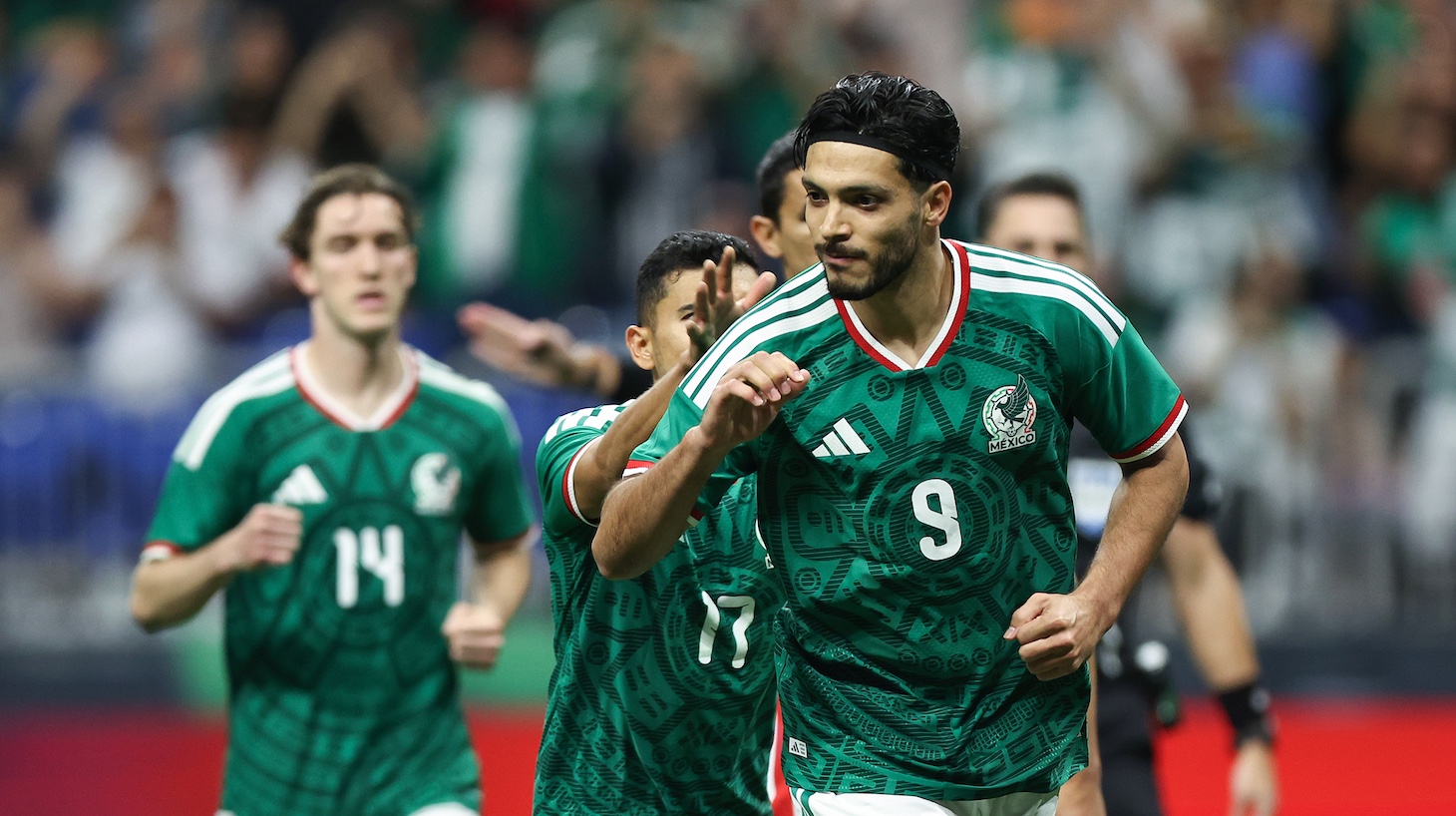
I can't be the only American with a healthy appreciation for Mexican soccer schadenfreude who nonetheless has a soft spot for Raúl Jiménez. Jiménez has become something like the Old Reliable for club and country, an honorable fate for a guy who's gone through so many ups and downs.
I started following Jiménez's career back in 2014, when he was the highly hyped young striker whom Atlético Madrid had selected to help fill the shoes of Diego Costa. I watched with disappointment as Jiménez's lone season in Madrid went terribly, and then watched with appreciation as he fought off the bust label with solid seasons in Portugal at Benfica. I watched with awe as he became one of the best midtable strikers in the Premier League during his first couple seasons at Wolverhampton, and then watched in horror as his career was derailed right at its peak when he suffered a major head injury in 2020 that threatened to end his career. I watched with admiration when Jiménez overcame the fractured skull to return to the pitch nine months later, and have since then watched with delight as he has once again claimed his position as one of the better midtable strikers in England with Fulham.
Jiménez plays a huge role in how Mexico goes about attacking—he has to, seeing as he's sometimes the only out-and-out forward on the field for them. Jiménez has always been a consummate all-rounder, and while he no longer has his old legs, he remains a really good outlet for corralling long balls and dropping in to link up play. Those weakened legs mean he can't stretch defenses the way he used to, and the lack of a real threat attacking space is the team's most glaring flaw. Without runners around him, Jiménez's penchant for asking for the ball into his feet can leave the penalty box under-populated; without creators around him, his reliance service from teammates ill-equipped to provide it can make Mexican possessions feel toothless. But when he is in the area and gets a good pass, he's still deadly, and Mexico will need to maximize those opportunities if they are to meet expectations.
Who Is Their Main Defending Guy?
Israel Reyes isn't Mexico's best defender, but he does play an important tactical role. Aguirre likes to oscillate between back-four and back-three systems, changing from game to game and sometimes even within the same game. There, Reyes is key. Though a nominal right back, when Mexico has possession Reyes will generally stick with the central defenders as the ball moves up the field, playing as the kind of hybrid full/center back that is so popular nowadays.
It's not the easiest role to master, requiring a player to know when to stay home, when to push forward, and, when pushing forward, whether to head toward the middle or out wide. Reyes, though, has it down pat. In particular, his talent for winning duels plays a big part in making Mexico so tough to break down. Notably, he played well in both of Mexico's recent, encouraging draws against Portugal and Belgium back in March, where he held up well against João Félix and Jérémy Doku—a positive sign for Mexico's hopes in the group and beyond.
Who Is Most Likely To Break Out?
Gilberto Mora is the clear answer here, and not only because, at 17 years old, he's still in the window of adolescent acne flare-ups. Mora is for my money the single biggest talent in all of CONCACAF right now. The kid simply oozes class.
Mora has played a lot on the wing in his young career, but he's clearly a bossy midfielder at heart. He has the sumptuous touch, clairvoyant turns, feel for space, and collaborative instinct that can't help but bring to mind a young Pedri. Even at his age, when Mora is on the pitch, the team belongs to him. He constantly shows for the ball and then dictates play, carrying it wherever he chooses with his deceptively slow gait, and bringing teammates into the action with one-twos.
While Aguirre has wisely sought to take some of the pressure off of his uber talented teen by not yet making him the team's centerpiece, it's only a matter of time before the rest of the world sees just how immense a prospect the Club Tijuana midfielder is. My bet is that that starts in earnest here in a couple weeks.
Who Is Most Likely To Eat Shit?
On paper, midfield is the USMNT's biggest position of strength right now. Between Tyler Adams, Weston McKennie, Gio Reyna, Malik Tillman, Johnny Cardoso, Tanner Tessmann, and Yunus Musah, the U.S. is loaded with studs, all of whom probably have at least one, and likely two, more World Cup cycles in them. That depth and relative youth probably helped convince midfielders Obed Vargas and Brian Gutiérrez to represent Mexico instead of their country of birth.
However, due to an injury to Johnny, a maybe injury or maybe just bad roster snub for Tessmann, and a bad club season for Musah, the actual U.S. roster at this World Cup is absolutely barren at the true central midfield position. Behind Adams and McKennie, the Americans only have Sebastian Berhalter, who isn't very good, and Cristian Roldan, who's actively bad. Boy, would it sure be nice to have Vargas and/or Gutiérrez on our side this tournament! Sure would suck if the U.S. flames out and those two ball out for Mexico, in the process forcing the U.S. to eat a big ol' pile of shit!
How Can They Win It All?
The USMNT has a bad group stage, but gets into the knockout rounds as a third-place finisher. To not disappoint known soccer fan Barron, the Trump administration cancels the visas of the whole German national team, the U.S.'s round-of-32 opponent. Gianni Infantino tries to sell the stunt as a cool new wrinkle fully within the host country's rights to implement, but UEFA moves to impeach him as FIFA president. After Infantino is ousted in a narrowly decided emergency vote, FIFA holds the rest of the tournament in Mexico alone. Armed with this new and improved home-field advantage, El Tri sweeps to the title.
But if that doesn't happen? No chance they win.