
Although Plato's Symposium is best remembered as a Socratic dialogue, it was also, at its core, a story about a dinner party. In Athens, symposia consisted of a lavish banquet followed by a lot of drinking, during which time the guests would deliver speeches. Like many dinner parties, the Symposium is famously crashed by a drunken guy (Alcibiades) who derails the conversation but is, at least, quite entertaining.
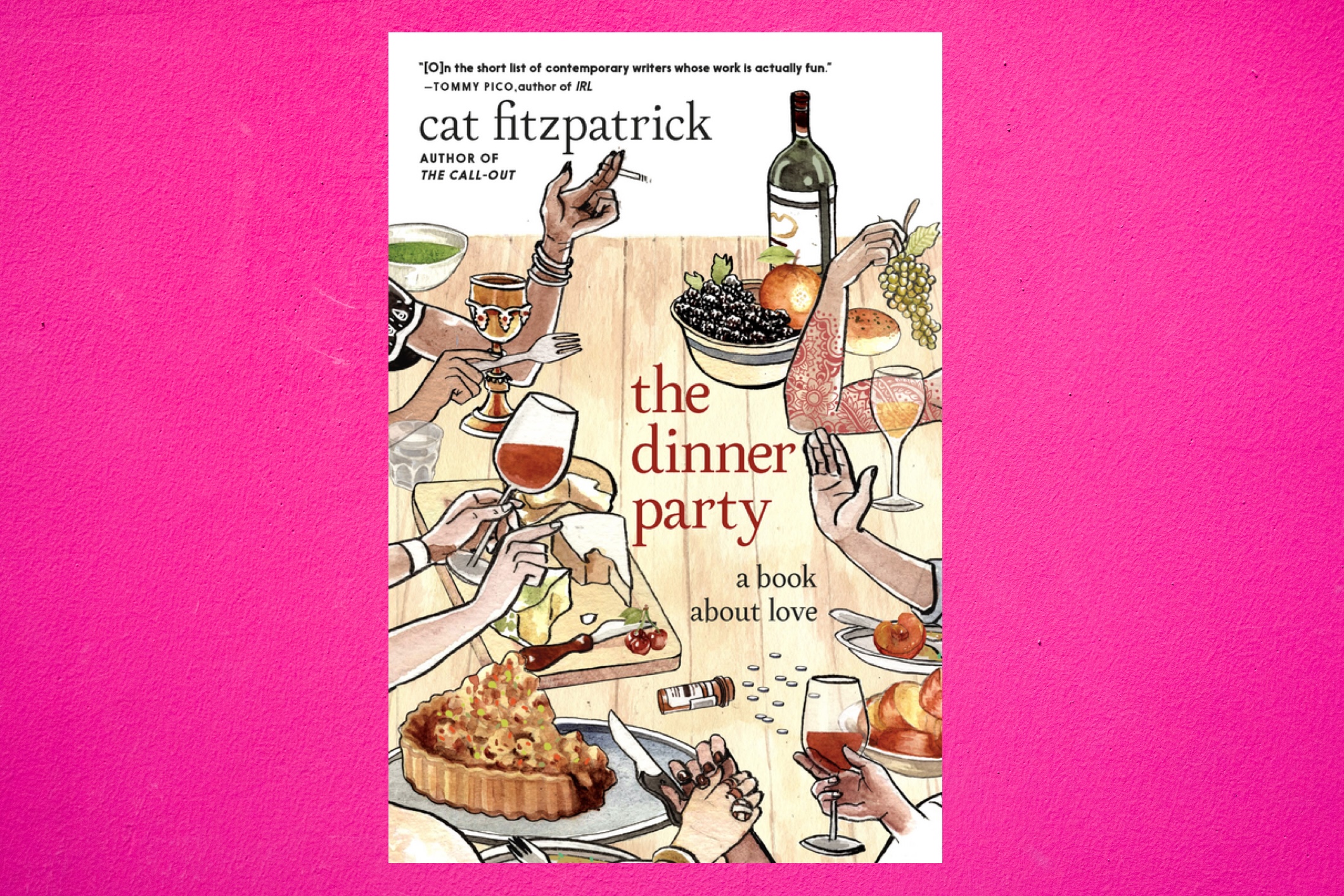
Although Plato's symposiasts are rather queer, at least in the Grecian way, none of them are trans. Luckily, poet and Littlepuss Press editor Cat Fitzpatrick offers a very trans symposium in her new book, The Dinner Party, whose title poem concerns a riotous debate about love amongst a gaggle of transsexuals supping on Vichyssoise and vegan cassoulet. After the soup comes out, Camille declares: "'I want a partner that I know and like,/With whom I share the deepest truth of me...'/'Oh look,' Adonis crows, 'we do agree!/The only difference is you’re such a dyke.'" Before long, the night devolves into debauchery, leaving the host to tidy up, take her beloved dog out to pee, and pass out in the wee hours of the morning.
Although a rhyming transsexual remake of a Socratic dialogue might seem a surprising combination, The Dinner Party is right at home in Fitzpatrick's body of work. She has a gift for telling contemporary stories in archaic forms. She has described her last novel, The Call-Out—a comedy of manners told in rhyming verse—as Eugene Onegin fan fiction. The delight that courses through her verse is palpable on the page. Titular poem "The Dinner Party," which is written in iambic pentameter, has rhymes that simply make you smile: "cuck" and "fuck," or "soup" and "poop." And yet the dinner guests' debate reaches moments of real ecstasy and grief in their quest to articulate what love means to them. All the book's poems orbit around love in its various forms, including "Baby Book," a heart-wrenching series on trying to make a baby as a queer and trans couple, and "Uxorious Sonnets," love poems about loving your wife so much that even smelling her shit makes you want to weep.
Fitzpatrick and I met over Zoom to talk about the art of metrical writing, the power of pastiche, and how the course of true love sometimes does run smooth. Our conversation has been edited for length and clarity.
I was reading your Bluesky thread about how The Dinner Party came together, and how it combined bits of writing from nearly 20 years ago with poems written quite recently. Could you talk more about how the book took shape, like how you chose which bits to include or leave out? I'm also curious to hear more about what it was like to revisit writing done so long ago, and how much license you gave yourself to revise or leave it alone as an artifact of the past.
The way it started as a book was with the poem, "The Dinner Party," which is one of the two most recent things in it. They were being written sort of at the same time, and that one came directly out of The Call-Out.
The Call-Out is a book about lateral strife, right? It's about like people being giant fucking bitches to each other, or more intelligently, what are the ways in which communities are prone to pull themselves apart? If you have a small community of weirdo freaks, and you all think you need to be helping each other and sticking together, and then instead you find yourself fighting, how does that happen? Why does that happen? The end of it is the narrator—who's been taking this kind of very sort of cynical, very negative view the whole time, kind of very sort of scathing, but also tragic—she just fucks off.
The whole book is done in the form of an AO3-posted Eugene Onegin fan fiction, and the epilogue is like the top-voted comment, which has a score of plus-one, because every other comment was negatively voted, is the implication. It's from one of the other main characters, basically saying, "I disagree with this whole interpretation." Yeah, some shit went down, but then the end is like, we survived the event she describes above. We're all still here, still ready to love. So it ends on this word, love. Clearly, that character is not a trustworthy character, but I think ending that way, I was thinking a lot about this concept of love, and trying to ask myself the opposite question, the more optimistic question, I guess, which is: What is the thing that draws us back together, or that draws us together in the first place? What are the impulses that do, despite all the things that might pull us apart, nevertheless bring us together?
So I started writing this poem, "The Dinner Party," as a sort of appendant to The Call-Out, offering a kind of counter-theme to it—against dissent, it was offering love and thinking about what love looks like. In some ways, it's very similar. It's a humorous rhyming comedy-of-manners narrative in which people make ridiculous speeches and behave absurdly in something approximating contemporary New York. I sat on it for a number of years. I wrote another book called Glamourpuss, and there's a bunch of poems that went into Glamourpuss, and they were a cohesive set. There were some things that didn't go into that for various reasons. I was looking them, and I was putting poems together and then sent them to my editor at Seven Stories, Dan Simon, and he took me out for lunch. Once per book I get to go out for lunch. I hope there'll be another book, because he takes me to a nice restaurant. Dan was like, "Listen, these are the good ones." I looked at them, and I was like, "Oh, this is a book about love. All of the ones that Dan said were the good ones are about love. That's what this is all about."
I am someone who plans—I build like spreadsheets, right? For The Call-Out, there was a spreadsheet of what was going to happen in every stanza basically throughout the whole thing before I wrote it. For the next one I'm doing, Britannia, there is also a spreadsheet. I'm the person who makes spreadsheets to tell you what will happen in a book, and [The Dinner Party] was not that at all. This was like, "Oh, there's a coherence that is the coherence of my life and of the way my life has changed."
The early ones are "A Stay in the Country," that's a poem about loneliness and wanting to have sex or be in a relationship or be loved and wandering around desiring things and being very isolated, and it moves through these sort of successive stages. The original "Stay in the Country" poems, I didn't change much at all. I added one more little poem in there. One of the poems is an addition, but other than that, I didn't really change them. Those were also the poems where I taught myself to write rhyming and metered verse back when I was 25. Like anyone else, I didn't get taught that shit. No one gets taught that shit anymore. I sat down, and I was like, Actually, how the fuck you do this? All the poetry I love is like this. How do you do it? I was like, "Oh, I've made these weird pastiches, and these will not be wanted by anybody in contemporary poetry. I guess they go in the drawer." So it was really nice to be able to pull them out. The "Letter to Crabstick" was not quite finished, I guess, when I got to that point. I rewrote it to be rhyming. It wasn't rhyming, so I made it rhyme.
I loved your choice to write "The Dinner Party," the title poem—which recaps a bunch of transsexuals arguing about the various idealistic notions of love at a dinner party—in iambic pentameter. That's a type of meter that many people associate with notions of love, whether courtly or romantic. Can you tell me more about the role of meter and rhyme in this poem? How did you choose the specific form of iambic pentameter, and what did rhyme offer you?
One thing obviously I was thinking about in this poem was [Plato's] Symposium. Obviously, the Symposium is not a metrical thing at all, but the other thing that I was really thinking hard about—and there is a little reference to him as my evil boyfriend—was John Wilmot, the wicked Earl of Rochester. He has this poem called "Timon," which I love a great deal, which is a poem about going to a terrible dinner party in the 17th century. He gets tricked into going to the dinner party, and it's full of people he hates and everyone is obnoxious. It's got this rush feeling to it. The Symposium is so measured most of the time, until right at the end, everyone stands up and gives their speech. Whereas "Timon" is this rush: Everyone stands up, someone starts to make a speech, somebody else cuts them off, somebody gets into a fistfight, some lady is flirting with you, it's like, thing, thing, thing, thing, thing, thing. You're going through this ordeal, and you come out the other side spat out from it. It's very kinetic. So I was definitely thinking about the the meter of "Timon." It's in iambic pentameter. It's a little rough, a little choppy. It's not like Alexander Pope's totally smooth, lucid, and flowing pentameter. It's got a slightly raw quality to it. I was trying to capture that. I guess there's a lot of the Earl of Rochester in this book. Also, the "Letter to Crabstick" is very much an Earl of Rochester poem.
Basically, everything in this book is a pastiche of someone. All of the five sections, there's a poet I'm pastiching for whatever set of reasons. So both "The Dinner Party" and "Crabstick" are pastiches of Rochester. "The Stay in the Country" is a pastiche of Andrew Marvell, the "Baby Book" poems are a pastiche of John Berryman's Love & Fame, and the sonnets at the end are a pastiche of Richard Barnfield's "certaine sonnets." That's a lot of how I work. I think about a model. I think about what would it look like if something like that existed now, because I want things like that now.
The reason I want to resemble the models is because the models are good. The thing that meter lets you do is it lets you have sound effects. You pick which syllables are going to be stressed. It lets you speed things up or slow things down. It lets you make things go very rhythmic or much rougher and choppier. There are technical ways you can change how things sound, even though all you're using are written things, which is an insane extra thing to have access to as a writer, right? It's actually fucking brilliant. An iambic pentameter is always gonna be a little bit slower than normal speech, whereas something that's anapestic will always be a little bit faster than normal speech.
Rhyme is a lot dumber than meter. Rhyme is just like, oh, certain words go bang, and it kind of has this recurring thing, right? It's there to be fun. The meter is the thing that does the real work, and is actually the really interesting thing. Not to almost agree with Milton, but rhyme is essentially a bauble, whereas meter is a real fucking tool.
I do love a bauble.
I love a bauble too! I'm not against baubles. This is why I disagree with Milton. I agree with Milton that rhyme is a bauble, and I'm like, Yes! Therefore it's good, fuck you, shut up!
I wanted to ask a follow-up question about what you were saying about how each of the different poems or series of poems in The Dinner Party is a pastiche of an existing poet or writer. Could you talk a little bit about when you're channeling these other writers—are you writing with them, are you writing against them?
I'm reverse-engineering them. My mom used to buy me this miso chili sauce that you could get in supermarkets in Ireland. It was good and deeply weird, not an authentic item of any sort, like some kind of weird Irish sort of thing, but it was fucking delicious. Then they discontinued it, and I had the last packet, and I was like, OK, so how do they make this? I tried to make something. What I made was not quite the same, but it was incredibly good. I'm now putting it in everything. You look at it, and you're like, how did they do that? And can I figure it out?
It's 100 percent reverse engineering. The obvious parts of reverse engineering are what are the properties, right? If you're doing a pastoral poem, you're thinking there are nymphs, there are shepherds, whatever—there are these properties that you can just drop into the poem. But the more interesting thing is to think about how this is done technically. This is again why meter is so interesting, because all the time I'm thinking, how does your meter work? What is the means by which you produce this effect?
The main thing I feel like I'm actually doing is reverse engineering a set of plot and metrical techniques. Then it's a process of learning, because you do that and you learn to do stuff. To me, this is also a way to stop it from being atavistic, right? So many people, for so long, have done metrical stuff. Like the whole fucking new formalist stuff? "New formalists" was such a misnomer. It was old formalists. What they wanted to do was to bring the past back, go back to the past, this return impulse. I don't have a return impulse. I don't want to go back to the past. I want to learn from it. So I think the reverse engineering thing goes to that. You're not trying to recreate what they did. You're trying to learn what they knew and what their techniques were, so you can then use them for your own purposes.
I loved how polyphonic "The Dinner Party" was—how you give voice to so many perspectives on what love really is, and what it means to practice it, whether it should feel comfortable or annihilating or a bit of both. I was curious, where did those perspectives come from?
I decided I wanted to do this thing, and I went to Ginger's. There were a bunch of people there, and I bought everybody drinks, and I said to them, "If I buy you a drink, will you tell me what you think about love?" I wrote it down in the Notes app, probably with many errors—spelling errors, errors of comprehension, whatever. I was in Ginger's, and I was a little drunk myself. Then I looked at this kind of jumble of stuff, and I started trying to kind of assemble the various things that people said to me into coherent things. A couple times, I added shit I made up or whatever. But somewhere beneath those opinions is, I asked a whole bunch of drunk transsexuals in a lesbian bar.
Because that's the case in the Symposium, right? You assume to some degree he is engaging with some things that people actually said. He's not just completely making up people's opinions. You take the example of Pausanias, right, who makes that speech about Greek love. But, actually, his speech is a little bit of a swerve on Greek love. This is too much information about Pausanius. I'm going to stop. Sorry, you don't need information about the Symposium. This is supposed to be about my book, not about Plato.
Were they your friends? Were any strangers to you?
No one was a total stranger, but there were people I didn't know well. There are like three characters in here who are one-to-one maps to people who are my three best friends, Casey, Jeanne, and Rani. There is a character who is each of those, in a distorted funhouse mirror kind of way. Then the other five characters are all composites.
It's not just that everybody gives their opinion. There is a progression from thinking about the reasons to love, to thinking about what it takes to start loving, to thinking about the consequences of love. There is a turning point, so I was thinking about trying to have a mixed set of people from different ages and different affiliations, so that there would be genuine dissent. I think the intergenerational thing is really interesting, because often I am in those situations. As an old bitch myself, I am often in a room with lots of young people.
Your poems often occupy these antiquated registers or forms—iambic pentameter, a pastoral poem—but include a modern and often irreverent lexicon. For example: "Above a smartass brainy little thot./There’s something vulnerable, and even sweet,/About a really stupid piece of meat!—"
I love a Himbo!
Yes! Writing in this register feels almost like time-traveling, transposing this familiar language to a rhythm that feels, at least to me, transported from the past. How do you think about the way you play with the past and the present in your work?
The time travel I hope is in a forward direction. It's not a case of returning us to the past, but of bringing this thing to us. If I have one talent, I think it is appetitiveness. I am someone who is very good at enjoying things. I am very good at knowing things that I like when I see them, and wanting them, and going yes, that is what I like, and refusing to give it up or be deflected from it. A certain kind of skill in desiring. I really fucking love this poetry, this bawdier stuff, like this is just when I was 13, I read Gerard Manley Hopkins, and that was fucking it for me. I was like, "I caught this morning morning's minion, king-/dom of daylight's dauphin, dapple-dawn-drawn Falcon, in his riding/Of the rolling level underneath him steady air, and striding/High there, how he rung upon—" I could go on.
Wow.
Do not get me started. I am someone who can recite not hundreds, but many tens of poems, because I fucking love them and I think about them all the time, and I say them to myself and I go about my day. A thing I increasingly came to realize is that while there are undoubtedly poems from after, let's say 1920 or 1930, when metrical verse so decisively goes out of fashion, that I do like, and that do move me deeply, a lot of the ones that move me the deepest are the ones that still have the most engagement with that thing, that are still thinking about meter. This is why I like Elizabeth Bishop so much. She is actually thinking really fucking hard about meter all the time. That is certainly one of the reasons why she's much more interesting than, for instance, Robert Lowell, who is just making some shit up, even though they were friends, weirdly. I think Elizabeth Bishop is actually a great metricist. Or Sylvia Plath. It's actually in there. She's thinking about meter in a way that a lot of people have stopped doing, you know—"love set you going like a fat gold watch"—there's rhythm right there.
I think one of the weirdest features of our contemporary landscape in any long view of historical literary cultures is the relative lack of metrical writing, whatever definition of meter, right? Everywhere back through English until about 1920, there is meter. You look at any other literary culture in history, and there is generally some form of metrical writing, some kind of extra rules stuff, right? This is across languages. It's across the whole fucking planet. And we have kind of invented this thing where we were like, No, we have to get rid of that for ideological reasons. In about 1920, 1910, people were like, ideologically we have to destroy that. And the thing is, people want it. One of my theories about contemporary culture is that there's this return of the repressed about it. Modernism says you can't have representative figurative art. You can't have metrical poetry. You can't have music with good tunes. And then you get the development of jazz music, you get the development of cartooning as an art, right? All these people who previously might have been trying to do oil painting or be fine artists, they don't do that anymore, because they actually want to draw shit. In a devalued cultural space, outside of the spaces of high art, you get a return of these techniques, which have been outlawed within the high art space, right.
I think the thing that happened with meter is that people invented hip hop, which is fucking incredible. Until about 1970, there were basically two meters in English history. There was alliterative meter, and there was what we might call common meter, which is the kind that I write in. And sometime between about 1970 and 1990, people invented a whole new form of meter, which has genuinely different rules and does not work in the same way, and it's fucking incredible. And people love it and it's huge and it is desired because people actually desire metrical writing. They desire to hear metrical lyrics. They want to hear people doing interesting things with those kind of patternings.
Obviously, I am not writing hip hop. If I am being generous to myself, I am the contemporary equivalent of the alliterative revival of the 14th century. You get the move to common meter starting in the 12th century. And then in the 14th century, even as many people are developing what we now call common meter further, there's a few people like the Gawain poet, who go back and write really great stuff in this older meter that is disappearing. Who knows! Maybe the kind of meter I write in is disappearing. But I felt like I wanted to make one more push to add a bunch of shit about transsexuals to the English metric common meter tradition. I don't want it to be a tradition that doesn't have fucking transsexuals in it. I want us in this tradition. If you're talking about like metrical narrative verse in English in this kind of thing spanning from like "The Owl and the Nightingale" through to "Aurora Leigh," let's have a little addendum where we've got a bunch of transsexuals doing it also.
Throughout The Dinner Party, meaning the book, death appears almost as love’s antagonist. In “Notes from an Emergency” from the Baby Book, the narrator writes: “So that if you died I would still have a piece of you/Because I love you so much/So our love would still be there if you die before me/Having a baby is a way of fighting against death/But death always wins.” And death, too, is the conclusion that the weary host of the dinner party comes to upon sitting with her little dog after all the guests leave, many of whom are younger and perhaps more naive in love, that to be in love means confronting the possibility that the object of your love might die. You’ve clearly been writing about love for decades of your life. When did death become an entangled theme?
There was a lot of death in my childhood, a lot of dying. My dad died when I was 13. My mom had a terrible life in her 40s: Her mom died, her dad died, her husband died, and the fucking dog died, all in the space of five years. My poor mother. It was really an intense time. I thought a lot about death, even as a young person, probably. When I started thinking about love for this book, probably it was with the "Baby Book." It was about being in a really long-term relationship, and starting to be like, No, for real, I'm going to be with this person till we die. That means one of us is going to die. 'Til death do us part, that's actually real. What will part us is death. I guess that's just being middle-aged, isn't it?
If one of the antagonisms in this book is between, on the one hand, strife and those forces that pull apart communities, which is so much what The Call-Out is about, and on the other hand, trying to think through the things that bind us together at all these different levels, right? Of being in love with people, having friends, having families, having community, and having people you don't know who you nevertheless are kind of bound to in love, right? The Greeks call that Xenia, and it's one of the kinds of love. It's the love for strangers, the love for guests. That's probably my favorite kind of love. One thing I was saying on tour is that I think running a small press is a form of love. The slush pile is a form of love. You meet strangers, and you're like, yes, I will dedicate some of my life to you.
If you think about the structure within "The Dinner Party," there are two ways that love ends. The last two speeches are about the consequences of love, and one is bad love. It's love that is pulled apart by these forces that pushes against it, that alienate you, that is terrible. Sophie makes this speech about the bad outcomes of love and about the ways that love might keep you together even in the midst of bad things happening. And then the other speech, the host's speech, is about good love, and what is the end state of good love? The end state of good love is death, right? When I was writing that poem, that felt very clear. I think it is also fair to say that death is what I am going to be thinking about more. Just as the last word of The Call-Out was "love," and then I wrote a book about love, so the last word of the dinner party is "dead," and I am now writing a murder mystery.
Although all of the poems in this book orbit around love, the "Uxorious Sonnets" concern a domestic kind of love. In one of my favorite sections the narrator writes: “when she takes my hips and pulls me close,/or wakes up in this ugly chair we keep/because it’s where she likes to fall asleep,/with groggy eyes and breath that’s slightly gross,/and I lean over her, and then we kiss,/I swear my very heart will break from bliss.” What was it like writing sonnets from this more muted register, and how do you locate the poetic in the mundane?
If I have a loyalty, even if the register is sometimes ecstatic, I hope it is all located in the mundane. In those "Stay in the Country" poems, which are the most like, "There are nymphs, there are shepherdesses," right? Actually you never see a nymph. You very hardly see a shepherdess. There's a tractor in the background somewhere. It's actually inconvenient to be camping. You're like, "Ow, this is not comfortable." I tried to suggest the strata of quotidianness that underlies the character's attempts to romanticize it.
The flip side of that is that I'm very resistant to metaphors. I very rarely put metaphors in any of my writing. It is mostly pretty literal. One feature of those sonnets is that they do have metaphors in them, which was something I was trying out. One of the questions I was asking myself is, What if I did allow myself to write some metaphors? So weirdly, if in some ways they seem more prosaic than some of the other things, in other ways I think of them as one of the most kind of flowery and highfalutin things I've ever written, one of the things that stretches for the most elevated register. You need more intensity of the quotidian to counterbalance it. In order to successfully reach for these elevated registers of pure love, you have to really fucking anchor it. You have to keep on kind of anchoring it. That kind of tension between wanting to commit really hard in those poems to a really intense romanticism, because actually I am so in love with my girlfriend. We have been together for 17 years, and every day I wake up and I am so in love with her, and that is a real thing I experience. It's an embarrassing thing. How do you write like that kind of highfalutin love poetry anymore? The answer I found was to really try and locate it in those little funny quotidian details, because also that is what you love, right? You do love the dailiness of it. You love the everydayness of it. What else would you love?
What does your dream dinner party look like?
About eight people. Eight is normally a good number, sometimes six. Ideally, it should start very harmonious and orderly and end in unbridled chaos.